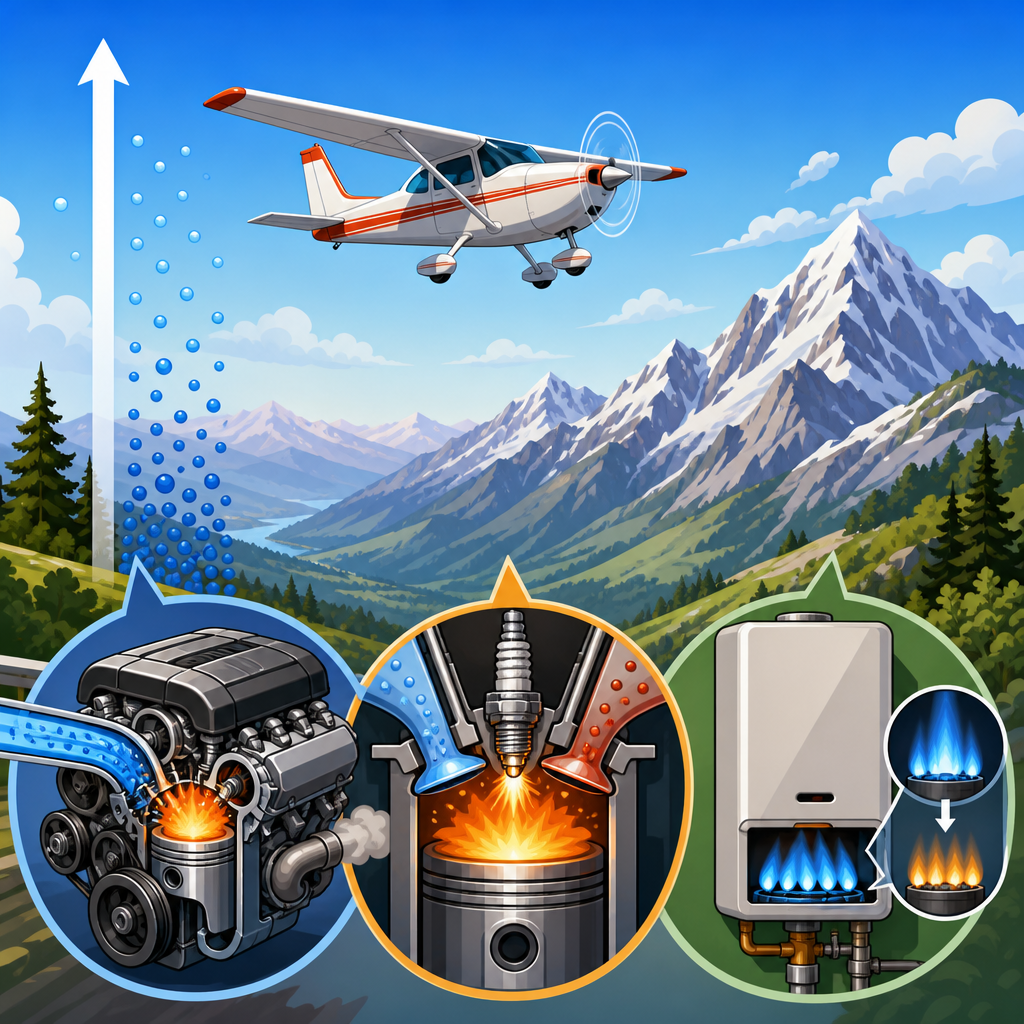
Altitude changes how fuel burns, how engines make power, and how gas appliances perform because air pressure drops as elevation rises. In practical terms, thinner air means fewer oxygen molecules enter a cylinder, burner, or firebox with each intake of air. That single physical change ripples through transportation, home heating, cooking, industrial equipment, and daily life in mountain communities. I have seen this firsthand while tuning carbureted generators above 7,000 feet, checking furnace manifold pressure in ski towns, and explaining to homeowners why a stove that worked perfectly at sea level starts sooting, running yellow, or struggling to maintain heat after a move uphill.
To understand what altitude does to combustion, engines, and gas appliances, it helps to define a few terms clearly. Combustion is the chemical reaction between a fuel and oxygen that releases heat. Air-fuel ratio is the proportion of air to fuel entering a burner or engine; for gasoline, the chemically ideal ratio is about 14.7 parts air to 1 part fuel by mass, known as the stoichiometric ratio. Naturally aspirated engines rely on atmospheric pressure to fill cylinders, while forced-induction engines use turbochargers or superchargers to compress intake air. Gas appliances include furnaces, boilers, water heaters, ranges, dryers, and space heaters fueled by natural gas or propane. At elevation, every one of these systems must cope with lower air density, reduced oxygen availability, and changes in pressure differentials that affect mixing, ignition, flame shape, venting, and heat transfer.
This matters for safety, efficiency, emissions, equipment longevity, and comfort. In mountain regions across Colorado, the Andes, the Himalayas, the Ethiopian Highlands, and the Tibetan Plateau, altitude is not an abstract engineering variable; it shapes how homes are built, how vehicles are tuned, and how communities cook, heat, and travel. A poorly adjusted burner at 8,500 feet can produce carbon monoxide. A naturally aspirated truck loses noticeable pulling power on a long grade. A propane water heater may need derating, or a smaller burner orifice, to prevent over-firing. Understanding these effects gives homeowners, drivers, technicians, and planners a better basis for choosing, installing, and maintaining equipment in high-altitude environments.
The core physics: why thinner air changes combustion
Atmospheric pressure falls with elevation, and air density falls with it. At sea level, standard atmospheric pressure is about 101.3 kPa, or 14.7 psi. By 5,000 feet, pressure is roughly 12.2 psi; by 10,000 feet, it is around 10.1 psi under standard conditions. Because each cubic foot of air contains less mass at higher elevation, it also contains less oxygen mass. Combustion devices meter fuel and air in different ways, but all depend on oxygen availability. If the fuel flow stays the same while oxygen flow drops, the mixture becomes richer than intended. Rich combustion tends to burn cooler in some zones, less completely overall, and with more soot, carbon monoxide, and flame instability.
Altitude also affects pressure differentials that move air and exhaust through equipment. Draft in naturally vented appliances depends on buoyancy and stack effect, both of which change with air density and temperature difference. Carburetors rely on pressure drop through a venturi to draw fuel, and that calibration shifts with altitude. Even simple open-flame burners change character uphill because primary air entrainment through venturi openings weakens as density changes. In field service, this is why elevation corrections are not optional notes buried in manuals. They are central design assumptions. Manufacturers publish high-altitude installation limits, orifice sizing tables, gas-pressure specifications, and derating guidance because the physics are predictable and measurable.
What altitude does to engines
For naturally aspirated gasoline and diesel engines, altitude reduces available oxygen for combustion and therefore reduces power. A common rule of thumb is a loss of about 3 percent of power for every 1,000 feet of elevation gain, although the exact figure varies with temperature, engine design, and fuel system. At 5,000 feet, a 200-horsepower naturally aspirated engine may effectively deliver something closer to 170 horsepower. Drivers notice this as weaker acceleration, longer passing times, and more frequent downshifts on climbs. Heavy vehicles and towing setups feel the effect most strongly because they operate near the margin of available torque.
Fuel delivery determines how cleanly the engine adapts. Older carbureted engines often run rich at elevation because the carburetor meters fuel based on airflow behavior that no longer matches sea-level calibration. In the workshop, I have corrected this with smaller main jets or altitude compensators where available. Symptoms of poor adjustment include black exhaust, rough idle, spark plug fouling, sluggish throttle response, and fuel smell. Modern electronic fuel injection handles altitude far better because the engine control unit uses manifold absolute pressure sensors, mass airflow sensors, oxygen sensors, and temperature data to trim fueling. Closed-loop control cannot create oxygen that is not there, so power still drops, but drivability and emissions remain much better than with a mis-jetted carburetor.
Turbocharged engines are the major exception. By compressing intake air, a turbocharger can recover much of the density lost to altitude, at least until it reaches boost-control or compressor limits. This is one reason many modern high-altitude fleets favor small turbo gasoline engines or turbo diesels. Aircraft piston engines have dealt with the same issue for decades; turbo-normalizing and turbocharging were developed specifically to maintain manifold pressure aloft. Still, there are tradeoffs. Compressing thin air generates heat, so intercooling becomes critical. Turbos also work harder at elevation, which can raise exhaust gas temperatures and increase mechanical stress under sustained load.
Engine management, cooling, and fuel economy at elevation
Altitude influences more than raw power. It changes combustion speed, knock tendency, cooling effectiveness, and fuel economy. Reduced air density lowers aerodynamic drag, which can improve highway efficiency, but climbing grades and reduced engine output often offset that advantage. In spark-ignition engines, lower cylinder pressure can reduce knock, sometimes allowing more ignition advance, but only if the control system is calibrated to use it. In diesels, lower oxygen availability can increase smoke if fueling is not cut back appropriately. Modern diesel control systems often limit injected fuel at altitude specifically to protect emissions hardware and exhaust temperatures.
Cooling also becomes more challenging. Air carries less heat away from radiators, charge-air coolers, brake systems, and underhood components when it is thin. Boiling point margins change with pressure as well, which is one reason cooling systems must be in good condition before mountain use. Pilots learn density altitude early because hot, high conditions degrade engine performance and reduce propeller and wing effectiveness simultaneously. The same concept matters on roads. A truck climbing on a hot day at 9,000 feet can experience lower power, higher coolant temperature, and transmission strain all at once. Good maintenance, proper gear selection, and realistic load expectations matter more at elevation than they do near sea level.
How altitude changes gas appliance performance and safety
Gas appliances face a parallel challenge: less oxygen for the same burner input. If a natural gas furnace or propane water heater is installed at altitude without adjustment, it can become over-fired relative to available combustion air. The visible signs are often yellow tipping, lazy flames, soot deposition, delayed ignition, and excessive heat on components. The invisible risk is carbon monoxide. Incomplete combustion rises when fuel and air are not balanced, and poor venting can compound the problem. That is why fuel-burning appliances should be installed and serviced according to the manufacturer’s altitude instructions and local mechanical and fuel-gas codes.
Most appliance makers specify derating above a threshold elevation, commonly 2,000 feet for some gas equipment and 4,500 feet for some others, though the exact number varies. A familiar field rule is roughly 4 percent input reduction per 1,000 feet above the stated base elevation for naturally aspirated appliances, but technicians must never substitute a rule of thumb for the actual data plate and manual. Derating can involve smaller burner orifices, adjusted manifold pressure within the allowed range, combustion-air changes, or selecting a high-altitude kit. For propane systems in particular, orifice sizing matters because propane contains more energy per cubic foot than natural gas and behaves differently in burner design.
| Equipment type | Typical altitude effect | Common correction | Main risk if ignored |
|---|---|---|---|
| Carbureted engine | Runs rich, loses power | Smaller jets or altitude compensation | Fouling, poor drivability, high emissions |
| Fuel-injected engine | Power loss with better mixture control | Sensor-based fuel trimming | Reduced performance under load |
| Naturally vented furnace | Reduced combustion quality and draft changes | Derating and manufacturer venting setup | Carbon monoxide, soot, overheating |
| Gas range | Lazy flame, incomplete combustion | Altitude kit or burner adjustment | Poor cooking performance, soot |
| Tank water heater | Over-firing relative to oxygen supply | Smaller orifice or certified high-altitude model | CO production, shortened appliance life |
Venting, combustion air, and code considerations
Combustion does not happen in isolation; appliances also need reliable air supply and exhaust removal. At altitude, naturally drafted systems can be more sensitive to vent sizing, connector rise, cold starts, house depressurization, and wind exposure. A building that has been tightened with better windows and air sealing may inadvertently starve an older appliance room of combustion air. In mountain homes, I often pay as much attention to the mechanical room and vent connector as to the burner itself. A clean flame on startup means little if the draft hood spills flue gases under worst-case depressurization.
Standards and codes matter here. Fuel gas codes, mechanical codes, and manufacturer instructions form the baseline for safe installation. Direct-vent and sealed-combustion appliances generally handle altitude better because they control combustion air paths more precisely and isolate the burner from indoor pressure fluctuations. Condensing furnaces and boilers use fans and pressure switches, but they still require approved altitude settings and vent lengths within specification. No technician should assume that a unit rated for a broad elevation range automatically needs no changes. Input, fan speed, vent tables, and combustion verification all deserve attention.
High-altitude communities: science shaped by culture and daily practice
The technical story connects directly to culture. Communities living at altitude adapt cooking methods, vehicle choices, housing design, and maintenance habits around thin air. In the Rockies, pickup owners talk casually about losing power over the passes, and contractors often prefer turbocharged diesels for towing and equipment hauling. In Andean and Himalayan regions, household energy choices reflect both altitude and fuel access, from LPG cylinders to biomass stoves to district heating in denser settlements. Traditional cooking techniques also evolve because boiling points fall with elevation; water boils at lower temperatures uphill, extending cooking times and changing food texture. Pressure cookers become more than convenience tools. They are practical responses to atmospheric physics.
There is also a public health dimension. Poor combustion in enclosed spaces contributes to indoor air pollution, especially where lower-cost stoves or heaters are used without adequate venting. High-altitude settlements can face cold climates, limited infrastructure, and fuel constraints simultaneously, which increases reliance on combustion appliances for long seasons. Better burner design, safer venting, and cleaner fuels have outsized benefits in these settings. When energy policy or housing programs ignore altitude, they often miss why standardized sea-level assumptions fail in mountain communities.
Best practices for homeowners, drivers, and technicians
The practical response to altitude is straightforward: select equipment rated for local elevation, install it exactly as specified, verify combustion, and maintain it consistently. For homeowners, that means checking whether a new furnace, range, or water heater requires a high-altitude conversion before installation. It means using qualified gas-fitters or HVAC technicians, keeping vents clear, and maintaining carbon monoxide alarms on every level of the home. For drivers, it means understanding that towing capacity, passing performance, and engine cooling margins shrink as altitude rises, especially in hot weather.
For technicians, the standard is higher. Read the rating plate and installation manual. Confirm gas type, inlet pressure, manifold pressure, orifice size, and elevation limits. Measure combustion with calibrated instruments rather than judging flame color alone. On engines, verify fueling, boost, ignition, and cooling system health with scan data or proper mechanical checks. The central lesson is simple: altitude is not a minor adjustment factor. It is a primary operating condition. Anyone responsible for performance or safety in high places should treat it that way.
Altitude changes combustion by reducing oxygen density, and that one fact explains why engines lose power, why carburetors run rich, why turbochargers help, and why gas appliances often need derating or conversion kits. It also explains why venting, combustion air, and code compliance become especially important in mountain homes and high-country workplaces. Across transportation and buildings, the consequences are practical: lower performance, different maintenance needs, altered cooking and heating behavior, and higher safety stakes when equipment is installed incorrectly.
For the broader Science, Culture & High-Altitude Communities topic, this subject works as a hub because it connects atmospheric physics to everyday life. The science is measurable, but the cultural impact is just as real. Communities at elevation adapt technology, routines, and expectations around thin air, whether they are choosing turbo engines, relying on pressure cookers, or specifying sealed-combustion heating systems. If you live, work, or travel at altitude, use this understanding as a starting point: check your equipment ratings, follow manufacturer altitude guidance, and make combustion safety part of every installation and maintenance decision.
Frequently Asked Questions
Why does altitude change combustion in engines, burners, and gas appliances?
Altitude changes combustion because air pressure drops as elevation rises, and lower air pressure means each cubic foot of air contains fewer oxygen molecules. Combustion depends on the right balance of fuel and oxygen. At sea level, engines, furnaces, stoves, water heaters, and generators are designed around a certain air density. As you go higher, that same intake stroke, blower cycle, or open burner port pulls in less oxygen even if the volume of air appears unchanged. The result is a mixture that effectively becomes richer unless the equipment compensates for it.
That richer mixture affects performance in different ways depending on the system. In an engine, it can reduce power, increase fuel consumption, and sometimes cause rough running, carbon buildup, or fouled spark plugs. In a gas appliance, it can produce lazy yellow flames, incomplete combustion, soot, and lower heating efficiency. In severe cases, poor combustion can also increase carbon monoxide risk, which is why manufacturers publish altitude limits and derating instructions for many appliances. The important point is that altitude does not change the chemical nature of the fuel itself; it changes the oxygen available to burn that fuel cleanly and completely.
How much power do engines lose at higher elevations?
As a general rule, naturally aspirated engines lose about 3 percent of their power for every 1,000 feet of elevation gain, although the exact number varies with temperature, humidity, engine design, and tuning. That means a generator, car, lawn equipment engine, or small utility motor that performs well near sea level can feel noticeably weaker in mountain areas. The reason is straightforward: with thinner air entering the cylinders, the engine cannot burn as much fuel efficiently on each cycle, so it produces less torque and horsepower.
Carbureted engines often show altitude effects more dramatically because the carburetor meters fuel through pressure differences and fixed jet sizes. When elevation increases, the fuel delivery may stay relatively high compared with the reduced oxygen supply, so the engine runs rich. That can lead to sluggish throttle response, smoky exhaust, rough idle, and hard starting. Fuel-injected engines usually handle altitude better because sensors and engine controls can reduce fueling to match the thinner air, but they still lose power unless they use forced induction. Turbocharged and supercharged engines can recover part of that loss by compressing incoming air, although even they have practical limits as altitude rises. For anyone operating equipment above 5,000 to 7,000 feet, it is wise to expect reduced output and confirm whether altitude-specific adjustments, jets, or tuning procedures are recommended.
Do gas stoves, furnaces, water heaters, and other appliances need adjustment at high altitude?
Often, yes. Many gas appliances need some form of altitude derating, burner adjustment, or conversion kit when installed well above sea level. The exact threshold depends on the manufacturer, but it is common to see special instructions beginning around 2,000 to 4,500 feet, with more critical adjustments at higher elevations. Because the air is thinner, a burner that receives the same gas flow it did at lower elevation may now be getting too much fuel for the available oxygen. That can reduce efficiency and create undesirable combustion characteristics.
For example, a furnace may need a smaller orifice, altered manifold pressure, or a high-altitude kit so the burner input matches the reduced oxygen supply. A water heater may require derating to prevent sooting and overheating of certain components. A gas range can develop softer, yellower flames and slower boiling times if the air-fuel mix is off. Fireplaces, boilers, commercial ovens, and industrial burners may also need reconfiguration to maintain safe flame shape and proper combustion. This is not an area for guesswork. The correct procedure is to follow the appliance rating plate, installation manual, and manufacturer instructions, then have a qualified technician verify combustion performance if required. Proper setup is about more than convenience; it affects safety, emissions, efficiency, and equipment life.
What are the signs of poor combustion at altitude?
Poor combustion at altitude usually shows up as a combination of performance problems and visible flame changes. In gas appliances, one of the first signs is a flame that looks yellow, lazy, or unstable instead of mostly blue and well defined. You may also notice soot deposits around burner areas, cookware bottoms, vent outlets, or heat exchangers. Appliances can take longer to heat water or cook food, and furnaces may seem to run longer while delivering less effective heat. In engines, common signs include reduced power, stumbling under load, black exhaust smoke, spark plug fouling, rough idle, and fuel odors caused by an overly rich mixture.
Some symptoms are less obvious but more serious. Incomplete combustion can raise carbon monoxide production, especially if the appliance is already marginally vented or poorly maintained. That is why high-altitude operation should never be treated as just a nuisance issue. If a gas appliance starts sooting, produces unusual odors, cycles improperly, or shows flame rollout or burner instability, it needs inspection. Likewise, if a carbureted generator or small engine begins loading up with fuel and running poorly at elevation, it may need rejetting or mixture adjustment. The safest approach is to treat any sustained change in flame quality, soot formation, or combustion behavior as a real service issue rather than a cosmetic one.
Can you prevent altitude-related combustion problems, and what is the best approach?
Yes, most altitude-related combustion problems can be reduced or prevented with proper equipment selection, setup, and maintenance. The best approach starts with recognizing that elevation is a design condition, not just an environmental detail. Before installing or operating an engine or gas appliance in a mountain area, check the manufacturer specifications for maximum operating altitude, derating rules, and approved conversion parts. Equipment that works perfectly at low elevation may require different jets, regulators, burner orifices, air shutter settings, or electronic calibration at higher elevations.
For engines, especially carbureted generators, pressure washers, ATVs, and small utility motors, the fix often involves altitude jets or mixture adjustments so the engine does not run excessively rich. For modern vehicles with electronic fuel injection, there is usually less direct adjustment needed, but routine maintenance still matters because worn sensors, dirty air filters, and ignition issues become more noticeable when oxygen availability is already reduced. For gas appliances, professional commissioning is often the smartest choice. That may include checking manifold pressure, verifying input rate, confirming proper venting, and testing combustion with appropriate instruments. It is also wise to install and maintain carbon monoxide alarms anywhere fuel-burning appliances operate. In practical terms, the best prevention strategy is simple: use equipment rated for your elevation, apply the manufacturer’s altitude guidance, and do not ignore small combustion changes, because at high altitude they tend to become larger problems faster.