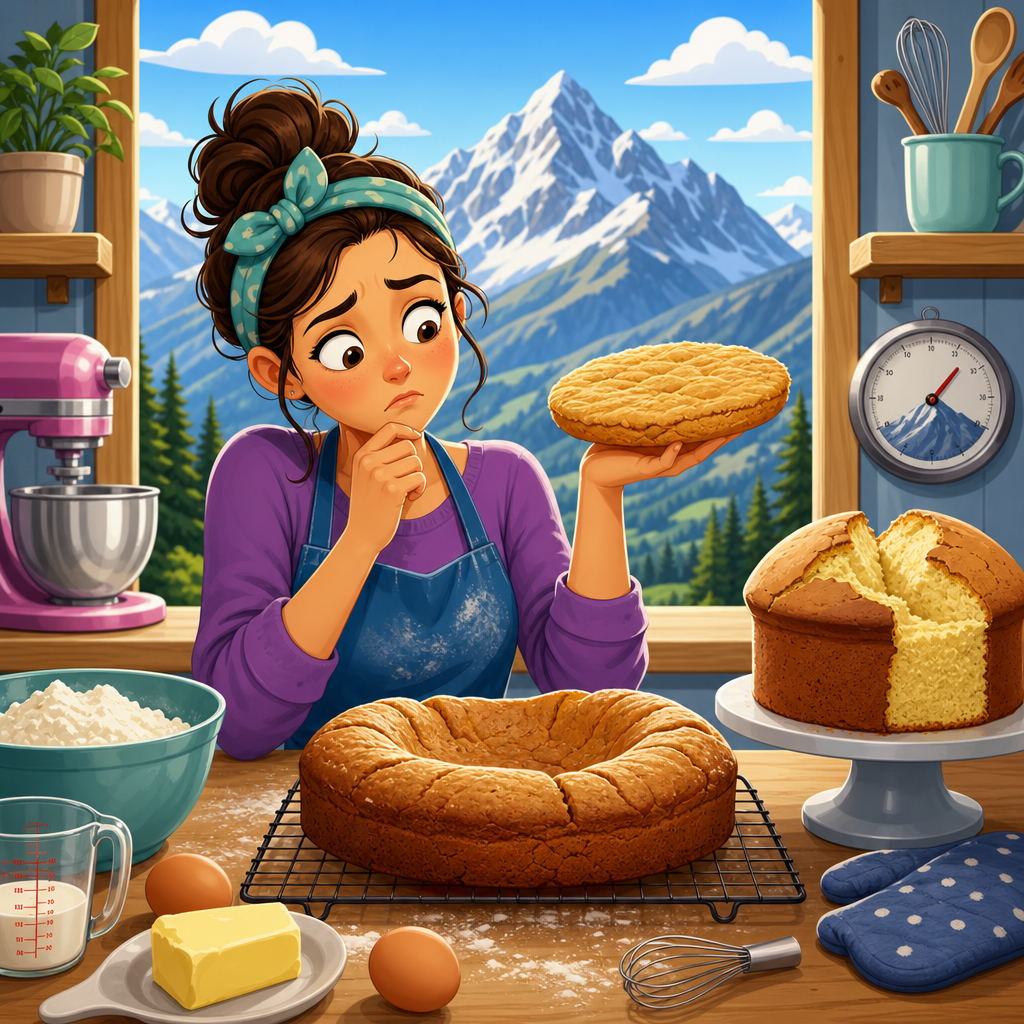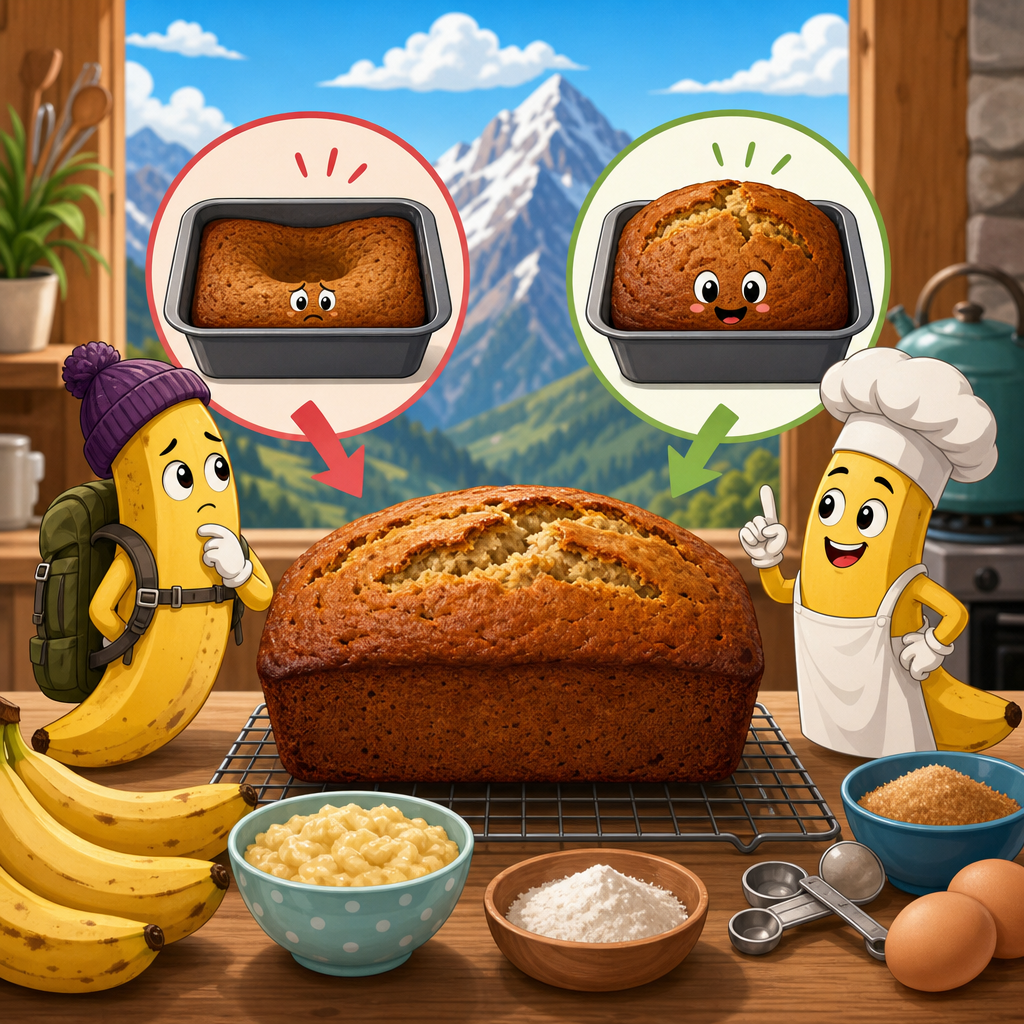
Banana bread at altitude often looks perfect for the first twenty minutes, then betrays the baker with a cratered center, gummy crumb, or loaf that rises high and collapses as it cools. That failure is not random. It happens because quick breads behave differently when air pressure drops, water boils at a lower temperature, and batter structure sets more slowly than gas expansion. In mountain kitchens, especially above 3,000 feet, the same banana bread formula that works at sea level can overexpand, lose moisture too fast, and fail to hold itself up before starches and proteins fully firm.
This guide explains how to stop the center from sinking and serves as the hub for quick breads and breakfast bakes within altitude baking. In practical terms, quick breads are loaves, muffins, scones, biscuits, coffee cakes, and similar baked goods leavened mainly with baking soda, baking powder, steam, or eggs rather than yeast. Breakfast bakes includes both sweet and savory items people mix and bake the same day, from blueberry muffins to baked oatmeal. I have tested these categories in high-elevation kitchens where recipes need repeated adjustment, and banana bread is the clearest example because its heavy fruit puree, high sugar, and tender crumb magnify every altitude problem.
Why this matters is simple: banana bread is often the first recipe home bakers try to “just make work,” but it teaches the core rules for every altitude quick bread. If you can control banana bread, you can usually fix pumpkin bread, zucchini bread, streusel coffee cake, muffin domes, and many breakfast casseroles with similar logic. The key terms are straightforward. Leavening is the gas-producing action from baking soda or powder. Structure is the network of gelatinized starch and coagulated proteins that keeps a loaf standing. Hydration is the balance of liquid, puree, fat, eggs, and sugar that determines whether the crumb bakes through before drying out. At altitude, successful baking means reducing runaway rise while helping the center set sooner.
Why banana bread sinks in the middle at altitude
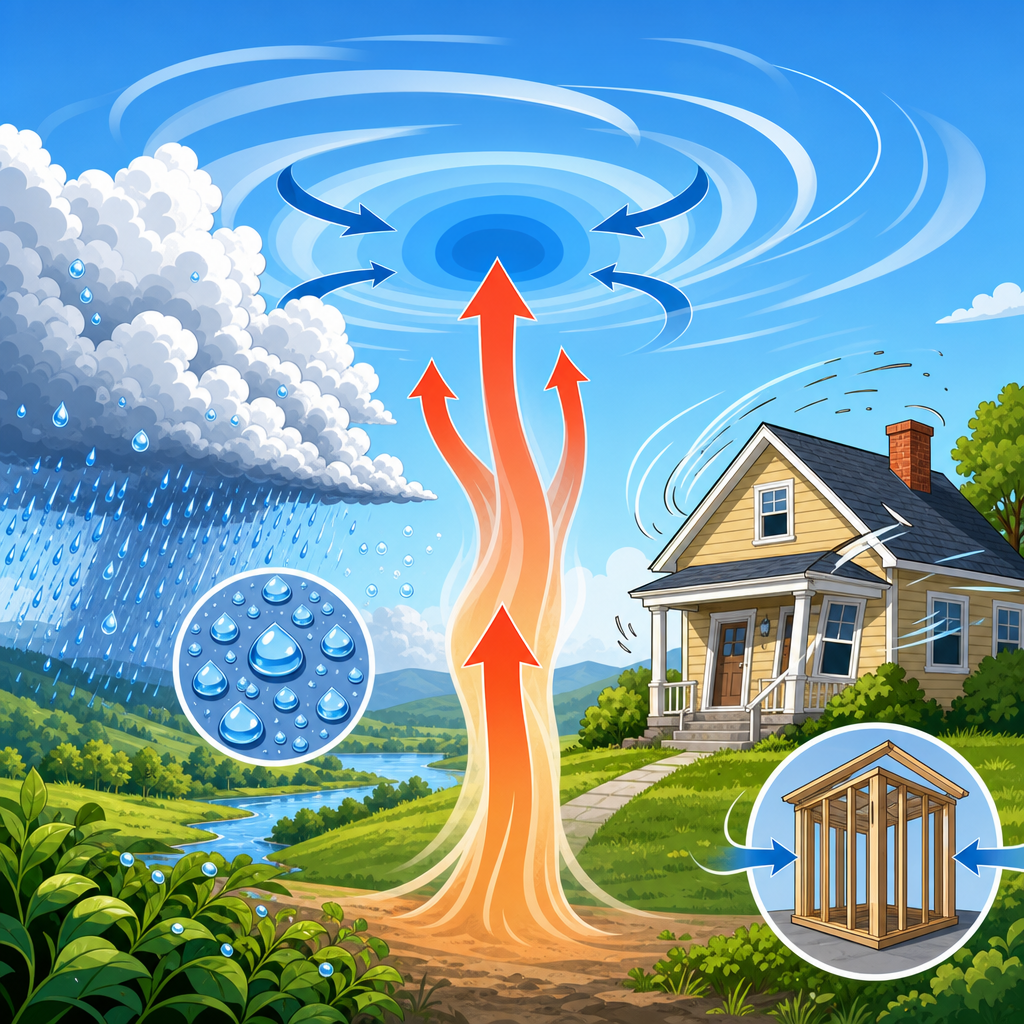
The center sinks because the batter expands faster than it stabilizes. Lower atmospheric pressure allows bubbles to grow larger and more quickly, so baking soda and baking powder become more aggressive. At the same time, water evaporates faster and boils at a lower temperature, which means moisture leaves the batter earlier while the loaf interior takes longer to firm. In a banana bread batter, mashed bananas add water, sugar, pectin, and weight. That combination is useful for flavor and tenderness, but it also creates a heavy, moist center that needs enough structure to support itself.
Several common habits make the problem worse. Too much leavening is the biggest culprit. Many classic banana bread recipes use a full teaspoon of baking soda for one loaf, and at 5,000 feet that can be excessive. Overmixing can also create tunnels and uneven lift, while undermixing leaves flour pockets and weak emulsification. Using very large bananas without weighing them changes the formula dramatically; two large bananas can differ by more than 60 grams, which is enough to turn a balanced batter into a wet one. Opening the oven door early, underbaking by relying only on color, or using a pan that is too small all increase the odds of a fallen center.
The fix is not one magic adjustment. It is a coordinated set of changes: slightly less chemical leavener, modestly higher oven heat, measured banana quantity, and enough flour or egg protein to support the loaf. This same pattern applies across quick breads and breakfast bakes. A sunken blueberry muffin, a cratered pumpkin loaf, and a coffee cake with a raw stripe under the streusel usually fail for the same structural reasons.
Core altitude adjustments for quick breads and breakfast bakes
For most banana bread recipes, begin with altitude ranges rather than drastic rewrites. At 3,000 to 5,000 feet, reduce baking powder or baking soda by about 1/8 teaspoon per teaspoon listed, increase oven temperature by 15 to 25 degrees Fahrenheit, and consider adding 1 to 2 tablespoons of flour if the batter is especially wet. Above 5,000 feet, reductions often move closer to 1/4 teaspoon per teaspoon of leavener, with slightly more liquid or an extra egg white when the crumb bakes up dry. The exact target depends on the original recipe, pan size, and moisture from the bananas.
I do not treat all quick breads the same, because ingredients matter. Banana bread and pumpkin bread usually need restraint on leavening first. Muffins often benefit from a hotter initial bake to set domes quickly. Biscuits and scones, which rely on steam and layers, need careful flour measurement and colder fat more than major sugar changes. Baked oatmeal and breakfast casseroles are less sensitive to leavener but still affected by evaporation and pan depth. The reliable approach is to identify what is causing failure: too much lift, too much moisture, too little structure, or uneven heat transfer.
| Product | Most common altitude problem | Best first adjustment | Useful second adjustment |
|---|---|---|---|
| Banana bread | Center rises then sinks | Reduce baking soda or powder slightly | Increase oven temperature 15 to 25°F |
| Pumpkin or zucchini bread | Gummy interior | Add 1 to 2 tablespoons flour | Measure puree carefully |
| Muffins | Overflowing tops or coarse tunnels | Reduce leavening | Fill cups slightly less |
| Coffee cake | Raw layer under streusel | Use wider pan for shallower batter | Bake a little hotter |
| Scones | Dry, crumbly texture | Add a bit more cream | Handle dough less |
| Biscuits | Spread instead of rise | Use colder fat and hotter oven | Cut with straight downward motion |
| Baked oatmeal | Dry edges, loose center | Shorten bake time slightly | Cover briefly near the end if needed |
These ranges align with extension guidance commonly taught by Colorado State University and other high-altitude resources, but they work best when paired with disciplined measuring. Use grams for flour, sugar, and banana puree whenever possible. One recipe can only be diagnosed if the ingredient quantities are consistent from bake to bake.
How to fix banana bread batter before it goes in the oven
Stopping sinkage starts at the mixing bowl. First, weigh the bananas. For a standard 8 1/2-by-4 1/2-inch loaf, I aim for about 225 to 250 grams of peeled banana, roughly one cup mashed. More than that can be fine at sea level, but at altitude it frequently creates a wet center that outpaces structure. If your bananas are extra large, hold some back. If the recipe uses sour cream, yogurt, or buttermilk as well, the need for precision becomes even greater because those ingredients soften crumb and slow setting.
Second, check the leavener against the acidic ingredients. Banana bread often includes baking soda because bananas, brown sugar, yogurt, and sometimes molasses create enough acidity to activate it. Too much soda does more than overinflate the loaf; it can also leave a coarse crumb and soapy aftertaste. If a recipe uses both baking powder and baking soda, trim the total lift gradually rather than guessing. In many altitude tests, reducing soda by 1/8 to 1/4 teaspoon is enough to prevent collapse without making the loaf dense.
Third, build structure deliberately. One extra tablespoon or two of flour can help, but so can changing technique. Creaming butter and sugar until just light, not billowy, limits oversized air pockets. If using oil, whisk eggs and sugar thoroughly so the emulsion is stable before adding banana. Fold dry ingredients only until no flour streaks remain. Overripe bananas are ideal for flavor, yet fully black bananas can carry more free moisture than spotted yellow-brown fruit; if your puree seems loose, compensate with a small flour increase rather than hoping bake time will solve it.
Pan size, oven temperature, and doneness cues that prevent collapse
Pan geometry matters more at altitude than many bakers realize. A batter depth that is forgiving at sea level can become a problem in thin air because the outer loaf sets while the center still climbs. If your banana bread regularly sinks, compare the recipe yield to the pan volume. An 8 1/2-by-4 1/2-inch pan holds less batter than a 9-by-5-inch pan, and overfilling either one increases center collapse. Filling a loaf pan about one-half to two-thirds full is a safer target for high elevations.
A slightly higher oven temperature is one of the most effective altitude corrections because it helps the batter set before overexpansion peaks. For banana bread, that usually means baking at 350 to 375 degrees Fahrenheit instead of 325 to 350, depending on the original formula and pan color. Dark metal pans brown faster and may require the lower end of that range. Glass dishes heat differently and often lengthen bake time, which can dry the edges before the middle is done. Heavy aluminum loaf pans are the most predictable choice.
Do not judge doneness by a toothpick alone. A toothpick can emerge with only a few moist crumbs while the loaf is still understructured in the center. Use three cues together: the top should spring back lightly, the loaf should begin to pull from the sides, and the internal temperature should generally reach about 200 to 205 degrees Fahrenheit for a starch-rich quick bread. If the top browns too early, tent loosely with foil after the loaf has mostly set. Cooling also matters. Leave the loaf in the pan about ten minutes, then move it to a rack so residual steam does not soften the crumb and contribute to settling.
Applying the same altitude logic to muffins, coffee cake, biscuits, scones, and baked oatmeal
As the sub-pillar hub for quick breads and breakfast bakes, banana bread is the starting point, not the whole category. Muffins follow nearly identical rules: control leavening, avoid excess fruit moisture, and use enough heat to set the structure early. If muffin tops spread flat or collapse around juicy berries, reduce chemical leavener slightly and toss the fruit with a spoonful of flour. For bakery-style domes, a hotter initial oven burst works only if the batter is not already overleavened.
Coffee cakes add another challenge because streusel creates insulation. At altitude, a thick crumb layer plus a heavy topping often leaves a damp band through the center. The best corrections are to use a wider pan for shallower depth, trim leavening modestly, and avoid overloading the topping with butter. Pumpkin bread, zucchini bread, and apple-cinnamon loaves behave much like banana bread because produce purees and shreds contribute hidden water. Squeeze zucchini well, weigh canned pumpkin, and account for juicy grated apple instead of treating all cups of produce as equivalent.
Biscuits and scones are less likely to sink in the center, but they teach the same lesson about structure. At altitude, dry flour and faster evaporation can make them crumbly, so a small increase in liquid is often more useful than extra leavening. Keep butter cold, laminate or fold only as needed, and bake hot enough to generate steam quickly. For baked oatmeal, French toast casseroles, and similar breakfast bakes, the issue is usually pan depth and moisture distribution rather than chemical rise. Shallower pans, measured fruit additions, and checking the center temperature produce more reliable results than extending bake time blindly.
Troubleshooting workflow and a reliable baseline formula strategy
When a loaf fails, change one variable at a time. That is how I troubleshoot in altitude kitchens, and it is the fastest route to a repeatable recipe. If the center sinks but the crumb tastes balanced, reduce leavener first. If the loaf is still wet after full baking time, weigh banana puree and increase flour slightly or switch to a smaller banana quantity. If the loaf is dry but still collapses, raise oven temperature before adding more flour, because the issue may be slow setting rather than excess moisture. Keep notes on elevation, pan size, ingredient weights, and internal temperature at doneness.
A dependable baseline banana bread for altitude usually includes measured banana puree, moderate sugar, one or two eggs for protein, restrained leavening, and a pan that is not overfilled. From there, additions such as walnuts, chocolate chips, blueberries, or cinnamon swirl should be treated as structural changes, not decorations. Nuts absorb little moisture but add weight. Chocolate can create molten pockets that mimic underbaking. Fresh berries release liquid as they burst. Once you understand the center-sinking mechanism, these variations become manageable.
The larger benefit of mastering banana bread at altitude is confidence across the whole quick-bread category. The same principles govern morning glory muffins, lemon poppy seed loaf, cornbread, cranberry scones, and many breakfast bakes served from one pan. Measure precisely, reduce runaway rise, set structure earlier, and match pan depth to batter weight. Start with your next loaf: weigh the bananas, trim the leavener, raise the oven slightly, and bake until the center is truly set.
Frequently Asked Questions
Why does banana bread sink in the center at high altitude?
Banana bread usually sinks in the center at high altitude because the batter rises faster than its structure can support. As elevation increases, air pressure drops. That lower pressure allows the gases created by baking soda, baking powder, steam, and creamed-in air to expand more quickly and more aggressively than they do at sea level. The loaf can look beautifully domed early in baking, but if the starches, proteins, and egg structure have not set firmly enough by the time that expansion peaks, the center collapses.
Moisture also plays a major role. Water boils at a lower temperature in mountain environments, so liquid in the batter turns to steam sooner. That can speed expansion, but it can also dry the surface before the middle is fully baked. The result is a loaf that appears done on the outside while the center remains under-structured, gummy, or fragile. Banana bread is especially prone to this because bananas add sugar, moisture, and weight. Those are great for tenderness and flavor, but they make the crumb softer and slower to set. If the recipe has generous sugar, a lot of mashed banana, or too much leavening, the middle becomes even more likely to rise dramatically and then cave in as it cools.
In practical terms, sinking is usually caused by one or more of these factors: too much baking soda or baking powder, too much sugar, too much liquid, an oven that runs cool, underbaking, or overmixing that weakens the batter’s final texture. At altitude, even a small imbalance is amplified. The fix is not one single trick but a coordinated adjustment: slightly reduce chemical leavening, increase oven temperature a little, possibly reduce sugar, possibly add a bit more flour, and bake until the center is truly set rather than just superficially browned.
What recipe changes help prevent a cratered or collapsed loaf above 3,000 feet?
The most reliable way to prevent a collapsed loaf above 3,000 feet is to make small, strategic adjustments instead of completely rewriting the recipe. Start with the leavening. Quick breads often need less baking powder or baking soda at altitude because gases expand more readily. If your banana bread rises fast and then falls, reducing the leavening slightly is often the first and most effective correction. Even a reduction of about 1/8 to 1/4 teaspoon can make a noticeable difference depending on the original formula and your elevation.
Next, look at the flour and liquid balance. Because structure sets more slowly at altitude, a batter that is perfect at sea level may be too loose in a mountain kitchen. Adding a little more flour can help the loaf hold itself up. A common starting point is an extra 1 to 2 tablespoons of flour per loaf. If your recipe includes milk, yogurt, sour cream, or another added liquid, reducing that slightly can also help. With banana bread, remember that bananas themselves contribute a lot of moisture, so measuring the mashed banana matters. If the recipe says 1 cup mashed banana, do not assume that three very large bananas are close enough. Excess banana can easily tip the batter toward a sunken center.
Sugar is another factor. Sugar tenderizes and slows structure formation, which is useful for softness but risky at altitude. If your loaf is consistently collapsing or staying gummy in the center, reducing the sugar by 1 to 2 tablespoons may improve stability without noticeably changing flavor. Some bakers also find that using one extra tablespoon or so of flour alongside a modest sugar reduction creates a more dependable crumb.
Finally, increase the oven temperature slightly, usually by about 15 to 25 degrees Fahrenheit. A slightly hotter oven helps the structure set before overexpansion causes collapse. That said, the temperature increase works best when combined with the other adjustments. If you only raise the temperature but leave a very wet, over-leavened batter unchanged, you may still end up with a peaked loaf that caves in underneath the crust. Successful altitude baking is about balance: a bit less lift, a bit more structure, and enough heat to set the center in time.
How do I know if my banana bread is actually underbaked in the middle rather than just too moist from the bananas?
This is one of the most common points of confusion, because good banana bread is supposed to be moist. The difference is that a properly baked loaf feels set, springy, and cohesive, while an underbaked loaf feels wet, heavy, and unstable. If the center sinks as the loaf cools and the interior has a glossy, dense, or paste-like strip running through the middle, that is usually underbaking or under-structuring, not just natural banana moisture.
A toothpick test helps, but it should be interpreted carefully. In banana bread, you do not necessarily want a bone-dry tester, because mashed fruit leaves some tenderness behind. What you do want is a tester that comes out with a few moist crumbs rather than wet batter. If the pick emerges coated with shiny, sticky batter, the center needs more time. You should also gently press the top center of the loaf. It should spring back rather than sink under light pressure. If the loaf wobbles when the pan is nudged, the middle likely has not set.
Color can be misleading, especially at altitude. A loaf may brown quickly on top because the oven is hotter or because sugar and banana encourage fast browning, while the center still lags behind. That is why internal temperature is such a useful tool. For banana bread, an instant-read thermometer inserted into the center should generally register around 200 to 205 degrees Fahrenheit when the loaf is fully baked. This is one of the clearest ways to distinguish a moist crumb from a raw center.
If your loaf keeps browning too much before the middle is done, tent it loosely with foil for the final portion of baking. That allows the center to catch up without over-darkening the crust. Also be sure your pan size matches the recipe. Batter baked in a pan that is too small will sit deeper, making it much harder for the middle to bake through before the top overcolors. At altitude, pan size, batter depth, and true doneness matter even more than they do at sea level.
Is oven temperature more important than baking time when making banana bread in mountain kitchens?
Oven temperature is usually the more important variable, because it determines how quickly the loaf’s structure sets in relation to how quickly gases expand. At altitude, this relationship becomes critical. A batter that sits too long in a gently heated oven may overexpand before its starches gelatinize and its proteins coagulate firmly enough to hold shape. That is exactly how you get the classic mountain-baking disappointment: a tall loaf that looks promising, then drops in the center.
That said, baking time still matters. Raising the oven temperature by 15 to 25 degrees Fahrenheit often helps banana bread set sooner, but the loaf may still need the same total baking time as the sea-level version, or sometimes slightly more, depending on your pan, your exact elevation, and how much moisture is in the batter. The goal is not simply a hotter oven or a shorter bake. The goal is controlled lift followed by complete baking through the center.
This is why it is helpful to think of temperature and time as partners rather than competitors. A modestly higher oven temperature gives the batter a better chance to set before collapsing. Then enough baking time ensures that the center is fully cooked, not just structurally supported by a browned shell. If you raise the temperature but pull the loaf too early because the top looks done, you will still get a gummy or sunken center. If you keep the original lower temperature and just bake longer, you may dry out the edges while the middle struggles to hold its shape.
For best results, use an oven thermometer to verify your oven’s true temperature. Many home ovens run hot or cool, and small inaccuracies matter a lot in quick breads at altitude. Start checking for doneness near the lower end of the recipe’s time range, but rely on center spring-back, a mostly clean tester, and preferably internal temperature rather than the clock alone. In mountain baking, visual cues are helpful, but structural cues are better.
What mixing and ingredient mistakes make altitude banana bread more likely to collapse?
Several very common mistakes can make banana bread far more likely to collapse at altitude, even if the recipe itself is solid. One of the biggest is overmixing. Banana bread is a quick bread, which means it depends on gentle mixing once the flour is added. If you stir too much, you develop excess gluten and can create an uneven crumb that tunnels, domes, or bakes up with weak spots. Overmixed batter can also trap and distribute air irregularly, which contributes to unstable rise in a low-pressure environment.
Another frequent issue is inaccurate measuring. At sea level, a slightly generous scoop of mashed banana, sugar, or leavening might still produce an acceptable loaf. At altitude, those little excesses can push the batter past the point of stability. Too much banana means too much moisture and weight. Too much sugar delays setting and weakens the crumb. Too much baking soda or baking powder creates a rapid rise that the loaf cannot sustain. Measuring flour incorrectly can also be a problem.