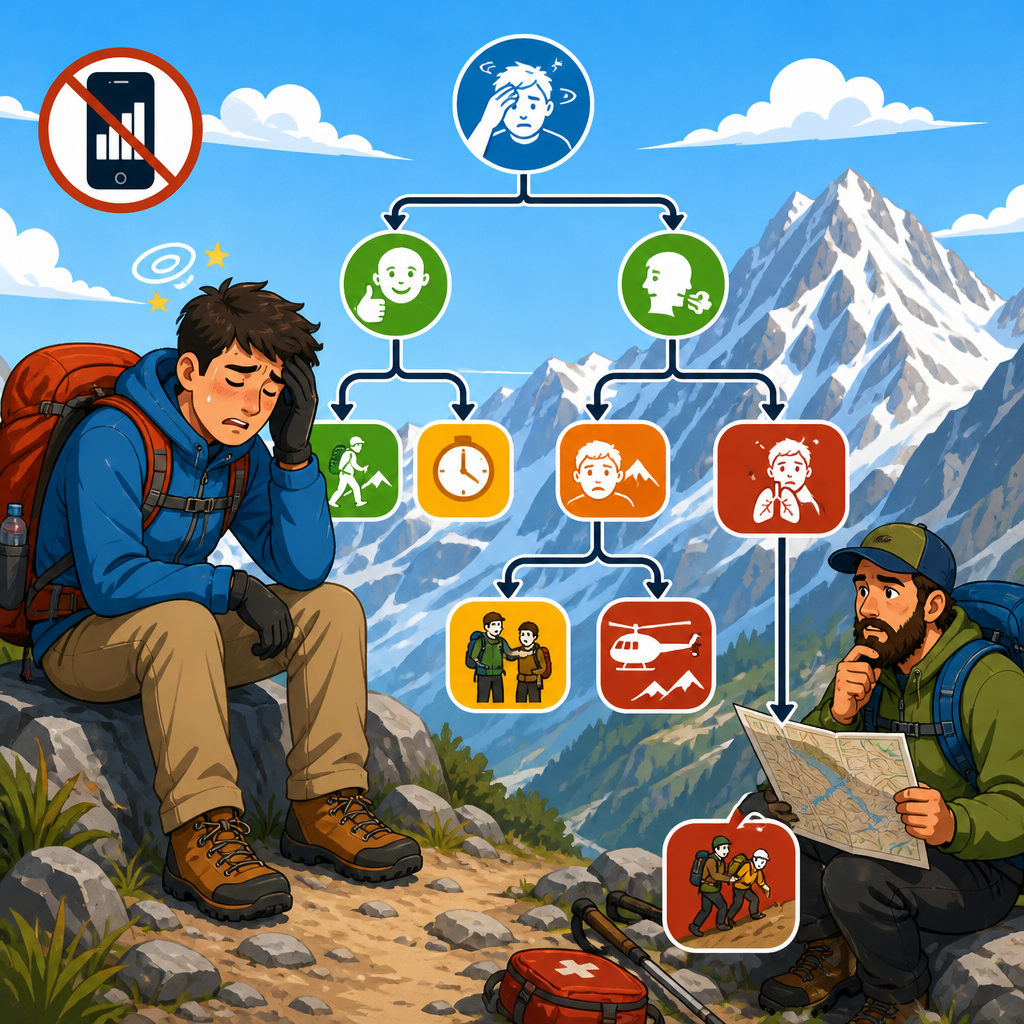
Altitude illness becomes dangerous fastest when symptoms worsen beyond the reach of cell service, because the usual reflex—call for help, search for advice, wait for instructions—stops working at exactly the moment a team needs a clear plan. A rescue decision tree is that plan: a prebuilt, step-by-step guide that tells a group when to stop, when to treat, when to descend, when to assist a patient, and when to launch an emergency evacuation. In mountain medicine, altitude illness usually refers to acute mountain sickness, high-altitude cerebral edema, and high-altitude pulmonary edema. These conditions exist on a spectrum, but each has distinct warning signs and different urgency. I have used written decision trees on remote alpine trips because judgment deteriorates under stress, weather, fatigue, darkness, and hypoxia. A good tree reduces hesitation, aligns partners, and turns vague concern into repeatable action. This matters because delayed descent is the single most common failure in severe altitude cases, and because remote terrain adds frictions that urban emergency planning never has: limited oxygen, no ambulance, unreliable weather windows, small teams, and hours of carry time. If you travel above treeline, ski tour at altitude, trek in the Andes or Himalaya, or guide clients on volcanoes and high passes, preparing a rescue decision tree before departure is not optional. It is a core safety system that connects symptom recognition, treatment, descent, and emergency response into one document your team can actually use when thinking clearly is hardest.
Start With the Illnesses You Must Distinguish
The first job of a rescue decision tree is to separate mild, moderate, and severe presentations. Acute mountain sickness usually begins with headache plus one or more of the following: nausea, loss of appetite, fatigue, dizziness, or poor sleep after a recent gain in sleeping elevation. A person with mild symptoms may only need rest, hydration by thirst, food, analgesics, and no further ascent. High-altitude cerebral edema is a brain swelling syndrome and should be assumed when a person at altitude has altered mental status, confusion, unusual behavior, severe lassitude, or ataxia. Ataxia matters because it is objective: if someone cannot walk heel-to-toe in a straight line, stand steadily, or perform simple coordination tasks they managed earlier, treat that as cerebral involvement until proved otherwise. High-altitude pulmonary edema is fluid accumulation in the lungs. Its hallmark signs are reduced exercise tolerance, breathlessness out of proportion to effort, cough, crackles, chest tightness, and later shortness of breath at rest or pink frothy sputum. Cyanosis and low oxygen saturation, if you have a pulse oximeter, support the diagnosis but do not replace clinical judgment.
In remote settings, the practical rule is simple: headache and nausea alone suggest acute mountain sickness; poor coordination or confusion means probable cerebral edema; breathlessness at rest or wet lungs means probable pulmonary edema. Mixed cases occur. A climber can have both cerebral and pulmonary edema, and any severe altitude illness should trigger the same default action: immediate descent with treatment during movement. The Wilderness Medical Society guidelines emphasize descent as definitive treatment for severe disease, while oxygen, portable hyperbaric chambers, dexamethasone, and nifedipine serve as adjuncts or bridges when descent is delayed. Your tree should reflect that hierarchy clearly so no one mistakes medication for a substitute for losing altitude.
Build the Decision Tree Before the Trip, Not During the Crisis
The most useful rescue trees fit on one page, can be read in low light, and rely on observable triggers instead of vague impressions. I structure them around four questions. First: what symptoms are present? Second: is the patient improving, stable, or worsening over 30 to 60 minutes? Third: can the patient walk with support? Fourth: what resources are immediately available—oxygen, dexamethasone, nifedipine, a hyperbaric bag, extra carriers, shelter, and a descent route? This design prevents teams from overfocusing on diagnosis while underplanning logistics. A sick hiker at 14,000 feet with mild symptoms but no ability to descend before a storm may need a different response than a similar patient at a staffed hut beside a road.
Decision points must be binary. “Monitor closely” is too soft unless it includes time and criteria. Better wording is: “Stop ascent. Rest 60 minutes. Give oral fluids, carbohydrate food, ibuprofen or acetaminophen if needed. Reassess headache, gait, nausea, and work of breathing. If symptoms improve and no red flags are present, remain at current altitude overnight. If symptoms persist or worsen, descend at least 500 to 1,000 meters.” The stronger your thresholds, the less likely summit fever will distort them. Include turnaround clauses such as “Any ataxia, confusion, or dyspnea at rest overrides itinerary, weather objective, and campsite plan.” Those clauses are what save time when group pressure rises.
Use Objective Triggers for Descent, Treatment, and Evacuation
Your rescue decision tree should name exact triggers that move a patient from watchful care to urgent descent or full evacuation. The table below captures the thresholds I use most often in the field.
| Presentation | Field clues | Immediate action | Escalation point |
|---|---|---|---|
| Mild acute mountain sickness | Headache, nausea, fatigue, poor sleep, normal gait, normal thinking | Stop ascent, rest, feed, hydrate to thirst, give analgesic, consider acetazolamide | No improvement after 24 hours or any worsening: descend |
| Moderate acute mountain sickness | Persistent headache, vomiting, marked fatigue, limited function | No further ascent, treat symptoms, strongly consider descent 500 to 1,000 meters | Cannot keep fluids down or cannot walk normally: descend now |
| Probable cerebral edema | Ataxia, confusion, bizarre behavior, severe weakness, declining consciousness | Immediate descent, dexamethasone, oxygen if available, hyperbaric bag if descent delayed | Nonambulatory patient or deteriorating mental status: emergency evacuation |
| Probable pulmonary edema | Breathlessness at rest, cough, crackles, blue lips, reduced exertional capacity | Immediate descent, oxygen, keep warm, nifedipine if indicated | Respiratory distress at rest or inability to move: emergency evacuation |
These thresholds work because they tie action to visible findings. They also answer the common backcountry question, “How sick is sick enough to descend?” If the patient cannot walk a straight line, thinks abnormally, struggles to breathe at rest, or gets worse despite rest and basic care, the answer is immediate descent. If the patient cannot be moved safely by the group, the answer becomes evacuation while using oxygen or a portable hyperbaric chamber as a bridge.
Match Treatments to the Scenario and the Limits of Your Team
Medication belongs in the decision tree, but each drug should appear with a narrow purpose. Acetazolamide helps acclimatization and can improve mild to moderate acute mountain sickness; it is not a rescue drug for severe cerebral or pulmonary edema. Dexamethasone is valuable for suspected cerebral edema because it can reduce symptoms quickly, sometimes dramatically, but it does not cure the underlying altitude problem. If the patient improves on dexamethasone and stays high, relapse is common. Nifedipine can help suspected pulmonary edema by lowering pulmonary artery pressure, especially when oxygen or descent is delayed. Supplemental oxygen is effective for both severe syndromes and is often the best bridge if you have enough supply to sustain use through the descent or while awaiting rescuers.
Portable hyperbaric chambers, such as the Gamow bag or Certec bag, can be lifesaving in expedition settings, but teams often overestimate what they solve. They require monitoring, manpower, and repeated cycles, and the patient usually worsens again if left at the same altitude afterward. Put plainly in your tree: bag treatment buys time; it does not replace descent. Also define who can administer medications, where they are packed, and whether your team has trained with them. I have seen kits stocked with dexamethasone that no one could find in the dark, and oxygen regulators that nobody had tested with the actual cylinder. Gear that has not been rehearsed is not really available.
Plan the Descent Like a Rescue Problem, Not a Hiking Problem
Descent is the treatment, but a descent plan needs more than “go down.” Your decision tree should specify the nearest lower sleeping altitude, the fastest realistic route, terrain hazards, night travel options, weather constraints, and whether the patient can walk, walk with support, ride an animal, or needs a litter. In practice, the biggest delay is not deciding that descent is necessary; it is improvising how to do it once the patient is already weak. Preidentify escape routes on maps and GPS devices, including routes to roads, huts, ranger stations, helicopter landing zones, and communities with vehicles. Mark altitude losses, not just mileage. A two-kilometer traverse that drops 700 meters may be more therapeutic than a six-kilometer trail that barely descends.
Assign roles before departure. One partner stays with the patient. One navigates and manages pace. One handles communication attempts, location tracking, and written updates. If the group is large enough, one scout moves ahead to prepare transport or meet rescuers. Build “if/then” branches for weather and darkness: if lightning threatens ridges, descend by the forested drainage; if whiteout obscures the glacier route, shelter, oxygenate, medicate, and move at first visibility. For guided teams, define the threshold at which clients are separated from the summit group and escorted down. The point is to make descent procedural rather than debatable.
Prepare for No-Service Communication and Delayed Rescue
Without cell service, communication planning shifts from convenience to redundancy. Every altitude illness rescue tree should list primary, secondary, and tertiary signaling methods. A satellite messenger such as an inReach or ZOLEO can send coordinates and two-way texts if the sky view is adequate. A personal locator beacon can trigger a distress response with less complexity but no medical back-and-forth. VHF or UHF radios may work within a park, expedition, or guiding operation when repeaters exist. Whistles, headlamps, mirrors, and ground-to-air markers still matter when aircraft are involved. Put battery management in the plan: cold drains power, and a dead device often means a preventable bivouac.
Your tree should also define what information to transmit. Send patient age, sex, altitude, exact coordinates in decimal degrees, symptoms, level of consciousness, breathing status, ability to walk, treatments given, weather on scene, landing zone options, and planned descent route. This is not bureaucracy; it directly affects what rescuers send. If there is no way to communicate outward, the plan must state when to dispatch a runner, how far that person must go to reach help, what written note they carry, and who remains with the patient. A runner leaving without a written brief often forgets timelines, medications, or coordinates under stress.
Train the Team, Review the Tree, and Keep It Usable
A rescue decision tree only works if the group trusts it before the emergency. Review it during trip planning, again at the trailhead, and once more when entering higher camps. Practice quick neurological checks, heel-to-toe gait testing, lung auscultation if someone is trained, oxygen setup, and packaging a patient for assisted walking. If you use a pulse oximeter, teach its limits. Saturation varies with cold fingers, device quality, and individual physiology. A reading of 78 percent at 4,500 meters in a functioning climber may not be alarming by itself, while a reading of 86 percent in a breathless patient with crackles can be very concerning. Trends and symptoms matter more than a single number.
Keep the final tree compact: laminated card, phone offline note, map case insert, and a copy in the leader’s medical kit. Update it after each trip using lessons learned. Most importantly, write one simple principle at the bottom: when in doubt, go down. Severe altitude illness rewards early, decisive action and punishes delay. If your team builds the decision tree now—before the expedition, before the summit push, before the storm and the confusion—you will make faster, calmer, safer decisions when rescue is hardest. Review your routes, pack the right medications and communication tools, and create your one-page descent plan before your next high-altitude trip.
Frequently Asked Questions
What should a rescue decision tree include when there is no cell service and someone develops altitude illness?
A useful rescue decision tree should be simple enough to follow under stress and specific enough that every person in the group understands exactly what happens next. At minimum, it should define the main altitude illness categories your team might face: mild acute mountain sickness, worsening acute mountain sickness, high-altitude cerebral edema, and high-altitude pulmonary edema. For each category, the tree should spell out the trigger symptoms, the immediate action steps, the medications available, the descent threshold, and who is responsible for each task. In practice, that means identifying red-flag symptoms such as confusion, loss of coordination, altered behavior, severe shortness of breath at rest, blue lips, inability to keep walking, or a declining level of consciousness. Those findings should automatically move the team away from “watch and wait” and into “descend now” or “evacuate now.”
The decision tree should also include practical field details that people often forget when they are tired or frightened. It should state how often to reassess the patient, how to document symptoms, what vital signs or observations matter most, and what counts as improvement versus deterioration. It should clarify whether the patient can walk with support, needs to be assisted, or cannot move safely without a carry system. It should list the group’s medical kit contents, including acetazolamide, dexamethasone, nifedipine if appropriate, supplemental oxygen if available, and a portable hyperbaric bag if the expedition has one. Equally important, it should note the route to lower elevation, bailout camps, ranger stations, known shelters, and any preplanned times when the team will attempt satellite communication or check in with outside contacts. A strong rescue decision tree removes ambiguity, which is exactly what you need when technology is unavailable and delayed decisions can make altitude illness much more dangerous.
How can a group tell the difference between mild altitude sickness and a true emergency that requires immediate descent?
The key distinction is whether the person has uncomplicated symptoms that stay stable at the same elevation or signs that the illness is progressing into a life-threatening condition. Mild acute mountain sickness usually involves headache, nausea, poor appetite, fatigue, dizziness, and poor sleep in someone who is still thinking clearly, breathing comfortably at rest, and able to walk normally. In that situation, the safest response is usually to stop ascending, rest, hydrate normally, treat symptoms, and monitor closely. If the person improves, they may continue later only with caution. If symptoms persist or worsen, the decision tree should direct the group to descend rather than continue upward.
A true emergency starts when neurologic or respiratory warning signs appear. If the patient becomes confused, unusually irritable, hard to wake, unable to walk heel-to-toe, stumbles without explanation, or shows obvious changes in coordination, think high-altitude cerebral edema. If they develop shortness of breath at rest, a persistent cough, chest tightness, crackling or gurgling breathing, inability to keep pace, or visible respiratory distress, think high-altitude pulmonary edema. Both are descent emergencies. A simple rule helps in the field: if the person cannot think clearly, cannot walk normally, or cannot breathe comfortably at rest, they should not stay at that elevation. In a no-cell-service environment, the rescue decision tree must assume that outside advice may not arrive in time, so it should default toward early descent when red flags appear rather than waiting for the picture to become undeniable.
What medications and gear should be built into the plan before a remote high-altitude trip?
A well-prepared group should build its decision tree around tools it actually knows how to use. Medications can be extremely valuable, but they should support the primary treatment, which for serious altitude illness is descent. Acetazolamide is commonly used to help prevent and treat acute mountain sickness by improving acclimatization. Dexamethasone is often carried as an emergency medication for significant acute mountain sickness or suspected high-altitude cerebral edema because it can reduce symptoms and buy time during descent. Nifedipine may be used in some cases of high-altitude pulmonary edema, especially on expeditions operating under medical guidance. If oxygen is available, it can be a major advantage. A portable hyperbaric bag can also be lifesaving in remote expeditions, but only if team members have practiced setting it up and monitoring the patient. No medication should create false confidence that the group can remain high when a patient is deteriorating.
Beyond medications, the gear list should support warmth, mobility, observation, and evacuation. That includes an accurate map, compass, GPS device, headlamps, spare batteries, shelter, sleeping insulation, extra food, water treatment, and weather protection because a delayed descent in cold or storm conditions can create additional emergencies. The medical kit should include a thermometer, pulse oximeter if your team uses one and understands its limits, gloves, basic wound supplies, and a written symptom checklist. Communication gear should ideally include a satellite messenger, personal locator beacon, or satellite phone, but the plan must assume those tools may fail, lose power, or have obstructed sky view. Finally, the group should carry or improvise equipment for assisted movement, such as trekking poles, extra slings, pads, or a lightweight litter system if terrain and trip style justify it. Preparation is not just about owning the gear; it is about assigning who carries what, who knows how to use it, and what action each item supports inside the rescue decision tree.
How often should the team reassess the patient, and what changes mean the plan needs to escalate?
In a remote setting, reassessment should be structured rather than casual. A good baseline is to evaluate the patient immediately when symptoms are recognized, then again after initial treatment and rest, and then at regular intervals based on severity. For mild symptoms, reassessment every 30 to 60 minutes may be reasonable, especially if the group has stopped ascending and is observing whether symptoms improve. For more concerning symptoms, checks may need to happen every 10 to 15 minutes during movement or active treatment. The decision tree should tell the team exactly what to look for each time: mental status, balance, walking ability, headache severity, nausea or vomiting, breathing rate and effort, cough, ability to speak in full sentences, urine output if relevant, and overall trend. A written note, even on paper or in a waterproof notebook, can prevent dangerous memory errors when a stressful situation unfolds over several hours.
The plan should escalate if symptoms do not improve with rest at the same elevation, if the patient loses function, or if any red-flag signs appear. For example, someone who begins with headache and nausea but later becomes clumsy or confused should immediately be moved into the emergency branch of the tree. Likewise, a person who starts with shortness of breath only on exertion but later struggles while sitting still should trigger urgent descent. Repeated vomiting, inability to drink, marked weakness, falling oxygen saturation if measured, a worsening cough, or a patient who simply looks sicker over time should all lower the threshold for action. One of the biggest mistakes in remote mountain care is being reassured by a temporary plateau. The decision tree should focus on trajectory, not just a single moment. If the patient is not clearly getting better, the group should be prepared to descend before exhaustion, darkness, weather, or terrain removes that option.
What is the safest way to organize roles and make evacuation decisions if the team cannot call for real-time advice?
The safest approach is to assign roles before the trip begins and rehearse the decision tree so the group does not have to invent a leadership structure during an emergency. One person should be the primary medical lead, responsible for symptom assessment and documenting changes. Another should be the operational lead, responsible for route choice, timing, weather awareness, and movement logistics. Others should be assigned to patient support, shelter setup, navigation, communication attempts, and gear management. This matters because altitude illness often unfolds while the whole team is fatigued, cold, and affected by the same environment. A predefined structure reduces hesitation and prevents groupthink, especially if summit goals or schedule pressure are pushing people toward denial.
Evacuation decisions should be based on objective triggers that the team agrees to honor in advance. For example, suspected high-altitude cerebral edema or high-altitude pulmonary edema should trigger immediate descent and a parallel effort to initiate emergency signaling if any non-cell communication method exists. If the patient cannot walk safely, the plan should specify whether the group will assist them down, shelter in place briefly while preparing transport, split the team to send a fast party for help, or use a beacon if available. The decision tree should also define when the entire group descends versus when a subset stays with the patient. In general, a symptomatic person should never be left alone, and any decision to split the party should consider terrain, weather, daylight, avalanche or fall hazard, and the skill of the messengers. The goal is not simply to “do something.” The goal is to make timely, disciplined choices that move the patient toward lower altitude and higher safety before the window for a manageable rescue closes.