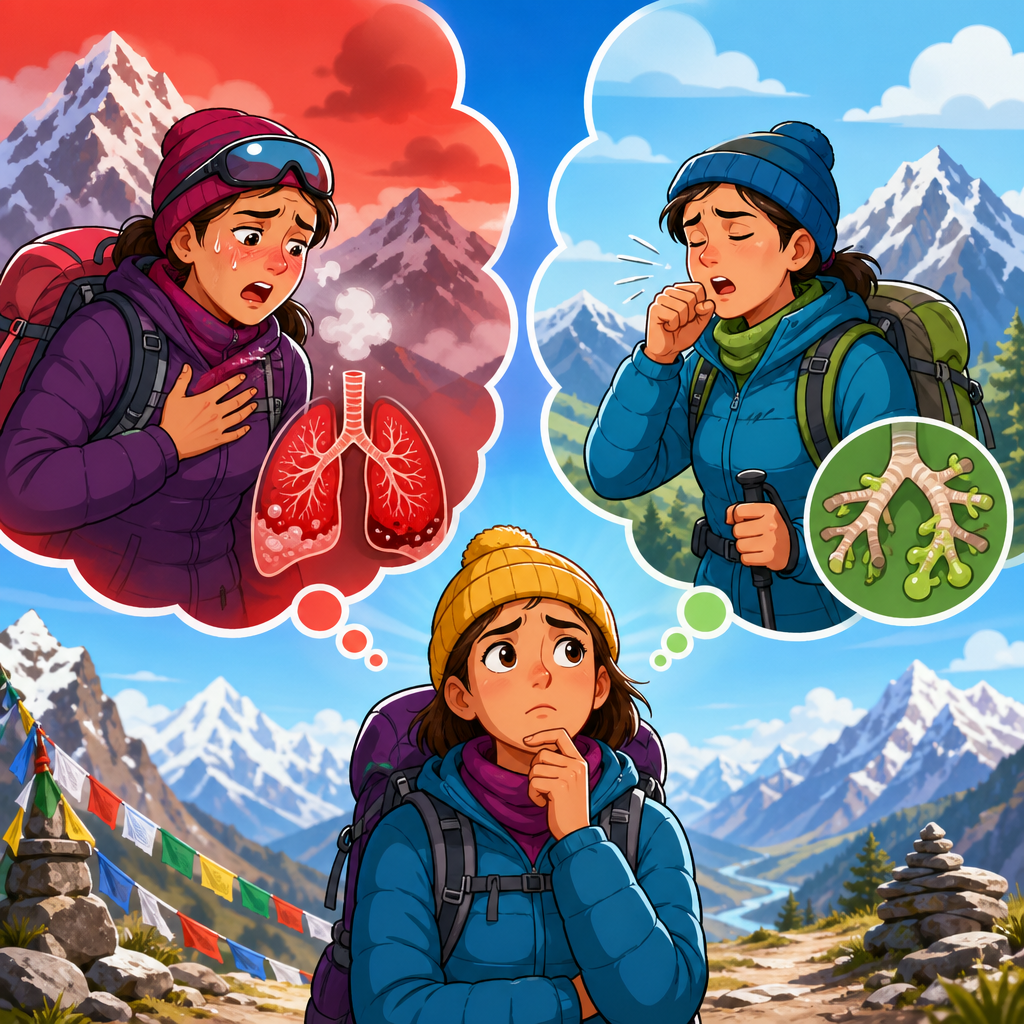
A cough at altitude can be a nuisance from cold, dry air, or it can be the first warning sign of high-altitude pulmonary edema, a life-threatening condition that demands fast descent. Knowing the difference between HAPE and bronchitis matters because both can begin with similar symptoms, yet they follow very different courses and require opposite assumptions. Bronchitis usually means inflammation of the bronchial tubes, often triggered by a virus, irritation, smoke, or dust. HAPE, by contrast, is fluid accumulation in the lungs caused by low oxygen at elevation, uneven constriction of pulmonary blood vessels, and rising pressure in the lung circulation. In plain terms, bronchitis irritates the airways; HAPE floods the air spaces where oxygen transfer should happen.
In mountain clinics, expedition tents, and rescue briefings, I have seen this confusion repeatedly. A trekker develops a cough on day two, assumes they caught a chest cold, and keeps climbing. By the time they recognize severe breathlessness, they are struggling to walk across camp. That pattern is why every climber, guide, and family member should understand the symptom timeline, the risk factors, and the red flags that separate a routine respiratory illness from a true altitude emergency. HAPE can occur in healthy, fit people. It does not require previous lung disease, and it does not always start dramatically.
The core problem is context. At sea level, a cough with mild shortness of breath may support a diagnosis like bronchitis, reactive airways, or a viral infection. At 3,000 to 5,500 meters, the same complaint must be evaluated through an altitude lens first. The Lake Louise approach to altitude illness emphasizes recent gain in elevation plus compatible symptoms. Wilderness Medical Society guidance similarly treats unexplained reduced exercise tolerance, breathlessness at rest, and low oxygen saturation at altitude as warning signs, especially when they worsen after further ascent. If symptoms improve quickly with descent or supplemental oxygen, that strongly supports HAPE over ordinary bronchitis.
This article explains how to spot a dangerous altitude cough, what HAPE feels like in its early and late stages, how bronchitis behaves differently, and when immediate descent is nonnegotiable. It also serves as the central guide for the HAPE topic within altitude illness and acclimatization, so it covers diagnosis, risk factors, field assessment, treatment priorities, and prevention in one place. The goal is simple: help you recognize the pattern early enough to prevent a cough from becoming a rescue.
What HAPE is and why it develops after ascent
High-altitude pulmonary edema is a noncardiogenic pulmonary edema caused by hypobaric hypoxia. Low oxygen triggers pulmonary vasoconstriction, but that constriction is uneven across the lungs. Blood gets diverted into less constricted regions, capillary pressure rises, and fluid leaks into the alveoli. This process impairs gas exchange, which causes more hypoxemia, which further worsens pulmonary vasoconstriction. That feedback loop is why HAPE can accelerate quickly once it begins.
HAPE usually appears within two to five days after gaining altitude, often above 2,500 to 3,000 meters, though susceptibility varies. Common risk factors include rapid ascent, vigorous exertion soon after arrival, prior HAPE, sleeping altitude gained too quickly, cold exposure, and concurrent respiratory infection. Children can develop HAPE, and so can elite athletes. Fitness is not protective. In fact, very fit trekkers sometimes climb too aggressively because they trust their legs more than their acclimatization.
Early HAPE often looks subtle. The first clues are reduced performance, unusual breathlessness during routine effort, delayed recovery after exertion, dry cough, and a sense that the chest is tight or “off.” As fluid increases, the cough becomes persistent, breathing becomes labored, and the person may be short of breath when lying still in a sleeping bag. Later findings can include crackles, blue lips, rapid heart rate, marked fatigue, and pink or frothy sputum. Frothy sputum is a late and dangerous sign, not something to wait for before acting.
How bronchitis usually presents at altitude
Bronchitis is inflammation of the bronchi, commonly due to a viral infection, but sometimes due to smoke, cooking fumes, dust, cold air, or postinfectious irritation. At altitude, dry air and repeated mouth breathing can make anyone cough, and woodsmoke in lodges can add further airway irritation. Acute bronchitis often begins with sore throat, nasal symptoms, body aches, or a general “coming down with something” feeling. The cough may be dry at first and later produce mucus. Chest discomfort is usually burning or sore rather than pressure from fluid-filled lungs.
The key difference is that bronchitis does not usually cause progressive oxygen failure linked to ascent. A person with bronchitis may cough a lot and feel tired, but they can often maintain similar walking tolerance unless they also have asthma, pneumonia, or another complicating condition. Their breathlessness is generally proportional to the cough itself, fever, or airway narrowing. They do not usually become dramatically more short of breath simply because they climbed 500 meters higher that day.
Bronchitis can still be serious, especially if it is actually pneumonia, asthma, influenza, COVID-19, or another lower respiratory infection. The challenge in the mountains is that these conditions can overlap with altitude illness. That is why the smartest field question is not “Is this just bronchitis?” but “Could this be HAPE until proven otherwise?” If the answer is yes, you manage the altitude threat first.
HAPE vs bronchitis: the fastest way to tell them apart
The most useful discriminator is progression after ascent. HAPE worsens with higher sleeping altitude, effort, and time spent hypoxic. Bronchitis usually follows an infection or irritant pattern that is less tightly linked to gain in elevation. The second discriminator is exercise tolerance. In HAPE, people who were walking normally yesterday may suddenly lag behind, stop frequently, or feel breathless on mild inclines. In bronchitis, the cough may be annoying, but dramatic collapse in performance is less typical.
Another difference is oxygenation. A pulse oximeter is not a standalone diagnostic tool because normal values fall with altitude, devices vary, and cold hands cause bad readings. Still, in practice, a saturation markedly lower than expected for that camp, especially combined with symptoms and tachycardia, raises concern for HAPE. I trust trends more than a single number: if a climber is dropping compared with teammates at the same altitude and looks increasingly breathless, I act.
| Feature | HAPE | Bronchitis |
|---|---|---|
| Typical trigger | Recent ascent, especially rapid gain in sleeping altitude | Virus, smoke, dust, cold dry air, airway irritation |
| Timing | Usually 2 to 5 days after ascent | Often follows cold symptoms or irritant exposure |
| Cough | Starts dry, may become wet or frothy later | Dry or productive, often with throat or upper airway symptoms |
| Breathlessness | Out of proportion to effort; can occur at rest | Usually mild unless another illness is present |
| Walking tolerance | Noticeably reduced, worsening fast | Often preserved or only mildly reduced |
| Response to descent or oxygen | Often improves quickly | Usually little immediate change |
Lung sounds can help, but they are not definitive. Crackles, especially in the right middle lobe early on and more diffusely later, support HAPE, yet some patients initially have clear lungs. Bronchitis may produce rhonchi or scattered wheeze rather than fine inspiratory crackles. Fever does not settle the question either. Mild fever can occur with either condition, and respiratory infection can coexist with HAPE.
Field assessment: questions, exam signs, and common mistakes
Start with four questions. How fast did the person ascend? When did the cough begin relative to the climb? Can they keep up with the group today compared with yesterday? Are they breathless at rest or when lying flat? If symptoms began after a rapid ascent and the answer to the last two questions is yes, HAPE moves high on the list.
On examination, count respiratory rate and heart rate, watch how the person speaks, and assess their ability to walk a short distance. Someone who needs to pause mid-sentence, uses neck muscles to breathe, or cannot walk across camp without stopping deserves immediate attention. Check for crackles, cyanosis, mental status change, and poor coordination. Confusion or ataxia suggests possible concurrent high-altitude cerebral edema, which increases urgency even further.
The biggest mistake is anchoring on sputum color. Many travelers think green or yellow mucus means infection and therefore rules out altitude illness. It does not. Another common mistake is treating the cough alone with cough syrup, antibiotics, or bronchodilators while ignoring falling exercise tolerance. Bronchodilators may help if bronchospasm is present, but they do not fix pulmonary edema. Antibiotics are appropriate only when bacterial infection is reasonably suspected; they should never delay descent when HAPE is possible.
What to do immediately if you suspect HAPE
The treatment priority is descent. Even 500 to 1,000 meters can make a major difference, and more is often better if the patient can be moved safely. Supplemental oxygen is highly effective when available. A flow rate sufficient to relieve symptoms and improve saturation should be used continuously during stabilization and evacuation. If descent is temporarily impossible, a portable hyperbaric bag can be lifesaving by simulating lower altitude.
Nifedipine is the best-established medication for HAPE because it lowers pulmonary artery pressure. It is most useful as an adjunct when oxygen or descent is delayed, and in selected prevention plans for people with prior HAPE. Phosphodiesterase-5 inhibitors such as tadalafil or sildenafil are also used in some protocols, but they are not substitutes for descent. Rest, warmth, and minimal exertion matter because activity worsens hypoxemia.
Do not tell someone with suspected HAPE to “sleep it off.” Night is when cases often deteriorate because ventilation falls during sleep and oxygen levels drop further. If the patient improves rapidly with oxygen and descent, that clinical response strongly supports the diagnosis. After stabilization, they still need medical evaluation, because recurrence, pneumonia, or residual hypoxemia can complicate the course.
Prevention, recurrence risk, and when bronchitis still needs care
The best prevention is gradual ascent. A common rule is to limit sleeping altitude gain above 3,000 meters to about 300 to 500 meters per night, with a rest day every three to four days, though terrain and itinerary may force adjustments. “Climb high, sleep low” remains practical advice because daytime exposure can aid acclimatization while lower sleeping altitude reduces overnight stress. Hydration, adequate calories, and avoiding overexertion in the first days help, but none of these replaces a conservative ascent profile.
Anyone with prior HAPE needs a personalized prevention plan before returning to altitude. That plan may include slower ascent, earlier turnaround thresholds, home discussion with a clinician experienced in mountain medicine, and prophylactic nifedipine in selected cases. If someone has had HAPE more than once, especially at modest elevations, evaluation for underlying susceptibility such as pulmonary hypertension or structural cardiovascular issues is reasonable.
Bronchitis still deserves attention when the cough lasts more than three weeks, fever is high, wheezing is significant, chest pain is focal, dehydration develops, or there is concern for pneumonia. But at altitude, the safest rule is this: if a cough is paired with worsening breathlessness, falling performance, or unusually low oxygen levels after ascent, treat it as HAPE until a qualified clinician proves otherwise. Learn the pattern, carry a pulse oximeter if your team knows how to interpret it, build flexible itineraries, and descend early when the story does not fit a simple chest cold.
A dangerous altitude cough is rarely identified by one symptom alone. It is identified by the combination of recent ascent, reduced exercise tolerance, disproportionate breathlessness, and deterioration with continued exposure to altitude. Bronchitis may coexist, mimic, or distract from the real problem, but it does not erase the mountain context. That is the key takeaway for this HAPE hub: altitude changes the meaning of common symptoms.
If you remember one practical rule, make it this one: a cough plus breathlessness after ascent is a diagnosis problem, but a cough plus worsening breathlessness at rest is a descent problem. Early HAPE often responds quickly when recognized, while delayed treatment can lead to respiratory failure, associated cerebral edema, and complex evacuation. The cost of descending unnecessarily is usually inconvenience; the cost of waiting too long can be fatal.
Use this page as your starting point for any HAPE question, from early signs and pulse oximeter interpretation to treatment choices and prevention planning. Review your itinerary before your next trip, discuss emergency thresholds with your team, and never let a “simple cough” make the summit decision for you.
Frequently Asked Questions
What is the difference between HAPE and bronchitis at altitude?
HAPE, or high-altitude pulmonary edema, is a dangerous buildup of fluid in the lungs caused by the body’s abnormal response to low oxygen at elevation. It is not an infection and it is not simply “chest congestion.” It is a medical emergency that can worsen quickly over hours. Bronchitis, on the other hand, is inflammation of the bronchial tubes, often related to a viral illness, airway irritation, smoke exposure, dust, or cold, dry air. Bronchitis can certainly cause coughing, chest discomfort, and mucus production, but it usually does not reflect fluid leaking into the air spaces of the lungs.
The confusion happens because both conditions can begin with a cough and shortness of breath. The key difference is the overall pattern. HAPE usually develops after ascent to altitude, often within the first several days, and tends to come with declining exercise tolerance, unusual breathlessness, fatigue, and a sense that the person is getting worse rather than stabilizing. Bronchitis often feels more like an irritated or inflamed airway problem, sometimes with a sore throat, runny nose, fever, or recent cold symptoms. At altitude, assuming a dangerous cough is “just bronchitis” can delay descent and treatment, which is why recognizing the broader picture matters so much.
What symptoms make a cough at altitude more likely to be HAPE than bronchitis?
Warning signs that point more strongly toward HAPE include shortness of breath that seems out of proportion to a simple cold, trouble catching your breath during mild activity, and later even at rest. A person may notice that walking uphill feels dramatically harder than it should, that they are falling behind the group, or that they cannot recover normally after exertion. A dry cough may be the first clue, but as HAPE worsens the cough can become persistent and may produce frothy or pink-tinged sputum. That is a major red flag.
Other concerning features include chest tightness, marked fatigue, rapid breathing, a racing heartbeat, bluish lips or fingernails, and crackling or rattling sounds in the chest. Many people with HAPE also appear weak, unusually quiet, or clearly unwell. Symptoms often worsen at night and with continued ascent. Bronchitis can cause coughing fits, mucus, wheezing, and chest soreness, but it usually does not cause severe oxygen-related symptoms such as breathlessness at rest, visible struggling to breathe, or a rapid downhill course after going higher. If the person cannot keep up, looks increasingly breathless, or is deteriorating instead of slowly improving, think HAPE first.
How can someone tell whether a cough is from cold, dry air, bronchitis, or a dangerous altitude illness?
Context is one of the best clues. Cold, dry air commonly causes a mild, irritating “altitude cough,” especially during exertion or after breathing hard through the mouth. It often feels scratchy, improves with covering the mouth, hydration, warmer air, and rest, and is not usually accompanied by major illness. Bronchitis tends to fit a pattern of airway inflammation: frequent cough, possible mucus, throat irritation, mild fever, recent viral symptoms, or exposure to smoke, cooking fumes, dust, or heavy campfire smoke. It is uncomfortable, but many people remain reasonably functional.
A dangerous altitude-related cough is different because it is rarely just the cough. Look at the whole person. Are they newly breathless with simple tasks? Are they unable to sleep flat, gasping, or waking up short of breath? Are they unusually exhausted, dizzy, or getting worse with continued time at altitude? Has their performance dropped sharply compared with what is normal for them? These pattern changes matter more than the sound of the cough alone. If a pulse oximeter is available, a lower-than-expected oxygen saturation for the altitude, especially combined with symptoms, can support concern, though it should never be used as the only decision tool. At altitude, a worsening cough plus worsening breathlessness should be treated with caution until HAPE is ruled out.
What should you do immediately if you suspect HAPE instead of bronchitis?
If HAPE is suspected, the priority is descent. Do not wait to “see if it passes,” and do not assume cough medicine or antibiotics will solve the problem. The person should stop ascending immediately and go down as soon as possible, ideally with assistance and without carrying a heavy pack. Even a modest descent can help, but the goal is to reach a lower elevation promptly and safely. Exertion can make HAPE worse, so keep movement controlled and monitor the person closely.
Supplemental oxygen, if available, is one of the most effective immediate treatments. A portable hyperbaric bag can also be lifesaving in remote settings when descent is delayed. Nifedipine is sometimes used in specific situations, particularly in expedition or wilderness medicine contexts, but it should not replace descent and oxygen. If the person is struggling to breathe at rest, confused, unable to walk normally, or showing bluish discoloration, treat it as an emergency and activate rescue or evacuation. In contrast, suspected bronchitis without severe red flags may be managed with rest, fluids, airway protection from cold air, and medical evaluation as needed. The consequence of underestimating HAPE is far greater than the consequence of being cautious.
When should a person with a cough at altitude seek urgent medical attention?
Urgent medical attention is needed if a cough is accompanied by shortness of breath at rest, rapidly worsening breathlessness, chest tightness, difficulty walking a straight line or keeping pace with minimal effort, confusion, fainting, bluish lips, or coughing up frothy or blood-tinged fluid. These are not routine bronchitis symptoms at altitude. They suggest impaired oxygen exchange and possible fluid in the lungs, which can become life-threatening very quickly. Anyone with suspected HAPE should be removed from altitude and evaluated as soon as possible.
It is also wise to seek prompt evaluation if symptoms started soon after ascent and continue to worsen over several hours, if the person cannot sleep because of breathing difficulty, or if they have a history of previous HAPE. People often get into trouble by normalizing the early signs: a little cough, getting winded sooner, a vague sense of weakness. At sea level these symptoms might seem minor, but at altitude they can signal the beginning of a serious cascade. When in doubt, err on the side of descent and assessment. The safest rule is simple: a cough alone may be harmless, but a cough plus worsening breathlessness at altitude should never be ignored.