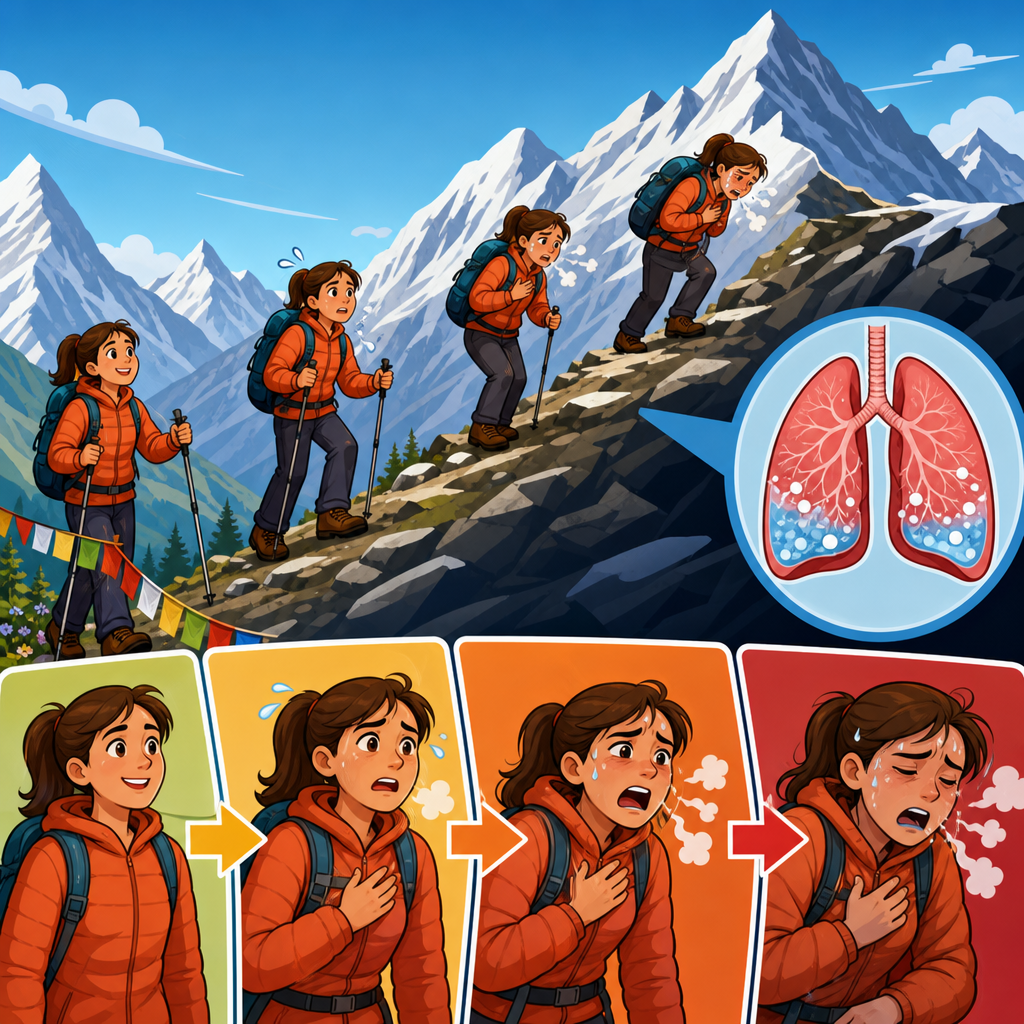
High-altitude pulmonary edema, usually shortened to HAPE, is the most dangerous form of noncardiogenic altitude illness and one of the fastest medical emergencies that can develop after a rapid ascent. HAPE happens when low oxygen at altitude triggers uneven constriction of the pulmonary blood vessels, sharply raising pressure in parts of the lung circulation. Fluid then leaks across the capillary wall into the air spaces, impairing gas exchange and causing worsening breathlessness, cough, reduced exercise tolerance, and, in advanced cases, respiratory failure. In practical terms, HAPE can turn a strong climber into a patient who cannot walk across camp within hours, which is why understanding how fast high-altitude pulmonary edema can progress after a rapid ascent matters for trekkers, guides, expedition doctors, ski travelers, soldiers, and anyone sleeping high after coming from low elevation.
In the field, I have seen people dismiss the earliest signs because they expected altitude problems to mean a headache first. HAPE often starts differently. A person arrives high, feels unusually winded on a short climb, notices a dry cough overnight, and by the next morning cannot keep pace with the group. The progression can be deceptively quick, especially after gaining sleeping altitude too aggressively, returning to altitude after a break, or exerting hard in cold conditions. The key terms are simple but important: rapid ascent means a large increase in sleeping elevation with little acclimatization; progression means the change from mild symptoms to severe respiratory compromise; and HAPE susceptibility refers to the well-documented tendency of some people to develop it repeatedly because of an exaggerated pulmonary vascular response to hypoxia.
This hub article explains the timeline, the physiology, the warning signs, the known risk factors, and the treatments that work. It also clarifies where HAPE overlaps with acute mountain sickness and high-altitude cerebral edema, because mixed presentations are common. If you need one practical rule to keep in mind from the start, it is this: suspected HAPE is never a wait-and-see problem. Immediate descent, supplemental oxygen when available, and reduced exertion save lives.
How quickly HAPE can develop after rapid ascent
HAPE usually develops within two to five days after ascent above about 2,500 to 3,000 meters, but the speed varies with altitude reached, individual susceptibility, exertion, cold exposure, and prior acclimatization. The classic pattern is arrival at a new sleeping elevation followed by reduced exercise capacity on day one, cough and breathlessness at rest by day two or three, and marked hypoxemia if the person remains high. However, after a very rapid ascent to high camps or mountain resorts, progression can be much faster. In susceptible people, clinically significant HAPE can appear within 24 hours, and severe cases can deteriorate over several more hours if descent is delayed.
The reason is physiological, not random. Hypoxia causes pulmonary vasoconstriction. In some lungs this response is exaggerated and patchy, so blood flow is diverted into less constricted areas, creating local overperfusion and high capillary stress. The capillary barrier becomes leaky, allowing protein-rich fluid and red blood cells to move into the alveoli. This is why HAPE is categorized as a high-permeability edema rather than simple fluid overload. Once enough alveoli fill, oxygen levels fall further, which intensifies pulmonary vasoconstriction and creates a dangerous feedback loop. That is the engine behind the rapid progression.
Real-world scenarios make the timeline easier to understand. A traveler flies from sea level to Lhasa and then drives higher the same day; a skier sleeps at a resort above 3,000 meters after arriving by car; a climber pushes from low camp to high camp with heavy exertion and cold wind exposure. These are common setups. In each, symptoms may begin as “I am more short of breath than everyone else,” then shift to an unusually high resting heart rate, persistent cough, poor sleep, crackles in the chest, blue lips, and staggering fatigue. When a person becomes breathless while resting in the tent, HAPE is already advanced.
Early symptoms, red flags, and what progression looks like
The earliest symptom is often disproportionate shortness of breath with exertion compared with companions at the same altitude. This can be subtle. Someone who was fit at lower elevations suddenly struggles on easy terrain, stops repeatedly, or cannot recover after modest effort. A dry cough, chest tightness, and declining pace often follow. As fluid accumulation worsens, the cough may become productive, sometimes with frothy or blood-tinged sputum. Audible crackles, especially over the right middle lung field early on, can appear before dramatic distress is obvious.
Progression from mild to severe HAPE is marked by three changes. First, breathlessness starts occurring at rest, not just during movement. Second, oxygenation falls enough to produce cyanosis, confusion, or poor coordination. Third, the person’s work of breathing increases: rapid respiratory rate, inability to speak full sentences comfortably, and a look of panic or exhaustion. A normal trekker may blame altitude fatigue, but a clinician or experienced guide reads these findings differently. Resting dyspnea at altitude is a medical emergency until proven otherwise.
Pulse oximetry can help but should never delay action. Many HAPE patients have oxygen saturation values far below peers at the same altitude, often dropping into ranges that would be alarming at sea level, yet interpretation must be altitude-specific. The more reliable field pattern is declining function plus worsening respiratory symptoms. If walking to the latrine becomes difficult, the person is too sick to stay high. In my experience, groups get into trouble when they treat cough or poor performance as isolated problems instead of recognizing the progression as a whole syndrome.
| Stage | Typical timing after rapid ascent | Common signs | Action |
|---|---|---|---|
| Early | 12 to 48 hours | Reduced exercise tolerance, unusual breathlessness, dry cough, fast pulse | Stop ascent, rest, assess closely |
| Established | 24 to 72 hours | Breathlessness on minimal exertion, persistent cough, crackles, low oxygen saturation | Descend, give oxygen if available, consider nifedipine |
| Severe | Hours to days if untreated | Breathlessness at rest, cyanosis, frothy sputum, confusion, inability to walk | Immediate descent, oxygen, portable hyperbaric bag, urgent medical care |
Who gets HAPE and why some cases progress faster
The strongest risk factor is rapid ascent without acclimatization. Sleeping too high too soon increases hypoxic stress before the pulmonary circulation has adapted. Previous HAPE is another major predictor. Recurrence rates are high in susceptible individuals, and many show exaggerated hypoxic pulmonary hypertension during testing. Young, fit people are not protected; in fact, they may ascend faster and exert harder, increasing risk. Cold exposure, respiratory infections, dehydration, and intense physical effort can all worsen the picture.
Children and adolescents can develop HAPE, sometimes with especially rapid decompensation because early symptoms are harder to recognize. People with congenital or acquired pulmonary hypertension, reduced nitric oxide availability, or structural issues affecting pulmonary blood flow may also be more vulnerable. There are reports of HAPE occurring at relatively moderate elevations, particularly after a return ascent in a susceptible person. That is why a “safe altitude” does not exist in absolute terms; risk depends on the person and the rate of gain.
One nuance matters. HAPE is not caused by drinking too much water, and it is not simply “fluid in the lungs” from heart failure. Heart size is usually normal, wedge pressure is not elevated, and the mechanism is driven by hypoxic pulmonary vasoconstriction and capillary leak. This distinction matters because it explains why diuretics are not routine treatment and can be harmful if they worsen dehydration or low blood pressure. When the mechanism is understood correctly, the management decisions become clearer and faster.
Diagnosis in the field and how to separate HAPE from other altitude illnesses
Field diagnosis is clinical. The Lake Louise approach and wilderness medicine guidance emphasize symptoms plus signs: recent altitude gain, reduced performance, cough, breathlessness, crackles or wheeze, central cyanosis, and low oxygen saturation relative to expected values. A chest X-ray, if available, may show patchy infiltrates, often beginning in the right middle lobe or lower zones, unlike the classic bat-wing pattern of cardiogenic edema. Ultrasound can reveal B-lines, but imaging is rarely what determines the immediate decision in a mountain setting.
The main differential diagnoses are pneumonia, bronchospasm, pulmonary embolism, and heart failure, plus overlap with acute mountain sickness and high-altitude cerebral edema. Pneumonia may include fever and localized findings, but infection and HAPE can coexist. Asthma causes wheeze, yet isolated wheeze without crackles or hypoxemia is less typical of HAPE. Pulmonary embolism is harder to exclude and may be considered when the setting is atypical. In a trekker who recently ascended, worsens rapidly, and improves dramatically with oxygen and descent, HAPE rises to the top of the list.
Mixed altitude illness is common enough that teams should actively look for neurologic signs. A HAPE patient who is confused, ataxic, or severely headache-prone may also have cerebral edema. That combination is particularly dangerous and lowers the threshold for urgent evacuation. As a sub-pillar hub within altitude illness and acclimatization, this point connects directly to related topics: prevention by staged ascent, the role of acetazolamide for acclimatization, and emergency management of cerebral symptoms all sit alongside HAPE rather than outside it.
Treatment: what works, what does not, and how fast recovery begins
The definitive treatment is descent. Even a drop of 500 to 1,000 meters can make a major difference, and more is better if it can be done safely. Supplemental oxygen is the next most effective intervention and should be started immediately when available. Reduced exertion is essential because exercise raises pulmonary artery pressure and worsens oxygen demand. If descent is delayed by weather or terrain, a portable hyperbaric chamber can temporize by simulating lower altitude, but it is a bridge, not a cure.
Nifedipine has strong support as an adjunct in HAPE because it lowers pulmonary artery pressure. Sustained-release nifedipine is commonly used in rescue and prevention for known susceptible individuals, following established wilderness medicine protocols and physician guidance. Phosphodiesterase-5 inhibitors such as tadalafil or sildenafil may also reduce hypoxic pulmonary hypertension and are used in selected prevention strategies, but they are not a substitute for descent in an acute case. Dexamethasone is not primary treatment for isolated HAPE, though it may be given when cerebral edema is suspected as well.
What does not work reliably? Waiting for acclimatization while symptoms worsen, pushing fluids aggressively, and assuming antibiotics alone will fix the problem. Diuretics are generally avoided unless there is a separate indication. Once descent and oxygen begin, improvement can be surprisingly fast; respiratory distress often eases within hours, and many patients stabilize dramatically overnight. Full recovery still takes time, and return to altitude should be cautious and medically informed. A person who has had HAPE once needs a prevention plan before the next trip.
Prevention after rapid ascent: practical rules for travelers and climbers
The best prevention strategy is controlled ascent. Above 3,000 meters, standard advice is to limit increases in sleeping altitude to about 300 to 500 meters per night and add a rest day every three to four days or after major gains. Day hikes higher are usually tolerated better than sleeping higher, which is the basis of “climb high, sleep low.” Commercial itineraries often violate these principles, especially when flights or road access allow instant altitude. That is exactly when HAPE risk rises.
Known HAPE-susceptible travelers should discuss prophylaxis before departure. In the right patient, nifedipine, tadalafil, or other targeted strategies may be appropriate under medical supervision. Screening for prior episodes matters more than generic fitness metrics. I always ask whether the person ever developed unexplained breathlessness, cough, or hospitalization after sleeping high, because many people were told they had “bronchitis” at altitude when the pattern was really HAPE. Prevention starts with recognizing that history.
Simple behavior changes help. Avoid all-out exertion during the first days at a new altitude. Protect against cold stress. Do not ignore a new cough combined with falling performance. Monitor vulnerable group members closely at night and in the morning, when deterioration becomes obvious. If symptoms suggest HAPE, stop ascent immediately. The benefit of prompt recognition is enormous: early descent can prevent the cascade toward severe hypoxemia, rescue complexity, and death. For anyone planning a fast trip to high elevation, review your itinerary, build in acclimatization, and know your emergency descent options before you go.
Frequently Asked Questions
How quickly can high-altitude pulmonary edema develop after a rapid ascent?
High-altitude pulmonary edema, or HAPE, can develop surprisingly fast, often within 1 to 4 days after a rapid ascent to high elevation. In many cases, the first symptoms begin within 24 to 72 hours of arriving at altitude, especially when someone has climbed too high too quickly without allowing enough time to acclimatize. What makes HAPE especially dangerous is that it may start with symptoms that seem mild, such as reduced exercise tolerance, unusual fatigue, or shortness of breath during exertion, and then progress over hours into a far more serious breathing emergency.
The speed of progression varies from person to person, but once fluid begins leaking into the air spaces of the lungs, breathing can worsen quickly. A person may move from being winded while hiking to struggling for breath while resting, coughing repeatedly, and becoming weak, confused, or unable to continue within a relatively short period. Because HAPE affects oxygen exchange directly, deterioration can accelerate fast after the early warning signs appear. That is why any new breathing difficulty after a rapid ascent should be treated seriously, especially at elevations where altitude illness is common.
What are the earliest signs that HAPE is starting to progress?
Early HAPE often begins subtly, which is one reason it can be missed. The earliest warning signs usually include shortness of breath that seems out of proportion to the activity level, unusual fatigue, decreased performance, and a dry cough. Someone who could normally walk uphill without much trouble may suddenly need to stop often, breathe harder than expected, or feel unusually drained. These symptoms can appear before the more dramatic signs of severe illness develop.
As HAPE progresses, the symptoms become more concerning and more specific. Breathlessness may start happening during light activity and then at rest. The cough can become more persistent and may later produce frothy or pink-tinged sputum, although that is not always present. Many people also experience chest tightness, a rapid heartbeat, fast breathing, weakness, and difficulty keeping up with their group. A person may look pale or bluish around the lips or fingernails if oxygen levels are dropping. The key point is that worsening breathlessness at altitude is never something to ignore, especially when it continues to progress instead of improving with rest.
Why can HAPE become severe so rapidly after going to high altitude?
HAPE becomes severe quickly because it is driven by a powerful reaction to low oxygen. At high altitude, lower oxygen levels cause the blood vessels in the lungs to constrict. In HAPE, that constriction is uneven, so pressure rises sharply in certain parts of the lung circulation. That increased pressure can damage the delicate barrier between the capillaries and the air spaces, allowing fluid to leak into the alveoli. Once fluid enters those air spaces, the lungs become less able to transfer oxygen into the bloodstream, and the body is exposed to even more low oxygen.
This creates a dangerous cycle. Lower oxygen triggers more pulmonary vessel constriction, which can increase pressure further and lead to more leakage. As a result, gas exchange worsens, and symptoms can snowball over a short period. Unlike simple shortness of breath from exertion, HAPE reflects a true failure of the lungs to oxygenate the body properly. That is why a person can seem only mildly ill at first and then become significantly impaired in a matter of hours, particularly if they keep climbing, continue strenuous activity, or stay at the same altitude without treatment.
How can you tell the difference between normal altitude adjustment and a medical emergency like HAPE?
Normal adjustment to altitude can include mild shortness of breath with exertion, a faster breathing rate, and some fatigue, especially during the first day or two after arrival. However, those symptoms should generally be stable or gradually improve as acclimatization begins. HAPE is different because the breathing problem is progressive. Instead of adapting, the person becomes more short of breath, less able to exert themselves, and increasingly weak. A cough that develops and worsens at altitude is also a major clue, particularly when it is paired with declining performance and breathlessness.
Red flags for a true emergency include shortness of breath at rest, inability to walk at a normal pace, persistent cough, chest tightness, marked fatigue, rapid breathing, and signs of low oxygen such as bluish lips, confusion, or poor coordination. Crackling sounds in the lungs may be heard if a clinician examines the chest, but you should not wait for a formal exam if symptoms are escalating. If someone at altitude is breathing harder and getting worse rather than better, HAPE should be considered until proven otherwise. When in doubt, treat it as a medical emergency and act quickly.
What should someone do immediately if HAPE is suspected after a rapid ascent?
If HAPE is suspected, the most important step is immediate descent. Going down to a lower altitude is the fastest and most effective treatment because it raises the available oxygen and reduces the altitude stress driving the condition. The person should stop exerting themselves right away, stay warm, and avoid continuing the climb under any circumstances. Supplemental oxygen, if available, can be lifesaving and should be given as soon as possible. Portable hyperbaric treatment bags can also help when descent is delayed or temporarily impossible, but they are not a substitute for getting lower when that can be done safely.
Medical evaluation is urgent because HAPE can keep progressing and can become fatal if ignored. In some settings, medications such as nifedipine may be used by trained clinicians or as part of a clear expedition medical plan, but descent and oxygen remain the priorities. A person with suspected HAPE should not be left alone, and they should be monitored closely for worsening breathing, declining alertness, or inability to walk. The bottom line is simple: HAPE is not a condition to watch and wait on. If symptoms fit the pattern and are getting worse after rapid ascent, treat it as a high-altitude emergency and move quickly.