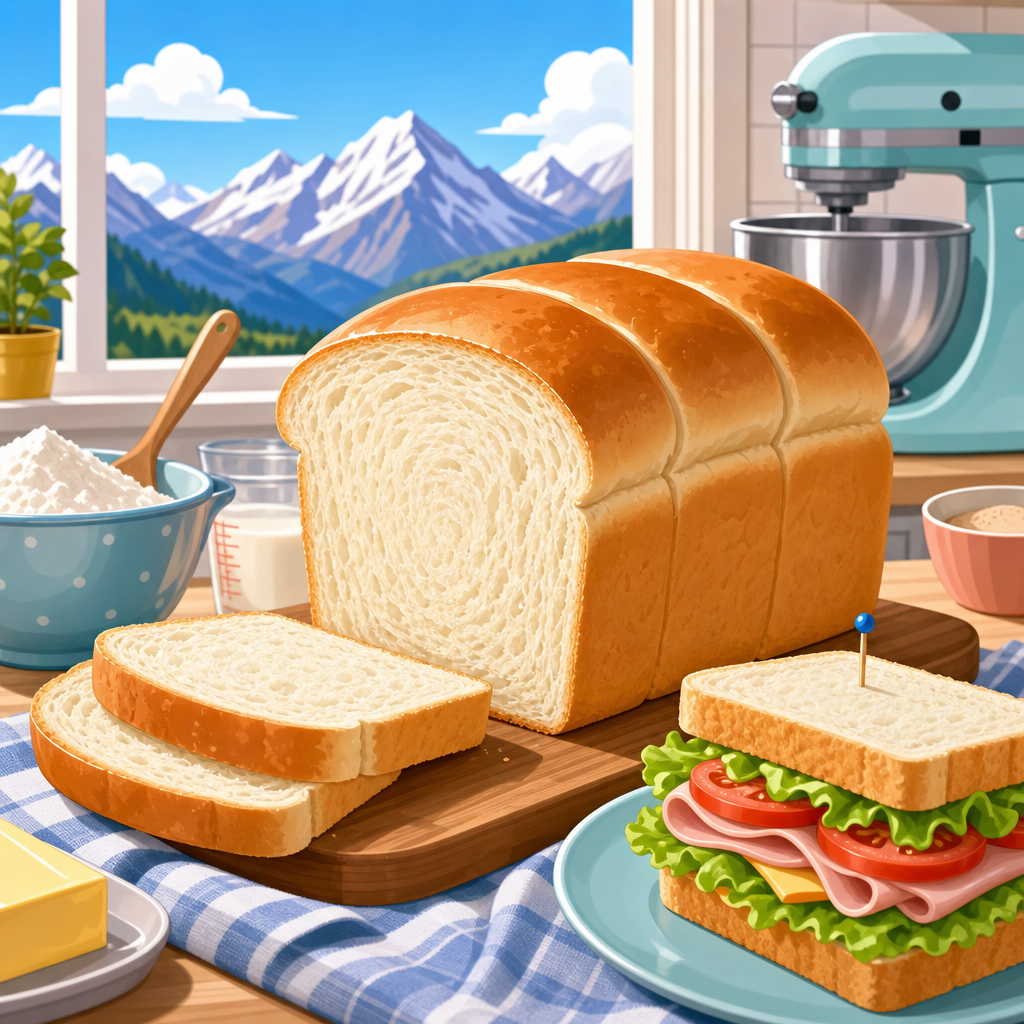
Soft sandwich bread at altitude depends on controlling fermentation, moisture, and structure more carefully than you would at sea level. In mountain kitchens, lower air pressure changes how dough rises, how quickly water evaporates, and how starches and proteins set in the oven. That is why a loaf formula that behaves perfectly in Portland or Chicago can overproof, dry out, and collapse in Denver, Santa Fe, or Flagstaff. If you want reliable, tender slices for toast, lunches, and everyday baking, you need a process designed specifically for elevation rather than a generic bread recipe with crossed fingers.
When bakers talk about altitude, they usually mean anything above 3,000 feet, with stronger effects appearing over 5,000 feet. Yeast bread refers to dough leavened by commercial yeast, while sourdough uses a live culture of wild yeast and bacteria. Sandwich bread is a soft, enriched loaf, often made with milk, butter or oil, and a little sugar, then baked in a loaf pan for a fine crumb and square slices. In my own high-altitude test bakes, the biggest difference is not that dough refuses to rise. It rises too fast, often before gluten is strong enough to hold the gas. The result is a loaf that balloons early, then wrinkles, tears, or sinks.
This matters because altitude baking is not just about getting any rise. It is about getting controlled rise. A good sandwich loaf should feel light but not hollow, spring back when pressed, slice cleanly, and stay soft for several days. To get there, you need the right dough temperature, proper hydration, moderate yeast levels, and clear proofing cues. This hub article covers the full picture for yeast breads and sourdough at altitude, with practical adjustments, troubleshooting logic, and the key methods that connect all the recipes in this subtopic.
Why altitude changes yeast breads and sourdough
At higher elevation, atmospheric pressure is lower. Gas cells in dough expand more easily, so fermentation appears stronger and proofing moves faster. At the same time, water boils at a lower temperature, which means dough and baked bread lose moisture more quickly. Flour also tends to be drier in arid mountain climates, so the same measured recipe may need more liquid than it did at lower elevation. Put those pieces together and you get the classic high-altitude bread problems: overproofed dough, coarse crumb, dry texture, weak oven spring, and loaves that mushroom over the pan before collapsing.
Commercial yeast and sourdough both react to these conditions, but not in identical ways. Instant or active dry yeast gives a faster, more predictable rise, which is helpful for sandwich bread but easy to overdo at altitude. Sourdough ferments more slowly because acids and bacteria influence the pace, yet it still becomes more active in warm high-altitude kitchens than many bakers expect. That is why the same principles apply to both: shorten fermentation windows, strengthen gluten with good mixing and folds, and use visual and tactile signals instead of relying only on the clock.
One point many home bakers miss is that altitude does not automatically require massive formula changes. It requires smart ones. I usually start with less yeast, slightly more liquid, and either a touch more salt or cooler dough temperatures to slow things down. Then I watch dough development closely. Those restrained adjustments preserve flavor and texture better than the common mistake of dumping in extra flour to make sticky dough feel safer. Dry dough may seem easier to handle, but at altitude it often bakes up heavy and stale by the next morning.
Core formula adjustments for soft sandwich bread
If you are adapting a standard sandwich loaf recipe for altitude, the most reliable changes are modest and deliberate. For elevations around 3,000 to 5,000 feet, reduce yeast by about 10 to 15 percent. Above 5,000 feet, reductions of 15 to 25 percent are often more effective, especially in warm kitchens. Increase liquid by 2 to 5 percent of flour weight to offset faster evaporation and drier flour. If the recipe is very sweet or rich, you may also need to reduce sugar slightly because high sugar speeds browning before the loaf fully sets.
Flour choice matters. Bread flour, usually around 12 to 13 percent protein, gives better support for high-altitude pan loaves than softer all-purpose flour, especially when using milk, butter, eggs, or mashed potato. A tangzhong or cooked flour paste can help even more. By pre-gelatinizing a small portion of flour with water or milk, you increase moisture retention and softness without making the dough slack. This is one of the most dependable methods for soft sandwich bread at altitude because it counters drying while improving shelf life.
Mixing should target full gluten development, not just rough combination. A dough that is undermixed may rise fast but lack the elastic strength to hold shape. I mix until the dough is smooth, tacky rather than wet, and able to stretch thinly in a windowpane test. If using sourdough, I often combine a short autolyse with a few coil folds during bulk fermentation. For yeasted sandwich bread, a stand mixer on low to medium speed usually develops structure efficiently, but hand kneading works if you give it enough time and avoid adding excess bench flour.
| Issue | Typical altitude adjustment | Why it helps |
|---|---|---|
| Dough rises too fast | Reduce yeast 10 to 25 percent | Slows fermentation so gluten can strengthen before full expansion |
| Bread bakes up dry | Increase liquid 2 to 5 percent | Offsets faster evaporation and lower boiling point |
| Loaf collapses or mushrooms | Shorten proof and strengthen gluten | Prevents overexpansion and weak cell walls |
| Crumb is coarse | Use bread flour or tangzhong | Improves structure and moisture retention for finer slices |
| Crust browns too fast | Lower oven 10 to 15 degrees Fahrenheit | Lets center bake through before exterior overcolors |
Best process for mixing, bulk fermentation, shaping, and proofing
The best process starts with temperature control. Dough temperature after mixing is one of the most important variables in high-altitude baking, yet many home bakers never measure it. For soft sandwich bread, I aim for a final dough temperature around 75 to 78 degrees Fahrenheit for commercial yeast and often a degree or two lower if the kitchen is warm. Use cooler water if needed. A dough that begins too warm can sprint through bulk fermentation and fool you into shaping it before the gluten is ready.
Bulk fermentation should increase the dough noticeably, but not always double. At altitude, doubling can be too much, particularly for enriched doughs in pans. Look for a dough that becomes smoother, airier, and slightly domed, with bubbles visible at the edges of the container. If using sourdough, expect bulk to be driven by both starter strength and room temperature. A levain that peaks quickly at altitude can still over-acidify dough if left too long, weakening gluten and producing a loaf that spreads instead of standing tall.
Shaping needs tension without tearing. Degas gently but thoroughly enough to remove large gas pockets that would become tunnels. Roll the dough into a tight cylinder, pinch the seam closed, and place it seam-side down in a greased pan. For proofing, ignore the old instruction to let the loaf rise far above the rim. At altitude, that is a setup for collapse. For many standard 8 1/2-by-4 1/2-inch pans, the dough is ready to bake when the highest point is roughly 3/4 to 1 inch above the rim and springs back slowly when pressed with a fingertip. If the indentation stays deep, it has gone too far.
How to bake for softness, even crumb, and good shelf life
Oven settings influence texture as much as the dough formula does. A slightly lower oven temperature, often 10 to 15 degrees Fahrenheit below the original recipe, helps enriched loaves bake through before the crust gets too dark. For many sandwich breads, 340 to 360 degrees Fahrenheit works well at altitude, depending on pan color and sugar level. Dark metal pans absorb more heat and brown faster, while light aluminum bakes more gently. Pullman pans with lids are particularly useful because they support the dough and produce a fine, square crumb ideal for sandwiches.
Bake to internal temperature, not just color. For enriched sandwich bread, I look for about 190 to 200 degrees Fahrenheit in the center. Bread that comes out earlier may seem soft at first but can compress into a gummy line as it cools. If the top browns too quickly, tent loosely with foil for the last part of baking. Once out of the oven, brush the top with melted butter for a tender crust and cool completely before slicing. Cutting hot bread releases steam too soon and can make the crumb seem underbaked even when the formula was correct.
To keep the loaf soft, store it after fully cooling in a bag or covered container at room temperature. Refrigeration speeds staling in most lean and enriched breads. If your climate is very dry, a tangzhong loaf or one made with a small amount of potato flour, mashed potato, or milk powder will usually stay tender longer than a basic white loaf. For longer storage, slice and freeze the bread, then toast pieces directly from frozen. That approach preserves quality far better than leaving a loaf exposed on the counter in a mountain kitchen.
Yeast breads and sourdough variations within this hub
This page is the hub for high-altitude yeast breads and sourdough because the same principles branch into many loaf styles. White sandwich bread is usually the easiest starting point because it gives clean feedback on hydration, proofing, and oven spring. Whole wheat sandwich bread needs additional water because bran absorbs more moisture and can cut gluten strands. Milk bread and brioche-style sandwich loaves require especially careful proofing because enriched dough can look slow early, then expand rapidly near the end. Cinnamon raisin bread brings another challenge: sugar and fruit both affect fermentation and browning.
Sourdough sandwich bread deserves separate attention because it combines the softness of pan bread with the fermentation complexity of natural leavening. To keep it tender, bakers often include milk, butter, honey, and sometimes a tangzhong, then use an active starter with moderate acidity. At altitude, I have found that many sourdough sandwich loaves benefit from shorter bulk fermentation and cooler overnight proofing. That schedule improves flavor while limiting overexpansion. If you are moving from artisan hearth sourdough to pan loaves, remember that the target is different: finer crumb, less dramatic scoring, and dependable sliceability.
Beyond sandwich bread, this hub supports articles on dinner rolls, hamburger buns, pizza dough, focaccia, cinnamon rolls, and rustic sourdough boules. The adjustments overlap, but the priorities shift. Rolls need softness and close crumb. Pizza dough needs extensibility without tearing. Boules need stronger surface tension and steam management. Once you understand why altitude accelerates rise and dries dough, you can adapt each of these formats with much more confidence. The details vary, but the rule remains constant: fermentation must be matched to structure.
Troubleshooting common high-altitude bread problems
If your sandwich bread collapses, the first suspect is overproofing, not lack of yeast. Bakers often see quick rise at altitude and assume they are succeeding, but the loaf may already be beyond its structural limit. Next, check dough strength. Weak gluten from low-protein flour, insufficient mixing, or excessive acidity in sourdough can all contribute. If the crumb is dry and crumbly, increase hydration slightly, verify baking time with a thermometer, and avoid adding too much flour during kneading. If the loaf splits wildly at the side, proof a little longer or score intentionally if the dough style allows it.
Dense texture usually comes from the opposite imbalance: underfermentation or too much flour. A dough can feel easy to shape and still be too stiff to expand well. Measure ingredients by weight, not volume. A cup of flour can vary dramatically depending on how it is scooped, and that variability is magnified in dry climates. If flavor is flat, lengthen fermentation slightly but compensate with cooler dough or reduced yeast so the loaf does not outrun its structure. For sourdough, evaluate starter maturity. A weak starter may produce acidity without enough gas, leading to a tight loaf with a pale, dull crumb.
Another frequent issue is inconsistency from one day to the next. Weather, room temperature, and flour moisture all matter more than many recipes admit. Keep notes on elevation, flour brand, hydration percentage, dough temperature, bulk time, proof height, bake temperature, and internal temperature. After a few batches, patterns become obvious. In practice, that record keeping is what turns altitude baking from frustrating guesswork into a repeatable system.
Making soft sandwich bread at altitude is less about secret ingredients than about disciplined control of yeast activity, moisture, and gluten strength. Reduce yeast modestly, raise hydration carefully, build full structure, and bake before the loaf overproofs. Use bread flour or moisture-retaining methods such as tangzhong when you want a finer crumb and longer softness. Measure by weight, watch dough instead of the clock, and verify doneness by internal temperature. Those steps solve most of the problems bakers blame on elevation itself.
As the hub for yeast breads and sourdough in the broader cooking and baking at altitude topic, this article gives you the framework behind every related recipe. Whether you are baking classic white pan bread, whole grain loaves, dinner rolls, or sourdough sandwich bread, the underlying mechanics stay consistent. Mountain baking rewards attention and restraint. Small, informed adjustments beat dramatic recipe overhauls almost every time.
Start with one dependable sandwich loaf, keep detailed notes, and refine only one variable per bake. That approach will teach you more than chasing dozens of recipes, and it will give you the soft, even, reliable bread most home bakers want. From here, build outward into rolls, buns, pizza dough, and sourdough loaves with the same altitude-aware mindset.
Frequently Asked Questions
Why does sandwich bread rise differently at high altitude?
At high altitude, lower air pressure changes the way gases expand inside dough, so yeast-produced carbon dioxide pushes upward faster and more aggressively than it does at sea level. That means dough can appear fully proofed sooner, but it may not have developed enough strength to hold that rise well. In practical terms, a loaf that would rise steadily and predictably in a lower-elevation kitchen may overexpand, weaken, and then collapse before or during baking in places like Denver, Santa Fe, or Flagstaff.
Altitude also affects evaporation. Moisture leaves the dough more quickly both during mixing and in the oven, which can make the dough feel firmer than intended and lead to a drier finished loaf if you do not compensate. On top of that, starches and proteins set differently in high-altitude baking, so the window between “properly proofed” and “overproofed” is often narrower. For soft sandwich bread, the goal is to slow things down, protect moisture, and build enough structure to support a fine, even crumb. That usually means watching the dough closely rather than following the clock alone.
How should I adjust yeast, proofing, and fermentation for soft sandwich bread at altitude?
The most reliable first adjustment is usually to reduce the yeast slightly and shorten your rise times. Because dough ferments faster at altitude, using the same amount of yeast as a sea-level recipe can push the dough too far too fast. A modest reduction often gives you better control and helps preserve flavor, texture, and loaf structure. Instead of waiting for the dough to “double” exactly, pay closer attention to visual and tactile signs: the dough should look expanded, feel airy but still elastic, and spring back slowly when gently pressed.
Temperature control matters even more in mountain kitchens. If your kitchen runs warm, fermentation can speed up dramatically, so cooler liquid, a slightly cooler dough temperature, or proofing in a less warm spot can help keep the rise manageable. Many bakers also benefit from using a shorter bulk rise and being especially careful not to let the final proof go too far. For sandwich bread, slightly underproofed is often safer than slightly overproofed at altitude, because the loaf can still gain lift in the oven without exhausting its structure. The result is a taller, softer loaf with fewer large holes and less risk of collapse.
How can I keep high-altitude sandwich bread soft and moist instead of dry or crumbly?
Softness starts with hydration. Since water evaporates faster at altitude, many bakers need to add a little more liquid than the original recipe calls for. The dough should feel soft, smooth, and lightly tacky rather than stiff or dry. If the dough feels tight during mixing, resist the urge to keep adding flour automatically. Too much flour is one of the most common reasons high-altitude sandwich bread turns out dense, dry, or crumbly.
Ingredient choice also helps. Milk, butter, oil, eggs, or a small amount of sugar can all support a softer crumb by tenderizing the dough and helping it retain moisture. Techniques matter too: knead enough to develop gluten so the dough can trap gas well, but do not mix so aggressively that the dough becomes overly tight and hard to expand. During baking, avoid overbaking, because moisture loss happens faster at altitude. Check for doneness early, and once the loaf is baked, cool it fully before slicing so the crumb can set without losing too much internal moisture. Storing the bread well-wrapped after cooling will also make a noticeable difference in keeping those slices tender for everyday use.
What is the best way to prevent my loaf from overproofing or collapsing at altitude?
Preventing collapse starts before the loaf ever goes into the pan. A well-balanced dough needs enough strength to support a rapid high-altitude rise, so proper gluten development is essential. That does not mean making the dough dry or tough; it means mixing until the dough is elastic and cohesive, with enough structure to hold gas evenly. If your dough is extremely loose and weak, it may inflate quickly but lack the strength to keep its shape. If it is too dry, it may struggle to expand evenly and bake up coarse rather than soft.
The next key is proofing discipline. At altitude, the difference between “ready to bake” and “gone too far” can happen quickly, especially during the final rise in the pan. Do not wait for a dramatic dome. For sandwich bread, it is often best to bake once the dough has risen appropriately above the rim of the pan and still feels resilient. If a gentle fingertip press leaves a dent that stays deep and the dough seems fragile, it may already be overproofed. Baking at the right time helps the loaf hold its shape, produce a finer crumb, and avoid the common high-altitude problem of rising beautifully and then sinking in the center.
Do I need to change oven temperature or baking time when making sandwich bread at altitude?
Often, yes. A slightly higher oven temperature can help set the loaf’s structure sooner, which is useful at altitude because the dough expands rapidly before the starches and proteins fully stabilize. That earlier setting can reduce the risk of collapse and help the bread hold a better sandwich shape. At the same time, because moisture escapes more quickly, you need to avoid baking so long that the loaf dries out. In many cases, a somewhat hotter oven paired with a slightly shorter bake works better than simply extending the time.
The best approach is to treat the written baking time as a starting point, not a guarantee. Begin checking earlier than you would at sea level. Look for a well-browned top, a loaf that feels light but structured, and an internal temperature that indicates doneness if you use a thermometer. If the crust is browning too fast before the center is fully baked, tent the loaf loosely with foil rather than dropping the temperature too much. That helps preserve softness while still allowing the interior to finish baking properly. For tender sandwich bread at altitude, you want a loaf that is fully baked and structurally sound, but not left in the oven long enough to lose the moisture that gives it a soft, sliceable crumb.