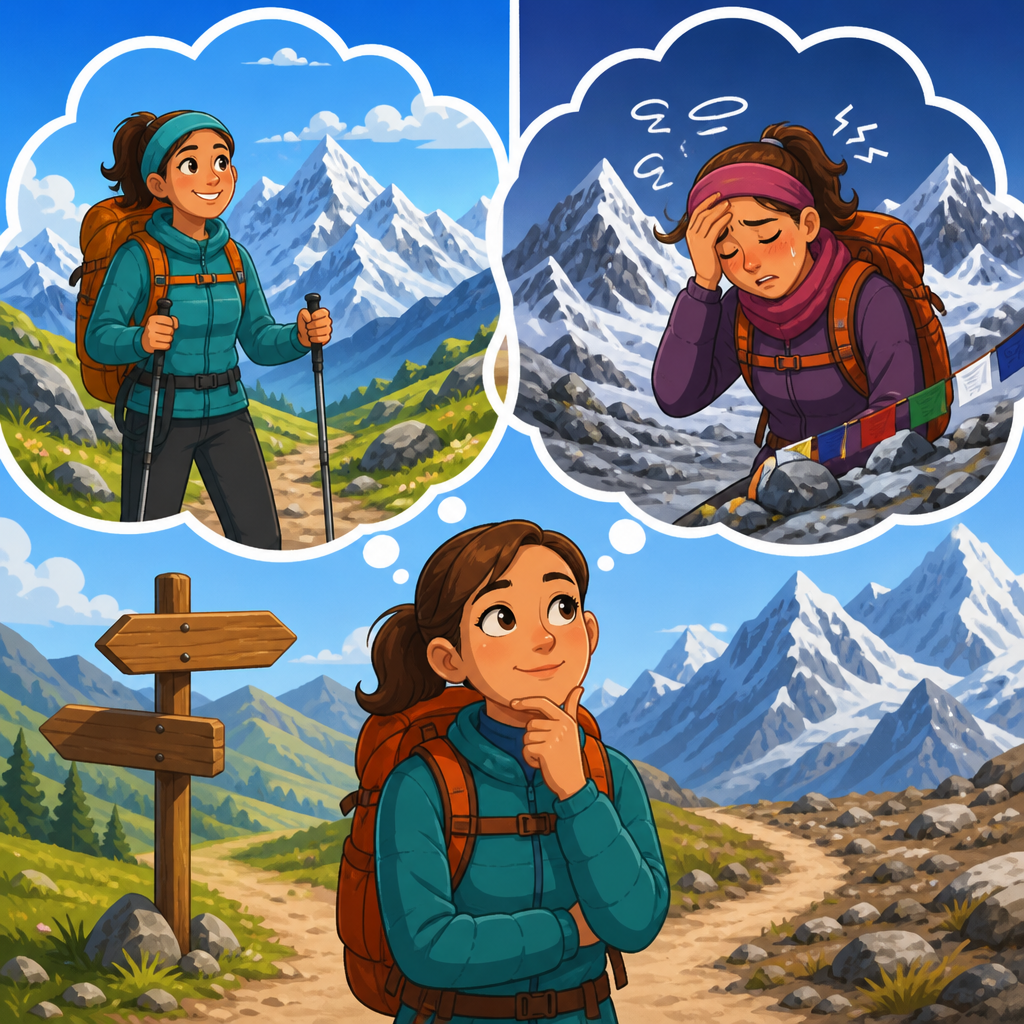
Many trekkers assume that strong legs, a stack of summit photos, or years spent in the mountains will protect them from altitude sickness, yet previous mountain experience is an unreliable predictor of acute mountain sickness on your next trip. Altitude sickness, often shortened to AMS, is the collection of symptoms caused by reduced oxygen availability at higher elevation, usually including headache, nausea, poor sleep, dizziness, fatigue, and loss of appetite. The question matters because people routinely use the wrong signals to judge risk. I have seen experienced hikers dismiss early symptoms on Kilimanjaro, Colorado fourteeners, and the Everest region because they had “always been fine before,” only to deteriorate after ascending too fast. Past exposure can help you understand how your body has responded before, but it does not create immunity. Risk is shaped more by sleeping altitude, ascent rate, recent acclimatization, individual susceptibility, exertion, illness, and itinerary design than by résumé value in the mountains.
To answer the core question directly: prior mountain experience can offer useful clues, but it does not reliably predict whether you will develop AMS on a future trip. Someone who tolerated 3,000 meters comfortably may still get sick at 3,800 meters if they fly in, sleep high on night one, and push hard while mildly dehydrated. Another traveler with little hiking background may do perfectly well if they ascend gradually and allow proper acclimatization. The physiology is straightforward. As barometric pressure falls with elevation, the partial pressure of oxygen drops, reducing oxygen transfer into the bloodstream. Your body responds by increasing ventilation, changing acid-base balance, producing more urine, and, over time, making deeper adaptations. Those responses vary between individuals and between trips in the same individual. That is why any solid altitude illness strategy starts with current trip factors, not confidence drawn from old adventures.
What AMS is and why prior experience only tells part of the story
AMS is the mildest form of altitude illness, but it is the gateway problem that travelers must recognize early. It typically appears six to twelve hours after gaining altitude and is diagnosed clinically: a new headache after ascent plus one or more accompanying symptoms such as gastrointestinal upset, unusual fatigue, lightheadedness, or disturbed sleep. The Lake Louise Scoring System remains the best-known standardized framework for symptom assessment in trekking and expedition settings. In practice, I use it as a structure, not a substitute for judgment. If a client develops a new headache at altitude and says food suddenly seems revolting, I treat that as meaningful even before a formal score is calculated. The key point is that AMS reflects how the body is handling current oxygen stress, not how many peaks a person has previously climbed.
Mountain experience can still be valuable, just in narrower ways than people expect. It teaches pace control, layering, hydration habits, nutrition discipline, and symptom awareness. Experienced trekkers are often better at noticing that a mild headache after dinner at 3,500 meters is different from ordinary fatigue. They may also be more willing to stop ascending. However, those advantages are behavioral, not biological protection. Prior success at altitude can even become a liability when it fuels overconfidence. A skier who felt fine during a weekend at 2,700 meters may book a fast itinerary in Peru or Nepal and assume the result will be the same at higher sleeping altitudes. That assumption ignores the dose-response nature of altitude exposure. Higher, faster, and longer changes the equation. Experience helps when it improves decision-making; it does not cancel the underlying physiology.
The strongest predictors of altitude sickness on your next trip
The most important risk factor for AMS is how quickly you ascend, especially how fast you increase sleeping altitude. Clinical guidelines from the Wilderness Medical Society consistently emphasize gradual ascent as the primary prevention strategy. Once above roughly 2,500 meters, risk rises substantially, and large jumps in sleeping elevation are the classic setup for trouble. From a field standpoint, the pattern is obvious. People who fly to Cusco, La Paz, or Lhasa and immediately add vigorous activity are far more likely to feel unwell than travelers who build in acclimatization days. Sleeping altitude matters more than daytime high points because the body must adapt over repeated hours at a given elevation. “Climb high, sleep low” works because exposure during the day can stimulate adaptation while reducing overnight stress.
Individual susceptibility is the second major factor. Some people are simply more prone to AMS, and prior episodes are meaningful. If you have developed AMS before under similar circumstances, that history predicts increased future risk better than general mountain experience does. Even so, susceptibility is not absolute. I have seen the same person remain symptom-free on one trip and struggle on another because the itinerary, recent sea-level living, sleep quality, and effort level changed. Research has not identified a simple screening test that reliably determines who will get AMS. Fitness is not protective. This surprises many athletes, but cardiorespiratory conditioning does not alter the drop in oxygen pressure. Fit travelers can ascend faster because they feel stronger, which may actually increase risk if restraint disappears.
| Risk factor | Why it matters | Real-world example |
|---|---|---|
| Rapid ascent | Reduces time for ventilatory and renal adaptation | Flying to 3,400 meters and hiking the same day |
| High sleeping altitude | Creates prolonged overnight oxygen stress | Sleeping at 4,000 meters on night two |
| Prior AMS history | Suggests higher personal susceptibility | Same traveler gets headaches every fast trip above 3,000 meters |
| Recent lack of altitude exposure | Acclimatization fades after days to weeks at low elevation | Living at sea level for months before a trek |
| Heavy exertion early | Can worsen symptoms and mask early warning signs | Hard summit push within twenty-four hours of arrival |
| Respiratory illness or poor sleep | Compromises adaptation and symptom interpretation | Starting a trip with a cold and fragmented sleep |
How acclimatization works and why it fades between trips
Acclimatization is a set of short-term adjustments that improve function in low-oxygen environments. The first response is increased breathing, driven by hypoxic ventilatory stimulation. That helps bring in more oxygen but also blows off carbon dioxide, which shifts blood chemistry toward alkalosis. The kidneys then compensate by excreting bicarbonate, allowing ventilation to remain elevated more comfortably over the next days. Heart rate often increases early, and fluid balance changes as altitude diuresis develops. Over longer periods, the body increases red blood cell production through erythropoietin signaling, though that process is slower and not the first defense against AMS. These mechanisms are why rest days and conservative sleeping schedules work. You are buying time for physiology to catch up.
Previous mountain experience does not persist as a permanent shield because acclimatization decays after you return to lower elevation. The exact timeline varies, but meaningful short-term adaptations diminish over days to weeks, and longer hematologic changes regress over time. That is why someone who spent a month guiding in the Alps last season is not automatically protected on a new Andean trek months later. What may persist is knowledge: they know how they tend to sleep at 3,500 meters, whether their appetite disappears early, and whether acetazolamide helped in the past. That information is useful. It is just different from being physiologically acclimatized. When planning risk, the better question is not “Have I been in the mountains before?” but “What altitude have I slept at recently, and how quickly am I going up now?”
Common myths about fitness, toughness, age, and mountain background
The most persistent myth is that fitness prevents AMS. It does not. Elite runners, cyclists, and military personnel get altitude sickness regularly when they ascend too fast. High fitness can improve workload tolerance, but the inspired oxygen at 4,000 meters is still lower for everyone. Another myth is that mountain toughness or mental grit can push you through early AMS safely. Symptoms are not weakness; they are data. I have had to turn around determined clients who wanted to “walk it off,” and the ones who listened usually recovered quickly after rest or descent. The ones who ignored symptoms often worsened overnight. Willpower does not improve oxygen pressure, and denial is one of the classic accelerants of preventable altitude illness.
Age and sex are less predictive than itinerary, though the evidence is mixed on small differences in some populations. Younger trekkers sometimes take more risks simply because they move faster and accept tighter schedules. Older travelers may ascend more conservatively and appear to do better for behavioral reasons. Growing up or living at moderate elevation can help initially, but it is not absolute protection, especially when travel involves substantially higher sleeping altitudes. Even guides and mountaineers are not exempt. On major trekking routes, I have watched seasoned climbers develop mild to moderate AMS when work demands, poor sleep, or repeated fast repositioning eroded the margin they usually maintain. Mountain background improves judgment when used well. It becomes dangerous when it is mistaken for immunity.
How to use your previous altitude history the right way
Your own altitude history is useful when it is specific. The best predictor from past experience is how you responded at a similar sleeping altitude, with a similar ascent profile, after a similar period away from altitude. If you slept at 3,500 meters for two nights last year without symptoms, that is mildly reassuring for a trip with the same pattern. If the new itinerary jumps to 4,200 meters on night one, the old trip tells you very little. Keep records. I recommend noting arrival altitude, sleeping altitude each night, symptoms, medications used, fluid intake, exertion level, and whether rest or descent improved things. A simple note on your phone can become valuable planning data. Over several trips, patterns often emerge that are more actionable than general confidence.
That history should guide prevention, not bravado. If you have had AMS before, plan extra acclimatization days and discuss prophylaxis with a qualified clinician, especially for remote or fixed itineraries. Acetazolamide is the standard preventive medication for many travelers at increased risk because it accelerates acclimatization by promoting bicarbonate excretion and supporting ventilation. Dexamethasone has a narrower role, mostly for treatment or selected prevention scenarios, and it does not replace acclimatization. Ibuprofen may help symptoms but is not a substitute for descent when illness progresses. Pulse oximeters can add context, but they should not override symptoms because oxygen saturation varies widely at altitude and does not diagnose AMS by itself. The right lesson from previous trips is practical humility: know your pattern, respect uncertainty, and build margin into the plan.
Prevention and red flags every traveler should know
The most effective prevention strategy is gradual ascent. Above 2,500 to 3,000 meters, many experts advise limiting sleeping altitude gains to roughly 300 to 500 meters per night when feasible and adding a rest day every three to four days or after larger gains. Real itineraries are not always ideal, so use every available lever: sleep lower when possible, avoid maximal exertion on arrival days, eat regularly even if appetite dips, and stay adequately hydrated without forcing excessive water. Alcohol and sedatives can complicate sleep and symptom recognition early in acclimatization. If risk is high because the route is fixed, prophylactic acetazolamide often makes sense when started before ascent, assuming no contraindication. Good planning prevents more altitude problems than heroics ever do.
Travelers also need a clear escalation rule. Mild AMS can improve with rest, halting ascent, fluids, light food, and medication, but worsening symptoms demand descent. Severe fatigue, persistent vomiting, shortness of breath at rest, inability to walk a straight line, confusion, or a dramatic decline in function are danger signs. These raise concern for high-altitude cerebral edema or high-altitude pulmonary edema, both medical emergencies. In those situations, descent is treatment, not defeat. Supplemental oxygen, a portable hyperbaric chamber, nifedipine for suspected pulmonary edema, or dexamethasone for suspected cerebral edema may be used by trained teams, but none should delay getting lower. Previous mountain experience is helpful only if it teaches this rule: if symptoms worsen with ascent, the mountain is telling you to change the plan. Build a smarter itinerary, watch your sleeping altitude, and use your past trips as data instead of false reassurance.
Frequently Asked Questions
Does previous mountain experience mean I am less likely to get altitude sickness on my next trip?
Not necessarily. Previous mountain experience is a poor predictor of whether you will develop acute mountain sickness, or AMS, on a future trip. Many people assume that because they have hiked big peaks, completed treks at elevation, or spent years in the mountains, their bodies will automatically handle altitude well every time. In reality, altitude response can vary from trip to trip, even in the same person. A successful high-altitude trip in the past does not guarantee the same outcome on your next ascent.
The main reason is that AMS is influenced by several immediate factors, not just your mountain résumé. Your rate of ascent, sleeping elevation, how much time you allow for acclimatization, your recent health, hydration, exertion level, and even how well you slept can all affect how your body responds. Someone who felt fine at altitude last year may develop symptoms this year if they ascend faster, start the trip already fatigued, or sleep much higher on the first few nights. Experience may help you make smarter decisions, but it does not make you immune.
Why can the same person feel fine on one high-altitude trip and sick on another?
Altitude sickness is highly situational. Your body’s ability to adapt to reduced oxygen availability depends not only on who you are, but also on how the trip unfolds. Two journeys to similar elevations can produce very different outcomes if one includes a gradual ascent and rest days while the other involves rapid gain in sleeping altitude. That is why people are often surprised when a destination they handled before suddenly feels much harder.
Other variables can also change the picture. A respiratory infection, dehydration, lack of calories, alcohol use, poor sleep, overexertion on the first days, and environmental stress such as cold or heat can all reduce your margin for adaptation. Even travel logistics matter. Flying directly to a high city and then beginning a trek immediately is very different from arriving lower and ascending over several days. In short, altitude tolerance is not a permanent badge you earn; it is a dynamic response that depends on the specific conditions of each trip.
If fitness and trekking experience do not reliably prevent AMS, what factors matter most?
The strongest practical predictors are related to altitude exposure itself. The most important factor is how quickly you ascend, especially how rapidly your sleeping elevation increases. Your body needs time to acclimatize to lower oxygen levels, and when that process is rushed, the risk of AMS rises. This is why cautious itineraries often recommend gradual gains and periodic rest or acclimatization days, particularly after reaching moderate to high elevations.
A personal history of altitude illness can be more useful than general mountain experience, but even that is not absolute. If you have previously developed AMS at a certain height or after a certain ascent profile, you may be at increased risk under similar conditions. However, good acclimatization planning can still reduce that risk. It is also important to understand what matters less than people think: being young, strong, and aerobically fit does not protect you. In fact, very fit trekkers sometimes get into trouble because they move too fast, feel confident enough to ignore early symptoms, or push harder than the itinerary safely allows.
What are the early signs of acute mountain sickness, and when should I take them seriously?
The classic early signs of AMS include headache, nausea, loss of appetite, fatigue, dizziness, and poor sleep after gaining altitude. Headache is especially important, because AMS is usually defined by headache plus one or more additional symptoms after ascent. These symptoms are often dismissed as dehydration, travel fatigue, or a “normal” part of trekking, but that can be a mistake. At altitude, mild symptoms deserve attention because they may be the first sign that your body is not acclimatizing well.
You should take symptoms seriously if they appear after going higher, especially if they worsen with continued ascent. The safest response is to stop climbing until symptoms improve. Rest, fluids, light activity only, and close monitoring may be enough for mild cases. But if symptoms become more severe, such as persistent vomiting, increasing weakness, confusion, trouble walking straight, or shortness of breath at rest, that may signal a more dangerous altitude problem and should be treated as urgent. A key rule is simple: never ascend with worsening altitude symptoms, and descend if symptoms are significant or not improving.
How can I reduce my risk of altitude sickness on my next trip if experience alone is not enough?
The best protection is a conservative acclimatization plan. Build your itinerary so that your sleeping altitude rises gradually, and include rest days when you reach higher zones. If possible, avoid rushing from sea level to a very high trailhead and then immediately sleeping much higher the same day. Give your body time to adapt before pushing for bigger elevation gains. This strategy is far more reliable than relying on past success, fitness, or confidence.
It also helps to pace yourself, eat regularly, stay reasonably hydrated, and avoid overexertion in the first days at elevation. Learn the symptoms of AMS before your trip so you can recognize them early rather than rationalize them away. If you have had altitude problems before, discuss your plans with a qualified medical professional in advance; in some situations, preventive medication may be considered. Most importantly, make decisions based on how you feel now, not on what you accomplished on previous mountains. A cautious, flexible approach is the smartest way to reduce risk and enjoy the trip safely.