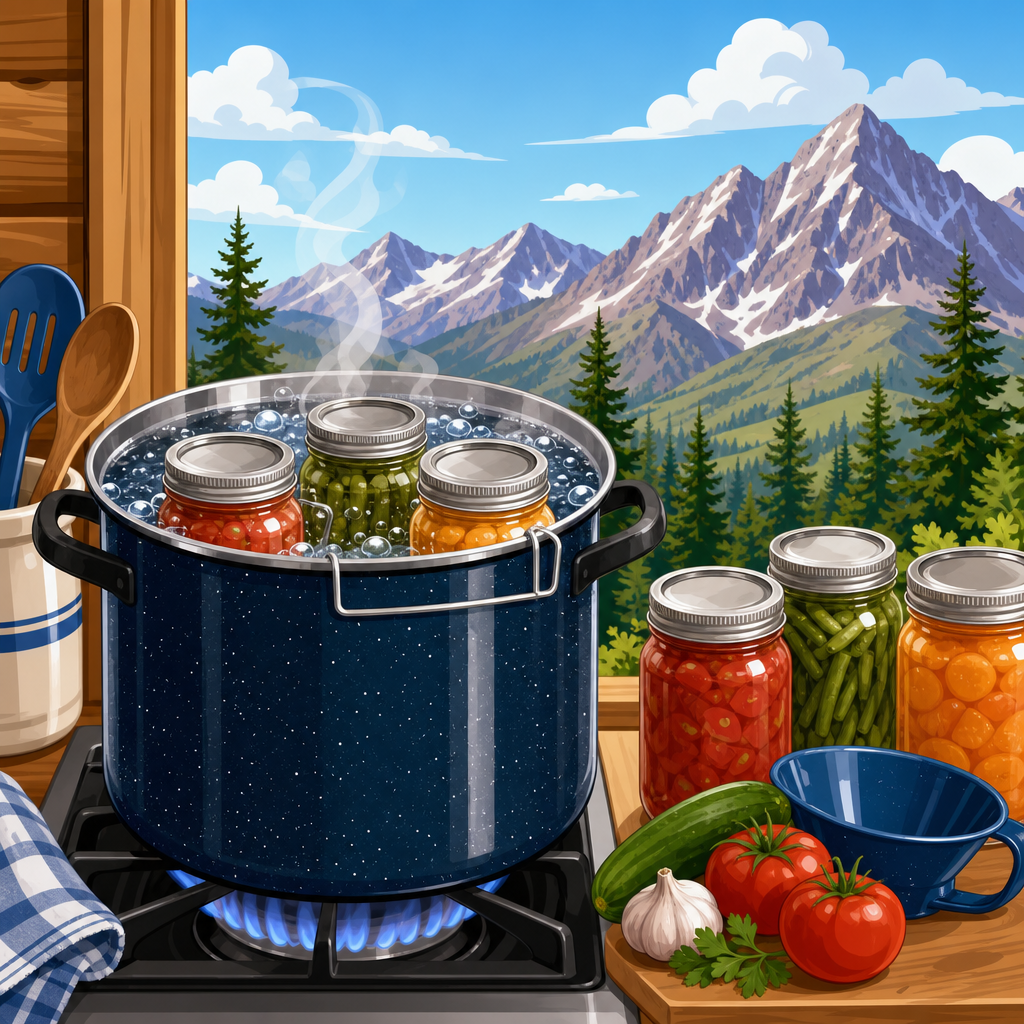
Boiling-water canning at altitude requires one central adjustment: as elevation increases and water boils at a lower temperature, jars must stay in the canner longer to achieve the same level of heat treatment that they would receive at sea level. For anyone preserving jam, jelly, fruit spreads, pickles, chutney, salsa, fruit in syrup, or tomato products, that single fact shapes food safety, texture, shelf life, and recipe success. In practical terms, altitude canning means following tested boiling-water canning recipes and increasing processing time according to established guidance rather than improvising with larger jars, tighter lids, or a harder boil.
In home food preservation, boiling-water canning is the method used for high-acid foods, generally foods with a pH of 4.6 or lower. High acidity prevents the growth of Clostridium botulinum, which is why boiling-water canning is appropriate for many preserves and acidified foods, while low-acid vegetables, meats, and mixed meals require pressure canning instead. At altitude, the challenge is not weaker heat in a casual sense; it is lower thermal lethality at the boil. Because water may boil well below 212°F as elevation rises, the food inside the jar heats less aggressively, and the tested process must be extended to compensate.
I have worked with canners in mountain regions where recipes that behaved perfectly at sea level produced runny jam, siphoning jars, and uncertain seals when the altitude adjustment was ignored. The fix was not mysterious. We verified the local elevation, matched the product to a tested recipe from the USDA Complete Guide to Home Canning or the National Center for Home Food Preservation, adjusted the processing time, and improved cooling practices. Once those basics were in place, results became predictable. That is why this topic matters so much inside candy, preserves, and canning: sweetness, acidity, and consistency affect quality, but process control determines safety.
This hub page explains how to adjust boiling-water canning time at altitude, which foods belong in a boiling-water canner, how altitude affects preserves and candy making, and where home preservers most often go wrong. It also points you toward the broader skills that matter in this category, from choosing pectin styles to understanding gel set, soluble solids, headspace, venting, and storage. If you preserve food above sea level, mastering these principles lets you keep flavor and texture high without compromising safety.
Why altitude changes boiling-water canning
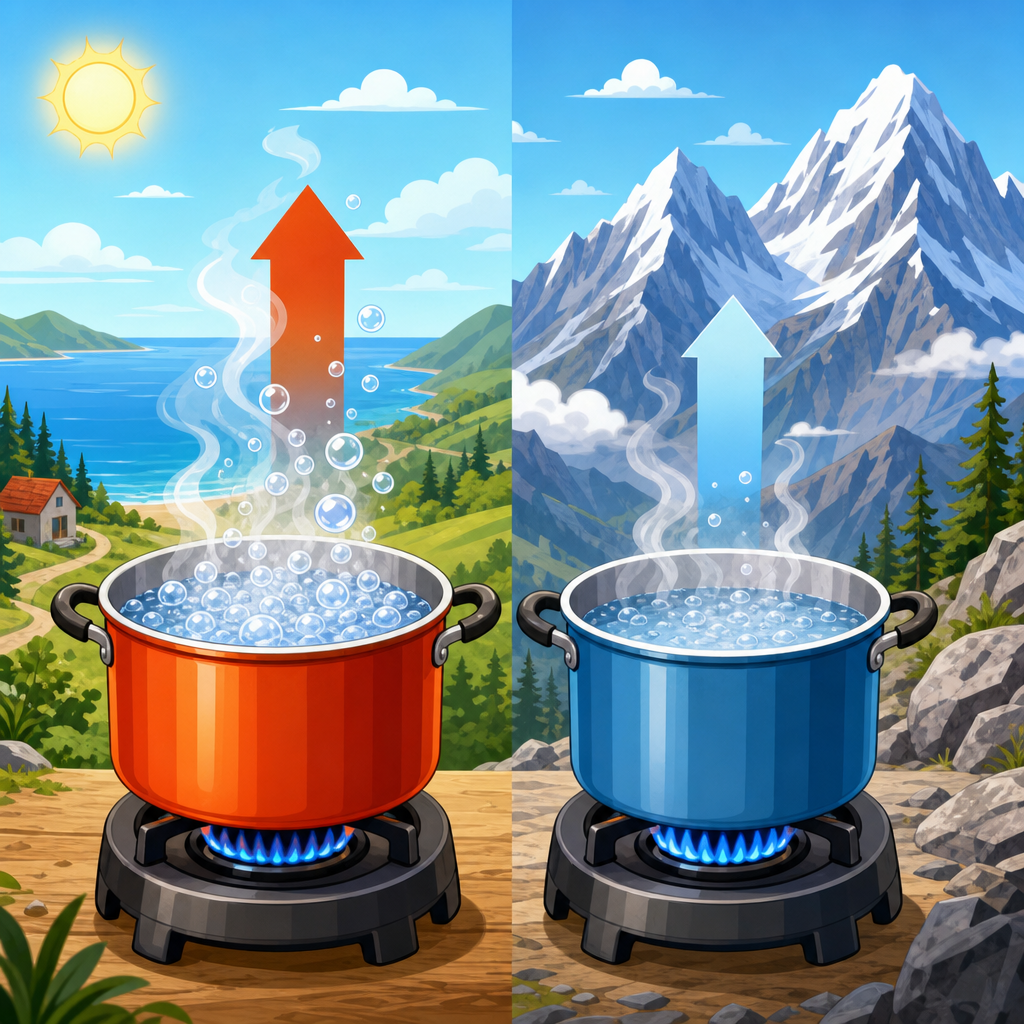
Altitude affects canning because atmospheric pressure drops as elevation rises. With less pressure pushing down on the surface of the water, water boils at a lower temperature. That lower temperature matters because boiling-water canning relies on a predictable heat exposure over a tested period. If the temperature of the boiling water is lower, the heating effect inside the jar is reduced, and the processing time has to increase to deliver an equivalent margin of safety.
For high-acid foods, the goal of processing is to destroy spoilage organisms, inactivate enzymes, drive air from the jar, and create a strong vacuum seal during cooling. At higher elevations, all of those outcomes are influenced by the lower boiling point. Jars may also vent more aggressively, and products with suspended fruit or dense pulp may heat more slowly than people expect. A hard, rolling boil is still required, but intensity of bubbling does not cancel out the lower boiling temperature caused by altitude.
One of the most common questions is simple: do you change ingredients or just processing time? For boiling-water canning, the answer is usually processing time. Tested recipes are developed around a specific formulation, jar size, and canning method. If you alter sugar, acid, starch, or solids substantially, the process may no longer be valid. At altitude, your first adjustment should be the USDA or extension-recommended time increase, not a homemade tweak.
How to adjust processing time at different elevations
The standard guidance for most boiling-water canning recipes is straightforward. If a tested recipe gives a sea-level processing time, increase that time based on your elevation range. Always start timing when the canner has returned to a full rolling boil after you place the filled jars inside. If the boil stops at any point during processing, bring the water back to a full boil and restart the timing from the beginning. Partial timing is not considered safe.
| Altitude | Boiling-water canning time adjustment |
|---|---|
| 0 to 1,000 feet | No change |
| 1,001 to 3,000 feet | Add 5 minutes |
| 3,001 to 6,000 feet | Add 10 minutes |
| Above 6,000 feet | Add 15 minutes |
Those adjustments appear in extension guidance because they are easy to apply and work across many high-acid products, but you should still read the exact recipe notes. Some tested formulas already include altitude directions, and tomato products often have additional acidification requirements using bottled lemon juice or citric acid. If a recipe from Ball, the USDA, or a university extension specifies its own altitude chart, follow that source exactly rather than combining charts from different recipes.
To find your altitude, use a topographic map, a GPS device, a smartphone weather app, or your county extension office. Do not guess. I have seen households estimate they were around 2,000 feet when they were actually above 4,000, which changed the needed adjustment by five minutes. That sounds small, but process schedules are built on tested margins. Precision matters more in canning than in most everyday cooking.
Which foods belong in a boiling-water canner
Boiling-water canning is intended for foods that are naturally high in acid or made high in acid through a tested recipe. In the candy, preserves, and canning category, that includes jams, jellies, marmalades, fruit butters, many fruit sauces, properly acidified pickles, relishes, chutneys, and some salsas and tomato products. Whole fruits packed in water, juice, or syrup are also commonly processed in a boiling-water canner when the recipe is tested for that method.
Not every sweet preserve belongs there automatically. Pumpkin butter is a classic example of a product that should not be canned at home because its density makes heat penetration unreliable. Some old family recipes for zucchini jam, pepper jelly, or low-sugar fruit spread are safe only if they follow a tested formula that controls acidity and consistency. Sugar itself is not the safety boundary people often assume; acidity and product density matter more.
Tomatoes deserve special attention in an altitude canning hub because their acidity varies. Modern varieties, ripeness, and growing conditions can all shift pH, which is why tested tomato recipes typically require added acid even when processed in boiling water. If you are canning salsa, the ratio of tomatoes to onions and peppers matters. If you are canning crushed tomatoes, the bottled lemon juice dose matters. This is not the place for freehand recipe development.
Preserves, pectin, and texture at elevation
Altitude does not only affect processing time. It also changes how preserves cook in the pan. Water evaporates faster, boiling is more vigorous relative to the lower temperature, and the endpoint for a good gel can become harder to judge if you rely only on visual cues. In mountain kitchens I have often shortened the pre-canning cook slightly and depended more on temperature checks, plate tests, and soluble solids targets than on appearance alone.
Traditional high-methoxyl pectin sets best with the right balance of sugar, acid, and concentration. Low-methoxyl pectin depends more on calcium. Liquid and powdered pectins are not always interchangeable, and at altitude the difference becomes more noticeable because overcooking can degrade pectin and darken flavor quickly. If your jam is consistently stiff, sticky, or dull-tasting, the issue may be overconcentration before the jars even enter the canner. If it is runny, the problem may be undercooking, incorrect sugar ratio, old pectin, or a premature doneness judgment.
For jelly making, a thermometer can help, but you should interpret it carefully because gel-point temperature shifts with atmospheric pressure. Many preservers were taught that gel stage appears around 220°F, but at altitude that benchmark is lower. A practical rule is to target about 8°F above your local boiling point rather than blindly chasing the sea-level number. A refractometer is even better for repeatability when you make preserves frequently, because soluble solids are not distorted by altitude the way a fixed temperature target is.
Common canning mistakes at altitude
The most frequent mistake is using an untested recipe from a blog, social feed, or inherited note card and then trying to make it safe by adding extra processing time. Time cannot rescue an unsafe formulation. If the acidity is uncertain, if the product is too thick, or if the jar size is larger than the tested version, more minutes in boiling water do not solve the problem. Start with a tested recipe first, then apply the altitude adjustment that belongs to that exact process.
The second mistake is poor fill and handling practice. Headspace that is too small can cause siphoning; too much headspace can weaken the seal or increase discoloration. Air bubbles trapped in thick preserves can affect fill level. Rings tightened too hard can prevent proper venting during processing, while a water level that drops below one to two inches above the jar tops can interrupt heat transfer. These are basic canning mechanics, but at altitude the system is less forgiving.
A third mistake is cooling jars too quickly. People often remove jars and place them in a draft, in front of an open window, or on a cold stone counter. Rapid temperature change can contribute to liquid loss and seal problems. Let jars rest upright on a towel or rack, undisturbed, for 12 to 24 hours. Then remove rings, check seals, wash residue from the jars, label them, and store them in a cool, dark place. If a jar failed to seal, refrigerate it for immediate use or reprocess within the recommended window using fresh lids and a full process time.
Equipment, workflow, and recipe standards
A safe altitude canning setup does not need to be elaborate, but it must be consistent. Use a deep boiling-water canner with a rack, jars in the size specified by the recipe, new two-piece lids if your product uses them, a jar lifter, bubble remover, headspace tool, and a timer you trust. For preserves, I also recommend an accurate digital scale, a wide preserving pan, an instant-read thermometer, and if you make jam regularly, a refractometer for checking soluble solids. Good tools reduce guesswork.
The most reliable standards come from the USDA Complete Guide to Home Canning, the National Center for Home Food Preservation, Ball canning publications, and university extension services. Those sources explain not just what to do, but why. They distinguish between boiling-water canning and pressure canning, specify acidification rules for tomatoes, define safe jar sizes, and warn against practices such as open-kettle canning, oven canning, and sealing jars by inversion. In my experience, preservers who anchor their workflow to these standards get safer products and fewer disappointing batches.
As the hub for candy, preserves, and canning within cooking and baking at altitude, this page connects the core rules. Use tested formulas for fruit spreads, pickles, chutneys, and tomato products. Adjust boiling-water processing time by elevation. Understand that candy stages, gel points, and evaporation behave differently at altitude. And separate quality questions from safety questions: texture can often be fixed next time, but safety depends on method now. Build your process on tested guidance, keep careful notes on elevation and batch results, and use that record to improve each season.
Boiling-water canning at altitude is manageable once you understand the mechanism behind the adjustment. Water boils at a lower temperature as elevation rises, so jars need longer processing to receive the same effective heat treatment as they would at lower elevations. That rule applies across the high-acid foods that define much of home preserving: jams, jellies, marmalades, fruit butters, pickles, relishes, chutneys, acidified salsas, fruits, and many tomato products. The method remains dependable at elevation when you pair tested recipes with accurate altitude-based timing.
The biggest takeaway is that safe canning is a systems practice, not a single trick. Correct acidity determines whether boiling-water canning is appropriate. Correct jar size, headspace, and handling support proper heat transfer and sealing. Correct processing time accounts for your elevation. And correct preserve-making technique protects the flavor, color, and set of the product inside the jar. When any one of those pieces is ignored, the result can be disappointing quality at best and unsafe food at worst.
If you use this page as your starting point for candy, preserves, and canning at altitude, keep your next steps simple. Confirm your elevation, choose one tested recipe from a trusted preservation source, apply the exact processing-time adjustment, and record the outcome. Then build from there into pectin selection, gel testing, acidification, and seasonal workflow. A disciplined approach will give you preserves that are safer, taste brighter, and hold up better on the shelf year after year.
Frequently Asked Questions
Why does boiling-water canning require longer processing times at higher altitudes?
At higher elevations, air pressure is lower, and that changes the temperature at which water boils. While water boils at 212°F (100°C) at sea level, it boils at a lower temperature as altitude increases. In a boiling-water canner, that matters because the jars are heated by the boiling water around them. If the water temperature is lower, the food inside the jars also receives less heat per minute than it would at sea level. The fix is not to boil harder, but to process the jars longer so the total heat treatment matches what a tested recipe intends.
This adjustment is especially important for high-acid foods typically processed in a boiling-water bath, such as jam, jelly, fruit preserves, pickles, chutney, salsa, fruit in syrup, and many tomato products. These foods rely on a combination of acidity, proper jar preparation, and a full tested processing time to control spoilage organisms and create a safe vacuum seal. If altitude adjustments are ignored, the product may be underprocessed, which can affect safety, storage stability, texture, color, and overall quality. In short, longer processing at altitude compensates for the lower boiling temperature and helps ensure the jars receive the heat exposure the recipe was designed around.
How do I adjust processing time for boiling-water canning at altitude?
The correct adjustment is to increase the processing time according to a tested altitude chart for boiling-water canning. For most standard home canning guidance, you begin with the recipe's listed processing time at sea level and add extra minutes based on your elevation range. A commonly used approach is to add 5 minutes at 1,001 to 3,000 feet, 10 minutes at 3,001 to 6,000 feet, and 15 minutes above 6,000 feet. However, you should always use the exact directions provided by a trusted source such as the USDA, the National Center for Home Food Preservation, your extension service, or the recipe developer if the recipe is from a tested canning source.
The key point is that altitude adjustment for boiling-water canning is based on time, not temperature settings or guesswork. Start timing only when the water has returned to a full rolling boil after the jars are loaded. Maintain that full boil the entire time. If the boil stops or drops significantly, the processing time may need to be restarted according to the recipe guidance. Also, use your actual elevation rather than estimating casually. Even a difference of a thousand feet can change the recommended adjustment. If you are unsure of your altitude, check a topographic map, a GPS app, or your local extension office. Accurate elevation plus a tested time adjustment is what makes altitude canning reliable.
Which foods processed in a boiling-water canner are most affected by altitude adjustments?
Any food that is safely canned using a boiling-water canner is affected by altitude, because the lower boiling temperature applies to the canner itself, not to one particular ingredient. That includes jams, jellies, marmalades, fruit butters, fruit spreads, whole or sliced fruit in syrup or juice, pickles, relishes, chutneys, many acidified foods, and certain tomato products when the recipe includes the required added acid. Even if a food seems sugary, salty, or acidic enough to be shelf-stable, the processing step still matters for destroying yeasts, molds, and many spoilage organisms, as well as for driving air from the jar and creating a dependable seal.
Altitude can also affect product quality. Underprocessed jelly may still seal but develop mold or lose quality sooner than expected. Fruit may discolor, tomatoes may separate more noticeably, and pickles may not keep their intended texture or flavor balance over storage. Salsa and chutney deserve particular attention because they are mixed foods and should only be canned using tested recipes with exact proportions of acid, vegetables, and processing time. If a recipe is approved for boiling-water canning, altitude adjustments are part of using that recipe correctly. If a food is not approved for boiling-water canning in the first place, altitude adjustment does not make it safe; it simply means the wrong canning method is still wrong, just for a longer time.
Can I make other changes instead of increasing the processing time, such as using hotter water or tightening the lids more?
No. For boiling-water canning at altitude, the proper adjustment is to increase the processing time according to tested guidance. Using hotter water is not an option, because in an open boiling-water canner the water temperature is limited by the boiling point at your elevation. Once the water is boiling, it cannot get hotter without changing to a pressure canning environment. Boiling more vigorously does not raise the temperature beyond that boiling point; it only makes the water move more forcefully. Likewise, tightening lids extra hard, overfilling the canner, or using thicker towels over the lid will not compensate for altitude and may create other problems.
It is also important not to invent your own shortcuts. Do not reduce headspace to "help the seal," do not skip preheating steps if the recipe calls for them, and do not assume that a longer cooling period on the counter replaces proper processing. A jar sealing is not proof of safe processing. Seals can form even when jars are underprocessed. The safe approach is simple but strict: use a tested recipe, prepare the food exactly as directed, adjust the processing time for your altitude, begin timing at a full rolling boil, and maintain that boil for the entire process. If you are canning low-acid foods, altitude adjustments work differently because those foods must be pressure canned, not water-bath canned.
What are the most common mistakes people make when boiling-water canning at altitude?
One of the biggest mistakes is not realizing that altitude applies far below mountain elevations. Many home canners assume altitude adjustments only matter in very high regions, but recommendations often begin above 1,000 feet. Another common error is using an untested online recipe that gives a single processing time with no altitude guidance. That can lead to underprocessing, especially for foods like salsa, tomatoes, or pickled vegetables, where acidity and density must be carefully controlled. People also frequently start timing too early, before the canner has returned to a full rolling boil after the jars are loaded, which shortens the real heat treatment.
Other mistakes include allowing the boil to fluctuate, failing to keep jars covered by the recommended depth of water, guessing at elevation, and assuming that a sealed lid means everything went right. Some canners also change ingredients in ways that affect safety, such as reducing vinegar in pickles, adding extra low-acid vegetables to salsa, or thickening fruit products beyond what the tested recipe specifies. At altitude, those deviations become even more risky because the heat treatment already needs careful adjustment. The best prevention is a disciplined routine: verify your elevation, use a current tested recipe, read the altitude chart before you start, prepare jars and food exactly as directed, and watch the canner closely throughout processing. Those habits protect both food safety and the finished quality of your preserves.