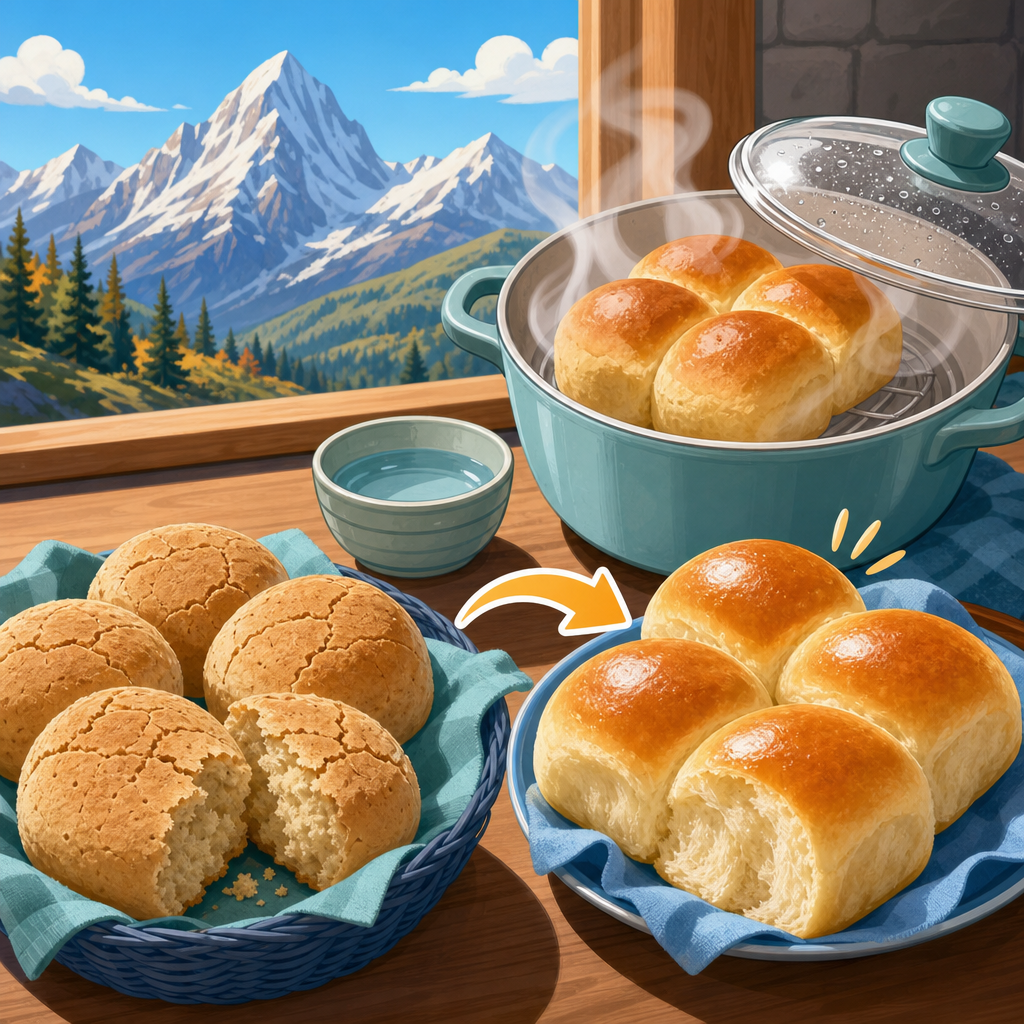
Dry dinner rolls at altitude usually come from one predictable chain of events: dough loses moisture faster, rises too quickly, and bakes before the crumb has time to stay tender. In mountain kitchens, that combination is common enough that many experienced bakers assume the recipe is wrong, when the bigger issue is how reduced air pressure changes yeast activity, evaporation, gluten behavior, and baking time. If you want soft, pull-apart dinner rolls at 3,000, 5,000, or 8,000 feet, you need to adjust process as much as ingredients.
Altitude baking matters because water boils at lower temperatures as elevation increases, which speeds evaporation and concentrates dough earlier in the bake. Yeast also expands gases more easily in lower air pressure, so dough can overproof before structure is ready. In practical terms, a roll recipe that works perfectly at sea level may produce dry, crumbly, over-risen rolls in Denver, Santa Fe, or mountain towns above 7,000 feet. I have tested enriched doughs, lean doughs, and sourdough dinner rolls across several elevations, and the same pattern repeats: dryness is rarely solved by adding random extra liquid at the last minute. It is solved by controlling hydration, proofing, flour strength, and baking finish.
This hub page explains how to fix dry dinner rolls at altitude while also serving as a guide to yeast breads and sourdough in high-elevation kitchens. You will learn the causes of dryness, the ingredient adjustments that matter most, how to handle commercial yeast and sourdough differently, and which methods consistently produce a soft crumb and thin crust. If you bake sandwich loaves, buns, cinnamon rolls, or country sourdough, the same principles apply. Dinner rolls are simply the most obvious place to see the problem, because small dough pieces dry out fast and overbake in minutes.
Why dinner rolls dry out faster at altitude
The main reason dinner rolls dry out at altitude is accelerated moisture loss. Lower atmospheric pressure means water evaporates more readily both during proofing and in the oven. Because rolls have a high surface-area-to-volume ratio, they shed moisture faster than a large loaf. That is why a dough that feels only slightly firm before shaping can bake into a noticeably dry roll after twelve to fifteen minutes. Add in a hot, dry climate common to many high-altitude regions, and exposed dough surfaces skin over quickly unless covered well.
Overproofing is the second major cause. At altitude, yeast fermentation often moves faster, and gas cells expand more easily. Bakers may see dough double early and assume it is ready, but a visually large dough is not always a properly developed dough. If rolls overproof, the gluten network stretches thin, then collapses or bakes into a coarse crumb. The result can feel paradoxical: the rolls look big but eat dry. In my batches above 5,000 feet, this happens most often on the second rise, especially when shaped rolls sit too long in a warm kitchen.
Flour choice also matters. Many home bakers use all-purpose flour for soft rolls, but at altitude a slightly higher-protein flour often gives better structure and moisture retention, particularly in recipes with milk, butter, eggs, or mashed potato. Weak dough spreads, proofs too fast, and bakes off moisture before setting properly. Salt and sugar balance matter too. Too little salt allows fermentation to race; too much sugar in an already stressed dough can slow hydration and make timing less predictable.
Ingredient adjustments that consistently improve moisture
When fixing dry dinner rolls at altitude, start with measured changes rather than broad guesses. Increase liquid modestly, usually by 1 to 2 tablespoons per cup of flour in enriched doughs, then evaluate dough feel. At 5,000 feet and above, many bakers need the higher end of that range, but not always on humid days. The correct dough should feel soft, slightly tacky, and elastic after kneading, not dry, stiff, or heavily floured. If you knead in too much bench flour, you often erase the hydration adjustment you just made.
Fat helps, but only to a point. Butter, oil, egg yolks, and milk all contribute tenderness, yet they cannot fully compensate for overbaking or overproofing. If your recipe is lean, consider enriching it slightly with milk instead of water, or replacing a small percentage of flour with potato flakes, mashed potato, or tangzhong-style cooked flour paste. Potato holds water well and keeps rolls soft the next day. Tangzhong, widely used in Asian milk breads, gelatinizes starches before mixing and can dramatically improve softness at altitude without making dough slack.
Use bread flour or a blend of bread and all-purpose flour when the dough repeatedly overexpands and dries out. Stronger flour supports oven spring without tearing. Also consider reducing yeast slightly, often by 10 to 25 percent compared with sea-level formulas. This single change slows fermentation enough to improve flavor and crumb. For sweet holiday rolls, I routinely reduce instant yeast first before changing sugar, because too-rapid rise is more often the real issue than sweetness itself.
| Problem | Likely altitude cause | Reliable fix |
|---|---|---|
| Dry, crumbly rolls | Fast evaporation and low hydration | Increase liquid slightly; cover dough well; avoid excess flour during shaping |
| Big but dry rolls | Overproofed dough with weak structure | Reduce yeast 10 to 25 percent; shorten final proof; use stronger flour |
| Tough crust, dry interior | Oven too hot for small rolls | Lower baking temperature by 15 to 25 degrees Fahrenheit and check earlier |
| Dense center, dry edges | Uneven shaping or underdeveloped gluten | Knead to moderate development; scale pieces evenly; bake in a tighter pan arrangement |
| Rolls stale by morning | Low moisture retention | Add potato, milk, or tangzhong; store airtight once cooled |
Mixing and kneading methods for soft high-altitude rolls
Good ingredient ratios will not save a poorly mixed dough. At altitude, I recommend holding back a small portion of flour at the start instead of adding all flour immediately. This lets you judge hydration more accurately after the liquid, eggs, butter, or starter have fully integrated. Dough often seems wetter after a short rest, so a five- to ten-minute autolyse or mixer pause can prevent over-flouring. That short rest is especially useful with whole wheat or high-extraction flour, which absorbs water more slowly.
Knead until the dough reaches moderate gluten development, then stop. Over-kneading in a stand mixer can warm enriched dough quickly, speeding fermentation and drying the final product. The target dough temperature for most enriched roll doughs is around 75 to 78 degrees Fahrenheit. Much warmer than that, and proofing accelerates before the dough has balanced strength and extensibility. If your kitchen is hot and dry, use cooler liquid or chill the flour briefly.
Shaping affects moisture too. Tight, even shaping creates smoother surfaces and better gas retention. Loose shaping produces irregular crust thickness and uneven baking, which often means dry outer sections before the centers are done. Weigh dough pieces so the tray bakes evenly. For pull-apart rolls, place pieces close together in a buttered or lined pan. Side-by-side baking protects the edges from drying and gives the soft, feathery sides associated with restaurant-style dinner rolls.
Proofing control: the fix most bakers miss
Most dry dinner roll problems at altitude are proofing problems wearing a hydration disguise. Final proof should be judged by feel, not by the clock. A properly proofed roll springs back slowly when lightly pressed and still has some elasticity. If the indentation stays deep or the dough feels fragile, it has gone too far. At high elevation, I often bake shaped rolls when they are about 75 to 85 percent expanded rather than waiting for a full visual doubling.
Humidity control matters during proofing. Dry mountain air can crust the dough surface, limiting expansion and creating tearing. Cover pans with lightly greased plastic wrap, a lidded proofing box, or a damp towel that does not touch the dough. A turned-off oven with the light on can work, but watch temperature carefully. Too warm, and the dough races. For many enriched doughs, 78 to 82 degrees Fahrenheit is enough. Sourdough rolls generally do better a bit cooler and slower, which supports flavor while preventing acid-driven weakening.
Retarding dough in the refrigerator is one of the most reliable high-altitude strategies. Cold fermentation slows yeast, improves flavor, and gives flour more time to hydrate. For dinner rolls, I often refrigerate after shaping or after the first rise, then finish proofing the next day. This is particularly effective for holiday schedules and for doughs with butter, eggs, or sourdough starter, all of which benefit from steadier timing. If your rolls repeatedly bake dry even after hydration adjustments, an overnight chill is worth testing.
Baking temperature, steam, and doneness
If your dinner rolls are dry at altitude, your oven may be finishing them too aggressively. Small breads bake fast, and many sea-level recipes call for temperatures that set crust before the interior has retained enough moisture. Lowering the oven by 15 to 25 degrees Fahrenheit often improves tenderness. For many enriched rolls, 350 to 375 degrees Fahrenheit is a better high-altitude range than 400. Dark pans brown faster and can worsen dryness, so lighter metal or aluminized steel is usually easier to manage.
Steam can help early oven expansion, but dinner rolls do not need the heavy steam used for artisan boules. Brushing rolls with milk, cream, egg wash, or melted butter changes crust behavior more than adding a pan of water. For the softest finish, brush with melted butter immediately after baking; this reduces surface drying as the rolls cool. Bake only until the tops are lightly golden and the internal temperature reaches roughly 190 degrees Fahrenheit for enriched dough, sometimes a touch lower for very small rolls. Pulling them at 205, common for lean hearth bread, is usually too far for tender dinner rolls.
Cooling is part of the fix. Leaving rolls uncovered in a dry kitchen for an hour can undo careful baking. Let them cool just enough to set, then cover loosely with a clean towel or place in a container once no longer steaming heavily. If you are serving later, rewarm briefly rather than baking longer upfront. The extra oven time added “just to be safe” is one of the most common causes of dry holiday rolls.
How commercial yeast and sourdough differ at altitude
Commercial yeast doughs usually show altitude issues faster because fermentation is more linear and often quicker. If a standard roll recipe uses instant yeast, begin by reducing yeast slightly, increasing liquid modestly, and shortening proof times. Instant yeast is generally easier than active dry at altitude because it disperses evenly and starts predictably. Active dry can work well, but inconsistent blooming temperatures create another variable when conditions are already moving fast.
Sourdough adds complexity because starter strength, acidity, and flour choice influence dough structure as much as elevation does. Dry sourdough rolls at altitude often result from an underfed or overly acidic starter, long final proof, or hydration that looks adequate on paper but feels too tight in practice. Use a starter that reliably doubles or peaks within a known window, and avoid pushing bulk fermentation just because the dough seems slower in a cool room. Once sourdough passes optimum fermentation, acids weaken gluten and the baked crumb can feel dry even when hydration is high.
For hybrid rolls using both starter and commercial yeast, reduce the yeast more than you think. The starter contributes fermentation power and enzymatic activity even when added mainly for flavor. In my own high-altitude testing, hybrid potato rolls and milk rolls perform best when the starter is used for flavor and softness while instant yeast remains only a small insurance policy. That balance produces reliable rise without the blowout proofing that turns soft dough into dry rolls.
Building your high-altitude yeast bread and sourdough system
The best way to stop dry dinner rolls is to stop treating each batch as a mystery. Build a repeatable system for all high-altitude yeast breads and sourdough. Record elevation, flour brand, dough temperature, hydration, yeast percentage, starter condition, proof times, pan type, oven temperature, and final internal temperature. Small patterns become obvious quickly. King Arthur Baking, the USDA altitude reference points, and professional formulas based on baker’s percentages are useful standards because they let you compare recipes on structure instead of guesswork.
This dinner roll article sits at the center of a broader high-altitude bread approach. The same troubleshooting connects to sandwich loaves that split at the side, hamburger buns that wrinkle after cooling, cinnamon rolls that dry at the edges, and sourdough boules that overproof before scoring. Start with rolls because they expose errors quickly. Once you can produce soft, evenly proofed rolls with a tender crumb, scaling those lessons to pan bread, focaccia, brioche, or rustic sourdough becomes much easier.
The essential fixes are straightforward. Keep dough softer than you expect, but not weak. Use enough flour strength to support rise. Reduce yeast when fermentation runs ahead of structure. Proof by feel, not by volume alone. Bake a little gentler and pull earlier than you would for crusty artisan bread. Protect moisture during cooling and storage. If you apply those adjustments consistently, dry dinner rolls at altitude stop being a recurring frustration and become one of the clearest signs that your high-altitude yeast bread and sourdough process is finally dialed in. Test one batch this week, take notes, and let the next tray improve on purpose.
Frequently Asked Questions
Why do dinner rolls turn dry more easily at high altitude?
Dry dinner rolls at altitude usually happen because several small changes stack up at the same time. At higher elevations, lower air pressure allows dough to rise faster, which can push it past its ideal proof before the structure is ready. At the same time, moisture evaporates more quickly from both the dough and the oven environment, so the surface dries sooner and the interior can lose tenderness if the bake is not adjusted. That means the rolls may look puffy and finished on the outside, yet still end up with a crumb that feels drier, less plush, and more crumbly than it would at sea level.
Another factor is gluten behavior. When dough expands rapidly, the gluten network can stretch too fast and become less supportive. If the dough is also slightly underhydrated for your elevation, the finished rolls can bake up lighter in weight but not softer in texture. Many bakers assume the flour or yeast is the problem, but in mountain kitchens the more common issue is that the original recipe has not been adapted to slower moisture loss, controlled fermentation, and shorter or gentler baking. In other words, dry rolls are often the result of fast rise plus fast evaporation plus too much oven time, not simply a bad recipe.
How can I adjust a dinner roll recipe so the dough stays softer at altitude?
The most reliable fix is to increase hydration slightly and slow the fermentation down. In practical terms, start by adding a little more liquid than the original recipe calls for, usually 1 to 2 extra tablespoons at a time for a standard batch, and evaluate the dough by feel rather than by the printed quantity alone. The dough should feel soft, supple, and lightly tacky, not stiff or dry. If it feels tight during mixing, altitude often makes that dryness show up later as a less tender crumb.
It also helps to reduce the yeast modestly, because dough tends to rise faster at elevation. Using a bit less yeast gives the dough more controlled expansion, which improves texture and helps prevent overproofing. Many bakers also benefit from increasing fat or sugar very slightly, depending on the recipe. Fat supports softness and sugar helps with moisture retention, though both should be adjusted carefully so the rolls do not become heavy. If your recipe includes eggs, milk, butter, or tangzhong-style flour paste, those enrichments can be especially useful at altitude because they help protect tenderness.
Finally, mix and knead with restraint. Overworked dough can become too elastic and lose some of the softness you want in pull-apart rolls. Aim for a smooth dough that passes a basic windowpane test but still feels lively and pliable. Once you shape the rolls, watch the dough itself rather than the clock. At altitude, proofing times are often shorter, and baking on the original schedule can easily lead to rolls that expand too much, bake too long, and dry out.
Should I reduce proofing time for dinner rolls at 3,000, 5,000, or 8,000 feet?
Yes, in most cases proofing time should be reduced at altitude, but the exact reduction depends on your elevation, dough temperature, kitchen temperature, and the amount of yeast in the formula. The higher you go, the more quickly yeast-driven expansion tends to happen. At 3,000 feet, the change may be moderate. At 5,000 feet, it is often very noticeable. At 8,000 feet, dough can move much faster than bakers expect, especially in warm kitchens. If you let rolls rise by the same timing used at sea level, they can overproof before they reach the oven.
Overproofed rolls are a major cause of dryness because they often bake into a structure that cannot retain moisture well. They may collapse slightly, bake unevenly, or develop a coarse crumb instead of a soft, cottony interior. For that reason, use visual and tactile cues rather than relying only on minutes listed in the recipe. Properly proofed rolls should look expanded and airy, and when gently pressed with a fingertip, the dough should spring back slowly and leave a slight impression. If it deflates or barely springs back, it has likely gone too far.
A good strategy is to begin checking the dough earlier than you normally would. For example, if a recipe says the second rise takes 45 to 60 minutes, start evaluating at 25 to 35 minutes in a high-altitude kitchen. You can also slow things down by reducing yeast slightly, proofing in a cooler room, or chilling the dough briefly if needed. Controlled proofing gives you a finer crumb, better oven spring, and rolls that stay softer after baking.
What oven and baking changes help prevent dry, tough rolls at high altitude?
One of the simplest ways to protect moisture is to avoid overbaking. At altitude, dinner rolls can brown quickly or appear done before they have baked in the most balanced way. If you keep them in the oven until they match a sea-level bake time exactly, they often lose too much internal moisture. Start checking earlier than the recipe suggests, and use color plus internal doneness as your guide. Soft dinner rolls are usually best when they are lightly golden rather than deeply browned.
Some bakers get better results by increasing oven temperature slightly while shortening the bake, while others prefer keeping the temperature similar and simply reducing time. The best choice depends on your recipe and pan. The goal is the same either way: set the structure without drying the crumb. If your rolls bake uncovered in a very dry oven, brushing the tops with melted butter after baking can soften the crust, but it is even better to solve the moisture loss during the bake itself by pulling the rolls as soon as they are fully baked.
Pan choice matters too. Rolls baked close together in a pan tend to stay softer than rolls spaced far apart on a sheet tray, because the sides shield one another and reduce moisture loss. Covering shaped rolls lightly during proofing also helps prevent a dry skin from forming before they even enter the oven. Once baked, cool them just enough to set, then cover loosely or store promptly so they do not continue drying out on the counter. In altitude baking, the oven is only part of the equation; moisture management before, during, and after baking all contribute to a softer result.
What are the most common mistakes that cause dry high-altitude dinner rolls, and how do I fix them?
The most common mistake is using the original sea-level recipe exactly as written and trusting the clock instead of the dough. At altitude, dough often needs more liquid, less yeast, and a closer eye on proofing. If you mix a dough that feels just acceptable at first but is slightly firm, it may bake into rolls that seem light yet dry. If you then let those rolls rise to the full printed time and bake them to a dark golden brown, the dryness becomes even more pronounced. The fix is to soften the dough slightly, moderate the rise, and shorten the bake as needed.
Another frequent issue is overflouring during mixing or shaping. Because high-altitude dough can feel sticky early on, bakers often add extra flour too quickly. That makes the dough tighter than intended and reduces the moisture available for a tender crumb. Instead of correcting stickiness immediately with more flour, let the dough rest for a few minutes and continue mixing before deciding whether it truly needs additional dry ingredients. A soft roll dough should not feel dry or dense.
A third mistake is ignoring enrichment and storage. Rolls made with some fat, dairy, egg, or potato often stay softer than very lean doughs, especially at elevation. And even well-baked rolls can seem dry if left uncovered after cooling. To fix this consistently, adjust the formula for softness, proof by feel, bake a little more gently, and store properly once the rolls come out of the oven. When all of those steps work together, high-altitude dinner rolls can be every bit as soft, tender, and pull-apart as they are at sea level.