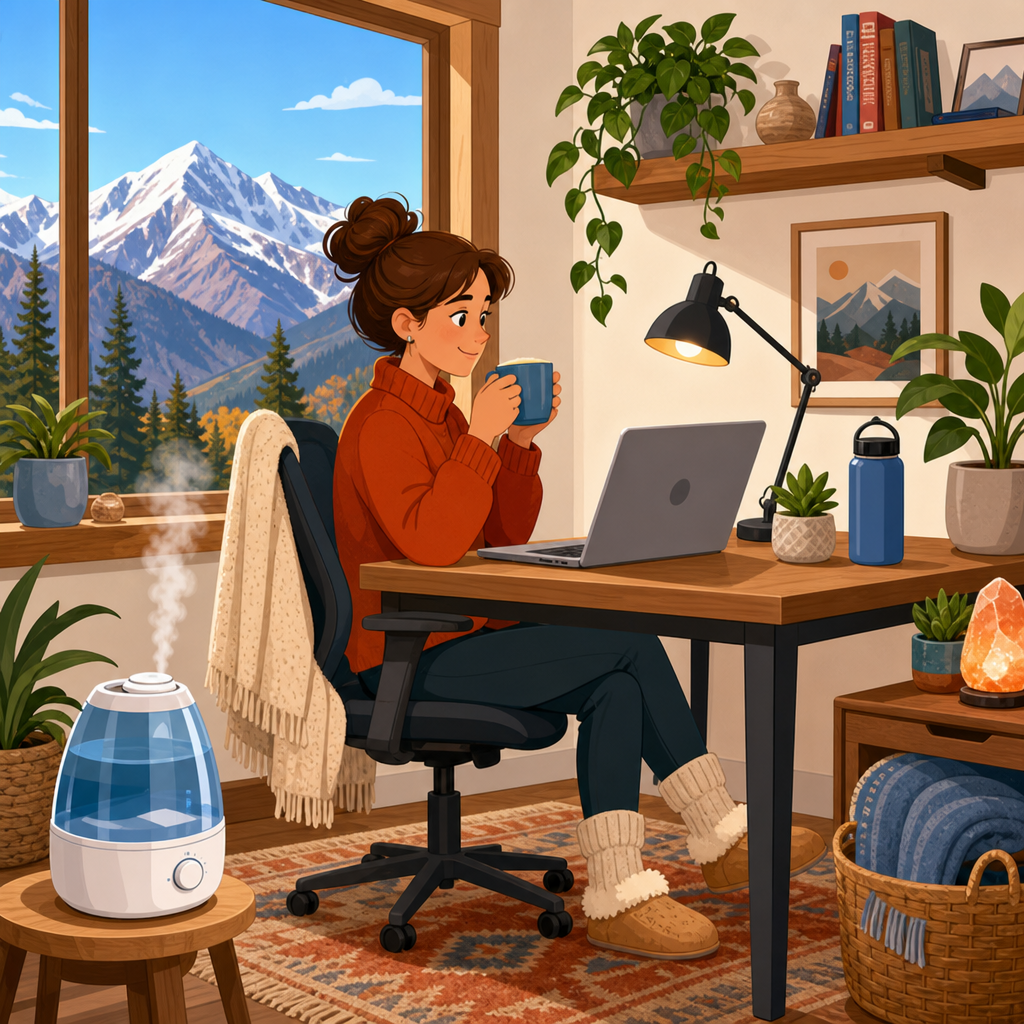
Mountain homes face a humidity problem that many homeowners underestimate until dry skin, static shocks, nosebleeds, cracked trim, and persistent discomfort make it impossible to ignore. Choosing between a portable humidifier and a whole-house humidifier for mountain homes is not just about convenience; it affects indoor air quality, health, energy use, wood preservation, and HVAC performance. In high-elevation climates, winter air is often exceptionally dry because cold outdoor air holds less moisture, and once that air is heated indoors, relative humidity can fall into the teens. That is well below the commonly recommended indoor range of about 30 to 50 percent.
Indoor Air & Humidity refers to how much moisture is suspended in the air inside your home and how that moisture interacts with temperature, ventilation, filtration, and building materials. Relative humidity, usually shortened to RH, is the key measurement because it tells you how saturated the air is at a given temperature. In mountain homes, RH can swing quickly due to strong sun exposure, cold nights, wood stoves, forced-air heating, and tighter modern construction. I have worked with homeowners in alpine and foothill properties who assumed a single bedroom unit would solve the issue, only to find dry upstairs rooms, warped instruments, or window condensation after months of trial and error.
This hub article explains the full landscape of indoor humidity control, starting with the core comparison of portable humidifiers versus whole-house humidifiers, then branching into sizing, maintenance, water quality, mold risk, comfort, and room-by-room strategy. If you are deciding what to buy, planning HVAC upgrades, or trying to protect skin, sinuses, hardwood floors, and furniture through winter, the goal is simple: understand which system matches your home, climate, and daily routine. In mountain regions, the best humidity solution is rarely the cheapest unit on the shelf. It is the one that delivers stable moisture, measurable control, and manageable upkeep across the spaces you actually live in.
Why mountain homes become so dry indoors
Mountain homes dry out faster than many low-elevation homes because of a mix of weather physics and building operation. Cold air holds less water vapor than warm air. When that cold air enters the house through ventilation, leaks, bath fans, or door openings, then gets heated to 68 or 70 degrees Fahrenheit, its relative humidity drops sharply. A home that feels merely cool and dry outdoors can become desert-dry indoors after the furnace runs for several hours.
Altitude can amplify the experience. At higher elevations, people often notice faster evaporation from skin and nasal passages, especially when sun, wind, and low dew points combine. Wood-burning stoves and gas furnaces can further reduce perceived comfort by increasing temperature without adding moisture. Many mountain homes also have large window areas and vaulted ceilings, which create temperature stratification and make humidity control less even from one floor to another.
The symptoms are practical and visible. People report dry throat in the morning, itchy eyes, eczema flare-ups, increased static electricity, and frequent lip cracking. Homes show clues too: gapping hardwood, shrinking millwork, stressed guitars or pianos, and houseplants that dry out faster than expected. These are not minor comfort issues. They are signs that indoor humidity is out of balance and needs deliberate control.
Portable humidifier vs whole-house humidifier: the core difference
A portable humidifier adds moisture to one room or a limited zone. A whole-house humidifier connects to the HVAC system and distributes moisture through the ductwork to multiple rooms. That is the basic distinction, but the real difference lies in coverage, consistency, maintenance burden, and control accuracy.
Portable units work best when your problem is localized. If one person has dry sinuses in a bedroom, or a nursery needs extra humidity overnight, a console, evaporative, ultrasonic, or steam unit can solve the issue without touching the rest of the house. They are cheaper upfront, easy to buy locally, and useful for renters or part-time residents. The downside is that every unit needs regular filling, cleaning, filter changes on some models, and placement that avoids over-wetting nearby surfaces.
Whole-house humidifiers are designed for central management. They usually mount on the supply or return plenum of a forced-air HVAC system and add moisture automatically when heat runs or when humidity demand calls for it, depending on the model and controls. In homes above roughly 2,000 square feet, especially multi-level mountain homes, this approach often produces more stable RH across occupied rooms. It also reduces the need to manage several separate appliances.
| Factor | Portable Humidifier | Whole-House Humidifier |
|---|---|---|
| Coverage | Single room or small zone | Most or all rooms served by HVAC |
| Upfront cost | Lower | Higher |
| Maintenance | Frequent filling and cleaning | Seasonal service and pad or canister changes |
| Humidity consistency | Variable by room | More uniform when properly sized |
| Best use case | Bedrooms, rentals, targeted relief | Full-time homes, larger houses, integrated comfort |
In plain terms, a portable unit is a spot treatment. A whole-house system is infrastructure. If your discomfort follows you from room to room, whole-house control is usually the more rational long-term option.
How each system performs in real mountain-home conditions
Performance in mountain climates depends on heat source, floor plan, insulation, and occupancy patterns. In a compact cabin with closed bedroom doors and a mini-split, one or two portable humidifiers may be enough because there is no central duct system to support an integrated unit. In a larger forced-air home with an unfinished basement, open living areas, and several bedrooms, a whole-house humidifier usually wins because moisture can move with conditioned air rather than staying trapped in one room.
I have seen homeowners place three portable units in different corners of a 3,000-square-foot home and still fail to keep RH above 22 percent in the main bedroom. The issue was not unit quality. It was distribution. Moisture added in one room does not automatically balance the rest of the house, especially with stairwells, stack effect, and door closures. By contrast, a properly sized steam whole-house unit with an outdoor temperature sensor can maintain a steadier indoor range while reducing manual work.
Portable units also vary widely by technology. Ultrasonic models are quiet and efficient, but if filled with hard tap water they can release fine white mineral dust unless they use demineralization cartridges or distilled water. Evaporative units are self-limiting and less likely to over-humidify, but fan noise and wick replacement matter. Warm mist and steam types can provide hygienic output but use more electricity. Whole-house bypass, fan-powered, and steam humidifiers each have their own tradeoffs, with steam offering the strongest output for very dry climates and larger homes.
Health, comfort, and indoor air quality impacts
The right humidity level supports comfort and reduces irritation, but more is not always better. Most building and health guidance centers around keeping indoor RH in a moderate band, often around 30 to 50 percent, with winter targets adjusted downward in very cold weather to limit window condensation. At the lower end, dry air can worsen eye irritation, dry skin, nasal dryness, sore throat, and static shocks. It can also make a room feel cooler, prompting thermostat increases that raise heating costs.
Humidity also affects how particles behave. Very dry conditions can keep some irritants airborne longer, while balanced humidity can support mucosal defenses in the nose and throat. That said, humidifiers do not clean air. They do not replace source control, filtration, or ventilation. If you have wildfire smoke, pet dander, dust mites, or VOC concerns, humidity is only one piece of Indoor Air & Humidity management.
Too much moisture creates a different class of problem. RH above about 50 percent for extended periods can support dust mites in some environments, and sustained high moisture near cold surfaces can lead to condensation, microbial growth, and material damage. This matters in mountain homes where windows may run cold and thermal bridges are common. The healthiest system is not the one that produces the most visible mist. It is the one that holds a controlled, measured range without overshooting.
Installation, sizing, and cost realities
The biggest mistake homeowners make is choosing based on purchase price alone. Portable humidifiers can cost far less upfront, but several units plus replacement filters, cleaning supplies, and daily labor add up over time. Whole-house systems cost more to install because they involve HVAC integration, water supply, drainage, electrical work on some models, and humidistat setup. However, they often lower the hidden time cost of humidity control.
Sizing matters. Portable units are rated by tank size and output, often in gallons per day. Whole-house humidifiers are sized by square footage, insulation level, air leakage, and local winter conditions. In dry mountain regions, undersizing is common because published coverage claims assume average conditions rather than high air exchange, sunny exposure, and low outdoor humidity. An HVAC contractor should calculate required moisture output instead of relying on a box label.
Operating cost depends on the technology. Bypass whole-house humidifiers are relatively simple but depend on furnace airflow and may waste some heat energy. Fan-powered units improve evaporation. Steam units cost more to run electrically but deliver precise output independent of heat cycles, which can be valuable in shoulder seasons or well-insulated homes where the furnace runs less often. If you rely on a heat pump or radiant system, product choice becomes even more important because not every humidifier integrates the same way.
Maintenance, cleaning, and water quality
No humidity system is maintenance-free. Portable humidifiers demand the most hands-on care. Tanks need frequent refilling, standing water must not be left to stagnate, and internal surfaces should be cleaned on schedule using manufacturer-approved methods. The EPA has long advised regular cleaning because poorly maintained room humidifiers can disperse microorganisms or minerals. In practice, that means weekly attention for many units during heavy-use months.
Water quality is a major factor in mountain communities, where private wells and hard water are common. Hard water minerals shorten filter life, create scale, and can produce white dust in ultrasonic units. Distilled water reduces that problem but increases ongoing cost and hassle. Some homeowners install small reverse osmosis systems for appliance fill water, but that solution only makes sense if the usage pattern justifies it.
Whole-house humidifiers shift the work rather than eliminating it. Evaporative pads, also called water panels, usually need seasonal replacement. Drain lines should be checked. Steam canisters have a service life tied to water mineral content. Annual HVAC maintenance is the right time to inspect solenoids, humidistats, and any outdoor reset controls. In my experience, homeowners are far more consistent with one professional seasonal visit than with cleaning three portable units every week for five months.
When a portable humidifier is the better choice
A portable humidifier is the better choice when you need targeted relief, lack ductwork, rent the property, or only occupy a few rooms regularly. It is also the right starting point if you want to test whether humidity is truly the issue before investing in HVAC modifications. For example, a mountain condo used mainly on ski weekends may only need a high-quality bedroom evaporative unit and a digital hygrometer to stay comfortable overnight.
Portable units are also useful for people with room-specific needs. A nursery, home office, or music room may benefit from independent control. If you store guitars, violins, or a piano in one zone, local humidification can protect wood and tuning stability without raising moisture in the entire house. This is especially practical in older homes with uneven heating or in additions that the central system does not serve well.
To make a portable strategy work, use enough measurement. Put hygrometers in the rooms that matter. Keep doors open if you want some moisture spread, and keep the unit sized to the room rather than assuming bigger is always better. Place it where mist or output will not settle on walls, windows, or electronics. For many households, portable works best as a precise tool, not as a substitute for whole-home planning.
When a whole-house humidifier makes more sense
A whole-house humidifier makes more sense when dryness affects most rooms, the home has central forced air, and you want stable comfort with less daily effort. This is especially true in primary mountain residences where heating runs for long stretches and indoor RH repeatedly falls below 25 percent. If wood floors gap every winter, residents wake up congested in different bedrooms, and several portable units still leave dead zones, an integrated system is usually justified.
Whole-house control is also easier to live with for families. One humidistat, one service interval, and one distribution system are simpler than multiple tanks, cords, and cleaning schedules. For homes with art, antiques, instruments, extensive woodwork, or large open living spaces, steady humidity protects materials better than room-by-room improvisation. The goal is consistency, not just temporary symptom relief.
Choose the system type based on climate severity and house design. In very dry mountain areas or larger homes, steam often performs best because it can add substantial moisture even when the furnace is not running much. In moderate cases, fan-powered or bypass units may be adequate and cheaper to maintain. A qualified installer should confirm airflow, drainage, water quality, and control settings so the system helps the home instead of creating condensation problems. Measure your RH, review your HVAC setup, and choose the solution that delivers controlled comfort all winter.
Frequently Asked Questions
What is the main difference between a portable humidifier and a whole-house humidifier for mountain homes?
A portable humidifier is designed to add moisture to a single room or a limited area, while a whole-house humidifier works with your HVAC system to regulate humidity throughout the entire home. In mountain climates, that difference matters a lot. High-elevation air is typically very dry in winter, and the dryness affects more than comfort. It can lead to dry skin, irritated sinuses, static electricity, shrinking wood floors, cracked trim, and added strain on heating systems. A portable unit can help in a bedroom, office, or nursery, but it usually cannot keep humidity balanced across multiple rooms, open floor plans, stairwells, and varying elevations inside the home.
A whole-house humidifier offers broader, more consistent moisture control. Because it is tied into the ductwork or HVAC system, it can maintain a target indoor humidity level more evenly from room to room. That consistency is especially valuable in mountain homes, where large windows, vaulted ceilings, and forced-air heating often make indoor air even drier. Homeowners who only need spot treatment may do well with portable units, but if the goal is to protect woodwork, improve comfort throughout the house, and support overall indoor air quality, a whole-house system is usually the more complete solution.
Which option is better for extremely dry winter air at high elevations?
For most mountain homes, a whole-house humidifier is the better long-term solution for extremely dry winter air. High-elevation environments are challenging because cold outdoor air contains very little moisture to begin with. Once that air is brought indoors and heated, relative humidity can drop sharply. That is why mountain homeowners often notice persistent dryness even when the house feels warm. A single portable humidifier may relieve symptoms in one room, but it often struggles to keep pace with the dryness affecting the rest of the home.
Whole-house systems are generally more effective because they deliver humidity as air circulates through the HVAC system. That means the moisture is distributed more evenly, helping reduce wide swings in indoor humidity that can make a home uncomfortable and harder on wood furnishings and finishes. In a mountain home, consistency is just as important as moisture output. If only one room is humidified and the rest of the house remains very dry, you may still see issues like cracking around trim, static shocks in hallways, and dryness in living areas where the portable unit does not reach.
That said, portable humidifiers can still be a practical choice in smaller homes, guest spaces, cabins used occasionally, or situations where only a specific sleeping area needs help. They are also useful as a temporary measure. But for homeowners dealing with ongoing dry-air problems across the whole property, a properly sized whole-house humidifier is usually the stronger answer.
Are whole-house humidifiers more cost-effective than portable humidifiers over time?
They often are, especially in larger mountain homes or homes with chronic winter dryness. Portable humidifiers usually cost less upfront, which makes them attractive at first. However, the long-term cost is not just the purchase price. You also have to factor in the need for multiple units if several rooms are affected, ongoing cleaning, filter replacement if applicable, electricity use, and the time required to refill water tanks regularly. In a mountain home with several bedrooms, common areas, and multiple levels, relying on portable units alone can become inefficient and inconvenient.
A whole-house humidifier typically involves a higher initial installation cost, but it can provide better value over time by covering the entire home with one integrated system. It may also help reduce some of the hidden costs of dry air. Proper humidity can make a home feel warmer at a given thermostat setting, which may support energy efficiency and reduce the urge to overheat the space. More importantly, stable humidity can help protect wood floors, cabinetry, furniture, millwork, musical instruments, and other materials that are vulnerable in mountain climates. Avoiding shrinkage, gaps, and cracking can save money that would otherwise go toward repairs or refinishing.
Cost-effectiveness really depends on home size, layout, occupancy, and how severe the humidity issue is. If you only need relief in one room, a portable unit may be perfectly sensible. But if you are trying to solve whole-home dryness in a high-elevation environment, a whole-house system often delivers better overall value and fewer headaches.
How does humidity control affect indoor air quality, comfort, and wood preservation in mountain homes?
Humidity control has a major impact on all three. From a comfort standpoint, air that is too dry can cause dry skin, chapped lips, irritated eyes, scratchy throats, bloody noses, and increased static electricity. Many mountain homeowners notice these symptoms most in winter, when heaters run constantly and indoor air becomes exceptionally dry. Maintaining a healthier humidity range can make the home feel more comfortable and less harsh on the body, especially during long heating seasons.
For indoor air quality, balanced humidity helps support respiratory comfort. Air that is too dry can irritate nasal passages and sinuses, which may leave occupants feeling uncomfortable or more sensitive to airborne particles. A well-managed humidity level can help reduce that parched indoor feeling and improve day-to-day livability. The key is balance. Too little humidity creates dryness-related issues, while too much can invite condensation or moisture problems. That is why controlled humidification is important, particularly in climates where outdoor conditions can shift quickly.
Wood preservation is one of the biggest reasons mountain homeowners invest in whole-home humidity control. Wood floors, doors, trim, cabinets, beams, and furniture all respond to moisture levels in the air. When indoor humidity drops too low for extended periods, wood can shrink, separate, warp, or crack. In mountain homes with custom millwork or natural wood finishes, those changes can become expensive to correct. Consistent humidity is much better for preserving the appearance and structural stability of these materials than allowing indoor air to swing from overly dry to slightly improved only in isolated rooms.
What should homeowners consider before choosing a humidifier system for a mountain home?
Start with the scope of the problem. If dryness is limited to one bedroom or a small office, a portable humidifier may be all you need. If symptoms and damage are showing up throughout the house, a whole-house humidifier is usually the better fit. Home size, ceiling height, insulation quality, window area, and HVAC design all influence how difficult it will be to maintain comfortable humidity. Mountain homes often have open layouts, large glass expanses, and longer heating seasons, all of which can make whole-home moisture control more important.
You should also think about maintenance and lifestyle. Portable units require regular tank refills and frequent cleaning to prevent buildup and maintain performance. Some homeowners do not mind that routine, but others find it burdensome, especially when using multiple units. Whole-house systems are more convenient in day-to-day operation, but they should still be serviced and monitored to ensure proper performance. Professional sizing and installation are important because over-humidifying can be just as problematic as under-humidifying, particularly in cold climates where window condensation can occur.
Finally, consider your long-term goals. If your priority is temporary relief, a portable humidifier may be enough. If your goals include protecting wood finishes, improving comfort throughout the home, supporting HVAC efficiency, and creating a more stable indoor environment during harsh mountain winters, a whole-house humidifier is often the more strategic investment. In many cases, the best decision comes down to whether you need room-by-room help or consistent humidity control across the entire home.