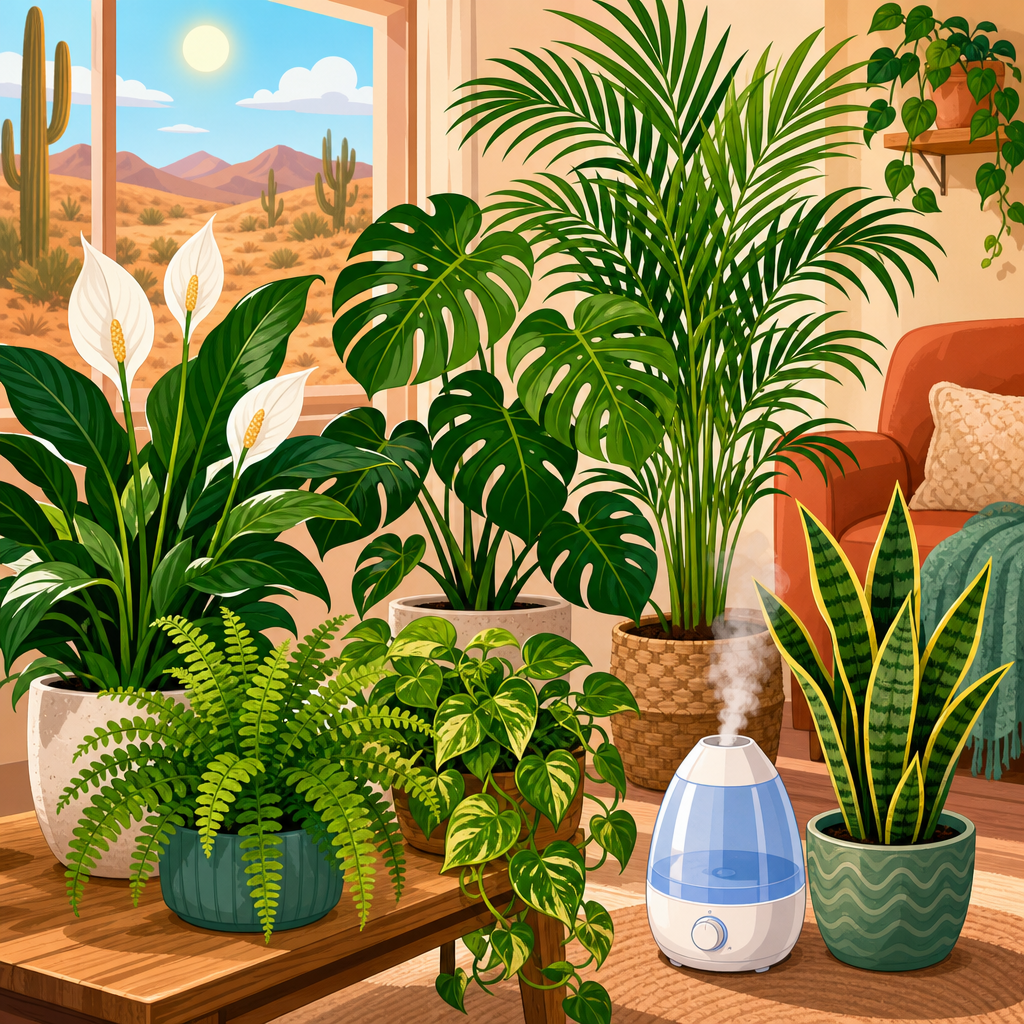
Dry indoor air makes homes feel harsher than the weather outside, and the best houseplants for adding humidity in dry climates can soften that environment while improving comfort for skin, eyes, sinuses, and furniture. Indoor humidity is the amount of water vapor held in the air, usually measured as relative humidity, and most homes feel best between about 30 and 50 percent. In arid regions, heated winter rooms and air-conditioned summer spaces often fall well below that range. I see the effects quickly when auditing dry homes: static shocks increase, wood trim shrinks, houseplants crisp at the edges, and people complain about itchy eyes, nosebleeds, scratchy throats, and restless sleep.
Plants help because of transpiration, the natural process by which roots absorb water and leaves release moisture through tiny pores called stomata. That released moisture does not replace a whole-house humidifier, but it does create measurable local benefits, especially when several medium to large plants are grouped together. The right species also encourage better daily habits. When people water consistently, monitor light, and pay attention to airflow, they usually become more aware of their overall indoor air quality. For a home focused on comfort, choosing humidity-boosting plants is a practical first step that fits neatly alongside air sealing, filtration, and sensible ventilation.
This guide serves as a complete hub for indoor air and humidity, with special attention to dry climates. It explains which plants release more moisture, which rooms benefit most, how placement changes results, and when plants are not enough on their own. It also covers care tradeoffs, because a humidity plant that declines in low light or develops pests will not improve a room for long. If your goal is a healthier, more comfortable home, start by matching plant size, leaf area, watering needs, and light conditions to your space rather than buying whatever looks lush at the garden center.
How houseplants raise indoor humidity
Houseplants increase humidity primarily through transpiration, and the species that help most usually share three traits: broad leaf surface, active growth, and steady access to moisture at the root zone. In plain terms, larger leaves and faster metabolism often mean more water moving through the plant and into the surrounding air. The potting mix also contributes a smaller amount through evaporation after watering. In the homes I have evaluated, a single small plant rarely changes a whole room reading on a hygrometer, but a grouping of five to ten healthy plants can create a noticeably more comfortable microclimate near desks, beds, and seating areas.
Environmental conditions matter. Bright indirect light generally increases transpiration more than dim corners because the plant is metabolically active. Warm air and moving air also speed moisture release, although excessive drafts can stress foliage. Pot size matters too: a root-bound plant in a tiny container will not move as much water as the same species growing vigorously in an appropriately sized pot. If your home sits at 18 to 25 percent relative humidity, think in terms of combined strategies. Plants are a supportive layer, not a magic fix. Their strength is targeted comfort and steady background moisture rather than rapid whole-home correction.
Best houseplants for adding humidity in dry climates
The strongest performers for dry homes are species that produce abundant leaf mass and tolerate regular watering without demanding swampy conditions. Areca palm is one of the most reliable choices. It grows a large canopy of feathery fronds, transpires well in bright filtered light, and adapts to living rooms and bedrooms better than many palms. Boston fern is another standout. Its many leaflets create high surface area, so it releases moisture efficiently, but it needs consistently moist soil and better humidity than most desert homes naturally provide. In practice, it works best when grouped with other plants or placed near a humidifier.
Peace lily offers a useful middle ground. Its broad leaves transpire steadily, it tolerates lower light than palms and ferns, and it visibly droops when thirsty, which helps owners water on time. Spider plant is less dramatic but dependable, easy to propagate, and effective when several are grown together. Parlor palm, rubber plant, pothos, and philodendron also contribute meaningful moisture while being more forgiving for typical households. For bright bathrooms or kitchens, bird’s nest fern and certain calatheas can perform well. Avoid assuming every succulent-rich display helps humidity; cacti and many succulents are adapted to conserve water, not release it freely.
| Plant | Humidity contribution | Best light | Care notes |
|---|---|---|---|
| Areca palm | High | Bright indirect | Water when top inch dries; needs space |
| Boston fern | High | Bright indirect | Keep evenly moist; sensitive to dry drafts |
| Peace lily | Moderate to high | Medium to bright indirect | Broad leaves; toxic if chewed by pets |
| Spider plant | Moderate | Medium to bright indirect | Easy care; useful in clusters |
| Rubber plant | Moderate | Bright indirect | Large leaves; let surface dry slightly |
| Parlor palm | Moderate | Medium indirect | Slower grower; dependable for apartments |
Choosing plants by room, climate, and lifestyle
The best plant for humidity is not always the plant with the highest theoretical moisture output. It is the plant that will remain healthy in your specific room. Bedrooms usually benefit from quiet, medium-light plants such as peace lily, parlor palm, pothos, or philodendron. Since people spend long continuous hours there, even a modest rise in local humidity can help with overnight dry throat and irritated nasal passages. Living rooms with large windows can support areca palm, rubber plant, and multiple spider plants, giving you more leaf area and stronger transpiration without turning care into a full-time task.
Kitchens and bathrooms are often ideal because they already have periodic moisture from cooking and bathing. That extra humidity supports ferns, calatheas, and bird’s nest fern, which may struggle in a heated den. Home offices need balanced choices. I often recommend one larger anchor plant, such as a rubber plant or palm, plus several smaller companions near the desk. In very dry mountain or desert climates, choose species that can tolerate low baseline humidity yet still transpire when watered well. That is why areca palm, spider plant, and pothos usually outperform fussier tropicals in real homes. Your schedule matters too; if you travel often, skip Boston fern.
Placement strategies that improve results
Placement determines whether a humidity-supporting plant merely survives or actually helps the room. Grouping is the first rule. Several plants placed within a few feet of each other create a localized moisture zone because each plant adds vapor and shades the others from intense drying. I have measured more stable humidity around clustered plants than around isolated specimens across a room. The second rule is to match plants to light without exposing them to hot direct sun that forces rapid drying. East-facing windows, bright north light, or set-back south and west exposures with filtered sun usually work well.
Keep plants away from heating vents, radiators, wood stoves, and aggressive air-conditioning output. These sources strip moisture from leaves and soil so quickly that transpiration benefits are reduced and leaf edges brown. If you want bedroom comfort, place plants within the occupied zone rather than on a distant dresser across the room. A nightstand is usually too small for large species, but a grouped arrangement near the bed can make the air feel less brittle. Pebble trays can add slight local evaporation, though their effect is modest. More useful is using cachepots or saucers correctly so you can water thoroughly, drain excess, and keep roots healthy.
Care practices that maximize moisture release safely
A healthy plant transpires more than a stressed one, so humidity benefits depend on sound care. Water deeply enough that the full root ball is moistened, then let the species-appropriate amount of drying occur before watering again. Chronic underwatering closes stomata and slows growth. Chronic overwatering damages roots, reduces oxygen in the mix, and can trigger fungus gnats or root rot. For most foliage plants, a chunky indoor mix with bark, coir or peat, and perlite gives the right balance. Terracotta dries faster and may suit overwaterers; plastic or glazed ceramic holds moisture longer and often supports stronger transpiration in very dry homes.
Leaf cleanliness matters more than many people realize. Dust blocks light and interferes with gas exchange, so wiping broad leaves or rinsing sturdy plants improves performance. Fertilize modestly during active growth, because a nutrient-starved plant will not produce the leaf mass needed for meaningful moisture release. Monitor with a digital hygrometer instead of guessing. Affordable meters from ThermoPro, Govee, and AcuRite make it easy to track bedroom and living room conditions. Watch for mold risk if windows collect condensation. In most arid homes, plants do not create that problem, but once indoor humidity rises above roughly 50 percent in cold weather, poorly insulated surfaces can become vulnerable.
Limits, tradeoffs, and when to add a humidifier
Plants are helpful, but they are not a replacement for mechanical humidity control when a home is severely dry. If your indoor air sits near 15 to 20 percent relative humidity through winter, even a room full of plants may only nudge conditions upward. In those cases, use plants as part of a wider plan that may include portable evaporative humidifiers, furnace-mounted humidifiers, weatherstripping, and ventilation adjustments. Portable units from brands such as Honeywell, Levoit, and Venta can raise humidity faster and more predictably. Plants then provide daily background support and improve how the space feels between humidifier cycles.
There are also practical tradeoffs. More watering means more maintenance and some mess. Certain plants, including peace lily and pothos, are toxic to pets if chewed, so placement matters in homes with cats or dogs. Overcrowded plant collections can reduce airflow and invite pests such as spider mites, scale, or mealybugs, especially in dry heated rooms. Fungus gnats are usually a sign of overly wet soil, not a reason to avoid plants altogether. The balanced approach is straightforward: choose the right species, use clean pots and fast-draining mixes, inspect foliage weekly, and pair plants with measured humidity targets instead of hoping greenery alone will solve every comfort problem.
The best houseplants for adding humidity in dry climates are the ones that combine generous leaf area, steady transpiration, and realistic care needs for your home. Areca palm, Boston fern, peace lily, spider plant, parlor palm, rubber plant, pothos, and philodendron all deserve a place in an indoor air and humidity strategy, but they work best when matched to light, grouped thoughtfully, and kept healthy with consistent watering. Plants improve local comfort, especially in bedrooms, offices, and living areas where dry air causes itchy skin, irritated eyes, static, and poor sleep. They also make people pay attention to the broader condition of their indoor environment.
The main benefit is not a dramatic overnight jump on a humidity meter. It is a steadier, more livable home that feels less harsh every day. When used alongside a hygrometer, sensible placement, and humidifiers where needed, humidity-boosting houseplants become a practical tool for daily life, skin comfort, eye relief, and overall home comfort. Start with one easy cluster in the room where dryness bothers you most, track the results for two weeks, and build from there. That simple approach will help you create a healthier indoor climate without adding unnecessary complexity.
Frequently Asked Questions
Which houseplants are best for adding humidity in dry climates?
The best houseplants for adding humidity in dry climates are usually leafy, water-loving varieties that release moisture into the air through transpiration. Some of the strongest choices include areca palm, parlor palm, Boston fern, peace lily, spider plant, pothos, rubber plant, and calathea. Larger plants with more leaf surface area generally contribute more moisture than small succulents or cacti, which are adapted to conserve water rather than release it. Tropical plants are especially useful because they naturally thrive in environments with higher humidity and tend to move more water from their roots to their leaves.
If your goal is to make a noticeable difference in a dry room, focus on grouping several medium to large plants together instead of relying on one specimen alone. A cluster of moisture-loving plants creates a small humid microclimate around itself, which benefits both the plants and the people nearby. It is also smart to match the plant to the room conditions. For example, a Boston fern can be excellent in a bright bathroom or kitchen, while a peace lily or pothos may be easier to manage in a living room or bedroom with indirect light. The most effective strategy is to choose healthy, actively growing plants that fit your light, watering habits, and available space.
Do houseplants really increase indoor humidity, or is the effect too small to matter?
Yes, houseplants really can increase indoor humidity, but it is important to set realistic expectations. Plants release water vapor through transpiration as they take up moisture through their roots and move it through their stems and leaves. That process adds humidity to the surrounding air, especially when the plants are well-watered, actively growing, and placed in groups. In a very dry climate, however, one or two small plants are unlikely to raise humidity across an entire house in a dramatic way.
Where plants tend to make the most meaningful difference is in localized spaces such as a home office, reading corner, bedroom, or plant shelf. In those areas, several leafy plants together can help soften the feel of dry air and may make the immediate environment more comfortable. They can be part of a broader humidity strategy that also includes reducing excessive heat, using a humidifier when necessary, and avoiding over-drying the air with constant air conditioning or forced-air heating. So while houseplants are not a complete substitute for mechanical humidification in extremely arid homes, they are absolutely useful and can contribute measurable moisture while also improving the atmosphere of a room in a natural, attractive way.
How many plants do you need to help with dry indoor air?
The number of plants you need depends on the size of the room, the severity of the dryness, the type of plants you choose, and how mature they are. A single small plant on a shelf may provide only a minimal humidity boost, while several full, healthy plants with lots of leaves can have a more noticeable impact. In a small room, a grouping of three to six medium-sized tropical houseplants can help create a more comfortable pocket of moisture. In a larger open-concept space, you would likely need many more plants to influence humidity levels in a meaningful way.
Leaf size and total foliage mass matter more than plant count alone. For example, one large areca palm may contribute more moisture than several tiny plants in decorative pots. Placement matters too. If you spread plants all over the house, the benefit becomes diffuse. If you cluster them in the room where dry air bothers you most, such as a bedroom during winter heating season, the effect is often more practical. If you want to track progress, use a hygrometer to measure relative humidity before and after adding plants. That gives you a clear, objective sense of whether your plant setup is helping keep the room closer to the ideal 30 to 50 percent range.
What is the best way to care for humidity-boosting houseplants in an arid home?
In an arid home, the key is to support healthy growth without overcorrecting and creating plant stress in other ways. Start by placing humidity-friendly plants in bright, indirect light unless the specific variety prefers something different. Keep the soil evenly moist for plants like ferns, peace lilies, and calatheas, but avoid waterlogged roots, which can lead to rot. Dry climates often cause potting mix to lose moisture faster, so you may need to water more often than you would in a more humid region. Check the soil with your finger rather than watering on a rigid schedule.
It also helps to use strategies that make moisture last longer around the plant. Grouping plants together, setting pots on pebble trays with water beneath the pot line, and keeping them away from heat vents, fireplaces, and blasting air conditioners can all reduce stress from dry air. Choose containers and potting mixes that suit the plant’s needs, and wipe dust from leaves so the plant can transpire efficiently. Watch for classic signs of low humidity such as brown leaf edges, crispy tips, curling foliage, or stalled growth. If those symptoms appear despite good watering, the air may simply be too dry for that plant, and adding a room humidifier near your plant collection may be the most effective way to support both the plants and your own comfort.
Can houseplants replace a humidifier in very dry climates?
In very dry climates, houseplants usually work best as a complement to a humidifier rather than a full replacement. They add moisture naturally, improve the look and feel of a room, and can help create a gentler indoor environment, but their output is limited by plant size, health, light levels, and watering conditions. If indoor relative humidity is dropping far below 30 percent because of desert air, winter heating, or constant air conditioning, even a large collection of plants may not be enough on its own to bring the whole room into the most comfortable range.
That said, plants still offer meaningful benefits beyond humidity alone. They can soften dry indoor spaces visually, encourage better air awareness, and help maintain a more balanced microclimate around the immediate area where you sit or sleep. Many people find that a combined approach works best: use a humidifier to raise overall humidity, then use leafy tropical houseplants to support that moisture level and make the room feel more alive and less harsh. This can be especially helpful for people dealing with dry skin, irritated eyes, scratchy throats, or static-prone furnishings. If your home is consistently very dry, the most practical plan is to think of plants as a natural assist, not a complete substitute for dedicated humidity control.