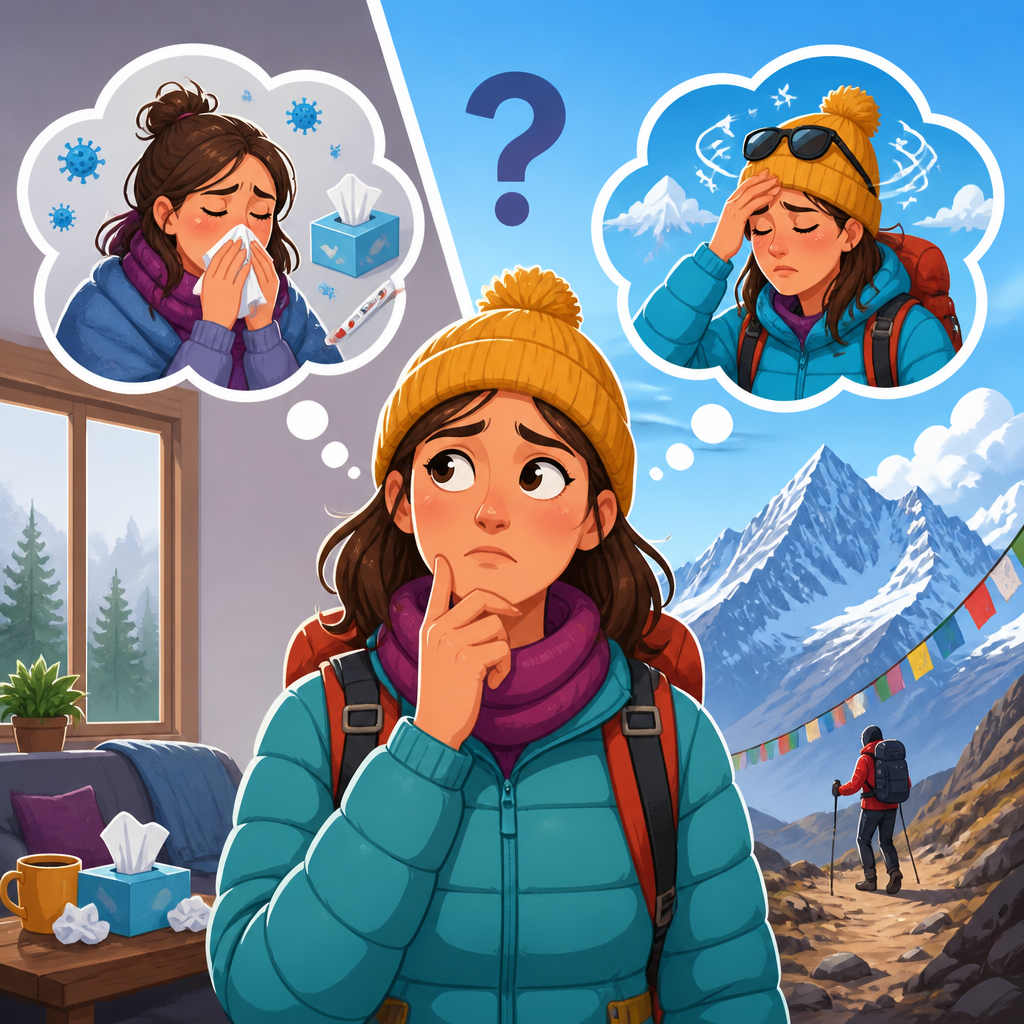
Can a recent cold make altitude sickness harder to recognize? Yes, and I have seen this confusion repeatedly on trekking routes, ski trips, and rapid ascents where people arrive at elevation with lingering congestion, fatigue, poor sleep, or a headache they assume is “just the cold.” Acute mountain sickness, usually shortened to AMS, often starts with the same nonspecific symptoms: headache, nausea, dizziness, unusual tiredness, reduced appetite, and sleep disruption after ascent to altitude. When a recent viral illness overlaps with those signals, early altitude illness is easier to dismiss, mislabel, or miss entirely. That matters because the first safe response to possible AMS is caution, not guesswork.
AMS is the mildest form of altitude illness, but it sits on a spectrum that can progress to high-altitude cerebral edema and high-altitude pulmonary edema, two medical emergencies. Most healthy people can travel safely to altitude, yet risk rises when ascent is too fast, sleeping elevation jumps sharply, exertion is heavy on arrival, or a person has had altitude problems before. Respiratory infections add another layer because they can affect hydration, appetite, breathing comfort, and energy, all of which influence how someone interprets symptoms during acclimatization. This hub explains AMS basics and risk factors comprehensively, with a focus on the practical question behind the title: how a recent cold can blur the picture, and how to sort symptoms out before they become dangerous.
Altitude refers to environments where lower barometric pressure reduces the amount of oxygen available with each breath. The percentage of oxygen in air stays about the same, but the partial pressure of oxygen falls as elevation increases, so less oxygen moves from the lungs into the blood. Acclimatization is the body’s adjustment process. Over hours to days, breathing increases, heart rate rises, and kidneys help shift acid-base balance so ventilation can remain higher. Given time, the body also increases red blood cell production. AMS happens when ascent outpaces those adaptations. In practice, many cases begin after sleeping above roughly 2,500 meters, though susceptibility varies widely and symptoms can appear lower or only at higher elevations depending on the person and the itinerary.
A recent cold matters because it can imitate AMS, mask AMS, or worsen the conditions that trigger AMS. Nasal congestion can make sleep feel airless even when oxygenation is adequate. Coughing can leave someone exhausted before a hike even starts. Post-viral headache, poor appetite, and dehydration can look almost identical to early mountain sickness. At the same time, someone who feels “already sick” may normalize new symptoms after ascent instead of treating them as a warning. The key principle is simple: after going higher, any new headache, nausea, dizziness, unusual fatigue, or reduced exercise tolerance should be considered altitude related until proved otherwise. That mindset prevents delayed descent and saves people from turning a manageable problem into a rescue.
How AMS starts and what it feels like
AMS typically develops within six to twelve hours after ascent, especially after a new sleeping altitude is reached. The classic definition used in the Lake Louise Scoring System includes a recent gain in altitude plus headache and at least one additional symptom such as gastrointestinal upset, fatigue or weakness, dizziness or lightheadedness, and difficulty sleeping. In the field, the pattern matters as much as the checklist. Someone who felt well at the trailhead but develops a headache by evening at a hut, skips dinner because of nausea, and sleeps badly is showing a very recognizable acclimatization problem. The symptoms are not dramatic at first, which is exactly why they get minimized.
The headache of AMS is often described as pressure-like and worsened by exertion, bending over, or coughing, though descriptions vary. Fatigue is usually disproportionate: a fit hiker suddenly struggles with a routine pace, or a skier feels heavy-legged after a short traverse. Nausea may be subtle, showing up as loss of appetite rather than vomiting. Sleep can become fragmented with periodic breathing, a common altitude pattern in which breaths cycle from deep to shallow with brief pauses. None of these signs alone proves AMS, but together after ascent they deserve action. Rest at the same elevation, avoid further ascent, hydrate sensibly, and reassess rather than pushing onward because the itinerary says so.
One of the most important distinctions I teach is that mild AMS is still altitude illness, not just “part of the trip.” Plenty of travelers expect a headache at altitude and treat it as inevitable. That assumption is unsafe. A small problem can stabilize with rest and a slower schedule, but if symptoms worsen at the same altitude or with continued ascent, the next step is descent. High-altitude cerebral edema usually announces itself with worsening AMS plus ataxia, confusion, unusual behavior, or declining coordination. High-altitude pulmonary edema more often presents with reduced exercise performance, breathlessness out of proportion to effort, cough, chest tightness, and later shortness of breath at rest. Those are not wait-and-see symptoms.
Why a recent cold muddies the diagnosis
A recent cold makes altitude sickness harder to recognize because the overlap is real. Viral upper respiratory infections commonly cause headache, sinus pressure, poor sleep, low appetite, malaise, and dehydration from fever or reduced intake. People also become less active while sick, so when they return to exertion at altitude, normal deconditioning for a few days can be mistaken for mountain weakness or vice versa. I have also seen travelers arrive with leftover congestion and use decongestants, cough suppressants, alcohol, and poor sleep interchangeably, creating a muddled picture where no one can tell whether the issue is medication side effects, lingering illness, or true AMS.
Congestion itself does not reduce the oxygen content of the air, but it can increase the sensation of struggling to breathe, especially at night. Mouth breathing dries the airway, cough worsens, and sleep quality falls further. That matters because poor sleep amplifies headache, irritability, and fatigue the next morning, exactly the symptoms that trigger concern for altitude illness. A cold can also make hydration harder to manage. People drink less because swallowing is uncomfortable or because cool mountain air blunts thirst. Thick secretions, darker urine, and dry mouth then push them toward more headache and more fatigue. None of this means a recent cold causes AMS directly; it means the cold can create the same clues and distract from the altitude timeline.
The safest way to separate the two is context. Symptoms that clearly intensify after ascent, especially after a higher sleeping altitude, should be treated as altitude related. Symptoms dominated by runny nose, sore throat, and cough without the typical altitude pattern may still reflect the cold, but that does not give a free pass to keep climbing. When there is uncertainty, default to conservative altitude decisions. Do not ascend with a persistent headache and nausea just because you had a cold last week. Rest, eat if possible, monitor urine output and energy, and see whether symptoms improve at the same elevation. If they do not, descend.
Major AMS risk factors every traveler should know
The strongest risk factor for AMS is ascending too high too fast. Sleeping elevation is more important than the highest point reached during the day because symptoms often emerge overnight or the following morning. As a practical rule, once above about 2,500 to 3,000 meters, conservative itineraries limit sleeping elevation gain and build in rest days. Prior history matters greatly. Someone who has had AMS before is more likely to get it again under similar conditions. Exertion on arrival also increases risk. Flying into a mountain city and immediately starting a hard hike is a classic setup for problems because the body has not had time to adapt.
Individual susceptibility varies more than most people expect. Fitness does not protect against AMS. I have watched endurance athletes get sick on schedules tolerated by less fit companions because training improves performance, not hypoxia tolerance. Age is not a reliable shield either. Children can get altitude illness, and older adults can acclimatize well if they ascend gradually. Alcohol and sedating medications complicate things by worsening dehydration, impairing judgment, and interfering with symptom recognition. Respiratory depressants are particularly unhelpful at altitude because ventilation is the body’s immediate adaptation. Even common sleep aids can become a problem if they blunt awareness or breathing.
Medical conditions deserve nuance. Asthma does not automatically increase AMS risk, but poorly controlled asthma at altitude can make breathing symptoms much harder to interpret. Migraine history can confuse the picture because altitude headaches may resemble familiar attacks. Anemia, significant cardiopulmonary disease, and active infection reduce physiologic reserve and warrant individualized planning with a clinician familiar with high-altitude travel. Recent illness is not an absolute contraindication to a mountain trip, but it should change risk tolerance. If you are recovering rather than fully recovered, the smart move is a slower ascent, lower first-night sleeping elevation, reduced exertion, and a clearer threshold for turning around.
| Risk factor | Why it matters | Practical example |
|---|---|---|
| Rapid ascent | Outpaces acclimatization | Flying to 3,400 m and sleeping there the same night |
| Previous AMS | Predicts future susceptibility | Same person gets headaches on multiple ski trips above 2,800 m |
| Heavy exertion on arrival | Raises oxygen demand before adaptation | Hard summit push within hours of reaching a high camp |
| Recent cold or viral illness | Masks symptoms and worsens sleep, hydration, appetite | Traveler blames altitude headache on lingering sinus pressure |
| Alcohol or sedatives | Impair judgment and can worsen breathing at night | Using sleeping pills after a fast ascent to “force sleep” at altitude |
How to tell whether symptoms are becoming dangerous
The decision point is not “Do I know with certainty what this is?” It is “Could this be altitude illness, and is it safe to stay or go higher?” Mild symptoms that improve with rest at the same elevation may remain mild AMS or simple adjustment. Worsening symptoms despite rest mean the acclimatization gap is growing. Red flags are straightforward: severe or escalating headache, repeated vomiting, inability to eat or drink, marked weakness, clumsiness, confusion, unusual drowsiness, breathlessness at rest, lips or nails looking blue, and a wet or persistent cough. Those findings demand descent and, when available, supplemental oxygen and medical assessment.
Pulse oximeters can help but should never overrule the clinical picture. Oxygen saturation changes with altitude and device quality, and cold fingers often produce bad readings. I have seen people with reassuring numbers who were obviously unwell and others with low numbers who felt fine and acclimatized normally. Trends are more useful than single values, especially when paired with symptoms and function. A practical field test is simple walking performance. If someone who was moving well yesterday is now unusually slow, unstable, or unable to keep up on easy terrain, treat that as meaningful. Function often reveals deterioration before people admit how sick they feel.
Prevention, planning, and the role of medication
The best prevention for AMS is a gradual ascent plan. If the itinerary allows, spend a night or two at moderate altitude before sleeping much higher, and add rest days on longer trips. “Climb high, sleep low” can help on trekking routes where day hikes above camp are practical, but it does not substitute for limiting sleeping elevation gain. Hydration should be steady, not excessive; overdrinking does not prevent AMS and can create its own problems. Eat carbohydrates if tolerated, keep the first day’s effort controlled, and treat a recent cold as a reason to be more conservative rather than more determined.
Acetazolamide has the strongest evidence base for prevention and can also help with early treatment in some situations. It works by promoting a mild metabolic acidosis that stimulates ventilation, improving acclimatization. It is not a performance enhancer and it does not make unsafe ascent schedules safe, but it is useful for people with prior AMS, short unavoidable ascents, or high-risk itineraries. Dexamethasone can prevent and treat AMS temporarily, yet it is generally reserved for specific situations because it suppresses symptoms without promoting acclimatization the way acetazolamide does. For headache relief, ibuprofen may help symptoms, but symptom control should not be mistaken for physiologic recovery.
If you are deciding whether to travel after a recent cold, ask practical questions. Are you sleeping normally? Eating normally? Exercising without unusual fatigue? Do you still need decongestants or cough medicine to get through the day? If the answer to several is no, you are not starting from baseline. That does not guarantee trouble, but it lowers the margin for error. Build a slower itinerary, discuss preventive medication with a qualified clinician if risk is meaningful, and brief your group on the signs that trigger a stop or descent. Clear plans beat optimistic improvisation every time in the mountains.
A recent cold can absolutely make altitude sickness harder to recognize because both conditions share headache, fatigue, poor sleep, low appetite, and a general sense that something is off. The safest conclusion is not to guess which one you have while continuing upward. Instead, use the altitude timeline, watch for clustering of classic AMS symptoms after ascent, and judge function honestly. Any worsening at the same elevation, or any deterioration with further ascent, should be treated as altitude illness until proven otherwise. That one rule prevents most avoidable mistakes.
The core lessons of AMS basics and risk factors are consistent across trekking, skiing, climbing, and mountain travel. Rapid ascent is the main driver. Previous altitude problems predict future ones. Fitness is not protection. Recent illness, especially a cold, can blur symptom recognition and delay the conservative decisions that keep mild illness from progressing. Prevention starts with itinerary design, not gear or willpower: slower sleeping elevation gains, moderate effort on arrival, steady hydration, and medication only as part of a broader plan. When symptoms appear, the first treatment is to stop ascending and reassess.
If you are planning a trip in the altitude illness and acclimatization category, use this page as your hub: review AMS signs before departure, identify your personal risk factors, and make your ascent schedule realistic for the least acclimatized person in the group. If a recent cold is part of the picture, be stricter, not looser, about warning signs. Mountain travel rewards patience. Build in time, listen to symptoms early, and choose descent before doubt turns into an emergency.
Frequently Asked Questions
Can a recent cold really make altitude sickness harder to recognize?
Yes. A recent cold can blur the picture because early acute mountain sickness, or AMS, often begins with symptoms that overlap with lingering upper respiratory illness. People commonly arrive at altitude already dealing with congestion, poor sleep, fatigue, low appetite, sinus pressure, or a mild headache, then assume any worsening is simply the tail end of the cold. That is exactly where mistakes happen. AMS typically develops after ascent and often presents with headache plus symptoms such as nausea, dizziness, unusual tiredness, and disturbed sleep. If someone has recently been sick, those warning signs can be easy to minimize or mislabel.
The key issue is timing and pattern. If symptoms become more noticeable after gaining elevation, especially above the altitude where a person was previously feeling normal, AMS should be considered even if a cold seems like a convenient explanation. In practical terms, if a trekkers says, “I thought it was just my cold, but I felt much worse after we climbed higher,” that raises concern. A recent cold does not cause AMS, but it can hide it, delay recognition, and make people slower to rest, stop ascending, or descend when they should.
Which symptoms overlap between a cold and altitude sickness, and which signs point more strongly to AMS?
There is significant overlap. Both a recent cold and AMS can involve headache, fatigue, poor sleep, reduced appetite, and a general feeling of being “off.” Some people with a cold also feel lightheaded, especially if they are dehydrated, sleeping poorly, or not eating well. That is why altitude-related illness can be missed in the first day or two after arrival.
What points more strongly toward AMS is the combination of symptoms appearing after ascent, especially headache at altitude along with nausea, dizziness, marked tiredness, or feeling worse with continued climbing. AMS often feels out of proportion to a simple cold. A person may say they are unusually weak, cannot keep up, lose interest in food, or feel distinctly worse overnight at a higher sleeping elevation. Congestion, runny nose, sore throat, and coughing fit more with a cold, but they do not rule out altitude illness at the same time. In other words, someone can have both.
What matters most is not trying to force every symptom into one category, but asking a practical question: did this person get worse after going higher? If the answer is yes, AMS moves up the list. If symptoms are severe, rapidly progressive, or accompanied by confusion, trouble walking straight, shortness of breath at rest, or worsening cough with reduced exercise tolerance, those are red flags for more serious altitude illness and require immediate action.
How can you tell whether a headache at altitude is “just from a cold” or something more concerning?
You cannot safely assume a headache at altitude is “just from a cold” without looking at the full context. Headaches from lingering congestion or sinus pressure often come with facial pressure, nasal symptoms, and a pattern that may be familiar to the person from previous colds. But an altitude-related headache is especially concerning when it begins or worsens after ascent and is accompanied by nausea, dizziness, poor appetite, unusual exhaustion, or sleep disruption. That combination is classic for AMS.
Another clue is response to decisions, not just medications. If someone rests, avoids climbing higher, hydrates sensibly, and symptoms stabilize or improve, that is reassuring. If they continue ascending and the headache worsens, especially with increasing fatigue or nausea, that should not be dismissed. The most important mistake is to treat the headache, feel temporarily better, and keep climbing without reassessing. Pain relief can reduce symptoms without addressing the underlying altitude stress.
In the mountains, a new or worsening headache after ascent deserves respect. Even if congestion makes a sinus explanation seem likely, altitude illness should remain on the table until the pattern clearly says otherwise. If the headache is severe, persistent, or associated with imbalance, confusion, repeated vomiting, or any decline in function, descent and medical evaluation become much more important than trying to sort out whether the original trigger was the cold or the altitude.
If someone recently had a cold, should they avoid going to high altitude altogether?
Not necessarily, but they should be more cautious. A mild, improving cold does not automatically mean a person must cancel a trip. However, it does mean they should pay much closer attention to how they feel during and after ascent because the leftover symptoms can mask early AMS. That is especially true on rapid ascents, ski weekends, summit attempts, and itineraries with limited time to acclimatize. If someone is still significantly fatigued, sleeping badly, eating poorly, or feeling unwell before they even go up, they are starting with less reserve and may have a harder time recognizing when altitude is adding to the problem.
Good planning matters. A slower ascent profile, a lower first sleeping altitude when possible, rest time after arrival, conservative activity on day one, and honest symptom monitoring all help. People should also avoid the common trap of attributing every symptom to travel, dehydration, bad sleep, or “the cold I just had.” If symptoms intensify with elevation, the plan should change. That may mean stopping the ascent, resting an extra night, or descending if symptoms do not improve.
What usually causes trouble is not the recent cold itself, but the false reassurance it creates. People feel they already have an explanation, so they ignore the altitude pattern. If there is any uncertainty, it is safer to treat the situation like possible AMS until proven otherwise rather than push on and hope it is only residual congestion or fatigue.
What should you do if you are unsure whether symptoms are from a lingering cold or altitude sickness?
When in doubt, act conservatively. The safest assumption is that altitude could be contributing, especially if symptoms began or worsened after ascent. The first step is to stop gaining more elevation until the situation is clearer. Rest, limit exertion, and monitor for progression. Mild symptoms that improve with rest may stay mild, but symptoms that persist or worsen with continued ascent are much more concerning for AMS.
It is also important to watch function, not just symptom labels. Can the person walk steadily? Think clearly? Eat and drink? Keep up a normal conversation? Sleep at all? Are they becoming more nauseated, more dizzy, or increasingly exhausted? A person who says, “I just have a cold,” but is moving poorly, refusing food, and getting worse at higher altitude should be treated as a possible altitude illness case until shown otherwise.
Immediate descent is important if symptoms are significant, worsening, or accompanied by red-flag features such as confusion, clumsiness, inability to walk normally, shortness of breath at rest, chest tightness, or a worsening cough with reduced exercise tolerance. Those findings go beyond routine AMS and may indicate a more dangerous altitude problem. The bottom line is simple: uncertainty should not be a reason to keep climbing. In mountain medicine, a delayed decision is often riskier than a cautious one.