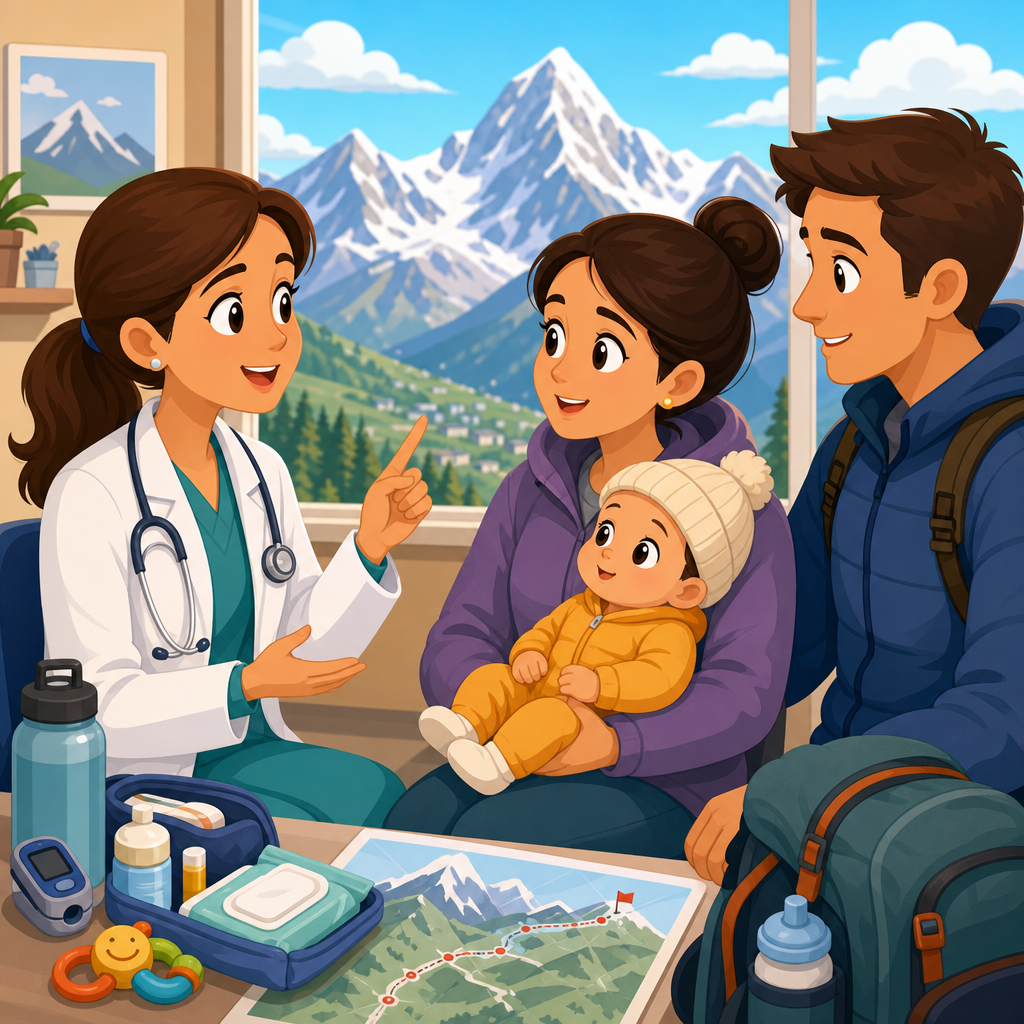
Traveling to altitude with a baby raises practical questions that many parents do not expect until a mountain trip is already booked. In pediatric practice, the discussion usually starts with a simple definition: altitude means elevation above sea level, and higher elevation means lower barometric pressure, which reduces the amount of oxygen available with each breath. Babies can travel safely to many mountain destinations, but they are not small adults. Their lungs are still developing, they cannot describe symptoms, and routine feeding, sleep, and temperature regulation can change quickly when the environment changes.
When I counsel families before ski trips, national park visits, and visits to relatives in mountain towns, I focus on risk rather than fear. Most healthy term infants do well at moderate elevation, especially when parents ascend gradually, keep routines flexible, and watch carefully for hydration, breathing changes, and unusual fussiness. The core issue is not simply the number on a map. It is the combination of altitude, speed of ascent, infant age, prematurity history, respiratory disease, weather exposure, and access to medical care. A healthy nine month old spending a few days in Denver is a different scenario from a six week old ex-preterm infant sleeping overnight at a remote lodge above 9,000 feet.
This topic matters because family travel often mixes excitement with preventable risk. High places can bring dry air, strong sun, cold nights, long car rides, and disrupted naps. Parents also tend to ask broader travel questions once altitude comes up: how should feeding work on the plane, what belongs in a baby travel kit, when is dehydration serious, and what symptoms mean it is time to descend or seek care? Used well, this article serves as a hub for kids and family travel planning because mountain travel forces families to think through nearly every travel variable at once.
Key terms help frame the conversation. Acclimatization is the body’s adjustment to lower oxygen levels over hours to days. Acute mountain sickness is a cluster of symptoms triggered by rapid ascent, commonly headache, nausea, fatigue, dizziness, and poor sleep in older children and adults. In babies, diagnosis is harder because they cannot report a headache, so pediatricians look for behavioral and physical clues instead. Pulse oximetry is the finger or foot sensor that estimates oxygen saturation, but readings vary with movement, cold fingers, and device quality, so numbers alone never replace clinical judgment.
How pediatricians assess whether a baby is ready for altitude travel
The first step is a pre-travel health review. Pediatricians usually ask the baby’s age, birth history, current weight gain, vaccine status, feeding pattern, prior breathing problems, and the exact itinerary. The most important distinction is whether the infant was born full term and is currently healthy. A healthy older infant with no heart or lung disease generally tolerates moderate elevation better than a newborn, a baby born prematurely, or a child with bronchiolitis, chronic lung disease, congenital heart disease, or significant anemia. These conditions affect oxygen delivery and make altitude stress less predictable.
Age matters because younger infants have less physiologic reserve. For a very young baby, especially under three months, pediatricians are more cautious about remote overnight trips to high elevation. There is no universal single cutoff that guarantees safety, but caution rises as altitude and remoteness increase. Guidance from wilderness and travel medicine sources often treats elevations above about 8,000 feet as the point where ascent strategy deserves more deliberate planning, and that is consistent with how many pediatricians frame the conversation for families.
Itinerary details often change the recommendation. Sleeping altitude matters more than the highest point reached briefly during the day. A family that drives from sea level to spend several nights at 9,500 feet is asking the baby’s body to adapt continuously. A family staying at 5,000 feet and taking a short scenic lift ride higher is dealing with a different exposure. I often advise parents to build in a lower first night, avoid same-day hard exertion for caregivers carrying infants, and choose lodging with easy access to lower elevation if symptoms develop.
Parents should also ask what medical care is available nearby. Mountain towns vary widely. Some have urgent care clinics, oxygen, and pediatric emergency capability; others have limited after-hours support and long transport times. Pediatricians usually want families to know where the nearest emergency department is, whether cell service is reliable, and how quickly they could descend if the baby became ill. Good planning reduces panic and makes objective decisions easier when everyone is tired.
What symptoms at altitude deserve attention in a baby
The central challenge is that babies cannot tell you they feel short of breath or dizzy. Pediatricians therefore teach parents to watch patterns rather than single moments. Red flags include persistent poor feeding, fewer wet diapers, unusual lethargy, repeated vomiting, worsening irritability that does not settle with routine soothing, labored breathing, pauses in breathing, blue or gray color around the lips, and a baby who seems markedly less responsive than usual. These symptoms are not specific to altitude, but at elevation they deserve prompt assessment.
Possible altitude-related illness in infants may show up as trouble sleeping, decreased appetite, fussiness, and fatigue after rapid ascent. Those signs overlap with ordinary travel disruption, so context matters. If the baby is alert, still feeding reasonably well, and improves with rest and hydration, careful observation may be enough. If symptoms progress, especially if breathing changes appear, pediatricians generally recommend descent and medical evaluation rather than waiting overnight to “see if it passes.” At altitude, deterioration can be subtle before it becomes obvious.
Breathing deserves special emphasis. Fast breathing can happen from crying, overheating, fever, or altitude stress. What concerns clinicians is sustained increased work of breathing: nostril flaring, grunting, chest retractions, head bobbing, or a baby who cannot feed because breathing is too hard. Families with infants who have had prior respiratory disease should be especially conservative. A mild viral illness that seems manageable at home can become much more difficult at altitude because reserve is lower and dry air can worsen congestion.
The key rule is simple: if symptoms are severe, persistent, or hard to interpret, go lower and get help. Descent is the most effective first intervention for suspected altitude illness. Oxygen may be used by clinicians when available, but it is not a substitute for evaluation when an infant appears ill. Over-the-counter altitude remedies marketed to adults are not a solution for babies and should not be used without explicit medical guidance.
Practical prevention: ascent, sleep, feeding, and hydration
Most pediatric advice about altitude travel with a baby is preventive. The safest approach is gradual ascent when possible. If the trip allows, spend a night at an intermediate elevation before sleeping much higher. Keep the first day quiet. Parents often overpack activities, but a baby arriving from low elevation does not benefit from an ambitious schedule. Plan for earlier bedtimes, more feeding opportunities, and more breaks than you think you need. Slow schedules reduce stress and make symptoms easier to spot.
Hydration matters because mountain air is dry and insensible fluid loss increases. For breastfed infants, feed on demand and expect that some babies will nurse more often. For formula-fed infants, bring enough familiar formula, safe water, and a method for accurate mixing. Do not dilute formula to “improve hydration.” In older babies eating solids, use familiar foods and offer fluids regularly. A simple monitoring tool is diaper count. If wet diapers fall noticeably below the baby’s usual pattern, reassess intake and activity immediately.
Sleep can be more fragmented at altitude, even in adults. Babies may wake more often because of dry air, congestion, or unfamiliar routines. Safe sleep guidance does not change in the mountains: use a firm, flat sleep surface, avoid loose blankets, and avoid bed sharing in unfamiliar lodging. Heavy bundling is a common mistake in cold destinations. Overheating is not protective. Dress infants in layers, check the chest rather than hands for temperature, and remember that cabins and hotel rooms can become warm overnight.
Parents also ask whether devices can make altitude safer. Home pulse oximeters can be useful for some medically complex children when a pediatrician has explained how to interpret trends, but for healthy infants they often generate misleading readings and anxiety. In practice, close observation of feeding, color, alertness, and breathing is usually more reliable than repeatedly chasing fluctuating numbers on a consumer device.
Travel logistics for mountain destinations and family trips
Altitude travel rarely happens in isolation. It is usually part of flying, road trips, winter sports travel, or visits to remote parks. That broader context is why this topic anchors kids and family travel planning. Air travel exposes babies to cabin pressure equivalent to moderate altitude, but healthy infants usually tolerate commercial flights well. The bigger issue is the cumulative load of disrupted naps, airport germs, dehydration, and then immediate ascent after landing. When possible, avoid landing and driving straight to the highest overnight stop.
Car travel introduces its own concerns. Frequent stops help with feeding, diapering, and avoiding prolonged time in a car seat outside travel use. Once you arrive, stroller walks and carrier use are fine if weather and terrain are reasonable, but caregivers should avoid overexertion while carrying a baby uphill on the first day at elevation. Sun and weather exposure are often underestimated. Ultraviolet intensity increases with elevation, and mountain weather changes quickly. For babies under six months, shade, clothing, and hats are the main sun protection tools; for older infants, pediatricians may discuss appropriate sunscreen use on exposed skin.
A compact travel checklist helps families prepare without overpacking. The most important items are the ordinary ones that support routine and assessment.
| Item | Why it matters at altitude | Practical note |
|---|---|---|
| Thermometer | Fever changes how breathing and feeding are interpreted | Any fever in a young infant needs prompt guidance |
| Extra feeds | Delays and weather can stretch travel days | Pack more formula, milk storage supplies, or snacks than planned |
| Nasal saline and suction | Dry air worsens congestion | Useful before feeds and sleep |
| Layered clothing | Mountain temperatures swing widely | Avoid overheating indoors |
| Diaper log awareness | Hydration is easiest to track through output | Know the baby’s usual wet diaper pattern |
| Local care plan | Remote destinations can delay treatment | Map urgent care, ER, and descent routes in advance |
If your family travel plans include siblings, the baby’s needs should still drive the pace. Older children may want skiing, hiking, or scenic summits, but splitting activities often works better than taking an infant to every stop. In real families, the smoothest trips usually come from choosing fewer destinations, lower sleeping elevations, and easy exit options rather than trying to maximize every attraction in a short window.
When to postpone the trip or ask for specialist guidance
Sometimes the best pediatric advice is not how to travel, but whether to delay. Families should contact their pediatrician before mountain travel if the baby was born prematurely, has chronic lung disease, congenital heart disease, pulmonary hypertension, significant anemia, sickle cell disease, recent bronchiolitis, current fever, or any history of unexplained low oxygen levels. These infants may need individualized recommendations, and some need input from pulmonology or cardiology before sleeping at substantial elevation.
Trips should also be reconsidered when the itinerary leaves little room to descend or obtain care. Backcountry huts, remote ski lodges, and cabins far from paved roads can be wonderful with older children, but they are poor choices for a very young infant or a baby with recent illness. In clinic, I am often less concerned about a moderate elevation city with a hospital nearby than about a higher, isolated property where weather can delay transport. Access changes risk.
After arrival, seek urgent medical care if your baby has blue discoloration, persistent breathing difficulty, repeated vomiting with poor intake, marked lethargy, signs of dehydration, or symptoms that clearly worsen with time. Trust parental observation. No one knows a baby’s normal behavior better than the caregiver who notices that something is off. That instinct should not be dismissed just because a vacation is expensive or complicated to change.
Traveling to altitude with a baby can be safe, enjoyable, and realistic when families plan with the same care they would use for any other meaningful health decision. The pediatric discussion usually centers on four points: know your baby’s baseline health, respect sleeping altitude and speed of ascent, watch feeding and breathing closely, and have a low threshold to descend or get help if symptoms are concerning. Most healthy infants tolerate moderate elevation better than worried parents expect, but the margin for error is smaller because babies cannot describe what they feel.
As the hub for kids and family travel, this topic also highlights a broader truth: successful travel with children is rarely about finding a perfect destination. It is about matching the plan to the child. Flexible schedules, familiar feeding routines, smart packing, and realistic activity choices prevent more problems than any gadget does. If your trip includes mountains, make your pediatrician part of the planning early, especially for young infants or babies with any heart or lung history.
The benefit of good preparation is simple. You spend less time guessing, less time worrying, and more time enjoying the trip. Review your itinerary, identify the sleeping elevations, and ask your child’s clinician the specific questions that fit your baby’s age and medical history before you go.
Frequently Asked Questions
Is it safe to take a baby to high altitude?
In many cases, yes, babies can travel safely to mountain destinations, but the answer depends on the baby’s age, overall health, the elevation you plan to visit, and how quickly you will ascend. Pediatricians usually begin by explaining that altitude means there is less oxygen available with each breath because barometric pressure drops as elevation increases. Most healthy infants do well at moderate elevations, especially when the trip is planned carefully and the baby remains close to familiar feeding and sleeping routines. That said, babies are more vulnerable than older children and adults because they cannot describe how they feel, they may respond to low oxygen differently, and their lungs and breathing control are still developing.
Before traveling, pediatricians often review whether the baby was born prematurely, has any history of breathing problems, congenital heart disease, chronic lung disease, sleep-related breathing issues, or recent respiratory infection. These factors can make altitude exposure more concerning. They also talk about the destination itself. Staying at a resort town at a moderate elevation is different from sleeping very high, ascending rapidly by car or cable car, or planning long days outdoors in cold weather. Parents are usually advised to avoid pushing babies to extreme altitudes, avoid sudden large elevation gains when possible, and choose itineraries that allow for rest and observation. If there is any uncertainty, the safest step is to ask the child’s pediatrician before booking or before departure.
What altitude symptoms should parents watch for in a baby?
This is one of the most important discussions pediatricians have, because babies cannot say, “I feel short of breath,” “I have a headache,” or “I’m dizzy.” Instead, parents need to watch for behavioral and physical changes. Concerning signs may include unusual fussiness, difficulty settling, poor feeding, vomiting, unusual sleepiness, reduced energy, faster breathing than normal, labored breathing, persistent cough, bluish lips, pauses in breathing, decreased wet diapers, or a baby who simply seems “not right.” Some of these symptoms can overlap with fatigue, motion sickness, dehydration, viral illness, or changes in routine, which is why pediatricians encourage parents to pay close attention to the whole picture rather than focusing on a single symptom.
At higher elevations, clinicians are especially alert for signs that could suggest altitude intolerance or low oxygen. A baby who is breathing harder, refusing feeds, sleeping far more than usual, or becoming difficult to wake should not be assumed to be merely tired from travel. Trouble breathing, grunting, chest retractions, persistent paleness or bluish color, or worsening symptoms after ascent deserve immediate medical attention. Pediatricians usually tell parents that if symptoms improve after resting, hydrating, and stopping further ascent, that is somewhat reassuring. If symptoms continue, become severe, or seem to worsen overnight, the baby should be evaluated promptly, and descent to a lower elevation may be necessary.
How can parents prepare a baby for a trip to altitude?
Preparation starts well before the car is packed or the flight boards. Pediatricians usually recommend discussing the trip in advance if the baby is very young, was born early, has any lung or heart history, has had recent bronchiolitis or RSV, or if the destination is notably high. A pre-travel visit may include reviewing the exact elevations where the family will sleep and spend time during the day, what medical care is available nearby, how long the trip will last, and whether the baby has tolerated travel well before. This planning matters because a gradual approach is often easier on infants than a rapid climb to a high sleeping altitude.
Parents are usually advised to keep the baby well hydrated through regular breastfeeds or formula feeds, maintain normal naps as much as possible, dress the infant in layers for shifting mountain temperatures, and avoid overbundling. A baby carrier or stroller suited to weather conditions can make the day easier, but caregivers should remember that sun exposure, wind, and cold can affect babies more quickly than adults. Bringing a digital thermometer, nasal saline, a suction device, diapers, familiar feeding supplies, and any prescribed medications is practical. Pediatricians also commonly emphasize choosing conservative plans: limit strenuous outings, avoid sleeping at unnecessarily high elevations, allow time to rest after arrival, and be flexible enough to change plans if the baby seems uncomfortable.
Should parents avoid certain altitudes or activities with an infant?
Pediatricians often encourage families to think less in terms of a single universal cutoff and more in terms of risk factors and trip style. A healthy baby may do well at many mountain destinations, but very high sleeping elevations, rapid ascents, remote backcountry travel, and cold-weather exertion can all increase stress on a young infant. Day trips that involve dramatic changes in elevation may also be harder than parents expect, especially if the baby spends the night higher than usual or has limited chances to feed and rest calmly. Activities that are manageable for adults, such as long hikes, skiing village outings in severe weather, or scenic drives to very high passes, may not be ideal for a baby.
There is also the question of safety equipment and environment. Infants should not be placed in situations where oxygen access would be uncertain, weather exposure is extreme, or evacuation would be difficult if breathing problems developed. Pediatricians may advise avoiding very remote settings with a young baby, particularly in the first months of life or in any infant with underlying medical concerns. If parents plan to use mountain gondolas, visit summit viewpoints, or drive to significantly higher elevations than where they are staying, it is worth asking whether those short exposures are necessary. In many cases, the most baby-friendly plan is the least aggressive one: moderate elevation, gradual ascent, short outdoor sessions, warm and shaded rest breaks, and no pressure to “do everything.”
When should parents call a doctor or seek urgent care during an altitude trip with a baby?
Parents should contact a medical professional promptly if the baby is feeding poorly, vomiting repeatedly, producing fewer wet diapers, acting much more irritable than usual, or seeming unusually sleepy after ascent. These signs may be related to altitude, dehydration, illness, or a combination of factors, and infants can worsen faster than adults. A call to the child’s pediatrician or to a local medical service is especially appropriate if the baby has a history of prematurity, chronic lung disease, heart disease, or recent respiratory infection. Pediatricians would generally rather hear from a worried parent early than have the family wait until symptoms are advanced.
Urgent or emergency evaluation is needed if the baby has difficulty breathing, is breathing very rapidly, has chest retractions, grunting, bluish lips or skin, repeated pauses in breathing, poor responsiveness, signs of dehydration, or any symptom that feels severe or rapidly progressive. If possible, stop further ascent immediately and move to a lower elevation while seeking care. Pediatricians usually tell families to trust their instincts: if a baby looks unwell in a way that is unusual, especially at altitude, it is worth taking seriously. Mountain trips can be enjoyable and safe, but the best approach is cautious, flexible, and centered on the baby’s breathing, feeding, comfort, and overall behavior rather than on sticking rigidly to a travel itinerary.