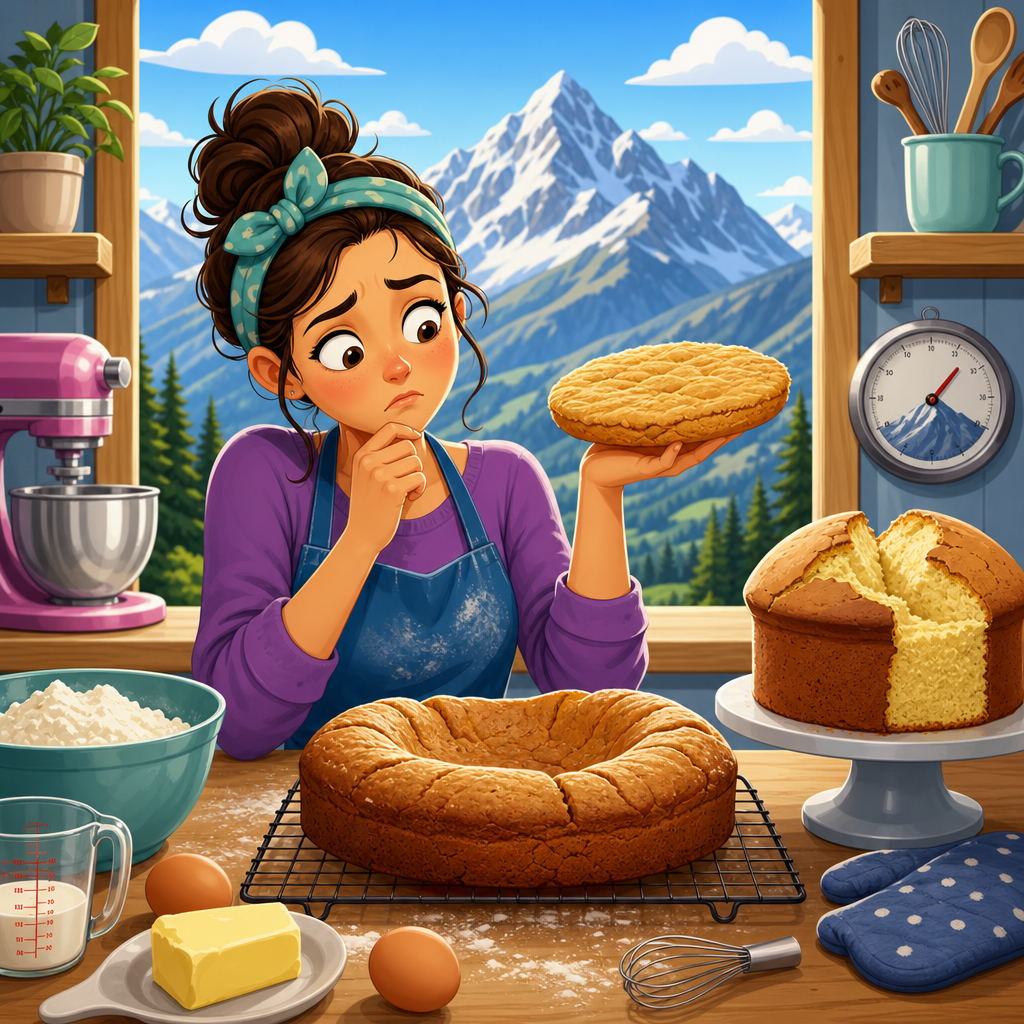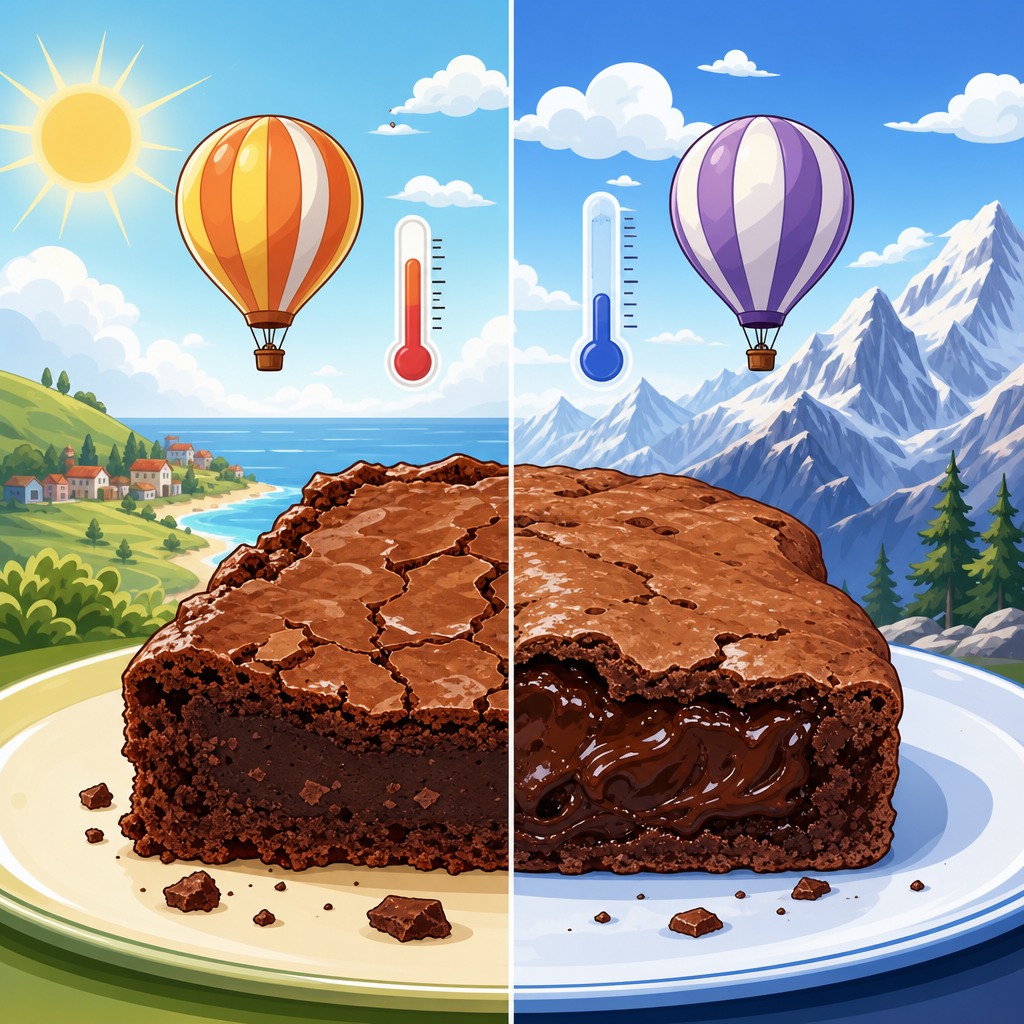
Brownies behave very differently at elevation, and the biggest contrast shows up between the edges and the centers. At sea level, a pan of brownies usually bakes with a predictable gradient: slightly firmer edges, a moist middle, and a top crust that sets without much drama. At altitude, that balance shifts. Lower air pressure changes how quickly moisture evaporates, how rapidly gases expand, how sugar concentrates, and how the batter sets. The result is a pan where the outer ring can turn dry, tough, over-risen, or greasy while the center remains underbaked, sunken, or oddly fragile.
When bakers talk about altitude baking, they generally mean elevations above about 3,000 feet, with more noticeable effects around 5,000 feet and higher. In practical terms, places like Denver, Santa Fe, Flagstaff, and mountain towns across the Rockies force brownie recipes to perform outside the conditions in which most cookbook formulas were tested. I have baked the same cocoa brownie formula in a lowland test kitchen and in a mountain kitchen near 7,000 feet; the differences were immediate. The high-altitude pan domed faster at the perimeter, developed a thicker crust earlier, and needed intervention before the middle had even begun to fully set.
This matters because brownies depend on a narrow structural window. Unlike layer cakes, they are not supposed to be airy. Unlike cookies, they are not supposed to dry out. A good brownie center should be dense, cohesive, and fudgy or chewy depending on style, while the edges should provide contrast without becoming hard. Understanding what altitude does to brownie edges versus brownie centers is the foundation of baking troubleshooting and workflow for this entire topic. Once you understand the mechanism, you can diagnose uneven texture, choose better pans, adjust oven temperature, and sequence your prep so the batter reaches the oven in the best possible state.
Key terms help. Brownie edges are the batter zone closest to the metal pan, where heat transfer is strongest and evaporation happens first. Brownie centers are the last part to reach setting temperature, and they are affected more by internal steam and dissolved sugar concentration than by direct pan contact. Structure comes from egg proteins, starch gelatinization in flour, and solidification of cocoa butter or butterfat as the brownies cool. Leavening can come from baking powder, chemical reaction in Dutch-process or natural cocoa formulas, or simply beaten eggs and steam. At altitude, every one of those variables becomes more sensitive, which is why a single problem often has more than one cause.
Why altitude exaggerates the difference between brownie edges and brownie centers
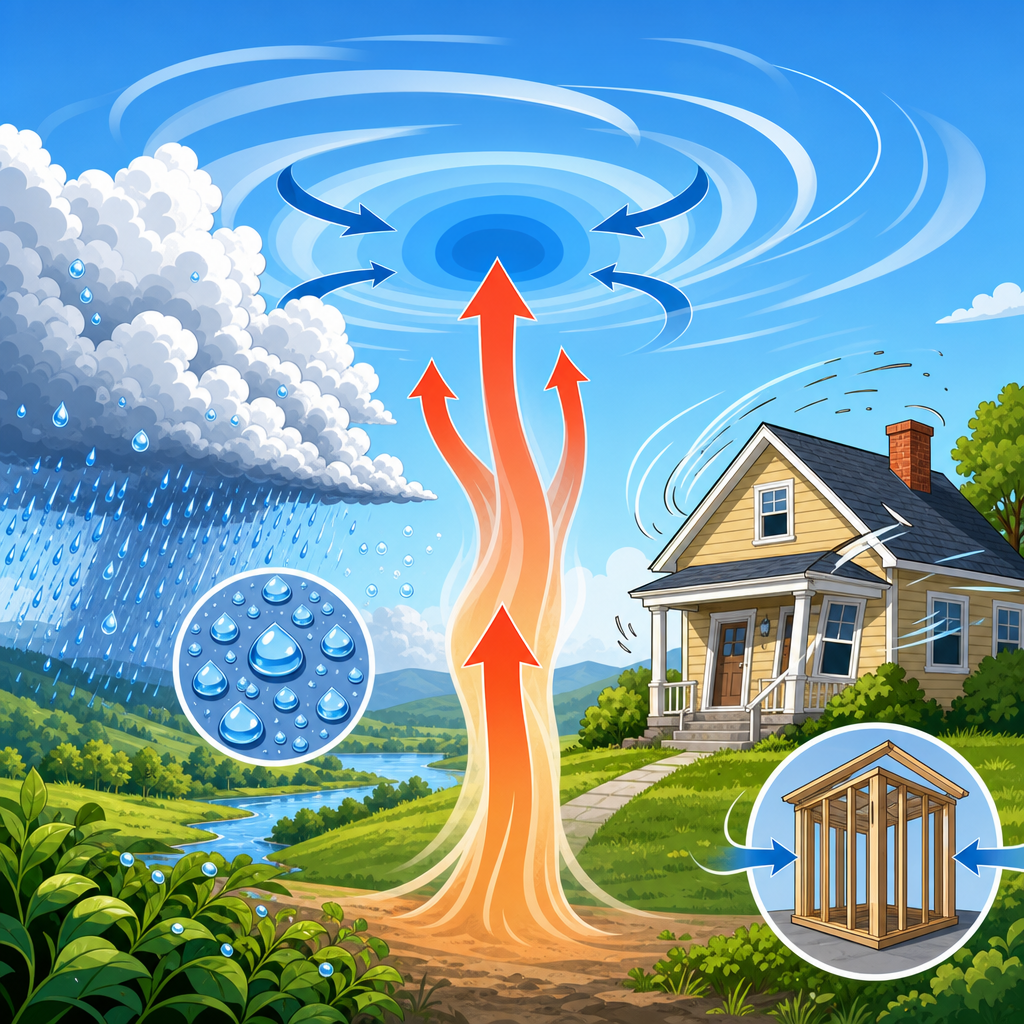
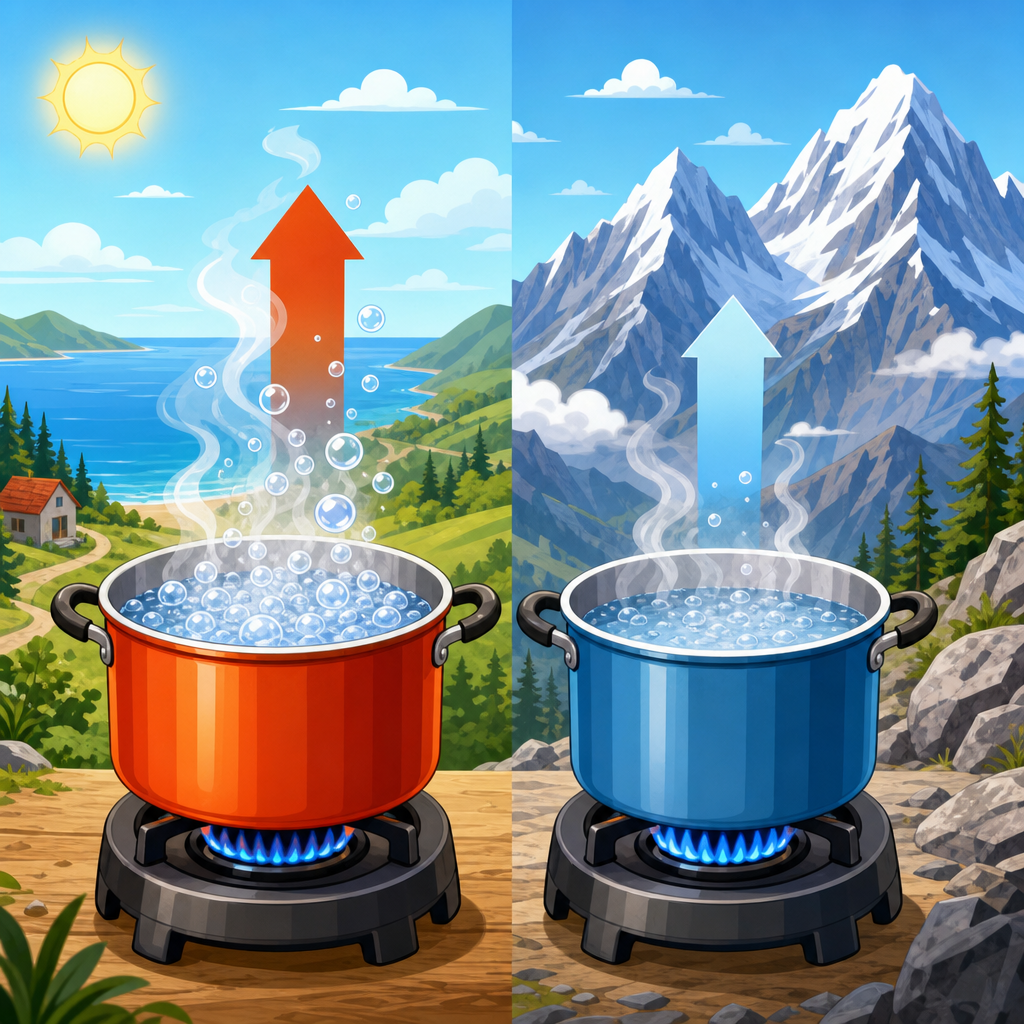
The main driver is lower atmospheric pressure. Water boils at a lower temperature as elevation rises, so moisture escapes more readily from the batter. At the same time, gases trapped in the batter expand faster. In brownies, this means the outer areas can rise and set before the center has enough time to stabilize. The edges are heated by the pan walls and bottom, so they lose moisture first. The center, insulated by surrounding batter, stays fluid longer. That difference exists at any elevation, but altitude widens it.
Sugar intensifies the effect. Brownie batter contains a high percentage of sugar relative to flour, and sugar delays coagulation and starch setting. In the center, that delay can be useful because it supports a dense, fudgy texture. At altitude, however, the center may remain molten while the edges push toward overbaked territory. I often describe it as a timing problem: the pan exterior reaches “done” before the middle reaches “safe to cool without collapse.” If you wait for the center, the edges toughen. If you pull the pan for the edges, the center may sink or smear into a pudding layer.
Fat distribution also matters. Butter melts early, and oil stays fluid through baking. In many brownie formulas, the edges can fry slightly against the hot pan if the batter is rich and the oven runs hot. That creates chewy, appealing corners at moderate altitude, but at higher elevations it can shift into greasy, brittle, or almost candylike edges. Meanwhile, the center may still look glossy and understructured because dissolved sugar and fat have not fully integrated into a finished crumb.
What happens to the edges: faster setting, more evaporation, and higher risk of toughness
Brownie edges at altitude typically set sooner, rise faster, and dry more quickly than the center. Because the metal pan transfers heat efficiently, the outer batter reaches protein-coagulation and starch-gelatinization thresholds earlier. That early set can lock in a thicker rim. In some pans, especially dark metal or glass, the edge temperature climbs enough to produce overbrowning before the interior catches up. You may see edges that pull away from the pan, become crumbly, or feel firm while still hot. After cooling, those same brownies can seem hard rather than pleasantly chewy.
Another common edge problem is exaggerated crust formation. The shiny top on brownies comes from dissolved sugar, egg proteins, and movement in the batter as it heats. At altitude, the edge crust can form and dehydrate before the center crust is established. That creates a pan with papery, crackly edges but a soft, fragile middle. In severe cases, the edge crust separates slightly from the interior, leaving a gap or flaky rim. Bakers sometimes misread this as success because the top looks attractive, yet the texture underneath is unbalanced.
Edges can also over-rise if the recipe includes too much leavening for the elevation. Chemical leaveners produce gas that expands more in lower pressure. The outer areas, already heating first, capture that expansion earliest. The edge then rises, domes, and sets. Once the center catches up and steam escapes, the perimeter may stay high while the middle falls, creating a concave slab. This is especially common in cakey brownie recipes that use baking powder. Fudgy formulas with little or no added leavener usually hold steadier, but they are not immune if eggs are whipped aggressively.
What happens to the centers: delayed setting, sinkage, and concentrated gooiness
The brownie center is the last zone to bake through, and altitude makes that lag more pronounced. Because moisture escapes readily and gases expand early, the center can puff before its structure is strong enough to hold shape. Then, as the brownies cool, the center collapses. This is not always underbaking in the simple sense. It can be a mismatch between expansion and structure. The batter rose beyond what egg proteins and flour could support, then deflated into a dense or sunken core.
Centers also tend to remain glossier and softer because sugar and fat stay fluid longer there. A small amount of underbaked softness is desirable in fudgy brownies, but altitude can push it too far. I have cut brownies that looked set at the perimeter while the middle clung to the knife in a paste-like band, even after a full cooling period. In those cases, the issue was not only time in the oven; it was excessive sugar concentration in the center after moisture migration, paired with insufficient protein setting.
Steam is part of the story. The center generates internal steam as water heats and evaporates. At higher altitude, that steam expands readily, then escapes. If the surface sets unevenly, pressure can crack the top or force the center upward temporarily. Once removed from the oven, the trapped steam dissipates and the middle settles. This is why brownies that seem perfectly level through the oven door can drop in the final minutes of cooling. A slight sink is normal in dense brownies. A deep crater is a sign that the center never built enough support.
Diagnosing edge-versus-center problems in a mountain kitchen
Effective brownie troubleshooting starts with pattern recognition. You do not fix dry edges and raw centers by guessing; you compare symptoms with likely causes and adjust one variable at a time. In my own workflow, I note pan material, batter temperature, mixing method, oven calibration, rack position, and cooling behavior before changing the formula. Brownie failures become predictable when you record them.
| Symptom | Most likely cause at altitude | Best first adjustment |
|---|---|---|
| Hard, dry edges and soft center | Oven too cool overall, forcing a long bake; moisture loss at perimeter | Raise oven temperature by 15 to 25°F and shorten bake time |
| High edges with sunken middle | Too much leavening or too much aeration | Reduce leavener slightly; mix less after eggs are added |
| Greasy edge band | Pan overheating or excess fat relative to flour and egg | Use light metal pan; add a small amount of flour |
| Gooey center that never cleans up | Sugar too high, center understructured | Decrease sugar modestly or add egg white/flour |
| Tough, cakey perimeter | Overmixing plus edge overbaking | Mix only to combine; insulate with parchment sling |
Pan choice is one of the most overlooked variables. Light-colored aluminum gives the most even brownie edge behavior because it conducts heat efficiently without the surface overheating as fast as dark metal. Glass bakes more slowly overall but can still overheat the perimeter by retaining heat, which is why brownies often continue firming at the edges after you pull the pan. Nonstick dark pans create the sharpest edge-center contrast at altitude. If your brownies repeatedly fail around the perimeter, changing the pan may solve more than changing the recipe.
Oven accuracy matters just as much. A home oven can be off by 25°F or more, and at altitude that error widens the gap between edge and center performance. An oven running cool encourages prolonged baking, which dries the edges while the center crawls toward doneness. An oven running hot can set the edge crust before the middle expands and then trigger a collapse. Use an independent oven thermometer and check for hot spots by rotating the pan about two-thirds through the bake if your oven heats unevenly.
Formula and workflow adjustments that keep the whole pan balanced
The most reliable way to protect brownie edges while finishing the center is to make the batter set sooner without making it airy. Start with temperature. A moderate oven increase, usually 15 to 25°F above the original recipe, helps the entire pan establish structure earlier and reduces the total bake time. This sounds backward to new altitude bakers, but it works because the center reaches setting temperature faster, so the edges spend less total time losing moisture. For many sea-level brownie recipes written around 325°F or 350°F, the high-altitude sweet spot is often one notch higher.
Next, control leavening and aeration. If the recipe contains baking powder, reduce it slightly at elevations above 5,000 feet. If there is no chemical leavener, pay attention to mixing. Whipping eggs and sugar to a thick foam can be useful in certain brownie styles, but too much incorporated air expands aggressively at altitude and destabilizes the center. I mix until glossy and uniform, not until ribbony. That preserves density and reduces doming at the edges.
Small formula changes are often enough. An extra tablespoon or two of flour can reinforce the center without turning the brownies cakey. A modest sugar reduction, especially in very sweet recipes, can help the middle set more cleanly. One extra egg white can improve protein structure when a formula repeatedly collapses in the center. Extra liquid is more nuanced. Some altitude guidance suggests adding water universally, but with brownies the better move is usually targeted: a little additional liquid helps if the crumb is dry throughout, not when only the edges are drying out.
Workflow matters because brownies are sensitive to delay. Once sugar is dissolved into warm butter or chocolate and eggs are mixed in, the batter should go into the pan and oven promptly. Letting it sit encourages sugar settling, bubble loss, and inconsistent top crust development. Prepare the pan first, preheat fully, and have your scale and ingredients ready before melting anything. Cool brownies in the pan only until the structure is stable, then use parchment to lift them out if residual pan heat is continuing to harden the edges. For mountain bakers, disciplined workflow is not optional; it is part of the recipe.
How this fits into baking troubleshooting and workflow across altitude recipes
Brownie edge-versus-center behavior is a useful hub problem because it teaches the same logic needed for bars, quick breads, cakes, and even cheesecakes at elevation. You are always balancing expansion, evaporation, and setting. If the perimeter finishes too early, look at pan conductivity, oven temperature, and total bake time. If the center collapses, look at structure, leavening, and sugar. Those principles connect directly to related troubleshooting topics such as tunneling in muffins, sunken cake centers, dry loaf edges, and crust separation in bar cookies.
The broader workflow lesson is to build repeatability. Use gram measurements. Record elevation, pan size, ingredient brand, and exact bake time. Note whether you used natural cocoa or Dutch-process cocoa, since acidity can affect leavening in some formulas. Track cooling time before slicing because brownies continue setting as they cool, especially in the center. Internal linking across an altitude baking resource should send readers from this hub to focused guides on oven calibration, pan selection, ingredient adjustment, and doneness testing, because all of those skills reinforce better brownie outcomes.
The practical takeaway is simple: altitude does not ruin brownies, but it magnifies the natural tension between edge and center. Once you understand why the edges bake faster, why the middle lags, and which adjustments bring them back into sync, troubleshooting becomes much easier. Start with a reliable pan, verify your oven, raise the baking temperature modestly, avoid excess aeration, and strengthen the center only as much as needed. Then keep notes and refine from batch to batch. If you want consistently fudgy centers and edges that stay chewy instead of hard, treat altitude baking as a workflow problem you can measure and improve, not a mystery.
Frequently Asked Questions
Why do brownie edges dry out faster than the centers at high altitude?
At high altitude, brownie edges lose moisture much faster than the centers because lower air pressure speeds up evaporation. The outer perimeter of the pan is already the part of the batter that receives the most direct heat, so once you add altitude into the equation, the edges are exposed to a double effect: stronger heat transfer from the pan and faster moisture loss into the drier, thinner air. That means the edge structure sets sooner, the sugar concentration rises faster in those areas, and the brownies can move from chewy to dry surprisingly quickly.
The center behaves differently because it is insulated by the surrounding batter. Even at elevation, it takes longer for the middle to heat through and fully set. This creates a bigger contrast across the pan than you would usually see at sea level. Instead of a gentle shift from slightly firmer edge to fudgy center, you may get a noticeably overbaked outer ring and a center that still seems underdone. That exaggerated difference is one of the clearest signs that altitude is affecting your brownies.
How does altitude change the texture difference between brownie centers and brownie edges?
Altitude tends to stretch the texture gap between the center and the edge. At sea level, brownies often bake into a fairly balanced pan: the edges are a little firmer, the middle stays moist, and the overall texture remains cohesive. At higher elevations, lower atmospheric pressure allows gases in the batter to expand more readily and moisture to evaporate sooner. As a result, the edges can set hard and lose tenderness before the middle has had enough time to fully bake.
That leaves you with a pan that may feel uneven in a more dramatic way. The center can be softer, looser, and more delicate, while the outer sections become cakier, crumblier, or even brittle depending on the formula. In some recipes, the top may crack more aggressively too, because the structure sets while the interior is still expanding. In practical terms, altitude often makes brownies less uniformly fudgy unless the recipe or baking method is adjusted to protect moisture and slow down edge overbaking.
Why can brownie centers seem underbaked at altitude even when the edges are done?
This happens because the pan does not bake evenly from edge to center, and altitude magnifies that normal pattern. The edges are in direct contact with the hot metal, so they heat and set first. Meanwhile, the center depends on heat gradually moving inward. At altitude, faster evaporation and quicker setting around the outside can make the perimeter look fully finished before the middle has reached the same stage of doneness.
There is also a structural issue. Since gases expand more easily at higher elevation, brownie batter can rise and shift internally before it has fully stabilized. If the recipe does not contain enough liquid, enough structural support, or the right baking time for your altitude, the middle may remain too soft while the edges continue firming up. That is why a pan can test paradoxically: dry-looking edges, a fragile center, and a texture that feels inconsistent. It does not always mean the brownies need much more time; often it means the recipe needs an altitude-specific adjustment so the whole pan sets more evenly.
What recipe or baking adjustments help keep brownie edges from overbaking while the centers finish properly?
The most effective fixes are aimed at slowing moisture loss and encouraging a more even set across the pan. A slight increase in liquid can help offset the faster evaporation that happens at altitude. Reducing the baking temperature a little can also be useful, because it gives the center more time to cook through before the edges become too firm. In many high-altitude kitchens, small changes make a real difference: a few extra tablespoons of liquid, a modest temperature reduction, or a slightly shorter bake time combined with careful doneness checks.
Pan choice matters as well. A lighter-colored metal pan usually browns more gently than a dark pan, which can overheat the edges. Some bakers also line the pan well and avoid placing it too close to the oven walls, where heat can intensify edge baking. If your recipe is very sugary or low in flour, the edges may become especially vulnerable because concentrated sugar and rapid moisture loss can make them set hard. In that case, a balanced adjustment to liquid and baking temperature is often more helpful than simply baking longer. The goal is not just to cook the center more; it is to protect the edges while giving the middle enough time to become dense, moist, and properly set.
How can you tell when high-altitude brownies are done without sacrificing either the edges or the center?
The key is to judge doneness by the whole pan rather than by the edges alone. At altitude, the edges often look finished early, so if you wait for the perimeter to appear fully dry and firm, the outer brownies may already be overbaked. Instead, look for a center that has mostly set but still retains a slight softness. A toothpick inserted near the middle should usually come out with moist crumbs rather than wet batter, especially if you want fudgy brownies. For very rich formulas, a few sticky crumbs are often ideal.
You should also watch the surface behavior. The top may develop a glossy crust and light cracking before the brownies are truly done, so visual cues should be combined with texture cues. Gently shaking the pan can help: if the center ripples like raw batter, it needs more time; if it has only a faint wobble, it is often close. Residual heat will continue to finish the center as the brownies cool, which is especially important at altitude. Pulling them at the right moment, rather than waiting for a completely firm middle in the oven, is one of the best ways to preserve chewy edges and a moist center at the same time.