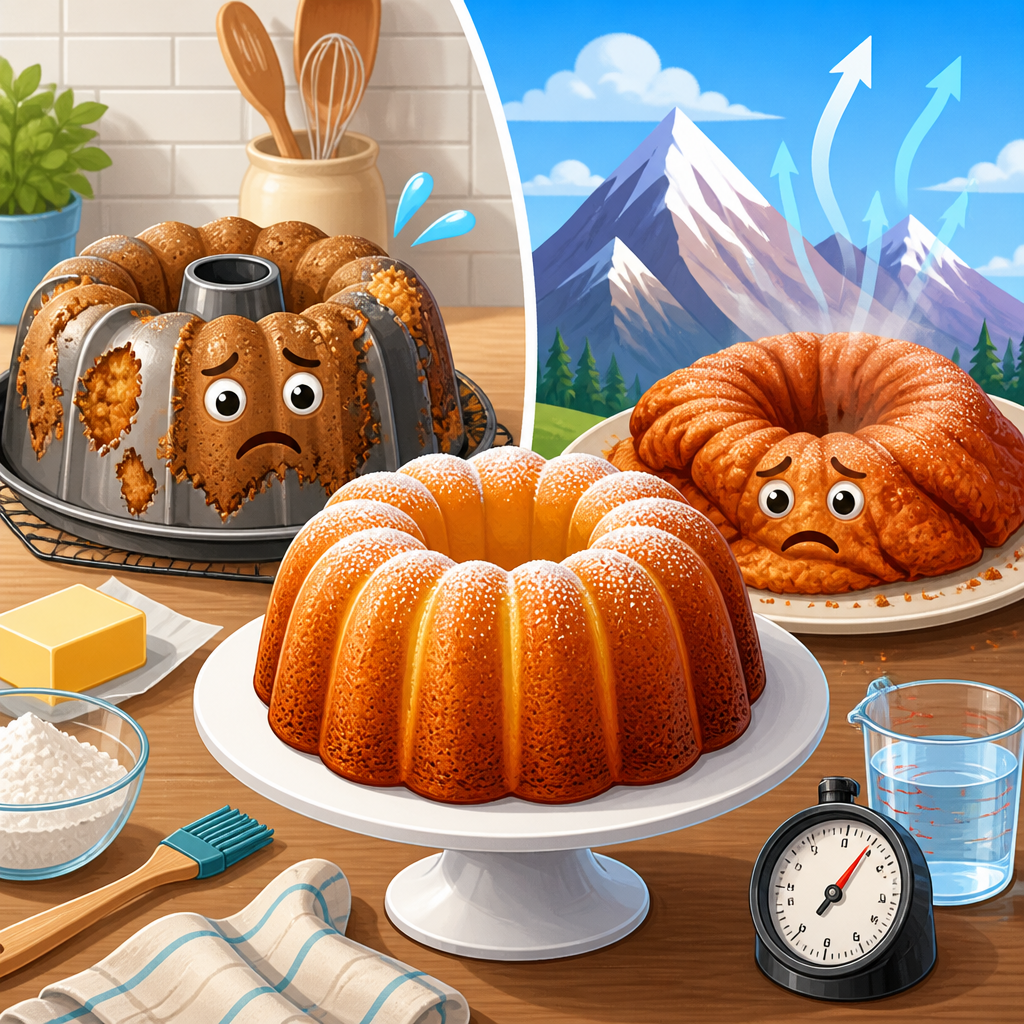
Bundt cakes can stick to the pan or collapse more easily at elevation because lower air pressure changes how batter rises, how moisture evaporates, how sugar concentrates, and how quickly structure sets in the oven. In practical terms, a cake formula that behaves predictably at sea level often overexpands, dries at the edges, and weakens in the center when baked at 3,000 feet, 5,000 feet, or higher. For anyone building confidence in high-altitude baking, this matters because Bundt cakes are less forgiving than layer cakes or sheet cakes: the pan is deeply contoured, the crumb must release cleanly from narrow curves, and the ring shape can hide underbaking until unmolding. Within the broader world of cakes and cupcakes, Bundt cakes sit at the intersection of chemistry and pan mechanics, making them one of the clearest examples of why altitude adjustments are necessary rather than optional.
When I test cake formulas above 5,000 feet, Bundt recipes reveal problems faster than almost any other style. A cupcake lets you see rise, cracking, and set at a glance. A Bundt pan traps those clues inside a heavier mass of batter, and the decorative creases increase the risk of adhesion if the crust softens or sugars caramelize too aggressively. Understanding the causes helps across the whole cakes-and-cupcakes category: butter cakes, oil cakes, sour cream cakes, pound cakes, chiffon cakes, and even denser fruit or chocolate cakes all respond to the same altitude forces, just with different levels of tolerance. If you can diagnose a Bundt cake at elevation, you can usually troubleshoot cupcakes, loaf cakes, and celebration layers with much better accuracy.
How elevation changes cake behavior
At higher altitude, atmospheric pressure drops. Water boils at a lower temperature, so moisture evaporates faster and gases in batter expand more readily. That means the bubbles created by creamed butter and sugar, chemical leaveners such as baking powder or baking soda, and steam all enlarge sooner and with less restraint. In a cake, that rapid expansion sounds helpful, but it often pushes the batter beyond what its protein-and-starch network can support. The cake rises fast, then the weakened cell walls stretch thin and collapse before the crumb fully sets.
This is why high-altitude cake recipes often reduce leavening, increase oven temperature slightly, add a little more flour, and sometimes reduce sugar or increase liquid. Each adjustment serves a structural purpose. Less leavener controls overexpansion. Slightly higher heat sets proteins and starch earlier. More flour strengthens the batter. Extra liquid offsets faster evaporation. Sugar deserves special attention because it is hygroscopic: it attracts water, delays starch gelatinization, and can leave a cake tender at sea level but fragile at altitude. In Bundt cakes, where the batter depth is substantial, those effects become pronounced.
Altitude does not affect every formula equally. A sturdy pound cake with high egg content and moderate chemical leavening usually fares better than a very light sour cream coffee cake loaded with sugar and baking powder. Cupcakes, because they are small, set quickly and can sometimes succeed with minimal changes. Tall layer cakes and Bundt cakes need more deliberate adjustment because the center remains fluid longer. If the top and outer ring set while the middle is still expanding, the result can be tunneling, a sunken ring, or a cake that looks done but drops after cooling.
Why Bundt cakes stick more often at altitude
Sticking is not only a greasing problem. It is usually the final symptom of several smaller failures: excess sugar concentration at the crust, inadequate pan preparation in tight grooves, underbaked interior crumb, or steam condensing as the cake cools in the pan. Bundt pans are designed with ridges, flutes, and narrow shoulders that create beautiful shapes but also create more surface area. More surface area means more places where syrupy batter can glue itself to metal if the crust softens before release.
At elevation, cakes lose moisture faster, yet paradoxically they can cling more. As water evaporates quickly, dissolved sugar becomes more concentrated along the pan walls. If the pan was not coated thoroughly with fat and flour, or with a reliable baking spray that contains flour, that concentrated sugar can caramelize and form tacky patches. Chocolate Bundt cakes are especially prone because cocoa solids absorb moisture and formulas often contain high sugar levels plus acidic dairy, which can keep crumb tender longer.
Cooling time also matters. A common sea-level guideline is to cool a Bundt cake 10 to 15 minutes before unmolding. At altitude, the ideal window can narrow. Too soon, and the crumb tears because the structure is fragile. Too late, and steam trapped between cake and pan condenses, then reabsorbs into the crust, causing sticking. I have had the cleanest releases with heavy aluminum pans from Nordic Ware, a brushed-on mixture of melted shortening and flour, and a cooling period long enough for the cake to firm but not enough for condensation to weld it in place.
Why Bundt cakes collapse at altitude
Collapse happens when expansion outpaces structure. In Bundt cakes, the central tube helps heat reach the middle, but the batter mass is still thicker than in cupcakes. At altitude, leavening gases expand more aggressively, so a recipe with 2 to 3 teaspoons of baking powder may perform beautifully at sea level and fail badly above 5,000 feet. The cake domes, climbs the sides, and then sinks as the starch-and-egg network cannot hold the inflated cells.
Sugar and fat intensify the risk. High-sugar cakes stay tender because sugar interferes with protein coagulation and starch gelatinization. High-fat cakes, especially those based on the creaming method, rely on tiny air cells beaten into butter. At altitude those cells become launch points for rapid expansion. Add weak oven calibration or opening the door too early, and the center falls. This is why dense-yet-moist Bundt favorites such as sour cream pound cake, cream cheese Bundt cake, and rich chocolate tunnel styles often need tighter process control than a simple vanilla cupcake.
Another overlooked cause is imbalance between baking soda and acid. If a recipe uses buttermilk, yogurt, brown sugar, molasses, or natural cocoa, the soda reaction can become very vigorous. At elevation, that initial burst may be enough to overinflate the cake before heat stabilizes it. Reducing baking soda by even one-eighth to one-quarter teaspoon can make the difference between a clean, even crumb and a sunken ring with coarse tunnels.
Core adjustments for high-altitude Bundt cakes, layer cakes, and cupcakes
The most reliable approach is systematic adjustment rather than guesswork. Start by changing one or two variables, keep notes, and compare crumb, rise, and release. In my test batches, the best results usually come from modest changes rather than dramatic rewrites. The exact numbers depend on altitude band, formula style, pan size, and oven performance, but the following ranges are dependable starting points for cakes and cupcakes.
| Issue | Typical altitude adjustment | Why it helps |
|---|---|---|
| Overrising and collapse | Reduce baking powder by 1/8 to 1/4 teaspoon per teaspoon; reduce baking soda slightly if formula is highly acidic | Limits gas expansion so the crumb can set before cell walls rupture |
| Dry edges, weak center | Increase liquid by 1 to 4 tablespoons depending on altitude and batch size | Offsets faster evaporation and supports starch gelatinization |
| Fragile crumb | Add 1 to 3 tablespoons flour per cup, or use higher-protein all-purpose flour | Strengthens structure and improves sliceability |
| Excess tenderness and sticking | Reduce sugar by 1 to 3 tablespoons per cup | Speeds setting, lowers syrup formation at the crust, and improves release |
| Late setting | Raise oven temperature by 15 to 25 degrees Fahrenheit | Helps proteins coagulate and starches set before overexpansion occurs |
These adjustments also help cupcakes, though the scale is smaller. Cupcakes usually need less reduction in leavening because their smaller volume sets quickly. Layer cakes often benefit from cake strips used cautiously; at altitude, too much insulation can delay edge setting and worsen collapse. Bundt cakes usually benefit most from pan preparation upgrades and batter strengthening because release is part of success, not an afterthought.
Pan preparation, mixing method, and baking process
For Bundt pans, preparation should be deliberate. Use a pastry brush to coat every groove with softened shortening, then dust with flour or fine cocoa for chocolate cakes. Nonstick spray can work, but sprays containing lecithin may build residue over time, creating sticky patches that sabotage future releases. Washing with hot water alone is not enough; residue needs periodic removal with a nonabrasive scrub. Heavy cast or aluminum Bundt pans release more predictably than thin, dark pans because they distribute heat more evenly and are less likely to overbrown the crust before the interior sets.
Mixing method affects altitude outcomes. The creaming method incorporates air, which is useful but can be excessive at elevation. Cream butter and sugar until lighter and slightly fluffy, not until the mixture resembles mousse. Overcreaming creates too many unstable bubbles. Once flour is added, mix only until combined; overmixing develops gluten unevenly and can produce tunnels. Oil-based Bundt cakes often perform more consistently at altitude because they contain fewer mechanically incorporated air cells, though they still need leavening adjustment.
Oven management is equally important. Verify temperature with a calibrated oven thermometer; many home ovens drift by 15 to 25 degrees. Position the Bundt pan on the center rack with space for air circulation. Do not open the oven in the first two-thirds of baking time. Test doneness with several cues: a skewer should come out with a few moist crumbs, the top should spring back lightly, and the internal temperature of most butter-based cakes should be around 205 to 210 degrees Fahrenheit. Underbaking is a leading cause of both sticking and post-cooling collapse.
How this applies across cakes and cupcakes
As a hub within cakes and cupcakes, Bundt troubleshooting connects directly to other formats. Cupcakes that peak sharply and then sink are showing the same overleavening pattern as a collapsed Bundt, only on a smaller scale. Layer cakes with gummy bottoms often need the same sugar reduction or oven increase. Pound cakes that crack excessively may be setting too fast on the outside and too slowly inside, which suggests balancing extra liquid with careful temperature control.
Different cake families respond differently. Foam cakes such as angel food and chiffon depend heavily on whipped egg structure; at altitude, they often need lower sugar and careful whipping to avoid dryness or collapse. Butter cakes need attention to creaming and leavening. Chocolate cakes often need extra liquid because cocoa absorbs water and can tighten the batter. Fruit-filled coffee cakes can sink in the center because fruit adds moisture and weight while the batter is already structurally stressed. For cupcakes, filling liners only one-half to two-thirds full is often safer at altitude than the classic two-thirds to three-quarters recommendation used at sea level.
The broader lesson is that altitude baking is pattern recognition. Once you identify whether the issue is overexpansion, delayed setting, moisture loss, or pan adhesion, you can correct the formula with purpose. Bundt cakes simply make those patterns obvious because their shape amplifies both success and failure.
Common mistakes and the fastest fixes
The most common mistakes are using a sea-level recipe unchanged, overfilling the Bundt pan, relying on visual browning instead of internal doneness, and skipping detailed notes. A pan filled beyond about two-thirds to three-quarters capacity leaves too little margin for altitude rise. Another frequent error is substituting ingredients without accounting for chemistry, such as swapping Dutch-process cocoa for natural cocoa in a recipe balanced around baking soda. That change alters acidity and can shift rise dramatically.
If a Bundt cake sticks, first evaluate whether it was underbaked or cooled too long before unmolding. If it collapses, cut back leavening and slightly raise heat on the next bake. If it seems dry yet still falls, add liquid and reduce sugar modestly rather than baking longer. For cupcakes, lower the fill level, shorten bake time, and verify that the center reaches doneness before the tops darken. Keep a baking log with altitude, ingredient brand, pan material, oven temperature, batter depth, and result. That record becomes more valuable than any generic rule.
Mastering Bundt cakes at elevation builds confidence for the entire cakes-and-cupcakes category because it teaches the core principles that govern every high-altitude batter. Lower air pressure speeds expansion, faster evaporation shifts moisture balance, and delayed structural setting creates the twin risks of sticking and collapse. Bundt pans add another layer of difficulty through deep contours and thicker batter mass, which is why they expose weaknesses quickly. The solution is not mystery or luck. It is controlled adjustment: slightly less leavening, a bit more liquid or flour when needed, moderate sugar, accurate oven heat, thorough pan preparation, and careful cooling before release.
For home bakers and recipe developers alike, the payoff is substantial. Once you learn to read these signals in a Bundt cake, you can apply the same logic to cupcakes, layer cakes, loaf cakes, pound cakes, and celebration bakes across your high-altitude kitchen. Start with one trusted recipe, change only a few variables at a time, and document the results. That disciplined approach produces cakes that rise evenly, unmold cleanly, and keep their structure from oven to serving plate. If you are building your skills in cooking and baking at altitude, use this hub as your foundation, then test the techniques across every cake style you bake next.
Frequently Asked Questions
Why do Bundt cakes stick to the pan more often at high altitude?
Bundt cakes tend to stick more often at elevation because high altitude changes both the batter and the way the cake bakes against the contours of the pan. As air pressure drops, moisture evaporates faster and the outer portion of the cake can set and dry more quickly while the interior is still rising. That uneven timing matters in a Bundt pan, where all the ridges, curves, and center tube create more surface area and more opportunities for delicate cake crumb to grab onto the metal. At the same time, batter at altitude often rises faster and more aggressively, which can push it into the fine details of the pan before the structure is strong enough to release cleanly later.
Another factor is sugar concentration. Because liquids evaporate more readily at 3,000 feet, 5,000 feet, and above, sugars can become more concentrated near the surface during baking. That can contribute to a tackier exterior that is more prone to clinging if the pan was not thoroughly prepared. In practical terms, even a recipe that unmolds beautifully at sea level may need more careful pan greasing, a flour-based baking spray, or a butter-and-flour coating at elevation. Letting the cake cool for the right amount of time also matters: too short and the crumb is fragile, too long and the sugars can firm up and bind to the pan. For high-altitude Bundt success, pan preparation becomes less of a minor step and more of a critical part of the formula.
Why are Bundt cakes more likely to collapse in the center at elevation?
Collapse usually happens because the cake rises faster than its internal structure can support. At higher elevations, lower air pressure allows the gases in the batter to expand more easily, so the cake can balloon upward before the proteins from eggs and flour and the starches in the batter have fully set. That creates a classic high-altitude problem: impressive rise early in baking followed by sinking as the center cools or loses support. Bundt cakes are especially vulnerable because their shape encourages a ring of cake with a wide exposed surface but still leaves enough interior mass that the middle of the crumb can lag behind the outside in setting.
The issue is often made worse by a formula that is slightly too weak for altitude. Too much leavener, too much sugar, or too much liquid can all create a batter that expands dramatically and then falls. Sugar tenderizes and delays structure setting, while excess liquid can keep the center soft for too long. If oven temperature is even slightly low, the cake may continue overexpanding before the crumb firms up. That is why high-altitude adjustments often involve reducing baking powder or baking soda a bit, slightly increasing oven temperature, and occasionally strengthening the batter with a touch more flour or an extra egg white depending on the recipe. The goal is not to stop the cake from rising, but to make sure the rise and the setting happen in better balance.
How does lower air pressure change the way a Bundt cake batter behaves?
Lower air pressure affects nearly every stage of baking, from mixing to rise to final texture. In the bowl, a high-altitude batter may seem normal, but once it enters the oven, gases from air bubbles, steam, and chemical leaveners expand more readily than they do at sea level. That means the batter can rise earlier and faster, often before the cake’s structure has had time to stabilize. For a Bundt cake, that rapid expansion can be a problem because the batter is expected to flow into a decorative pan evenly and then bake into a firm yet tender shape that unmolds cleanly. If the rise outpaces the setting of the crumb, the result may be tunnels, coarse texture, a domed top, sticking, or collapse.
Moisture loss also becomes more noticeable at altitude. Water boils at a lower temperature, so evaporation happens sooner and more quickly. The edges and outer surfaces of the cake can dry out before the center is fully baked, which leads to competing problems at once: a crust that is firmer and more adhesive to the pan, and an interior that may still be fragile. This is one reason Bundt cakes can feel less forgiving than flatter layer cakes in mountain baking. Their pan geometry amplifies the effects of fast evaporation and rapid rise. Understanding that lower air pressure changes expansion, evaporation, and structure setting all at once helps explain why even a reliable sea-level Bundt formula may need thoughtful changes to perform well higher up.
What recipe adjustments help prevent sticking and collapsing in high-altitude Bundt cakes?
The best adjustments depend on the exact recipe and elevation, but a few principles consistently help. First, reduce the leavening slightly if the cake is rising too fast and then falling. At altitude, the same amount of baking powder or baking soda can produce more lift than intended, so trimming it can improve stability. Second, consider a modest increase in oven temperature, often by about 15 to 25 degrees Fahrenheit, to help the cake set sooner before it overexpands. Third, if the batter seems too weak or too tender, a little more flour can strengthen the structure, and in some recipes reducing sugar slightly can also help because sugar delays setting and can make the crumb more fragile.
Moisture management is equally important. Because high-altitude cakes lose water faster, many bakers add a bit more liquid to keep the crumb from drying out before the center is done. That sounds counterintuitive when collapse is also a concern, but the key is balance: enough moisture to prevent a dry, overbaked exterior, but not so much that the middle stays under-set. For sticking, use meticulous pan preparation. Coat every groove and the center tube thoroughly, then add flour or use a baking spray that contains flour. Avoid letting grease pool in the details, since uneven coating can actually encourage patches of sticking. Finally, allow the cake to cool briefly in the pan, usually just long enough for it to firm up but not so long that it bonds to the surface. High-altitude Bundt baking is often about making several small corrections rather than one dramatic fix.
How can I tell whether my Bundt cake problem is caused by altitude or by another baking issue?
Altitude is the likely culprit when the same recipe works well at sea level but becomes unreliable as you bake at 3,000 feet, 5,000 feet, or higher, especially if you notice a pattern of over-rising, center sinking, dry edges, coarse crumb, or stubborn sticking. Those are classic signs that lower air pressure and faster evaporation are changing how the batter behaves. If the cake balloons high and then drops, the formula may be too weak for your elevation. If the outside browns and firms quickly while the inside remains delicate, rapid moisture loss and delayed internal setting may be part of the problem. If sticking happens even with recipes you trust, altitude may be increasing surface drying and sugar concentration enough to make release more difficult.
That said, not every Bundt cake issue is caused by elevation alone. Underbaking, inaccurate oven temperature, overmixing, expired leaveners, poor pan preparation, and unmolding at the wrong time can create very similar results. The best way to diagnose the cause is to look for patterns and make one adjustment at a time. Check oven accuracy with a thermometer, measure ingredients carefully, and note whether the cake consistently rises too fast, dries too much at the edges, or collapses despite testing done-ness properly. If small high-altitude changes such as reducing leavening, increasing oven temperature slightly, and strengthening pan prep improve the outcome, that is strong evidence that elevation was the main factor. In other words, altitude usually does not create entirely new problems; it magnifies the weak points already present in a recipe.