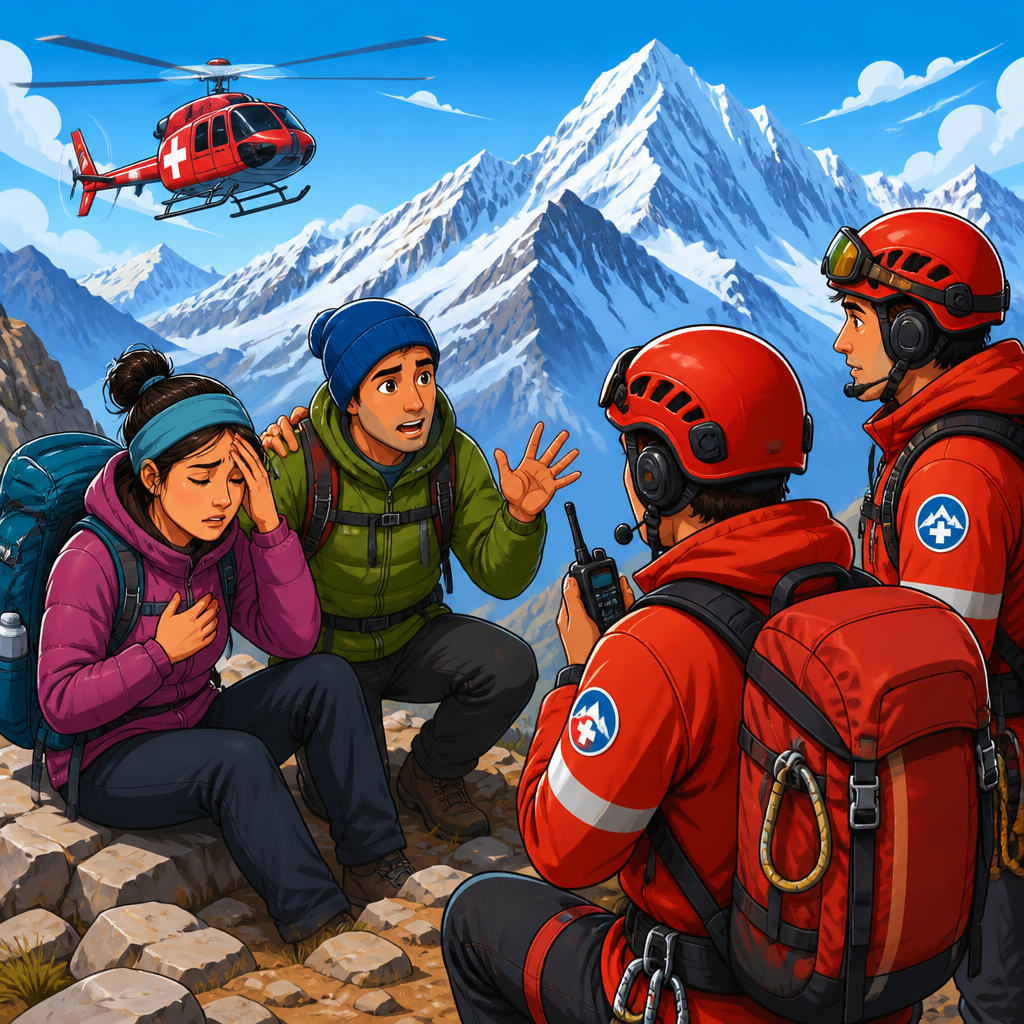
How to communicate suspected altitude illness to mountain rescue teams starts with a simple principle: the clearer your report, the faster rescuers can judge risk, prioritize resources, and guide treatment before they reach you. Altitude illness is the umbrella term for medical problems caused by reduced oxygen at elevation, mainly acute mountain sickness, high altitude cerebral edema, and high altitude pulmonary edema. In practice, the distinction matters because symptoms that seem mild at first can progress quickly, especially when a tired team underestimates confusion, breathlessness, or loss of coordination. I have handled incident briefings where one accurate radio call changed the outcome, because rescuers knew whether to advise immediate descent, oxygen, dexamethasone, nifedipine, or rapid evacuation. This article explains how to report suspected altitude illness clearly, what rescue teams need to know, how descent and treatment decisions are made, and how this emergency response topic connects the wider altitude illness and acclimatization journey.
Communication failures are common in the mountains because cold, wind, fatigue, language barriers, and patchy signal degrade judgment just when precision matters most. A vague message such as “my friend feels bad” forces rescuers to spend valuable minutes extracting basics that should have been delivered first. A useful report names the patient, location, altitude, symptoms, timeline, mental status, breathing status, mobility, weather, and what treatment has already been given. That level of detail helps rescuers separate uncomplicated acute mountain sickness from potentially fatal brain or lung edema. It also supports the key emergency question: can the patient descend with assistance, or do they need immediate rescue support where they are? Because this page is the hub for descent, treatment, and emergency response, it lays out the practical framework that supports every related decision in the field.
What mountain rescue teams need in the first report
When you contact mountain rescue, think in terms of a structured handoff rather than a distress message. The first report should answer six questions in order: who is ill, where are they, what is happening, when did it start, what has changed, and what support is needed now. Give the patient’s age, sex, relevant medical history if known, current altitude, exact location using map reference, GPS coordinates, route name, or landmark, and whether the party is moving or stationary. State the suspected condition directly: “possible high altitude cerebral edema” is more useful than “acting strange.” Rescue coordinators do not need certainty; they need a reasoned suspicion.
Symptoms should be described in plain observable terms. Instead of saying “he looks rough,” say “severe headache, vomiting twice, stumbling, cannot walk heel to toe, answers slowly, does not know the date.” Instead of “short of breath,” say “breathless at rest, respiratory rate around 32, coughing pink frothy sputum, cannot lie flat.” Those details point toward cerebral or pulmonary edema and trigger higher urgency. If you have objective measures, include them: pulse oximeter reading, heart rate, respiratory rate, temperature, blood glucose if checked, and level of consciousness. Numbers are not required to launch a rescue, but if they are available and credible, they sharpen triage significantly.
Rescuers also need the timeline because altitude illness is pattern based. Explain the ascent profile: starting altitude, sleeping altitude for the last two nights, highest altitude reached, rate of gain, rest days, and any recent rapid ascent. Mention exertion, dehydration, alcohol, sedatives, or respiratory infection, because these factors complicate assessment. I have seen teams focus on one dramatic symptom and forget the key clue that the patient slept 1,000 meters higher than the previous night. That omitted fact can explain why an apparently fit climber is now deteriorating. The more complete the timeline, the easier it is for rescuers to judge whether immediate descent is mandatory or whether guided self-evacuation is still safe.
How to distinguish the main altitude illnesses during a rescue call
Mountain rescue teams do not expect callers to diagnose perfectly, but they do expect them to report symptom clusters accurately. Acute mountain sickness usually presents with headache plus one or more of the following after recent ascent: nausea, fatigue, dizziness, poor sleep, and loss of appetite. Mild cases may improve with rest, fluids, light analgesia, and holding altitude. Severe symptoms, worsening headache, repeated vomiting, or inability to function move the case beyond a routine discomfort report. During the call, say whether the patient can drink, walk, think clearly, and keep down medication. Those facts often matter more than a generic severity label.
High altitude cerebral edema is a progression marked by brain dysfunction caused by altitude exposure. The two field signs that most strongly concern rescue teams are altered mental status and ataxia. Altered mental status includes confusion, unusual behavior, disorientation, irritability, drowsiness, and reduced responsiveness. Ataxia means loss of coordination, often obvious when the patient walks unsteadily, staggers, or cannot perform a simple straight-line walk. If either is present at altitude, assume a serious emergency. Report exactly what you observed, not your interpretation alone. “She put her boots in the stove vestibule, cannot explain where we are, and falls to the left when standing” is powerful, actionable information.
High altitude pulmonary edema is fluid accumulation in the lungs and can kill quickly if descent is delayed. Key warning signs are breathlessness at rest, persistent cough, reduced exercise tolerance out of proportion to the route, crackles or rattling in the chest if heard, bluish lips, and sometimes pink frothy sputum. Patients may first report that they cannot keep up with the group, then become breathless in camp, then struggle to speak in full sentences. Rescue teams will want to know whether symptoms improve when sitting upright, whether the patient can walk even a few steps, and whether supplemental oxygen is available. These details guide advice while rescue assets are mobilized.
How to give a concise, high-value rescue handoff
A good rescue handoff is short, ordered, and specific. Use a calm structure and stick to observable facts. If signal is weak, the opening thirty seconds are critical. Lead with the severity, exact location, and immediate danger. Then move into symptoms, timeline, and actions taken. Avoid rambling background details before the essentials are delivered. In training scenarios, the clearest callers usually think like expedition leaders: they front-load location, number of patients, ability to descend, and red-flag symptoms.
| Information rescuers need | Good example | Why it matters |
|---|---|---|
| Exact location | “North side of Cho La approach, 27.9321, 86.8154, near yellow prayer flags, 5,240 m” | Speeds route planning and avoids search delays |
| Primary problem | “Suspected HACE: confusion and severe ataxia after rapid ascent” | Sets urgency and likely treatment advice |
| Breathing status | “Breathless at rest, RR 30, wet cough, cannot walk ten meters” | Suggests possible HAPE and evacuation priority |
| Timeline | “Symptoms started last night, markedly worse over four hours” | Shows progression and instability |
| Treatment given | “Oxygen at 2 L/min, dexamethasone 8 mg, starting assisted descent” | Prevents duplication and guides next steps |
| Scene factors | “Snowing, 40 km/h wind, one non-ambulatory patient, four helpers” | Determines extraction method and safety |
One practical script works well: “We have one suspected altitude illness patient at [location and altitude]. Main concern is [HACE, HAPE, or severe AMS]. Symptoms started [time] after ascending from [previous sleeping altitude]. Current findings are [mental status, walking ability, breathing status]. We have given [treatment]. The patient is [able or unable] to descend. Weather is [conditions]. We need [telephone advice, stretcher team, helicopter if available, or coordination with local guides].” This format is easy to remember and lets the dispatcher ask focused follow-up questions. If English is not your first language, prewritten prompt cards or phone notes can make a major difference under stress.
Descent decisions: what to report and why it changes everything
Descent is the single most important intervention for serious altitude illness, and rescue teams will make early decisions around whether descent is possible immediately, safely, and fast enough. Report who can assist the patient, what terrain lies below, whether there is a trail or technical ground, how far the next lower sleeping altitude is, and whether darkness, avalanche hazard, rockfall, or storm exposure blocks movement. A patient with headache and nausea who can walk with support is a different rescue problem from a confused patient above a glacier section in high wind. The illness may be similar, but the extraction strategy is not.
Explain whether the patient worsens with exertion. In pulmonary edema, even short movement can sharply increase breathlessness, so rescuers may advise oxygen first, slower descent, or minimizing load. In cerebral edema, the danger is impaired judgment and inability to self-protect; a patient may insist they are fine while falling repeatedly. I have seen companions delay descent because the patient was “still talking,” even though they could not walk a straight line. For rescue teams, that is already enough to treat the case as a time-critical altitude emergency. Clear reporting helps prevent lethal optimism.
If a portable hyperbaric chamber, bottled oxygen, or medications are available, mention them immediately. These resources do not replace descent, but they can stabilize a patient while evacuation is organized. For example, oxygen often improves pulmonary edema symptoms rapidly, whereas dexamethasone can produce noticeable neurological improvement in cerebral edema. Rescue teams still need to know whether that improvement is partial or sustained, because treatment response does not eliminate the need for descent and medical review. Report changes every fifteen to thirty minutes if you remain on scene and communication allows.
Treatment information that mountain rescue teams expect
Mountain rescue teams need an exact record of treatment already given because dosage, timing, and response shape the next steps. State the name of each medication, dose, route, and time. For suspected cerebral edema, callers may report dexamethasone; for pulmonary edema, nifedipine may be relevant in some settings; for uncomplicated headache, acetaminophen or ibuprofen may have been used. Acetazolamide can support acclimatization and mild acute mountain sickness management, but it is not the primary emergency treatment for cerebral or pulmonary edema. Saying only “we gave altitude meds” is not enough.
Oxygen details matter. Report whether oxygen is continuous or intermittent, at what flow rate, and whether the patient improved. If you have a pulse oximeter, give serial readings rather than a single number, because trend is more informative than one isolated value. A saturation of 68 percent at extreme altitude may look alarming but needs context; equally, a seemingly acceptable reading does not rule out severe illness if the patient is confused or breathless. Rescue teams interpret oximetry alongside symptoms, altitude, cold exposure, and device reliability. Cold fingers, poor perfusion, nail polish, and cheap sensors all reduce accuracy.
Hydration, urination, and recent food intake are also worth reporting, but carefully. Dehydration can worsen headache and fatigue, yet forced overhydration is not an altitude treatment and can create other problems. Mention vomiting frequency, whether the patient can sip fluids, and whether they have urinated normally. Report other possible diagnoses honestly: stroke, hypothermia, intoxication, infection, asthma, heart disease, carbon monoxide exposure from a stove, and trauma can mimic or coexist with altitude illness. Rescue teams appreciate balanced observation because real incidents are often messy and mixed, not textbook-pure.
Common communication mistakes that delay rescue
The most common mistake is underreporting neurological changes. Teams often call only when the patient cannot move, even though subtle confusion and ataxia were present hours earlier. Another mistake is framing the problem as exhaustion without describing rest symptoms. A climber who is merely tired improves when stationary; a patient with pulmonary edema may remain breathless while sitting still. A third mistake is omitting ascent history. Rescue teams repeatedly hear, “we only went a little higher,” when the sleeping altitude gain was actually large enough to explain the emergency. Precision beats reassurance every time.
Poor location reporting is another major source of delay. “Near the ridge” or “close to base camp” can cover a huge area. Use coordinates, map references, trail junction names, camp names, or obvious terrain features, and confirm them by repeating back what the dispatcher heard. If communication is intermittent, send the essentials by text as well, because messages sometimes transmit when calls fail. Keep your phone warm to preserve battery, switch to low-power mode, and nominate one communicator so the story stays consistent. Multiple callers with conflicting versions can create confusion in the rescue coordination center.
Finally, do not overstate capability. If the patient cannot descend safely, say so plainly. Some groups fear embarrassment or helicopter cost and downplay severity, then the patient collapses mid-descent. Others demand air rescue when a supported walkout is safer and faster. Mountain rescue teams make better decisions when callers describe reality rather than preference. Their job is to match the response to the actual medical and environmental risk.
Building a reliable emergency response plan before the climb
The best altitude emergency communication starts before anyone gets sick. Every team should know local rescue numbers, radio channels if used, nearest clinics, helicopter limitations, weather patterns, and whether insurance covers high-altitude evacuation. Carry a written medical card for each member with allergies, medications, major conditions, and emergency contacts. Preload offline maps, mark likely camps and descent options, and agree on objective turnaround and descent triggers. On commercial expeditions, these systems should be rehearsed, not assumed. On independent trips, they matter even more because there is no built-in safety net.
Preparation also means agreeing on observation standards. Decide who checks gait, mental status, respiratory effort, urine output, and symptom progression if someone becomes unwell. A simple notebook or phone log with times, medications, pulse, respiratory rate, and location can transform a chaotic scene into a clear medical handover. That documentation is invaluable not only for rescuers but also for clinics receiving the patient later. Across altitude medicine, descent, treatment, and emergency response are linked: early recognition makes descent earlier, earlier descent reduces treatment burden, and better communication improves emergency outcomes. Review your team plan now, build a reporting template, and make sure every climber can use it before the next high camp.
Frequently Asked Questions
What information should I give mountain rescue first if I suspect altitude illness?
Start with the essentials rescuers need to assess urgency and make decisions quickly: your exact location, the patient’s condition, and what changes are happening right now. Give the best location you can, including mountain name, trail or route name, camp or hut name, GPS coordinates if available, altitude, and whether you are above or below key landmarks such as a ridge, pass, glacier, or junction. Then describe the patient clearly: age, sex, relevant medical history if known, current altitude, highest altitude reached recently, how quickly they ascended, and whether they slept at altitude. After that, explain the symptoms in plain language and in order. Mention headache, nausea, vomiting, dizziness, unusual fatigue, confusion, poor coordination, breathlessness at rest, chest tightness, cough, pink or frothy sputum, bluish lips, or inability to walk normally. Rescue teams also want to know whether symptoms are getting better, worse, or staying the same, and whether the person can still descend under their own power.
Be especially clear about red-flag signs that suggest severe altitude illness rather than routine discomfort. If the person is confused, drowsy, staggering, collapsing, very short of breath while resting, coughing up fluid, or becoming less responsive, say that immediately. Those features may point to high altitude cerebral edema or high altitude pulmonary edema, which can deteriorate fast and usually demand rapid descent and higher-priority rescue planning. Finally, report what you have already done: descent started or not, oxygen given, medications used such as acetazolamide, dexamethasone, or nifedipine, shelter status, weather at your location, number of people in the party, and your communication method and battery life. A structured first report helps rescuers judge seriousness before they arrive and allows them to give better instructions right away.
How can I describe symptoms so mountain rescue can tell whether it may be mild altitude sickness or a more serious emergency?
Use simple, observable descriptions rather than vague labels. Instead of saying “they’re not doing well,” say “they have a severe headache, vomited three times, cannot walk in a straight line, and are confused about where they are.” That kind of report is much more useful because rescue teams often sort altitude illness by the pattern of symptoms and the speed of decline. Mild acute mountain sickness commonly begins with headache, nausea, fatigue, poor appetite, lightheadedness, and trouble sleeping. Those symptoms matter, but they do not carry the same immediate risk as changes in brain function or breathing at rest.
Signs that suggest a more dangerous situation should be emphasized clearly and repeated if needed. For possible high altitude cerebral edema, report confusion, unusual behavior, poor balance, clumsiness, slurred speech, inability to follow instructions, increasing drowsiness, or loss of consciousness. For possible high altitude pulmonary edema, report breathlessness while resting, fast breathing, worsening cough, crackling sounds in the chest if heard, inability to lie flat comfortably, blue or gray lips, and any pink or frothy sputum. It also helps to compare the patient to their normal baseline: “Normally very fit and alert, now needs support to stand and answers slowly.” Mountain rescue teams rely on these details to separate fatigue, dehydration, and mild altitude sickness from conditions that may become life-threatening if descent is delayed.
What details about altitude, timing, and recent travel matter most in a rescue call?
Altitude illness is strongly tied to how high someone is, how fast they got there, and how symptoms changed over time, so those details are central to an effective report. Tell rescuers your current altitude, the highest altitude reached during the trip, where the patient slept over the last several nights, and how quickly the ascent happened. For example, “We slept at 2,800 meters, climbed to 4,100 meters today, and symptoms started two hours after arrival” is far more useful than “We went higher and they got sick.” Include whether the patient improved at lower altitude before and worsened again after re-ascent, because that pattern can be important.
Timing matters just as much as height. Report when symptoms first appeared, what the first symptom was, and whether the decline has been steady or sudden. If the patient became much worse overnight, after exertion, or after moving to a higher camp, say so. Also mention factors that can confuse the picture, such as dehydration, alcohol use, exhaustion, cold exposure, infection symptoms, or head injury, because rescue teams must consider other problems alongside altitude illness. A clear timeline allows rescuers to estimate progression, decide whether the patient may still walk out safely, and determine what equipment and personnel they should bring.
Should I mention treatments already given, even if I am not sure they worked?
Yes. Always tell mountain rescue what treatment has already been started, when it was given, and what happened afterward. This includes descent attempts, rest, shelter, warming, hydration, oxygen, portable hyperbaric bag use, and any medications. If medication was given, specify the name, dose if known, and time. For example, saying “we gave dexamethasone 8 mg at 14:30 and started descent 30 minutes later” is much more valuable than simply saying “we gave something for altitude.” If the person is on regular medicines or has allergies, include that too.
Even if the treatment seemed to do little, that information still helps rescue teams interpret the situation. A patient with severe symptoms who does not improve with oxygen or descent may need a different level of response than someone who improves quickly after losing a few hundred meters. Likewise, partial improvement can still point strongly toward altitude illness. Rescue teams also need to know practical limitations: how much oxygen remains, whether the patient can swallow, whether vomiting prevents oral medication, whether weather is blocking descent, and whether the group can continue moving safely. Reporting treatments honestly prevents duplication, supports better medical advice over the radio or phone, and helps rescuers arrive prepared for the next step rather than repeating what has already failed.
How should I communicate if conditions are chaotic, the signal is poor, or I am stressed?
Keep your report short, structured, and repeatable. A simple format works well: location, patient, symptoms, severity, actions taken, hazards, and callback plan. For example: “We are on the north side of Mount X at 4,250 meters, near the upper lake, GPS follows. One 34-year-old male. Severe headache, confusion, cannot walk straight, worsening over two hours. We have started descent and gave oxygen. Weather is windy with poor visibility. Three people in group. Phone battery 18 percent. Please repeat back instructions.” This kind of organized message is easier for rescuers to understand the first time, especially when audio is broken or interrupted.
If the signal is weak, prioritize the most decision-critical details first: exact location, whether the patient can walk, mental status, breathing status, and whether symptoms are worsening. Speak slowly, use plain language, and avoid guessing when you do not know the answer. If you are uncertain, say “I’m not sure” rather than filling gaps with assumptions. Have another group member listen and confirm facts if possible. Write key points down before calling so you do not forget them under stress. If you lose contact, try to send the same information by text or satellite messenger, because written messages often succeed when voice calls fail. The goal is not a perfect medical report. It is a clear, actionable picture that lets mountain rescue judge urgency, guide immediate care, and reach you with the right plan.