Why your crust hardens too fast at altitude comes down to a mix of lower air pressure, faster moisture loss, and bread formulas that behave differently once you move above roughly 3,000 feet. In high-altitude baking, water boils at a lower temperature, dough dries faster, fermentation can speed up or become erratic, and the outside of a loaf can set before the interior has fully expanded. For yeast breads and sourdough, that means a crust that turns rigid, thick, or leathery too early, limiting oven spring and leaving the crumb tighter than it should be.
I have worked through this problem in home kitchens from the Front Range to mountain towns above 7,000 feet, and the pattern is consistent: bakers often blame the oven alone, when the real issue starts much earlier with dough hydration, proofing control, and heat management. This matters because crust setting is not just cosmetic. The timing of crust formation determines loaf volume, ear development, bloom, sheen, chew, and how long bread stays pleasant to eat. A boule with a crust that hardens too fast may look dark and dramatic, yet slice dry within hours.
In this hub for yeast breads and sourdough at altitude, the core idea is simple. Good high-altitude bread requires delaying crust set while keeping structure strong enough to hold gas. That balance touches every stage: flour choice, mixing, starter strength, bulk fermentation, shaping tension, scoring, steam, baking vessel, and cooling. Once you understand those levers, you can troubleshoot almost any mountain-baking problem with confidence and adapt recipes written for sea level instead of abandoning them.
What changes at altitude and why crust sets early
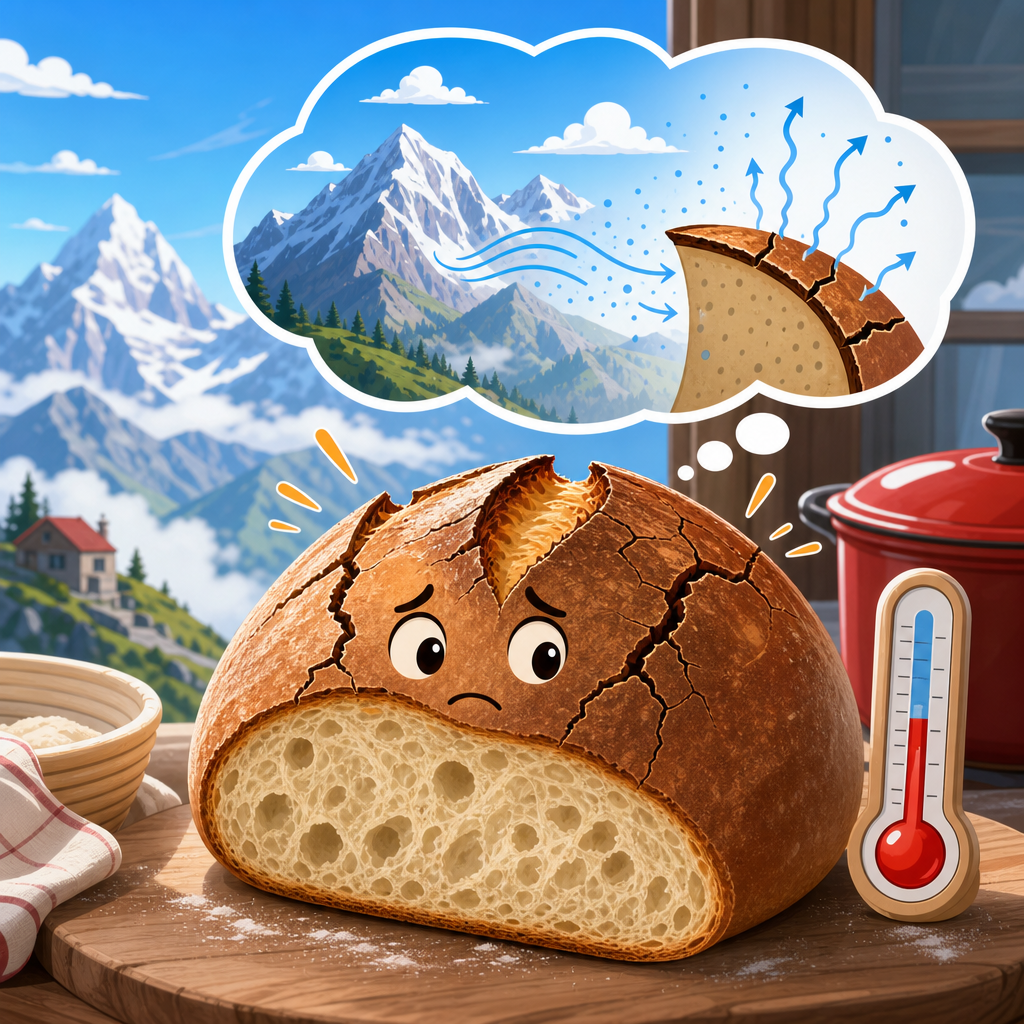
At altitude, atmospheric pressure drops. Because pressure is lower, water evaporates more readily and boils at a lower temperature. In practical baking terms, dough surfaces lose moisture faster during proofing and in the first minutes of baking. That matters because steam at the loaf surface is what keeps the skin flexible long enough for expansion. When the surface dries too soon, starches gelatinize and proteins coagulate into a firm shell before the inside gases finish pushing outward.
Yeast breads and sourdough are especially sensitive because they rely on controlled expansion during oven spring. Carbon dioxide already trapped in the dough expands in the heat, ethanol and water vaporize, and residual fermentation continues briefly until heat slows microbial activity. If the crust hardens before those internal forces peak, the loaf cannot open properly. You get weak scores, side blowouts, compressed crumb bands, or a squat profile. Bakers often call this overproofing, but at altitude it is frequently premature crust setting combined with slightly overaggressive top heat.
The effect grows stronger as elevation rises. Around 3,000 to 5,000 feet, many formulas still work with minor adjustments. By 5,000 to 7,500 feet, dough commonly needs higher hydration, shorter proof windows, and stronger steam. Above that, both enriched doughs and lean hearth loaves can crust over in proofing boxes, on bannetons, and even under kitchen towels if ambient humidity is low. Winter heating makes the issue worse by dropping indoor relative humidity sharply.
Flour also matters. Bread flour with higher protein can hold more water and support gas retention, but if hydration is not increased accordingly, the dough surface can feel deceptively strong while actually being underhydrated. Whole grain flour absorbs more water and contains bran that interrupts gluten, so a whole wheat altitude dough can dry on the outside and still be underdeveloped inside. Sourdough adds another layer: acidity strengthens dough up to a point, but a warm, fast bulk at altitude can tip into proteolysis and weaken structure before baking.
How altitude affects yeast breads and sourdough differently
Lean yeast breads, sandwich loaves, enriched doughs, and naturally leavened sourdough all face the same environmental physics, yet they show crust problems in different ways. Commercial yeast breads generally ferment predictably and benefit from easy timing adjustments. At altitude, reducing yeast slightly, increasing water modestly, and protecting the dough skin often solves early hardening. A classic white sandwich loaf, for example, may need 2 to 4 percent more water and 10 to 25 percent less yeast than the sea-level version, depending on flour and room conditions.
Sourdough is less linear because starter activity depends on feeding ratio, flour type, inoculation percentage, dough temperature, and acid balance. A starter that peaks beautifully at sea level may peak sooner in a warm mountain kitchen, leading bakers to overferment the dough before it reaches the oven. When that overfermented dough also dries on the surface, the result is contradictory: weak structure inside and a hardened shell outside. The loaf spreads, the score drags, and the crust colors early while the center remains dense or slightly gummy.
Enriched doughs such as brioche, milk bread, or cinnamon rolls often harden from sugar and milk solids browning too quickly. At altitude, that browning can happen before the crumb is fully baked because evaporation accelerates and ovens are often calibrated aggressively. Covering loosely with foil late in the bake helps, but the better fix starts with dough management: enough hydration, careful final proofing, and not letting shaped pieces sit exposed while the oven preheats.
Rye and high-percentage whole grain loaves deserve special mention. These formulas already tend toward denser crumbs and darker crusts. At altitude, they need disciplined moisture control, often including soakers, autolyse or fermentation rests, and covered baking. In my tests, a 70 percent whole wheat boule that looked manageable at 72 percent hydration at sea level baked far better near 5,500 feet at 76 to 78 percent hydration, with stronger steam and slightly reduced bake temperature after the first phase.
Signs your crust is hardening too fast
The most reliable indicators appear before and during baking. If a shaped loaf forms a dry skin while proofing, feels tacky underneath but papery on top, or resists expansion when touched lightly, expect early crust set. If scoring drags instead of opening cleanly, the surface has likely dried too much. In the oven, watch for rapid darkening within the first ten to fifteen minutes, shallow bloom, ruptures at the base, or scores that seal instead of lifting.
After baking, the loaf may show a thick outer shell, a dense ring beneath the crust, and a crumb that seems compressed near the top. Sandwich loaves may pull away from the pan sides unevenly or dome modestly but split along one weak point. Dinner rolls may look browned and firm well before they reach target internal doneness. Sourdough boules may sound hollow when tapped yet cool into a tough shell that softens only slightly overnight.
One mistake I see often is reading these signs as purely a hydration issue. Hydration matters, but crust hardening can also reflect weak steam, overproofing, underproofing, too much top heat, poor oven sealing, or using convection too early. The solution is to diagnose the stage where the surface first loses flexibility. If drying starts on the bench or in the banneton, fix proofing conditions. If the dough stays supple until loading but then crusts over immediately, fix steam, temperature, and vessel choice.
| Symptom | Most likely cause at altitude | Best first adjustment |
|---|---|---|
| Score will not open | Surface dried during proofing or weak steam | Cover dough better and increase initial steam |
| Dark crust, dense crumb | Top heat too strong and crust set too early | Lower initial temperature 10 to 15°F or bake covered longer |
| Side blowout | Premature crust set or underproofing | Improve steam and extend final proof slightly |
| Leathery shell after cooling | Low hydration or overbake | Add water and verify internal temperature |
| Pale loaf that still feels hard | Dry skin before baking, not enough expansion | Prevent proofing skin and score more decisively |
How to adjust formula, fermentation, and baking method
Start with hydration. Most altitude bakers need more water than the original recipe states, but the increase should be deliberate, not random. For lean white doughs, begin with 1 to 2 percent more water by flour weight at moderate altitude and 2 to 4 percent more at higher elevations. For whole grain doughs, the adjustment may be larger. Add bassinage if needed so you can assess gluten strength before committing to a wetter dough. A dough that feels slightly softer than your sea-level target is often correct in a dry mountain kitchen.
Next, manage fermentation speed. Lower pressure does not automatically make yeast stronger, but mountain kitchens often run warmer and drier, and dough can expand faster because gas encounters less external resistance. Reduce instant yeast modestly, track dough temperature with a thermometer, and rely on visual fermentation cues rather than clock time. For sourdough, lower inoculation in warm conditions, use cooler water, and avoid pushing bulk until the dough becomes overly aerated and fragile. The ideal endpoint is dough that is lively, extensible, and still capable of spring.
Surface protection is essential. Use covered containers for bulk fermentation, proof shaped loaves in bags or under reusable covers, and do not let formed dough sit exposed while waiting for oven readiness. Rice flour in bannetons helps release dough, but too much can dry the outer skin. A light dusting works better than a heavy coat. If your kitchen is particularly arid, a lightly dampened cloth over a bowl can help, though it should not touch the dough directly.
Steam is the main tool for delaying crust set. Professional deck ovens inject steam because it keeps the loaf surface elastic and promotes glossy gelatinization. At home, the most effective method for sourdough boules is a preheated Dutch oven or cloche. The dough releases its own moisture into the enclosed space, creating a humid microclimate. For bâtards and baguettes, use a baking steel or stone with a separate steam source, such as a preheated cast-iron pan loaded with boiling water just after the bread goes in. Lava rocks can improve steam persistence, but safety matters: avoid glass pans and never pour water onto oven windows.
Temperature strategy matters too. Many sea-level recipes begin at 475 to 500°F for lean hearth loaves. At altitude, starting 10 to 15°F lower often improves bloom because it slows early crust set without sacrificing oven spring. For covered bakes, extend the covered phase slightly before uncovering to color the crust. For enriched breads, tent with foil if browning outruns internal baking. Always verify doneness with both color and internal temperature: around 190 to 200°F for many sandwich loaves, and 208 to 212°F for many hearth-style sourdough loaves, depending on formula.
Building a reliable high-altitude bread workflow
The best long-term fix is consistency. Weigh ingredients in grams, record flour brand and protein level, note room temperature, dough temperature, proof times, and oven settings. When I troubleshoot altitude bread, I change one variable at a time: first hydration, then yeast or inoculation, then initial baking temperature, then steam. Without records, every loaf feels like a guess. With records, patterns emerge quickly, especially across seasons.
Use recognized methods to strengthen dough without drying it out. An autolyse improves water absorption and extensibility in many white and mixed-flour doughs. Stretch-and-fold or coil-fold sequences build structure gently during bulk. A cold final proof can help timing and scoring, but at altitude it can also dry the surface if the loaf is not well covered. If you refrigerate bannetons overnight, place them in large food-safe bags or covered containers so the skin stays supple.
Starter maintenance deserves the same rigor. Keep feedings regular, know your peak time, and judge readiness by rise, aroma, and texture rather than habit. A healthy wheat starter should smell pleasantly acidic, show a domed top near peak, and leave a webbed interior when sampled. If it peaks too quickly in summer, raise the feeding ratio or lower the storage temperature. Strong starter improves oven spring, but overly acidic starter can tighten or weaken dough depending on maturity and percentage used.
This subtopic also connects to related areas across altitude baking. If your bread browns too fast, your article path naturally leads into oven management and pan shielding. If your rolls dry out, that points toward dough enrichment and storage. If sourdough spreads flat, you will want deeper guidance on starter maturity, shaping tension, and Dutch oven technique. Treat this page as the decision point: identify the symptom, then follow the relevant branch in your broader altitude baking system.
Common mistakes and the fixes that work
The biggest mistake is assuming every altitude problem requires more flour. Extra flour may make sticky dough easier to handle, but it often worsens fast-hardening crust by lowering effective hydration. Another common error is overproofing in search of volume. At altitude, a dough can look fully proofed before its gluten is ready, especially when warm. Use the finger dent test carefully, but trust dough strength, gas distribution, and shaping feel more than a single poke.
Another mistake is ignoring oven recovery and loading time. If the door stays open too long while scoring, steaming, and loading, home ovens cycle hard to recover, sometimes blasting the top elements and setting crust abruptly. Work efficiently. Preheat fully, prepare steam in advance, and load decisively. Avoid convection for the initial phase unless your recipe was developed for it, because moving air accelerates evaporation at the surface.
Finally, do not judge crust only when the loaf first leaves the oven. Bread continues to equilibrate as it cools. If the crust seems hard immediately but softens to a pleasant chew after an hour, the bake may be fine. If it stays tough, thick, or sharply brittle, revise the process. Start with better surface protection, stronger steam, and slightly higher hydration, then fine-tune fermentation and temperature. High-altitude yeast breads and sourdough become predictable once you control when the crust sets.
A crust that hardens too fast at altitude is not a mystery and it is not a sign that mountain bread baking is inherently unreliable. It is a timing problem caused by faster moisture loss, different fermentation behavior, and heat that firms the loaf exterior before the interior finishes expanding. Once you recognize that, the fixes become practical: increase hydration thoughtfully, protect the dough surface, manage proofing closely, use stronger steam or covered baking, and moderate the initial oven temperature when needed.
For yeast breads, that often means slightly less yeast, slightly more water, and stricter control of proofing and pan bake color. For sourdough, it means watching starter maturity, bulk fermentation, shaping tension, and steam with much more precision. In both cases, the goal is the same: keep the dough skin flexible long enough to allow full oven spring, then let the crust color and crisp after the loaf has reached its volume.
If you bake bread above sea level, use this page as your hub for the entire yeast bread and sourdough process. Audit one loaf this week, record the symptoms, adjust a single variable, and build from there. A better crust is usually the first sign that the rest of your altitude baking is falling into place.
Frequently Asked Questions
Why does bread crust harden too fast at high altitude?
At high altitude, bread crust hardens too fast because the baking environment changes in several important ways at once. Lower air pressure allows water to evaporate more quickly, so the surface of the dough loses moisture faster than it would at sea level. That faster drying can cause the outer layer of the loaf to firm up and begin setting before the interior has finished expanding. Once that crust becomes rigid too early, it can restrict oven spring, leading to a loaf with a thick, tough, or leathery exterior and a tighter crumb inside.
Altitude also affects how heat and fermentation behave. Water boils at a lower temperature as elevation increases, which changes how moisture moves through the dough during baking. At the same time, yeast activity can become less predictable, often moving faster during proofing and making dough more vulnerable to overexpansion before it enters the oven. In practical terms, this means high-altitude bakers often need to adjust hydration, proofing times, baking temperature, and steam to keep the dough surface flexible long enough for the loaf to fully rise in the oven.
At what elevation does crust drying usually start becoming a problem?
For many bakers, crust drying starts to become noticeable at around 3,000 feet above sea level, although the exact point varies depending on climate, oven type, and the bread formula. In a dry region, the effects can show up even earlier because low ambient humidity adds to the rapid moisture loss caused by reduced air pressure. By the time you reach moderate to high elevations, dough and shaped loaves often feel drier, proof faster, and develop surface skin more easily unless they are carefully covered or humidified.
That said, altitude alone is not the only factor. A lean dough with lower hydration, a long uncovered proof, a convection oven, or a bake with little steam can all make the crust set prematurely even more quickly. Bakers above 3,000 feet usually benefit from watching dough behavior rather than relying only on sea-level recipes. If your loaf repeatedly develops a firm shell before it finishes rising, that is a strong sign that your formula or process needs to be adapted to your elevation.
How can I keep the crust from setting before the loaf fully expands?
The most effective way to delay crust hardening is to preserve surface moisture during the earliest stage of baking. Steam is one of the best tools for this because it keeps the exterior of the dough supple, allowing the loaf to continue expanding instead of sealing over too soon. For hearth-style breads and sourdough, baking in a covered Dutch oven is especially helpful at altitude because it traps the loaf’s own moisture and creates a humid micro-environment. If you are baking on a stone or sheet pan, adding steam at the beginning of the bake can also make a major difference.
Formula adjustments matter too. Slightly increasing hydration often helps counteract faster evaporation, while avoiding too much bench flour and keeping shaped dough covered during proofing can prevent a dry skin from forming before the loaf even reaches the oven. Some bakers also benefit from modestly raising oven temperature at the start to encourage strong oven spring, then lowering it if the crust is darkening too quickly. The goal is balance: enough initial heat for expansion, enough moisture to keep the crust flexible, and enough control over proofing that the loaf enters the oven with strength rather than fragility.
Do yeast breads and sourdough react differently to altitude when it comes to crust formation?
Yes, both yeast breads and sourdough are affected by altitude, but they can show the problem a little differently. Commercial yeast doughs often ferment quickly and can overproof more easily at elevation, especially if the baker follows sea-level timing. When overproofed dough goes into the oven, it may lack the strength to expand well, and a crust that sets early can worsen the problem by trapping a weakened structure. The result is often a loaf with reduced volume, a firmer shell, and a drier texture overall.
Sourdough introduces additional variables because starter activity, acidity, dough strength, and long fermentation all influence how the loaf behaves. At altitude, sourdough can dry on the surface during bulk fermentation or final proof if it is not covered well, and the crust may become noticeably thicker if the dough enters the oven slightly underhydrated or overproofed. Strong steam, careful fermentation control, and proper dough tension are especially important with sourdough. In both styles of bread, the core issue is the same: the outer layer must stay extensible long enough for the interior gases to expand and the crumb to finish developing.
What recipe and baking adjustments help most at high altitude?
The most useful adjustments usually involve hydration, proofing, steam, and oven management. A small increase in water can compensate for the faster moisture loss common at elevation, particularly in lean doughs. Reducing yeast slightly or shortening proofing times may help prevent overfermentation, which becomes more likely when dough rises faster or less predictably. Covering the dough during rest periods, limiting excess flour during shaping, and avoiding drafts are also simple but highly effective ways to reduce surface drying before the bake begins.
During baking, many high-altitude bakers get better results by maximizing steam early and monitoring crust color closely. A covered bake for the first part of the oven cycle, or a well-steamed oven, can delay crust formation long enough to improve oven spring and crumb openness. If the loaf browns or hardens too fast, lowering the temperature slightly after the initial rise phase can help. It is also wise to make changes gradually rather than all at once. Increase water a little, adjust fermentation timing based on dough appearance, and take notes on crust texture, loaf volume, and bake time. High-altitude bread baking is rarely about one dramatic fix; it is usually about several small adjustments that work together to keep the crust from becoming rigid before the loaf is ready.