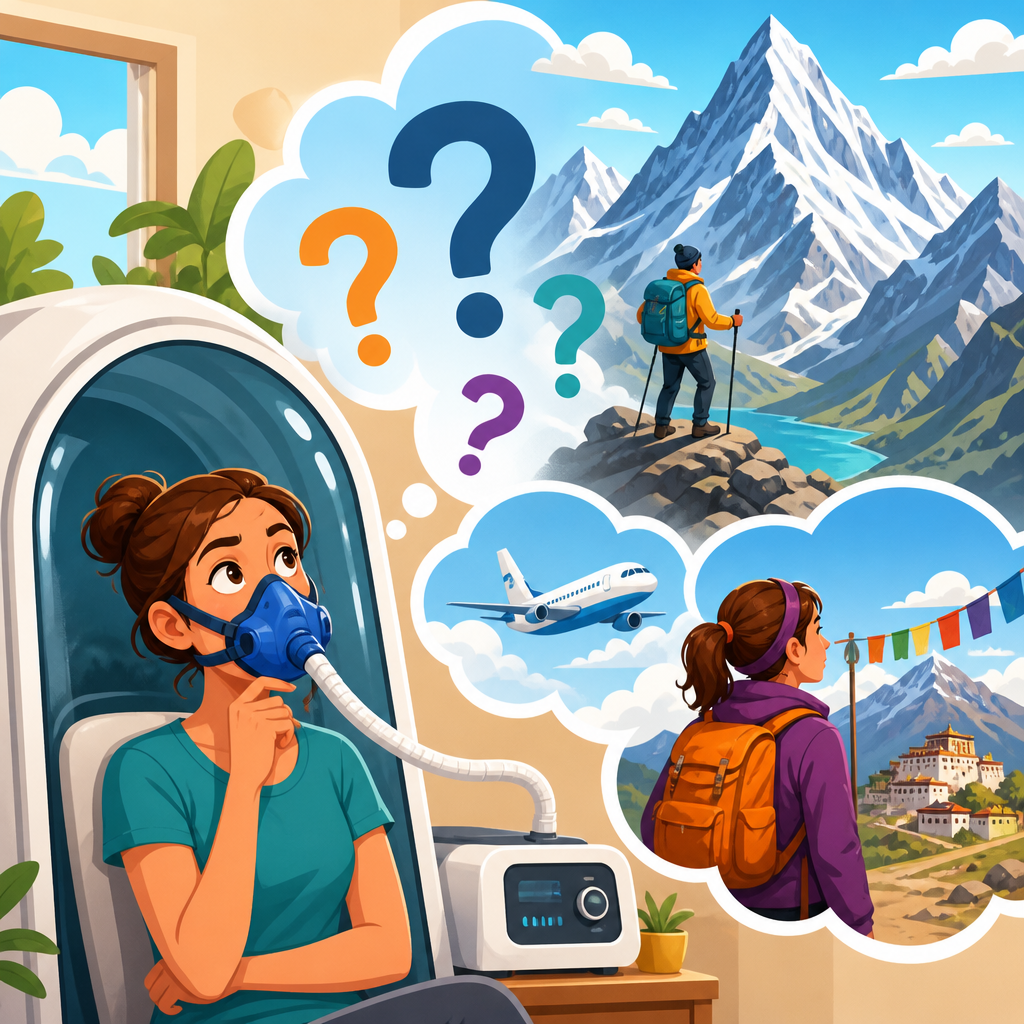
Intermittent hypoxic exposure before travel sits at the crossroads of altitude medicine, sports science, and practical trip planning, yet many travelers still receive oversimplified advice about what it can and cannot do. In plain terms, intermittent hypoxic exposure means repeatedly breathing air with reduced oxygen, or spending time in a lower-oxygen environment, for short scheduled periods before ascending to altitude. It is often described as pre-acclimation because the goal is to trigger some of the same physiological responses that normally develop after arrival in the mountains. As the hub for pre-acclimation and training within altitude illness and acclimatization, this article explains what the method includes, where the evidence is strongest, and which important questions remain unsettled. That matters because acute mountain sickness, sleep disruption, reduced exercise capacity, and poor decision-making can affect trekkers, climbers, skiers, guides, and workers even on well-planned trips. In practice, I have seen travelers assume that a few sessions in a hypoxic tent make them “altitude proof,” while others dismiss structured pre-acclimation entirely because one study showed mixed results. Both positions miss the nuance. Intermittent hypoxic exposure may help some people, especially when schedules limit gradual ascent, but its benefits depend on protocol design, altitude target, dose, timing, and the traveler’s baseline health, itinerary, and risk tolerance.
Before getting into the research gaps, it helps to define adjacent terms clearly. Intermittent hypoxic exposure usually refers to passive sessions, often while sitting or resting, in normobaric hypoxia generated by a device that lowers inspired oxygen fraction. Intermittent hypoxic training adds exercise during those sessions. Hypoxic sleeping uses tents or rooms overnight for repeated nights. Natural pre-acclimatization can also happen through repeated visits to moderate altitude before a major trip. These approaches overlap, but they are not interchangeable, and studies often group them together too casually. The best way to read the evidence is to ask a practical question: what outcome are you trying to improve? Lower risk of acute mountain sickness is not the same as better summit-day power output, faster ventilatory acclimatization, or improved sleep at 3,500 meters. Research has not fully settled which protocol works best for which traveler.
What intermittent hypoxic exposure is designed to change
The core idea is straightforward. Lower oxygen stimulates chemoreceptors, increases ventilation, and over repeated exposures may produce adaptations that make a later altitude exposure easier to tolerate. Those changes can include a stronger hypoxic ventilatory response, altered acid-base handling, changes in sympathetic activation, and over longer or more substantial doses, increased erythropoietin signaling that may contribute to red blood cell production. The problem is that not every adaptation appears on the same timeline. Ventilatory changes can occur relatively quickly, while meaningful increases in total hemoglobin mass generally require a larger cumulative dose, often measured in many hours across days or weeks. That is why a weekend of brief sessions should not be expected to replicate a month of living high.
In expedition planning, the most relevant near-term goals are usually reducing acute mountain sickness symptoms, improving sleep quality during the first nights, and preserving functional capacity after rapid ascent. For these goals, pre-acclimation does not need to create elite endurance adaptations to be useful. A traveler flying from sea level to Cusco, Lhasa, or a Colorado ski resort may benefit if the intervention helps stabilize breathing and lowers symptom severity during the first forty-eight hours. However, the size and reliability of that effect remain uncertain because protocols differ so much across studies. Some use five sessions; others use fifteen. Some simulate 2,500 meters, others 4,500 or higher. Some exposures are one hour; others last all night. Those are not minor details. They are the intervention.
What the current evidence suggests, and where it is thin
The evidence base points to a cautious conclusion: intermittent hypoxic exposure before travel can help, but the effect is inconsistent and probably smaller than many commercial claims suggest. Reviews in altitude medicine and exercise physiology generally find that repeated hypoxic exposures may reduce acute mountain sickness incidence or severity in some settings, especially when the total exposure dose is adequate and the ascent is otherwise rapid. Yet many trials are small, underpowered, or methodologically uneven. Blinding is difficult. Participant fitness varies. Outcomes are measured at different altitudes and time points. Some studies include acetazolamide use; others exclude it. These design choices make direct comparison difficult.
One of the clearest patterns is that dose matters. A handful of short sessions over one week may stimulate measurable ventilatory changes, but the effect may fade quickly or fail to translate into meaningful protection on arrival. By contrast, protocols involving repeated nightly hypoxia over one to three weeks often show more promising results, though they demand more equipment, more adherence, and more expense. There is also evidence that individual response is highly variable. In practice, I have seen two trekkers complete the same hypoxic sleep program and arrive at the same altitude with very different symptom profiles. One sleeps reasonably well and functions normally; the other still develops headache and nausea on day one. Research supports that this variability is real, not anecdotal noise.
| Approach | Typical protocol | Main potential benefit | Key limitation |
|---|---|---|---|
| Passive intermittent hypoxic exposure | Resting sessions of 60 to 120 minutes, several times weekly | May improve ventilatory acclimatization before rapid ascent | Short total dose may limit real-world protection |
| Intermittent hypoxic training | Exercise performed in simulated altitude | Can combine trip preparation with hypoxic stimulus | Fitness gains and acclimatization effects are not the same outcome |
| Hypoxic sleeping | Nightly use of tent or room for one to three weeks | Greater cumulative exposure; often the most plausible pre-acclimation method | Sleep disruption, cost, and adherence issues are common |
| Repeated natural altitude visits | Day trips or short stays at moderate altitude before travel | Accessible for people living near mountains | Logistics and inconsistent exposure reduce standardization |
Unsettled question one: what is the minimum effective dose?
This is the biggest unanswered practical question. Travelers want a simple prescription: how many hours, at what simulated altitude, over how many days, before departure? Research does not yet provide a universal answer. Many experts suspect there is a dose-response relationship, but the threshold for meaningful benefit likely changes with the outcome being measured. A protocol sufficient to alter overnight oxygen saturation might still be too weak to reduce acute mountain sickness after a flight to 4,000 meters. Studies also disagree on whether moderate hypoxia repeated more often works better than fewer sessions at a more severe stimulus.
From a planning standpoint, this uncertainty matters because pre-acclimation competes with time, comfort, and cost. If the minimum effective dose turns out to be ten nights rather than four, many travelers will choose medication or itinerary changes instead. The research challenge is that dose has several parts: inspired oxygen fraction, session length, frequency, total duration, and time between the last session and ascent. Until trials standardize these variables and compare them head to head, claims about “optimal” protocols should be treated carefully.
Unsettled question two: which travelers benefit most?
Not everyone starts from the same risk profile. A healthy skier going from sea level to 2,800 meters for two nights is different from a trekker flying to 3,400 meters and sleeping above 4,000 within days. Susceptibility to acute mountain sickness also varies from person to person. Prior history remains one of the strongest predictors, but even that is imperfect because route, exertion, illness, sleep, and hydration differ across trips. Research has not clearly identified whether intermittent hypoxic exposure works best for altitude-naive travelers, people with prior mild symptoms, or those with repeatedly severe symptoms who are trying to avoid medication.
There are also age, sex, and fitness questions. Higher aerobic fitness does not guarantee easier acclimatization, yet fitter travelers often ascend faster and push harder, which can increase symptom risk. Older travelers may pace themselves better but may also have more cardiovascular or sleep issues. People with asthma, migraine, anemia, sleep apnea, or cardiopulmonary disease require more individualized assessment, and most hypoxia studies exclude them. As a result, the populations that most want clear guidance are often the least represented in trials.
Unsettled question three: does protocol type matter more than the hypoxic stimulus itself?
There is an important difference between sitting in hypoxia and sleeping in it. Passive daytime exposure may be easier to tolerate and schedule, but overnight exposure delivers a much larger cumulative dose. Exercise in hypoxia may seem more efficient, yet the training stress can complicate interpretation by adding fatigue, sleep disturbance, or dehydration. Some evidence suggests that repeated nocturnal exposure creates more robust acclimatization markers, but not everyone can sleep well in a tent, and poor sleep before travel is its own problem.
Normobaric hypoxia versus hypobaric hypoxia is another unresolved issue. Most commercial systems reduce oxygen concentration at normal barometric pressure, while real mountains reduce barometric pressure itself. Physiologically, these conditions overlap substantially, but they may not be identical. Some researchers argue that ventilation, fluid shifts, and symptom profiles differ enough to matter. Others conclude the practical distinction is smaller than protocol quality and total dose. Right now, the evidence does not justify claiming that one simulated environment reliably reproduces all aspects of ascent better than the other.
How pre-acclimation fits with medications, pacing, and itinerary design
Intermittent hypoxic exposure should be viewed as one tool, not a substitute for sound altitude strategy. The most reliable prevention remains gradual ascent, conservative early exertion, and prompt response to symptoms. Acetazolamide has stronger evidence than most pre-acclimation protocols for preventing acute mountain sickness, especially when ascent is rapid and sleeping elevation jumps quickly. Dexamethasone has a specific preventive role in select cases but is not a general acclimatization aid. Nifedipine and phosphodiesterase inhibitors belong to more specialized discussions around high-altitude pulmonary edema risk and performance, not routine pre-acclimation planning.
For travelers building a practical plan, the best use case for intermittent hypoxic exposure is often when itinerary constraints cannot be changed. A climber flying into a high base camp region, a worker deployed on a fixed rotation, or a tourist with nonrefundable bookings may use pre-acclimation to reduce early risk while still carrying medication and keeping a conservative schedule. In that context, the intervention earns its value if it lowers symptom burden enough to preserve judgment, appetite, sleep, and mobility during the first days. It does not need to be perfect to be useful, but it should never justify ignoring red flags.
What a sensible pre-travel decision framework looks like
When I help travelers think through pre-acclimation, I start with five questions. What altitude will you sleep at on nights one through three? How quickly are you ascending after arrival? Have you had prior altitude illness, and how severe was it? Can you tolerate acetazolamide, and have you used it before? How much time and money are you willing to spend for a benefit that may be modest and variable? These questions usually clarify whether intermittent hypoxic exposure is central, optional, or unnecessary.
For a low-risk trip, such as sleeping below 2,500 meters with gradual gains, pre-acclimation is usually not worth major effort. For moderate-risk itineraries with immediate sleeping elevations around 2,500 to 3,500 meters, it may be reasonable if access is easy and cost is acceptable. For higher-risk rapid ascents above 3,500 meters, especially with previous symptoms, it can be part of a layered prevention plan, but only alongside medication, pacing, and contingency planning. The strongest hub-level takeaway is simple: match the method to the itinerary, not the marketing. If you want a deeper plan, review protocol-specific guidance, medication comparisons, and altitude-risk calculators within the broader acclimatization resources, then discuss high-risk itineraries with a clinician experienced in mountain travel.
Intermittent hypoxic exposure before travel remains promising, but the research has not settled the questions travelers care about most: who benefits, how much exposure is enough, which protocol works best, and how durable the effect is after departure. What is already clear is that pre-acclimation is not magic, and it is not meaningless. Used thoughtfully, it may improve readiness for some trips, particularly when gradual ascent is impossible. Used carelessly, it can create false confidence. The main benefit of understanding the evidence is better decision-making: choosing the right combination of pre-acclimation, medication, pacing, and itinerary design for your actual risk. Use this page as your starting point for pre-acclimation and training, then build a trip plan that respects altitude rather than assuming any single intervention solves it.
Frequently Asked Questions
What is intermittent hypoxic exposure before travel, and why is it so hard to give a simple answer about whether it works?
Intermittent hypoxic exposure, often shortened to IHE, refers to planned sessions before a trip in which a person spends limited periods breathing air with less oxygen than normal sea-level air, or sits, rests, or sometimes exercises in a reduced-oxygen environment. The basic idea is straightforward: expose the body to manageable doses of hypoxia in advance so that some of the early adjustments associated with altitude begin before the traveler ever arrives in the mountains. In theory, that could mean less discomfort, fewer symptoms, or an easier first few days at altitude.
The reason researchers still cannot give a clean yes-or-no answer is that “intermittent hypoxic exposure” is not one single protocol. Studies have used different oxygen levels, session lengths, frequencies per week, total number of sessions, and whether participants were resting or exercising during exposure. They have also involved very different populations, including athletes, military personnel, healthy tourists, and people with varying levels of fitness and altitude experience. When the intervention itself varies this much, comparing results becomes difficult.
Another reason the answer remains unsettled is that success can be defined in different ways. Some studies look at symptoms of acute mountain sickness, while others measure oxygen saturation, ventilation, sleep, exercise capacity, headache scores, or blood-related adaptations. A protocol that slightly improves oxygen saturation may not clearly reduce mountain sickness symptoms, and a protocol that benefits performance in athletes may not translate into practical protection for a vacation traveler. That mismatch between laboratory outcomes and real-world goals is a major reason advice often becomes oversimplified.
There is also the issue of timing. Even if intermittent hypoxic exposure stimulates useful adjustments, researchers are still sorting out how long those changes last and how close to departure the sessions need to occur. A short block of exposure may help only briefly, while a longer block may be harder for ordinary travelers to complete. So the concept is biologically plausible, and some findings are promising, but the field has not yet settled on the exact dose, schedule, target traveler, or expected benefit that would justify universal recommendations.
Can intermittent hypoxic exposure actually prevent altitude sickness, or does it mainly affect lab measurements rather than real symptoms?
This is one of the central unresolved questions. Some research suggests intermittent hypoxic exposure may improve certain physiological responses associated with altitude adaptation, such as breathing drive, oxygen saturation, or tolerance to hypoxic stress. Those changes sound encouraging, and they may indicate that the body is becoming somewhat more prepared for lower-oxygen environments. However, the more important question for most travelers is not whether a number improved in a study, but whether they are actually less likely to develop headache, nausea, poor sleep, fatigue, dizziness, or more serious altitude problems once they arrive.
The evidence on that practical outcome is mixed. In some settings, pre-travel hypoxic exposure appears to reduce symptom burden or delay the onset of symptoms, especially when paired with a sensible itinerary that avoids a rapid jump to a high sleeping altitude. In other studies, the benefit is small, inconsistent, or difficult to separate from other factors, including expectation effects, baseline fitness, hydration habits, sleep quality, prior altitude history, and the rate of ascent during the trip itself. That means a traveler may complete a pre-acclimation program and still get altitude sickness if the itinerary is aggressive enough.
It is also possible that intermittent hypoxic exposure helps some people more than others. Individuals differ widely in how they respond to altitude. One person may show clear adaptation after a series of sessions, while another may have little meaningful protection. Researchers have not fully identified who is most likely to benefit, how much benefit is realistic, or whether certain symptom-prone travelers respond better than others. That variability makes blanket promises irresponsible.
The practical bottom line is that intermittent hypoxic exposure should not be treated as a guaranteed shield against altitude illness. At best, current research supports viewing it as a possible risk-reduction tool rather than a substitute for gradual ascent, conservative first-day effort, symptom monitoring, and medically appropriate prevention plans. If travelers understand it in that more modest way, it fits the evidence far better than the common marketing claim that it can “prevent altitude sickness” on its own.
How much intermittent hypoxic exposure would someone need before travel, and is there any settled protocol that experts agree on?
At present, there is no universally accepted pre-travel protocol that experts agree is optimal for all travelers. That is one of the biggest unanswered issues in the field. Research has examined sessions lasting from relatively short exposures to much longer blocks, delivered over days or weeks, at different simulated altitudes, with different levels of supervision and different equipment. Some protocols use passive exposure while sitting quietly, while others combine hypoxia with exercise. Because of that range, there is no single schedule that can honestly be presented as “the proven standard.”
The question of dose matters because too little exposure may not trigger meaningful adaptation, while too much may be impractical, uncomfortable, or potentially unhelpful. The body’s response to hypoxia is not simply linear, where more always equals better. Researchers are still trying to determine the minimum effective exposure, whether repeated shorter sessions can match the value of longer ones, and whether the intensity of hypoxia should remain constant or progress over time. They are also studying how long any benefit persists after the final session, which is crucial for travelers whose plans may shift or whose departure date is not fixed.
Another unresolved factor is the difference between biological response and logistical reality. A protocol that appears useful in a controlled setting may be unrealistic for an ordinary traveler with work, family, and travel prep responsibilities. Even if a study suggests benefit from frequent sessions over multiple weeks, adherence in the real world may be poor. That makes it harder to translate research into routine travel advice.
For now, the absence of a settled protocol means travelers should be cautious around programs that advertise a precise number of sessions as scientifically definitive. The current evidence base does not support that level of certainty. Any plan should be framed as experimental or individualized rather than standardized, and it should be considered alongside the actual travel itinerary, sleeping altitude, rate of ascent, prior altitude history, and access to medical advice. In other words, the dose question is not a technical detail on the margins of the debate; it is one of the main reasons the debate is still open.
Is intermittent hypoxic exposure the same thing as altitude training for athletes, and do findings from sports science apply to regular travelers?
They overlap, but they are not the same goal, and that distinction matters. In sports science, hypoxic training methods are often studied to improve endurance, stimulate certain hematological responses, or enhance performance once the athlete returns to normal oxygen conditions or competes at altitude. In travel medicine, the question is usually much more practical: will a traveler feel better, sleep better, and reduce the risk of altitude illness during a trip? Those goals are related, but not interchangeable.
Athletes also tend to differ from the average traveler in ways that influence how results should be interpreted. They may have higher baseline fitness, tighter control over training and recovery, more structured exposure schedules, and closer monitoring. They may also tolerate protocols that would be unrealistic for someone preparing for a trekking holiday, ski trip, work assignment, or family vacation. So even when athlete studies show physiological adaptation, that does not automatically mean the same protocol will produce meaningful symptom prevention in the general traveling public.
There is also a common misunderstanding that if hypoxic exposure can improve performance markers, it must therefore protect against altitude illness. That is not necessarily true. Performance adaptation and illness prevention involve overlapping but distinct mechanisms. A person might gain some efficiency or tolerance under hypoxic conditions without being fully protected from the symptom cascade that accompanies rapid ascent and sleeping at high altitude. Likewise, a traveler who is not seeking any performance gain may care only about comfort and safety, not exercise output.
The best way to interpret the sports science literature is as useful but incomplete. It helps establish that the human body can adapt to repeated hypoxic stimuli and that those adaptations are measurable. What it does not yet settle is how directly those findings map onto ordinary travel scenarios, especially for people who are older, less fit, carrying medical conditions, traveling with limited recovery time, or ascending on rigid commercial itineraries. That gap between athlete-focused research and traveler-focused outcomes is one of the main reasons this topic remains unsettled despite years of study.
What are the biggest limits and risks travelers should keep in mind before relying on intermittent hypoxic exposure as part of a trip plan?
The first and most important limit is that intermittent hypoxic exposure is not a substitute for the basics of safe altitude travel. A gradual ascent when possible, cautious pacing during the first days, attention to symptoms, and a plan for what to do if symptoms worsen remain more established and more important than any pre-trip hypoxic routine. Travelers can get into trouble when they treat pre-acclimation as permission to ascend faster than they otherwise should. The research does not support that kind of confidence.
Another limitation is uncertainty of response. Two travelers may complete the same exposure program and have very different experiences at altitude. Because researchers have not fully identified reliable predictors of benefit, travelers may invest time and money into a protocol without knowing whether it will materially change their risk.