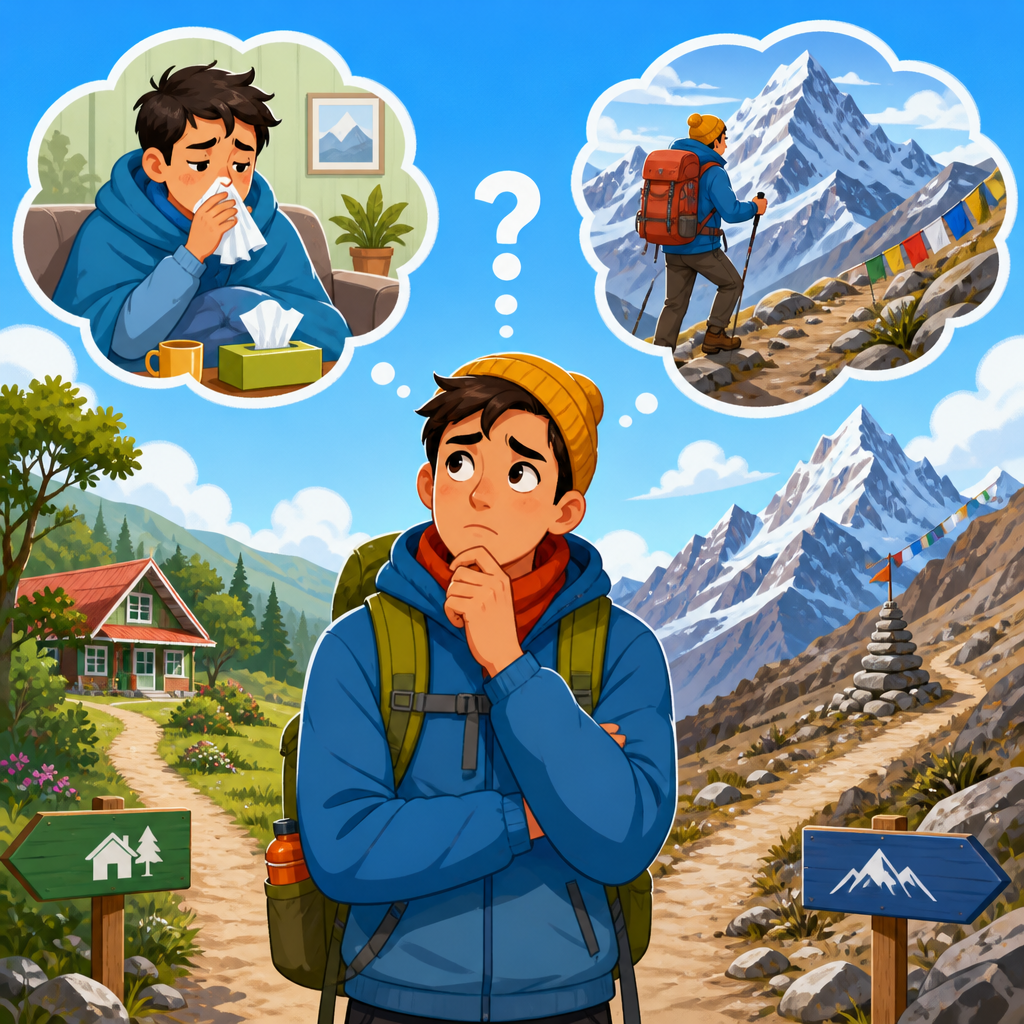
Should you cancel a high-altitude trip if you are coming off a cold? The safest answer is: sometimes, but not always, and the decision depends on your current symptoms, the altitude you plan to reach, how fast you will ascend, and whether your trip logistics allow a conservative backup plan. In trip planning and logistics, this question matters because altitude changes how your body handles oxygen, hydration, sleep, and respiratory irritation. A minor cold at sea level can feel very different at 8,000 feet, 10,000 feet, or above, especially during the first twenty four to forty eight hours after arrival.
When travelers talk about “a cold,” they usually mean a viral upper respiratory infection affecting the nose, throat, and sinuses. “High altitude” often starts around 8,000 feet or 2,500 meters for trip planning purposes, because that is where some people begin noticing shortness of breath, reduced exercise tolerance, disrupted sleep, and headache. Acclimatization is the process by which your body adjusts to thinner air over time. The practical issue is not just whether you still have a runny nose. It is whether lingering congestion, cough, fatigue, fever, sinus pressure, or chest symptoms could combine with altitude stress to make the trip unpleasant, unsafe, or logistically expensive.
I have helped plan mountain itineraries for travelers, trekkers, and families headed to places like Colorado ski towns, Cusco, the Andes, and Nepal gateways, and the biggest mistakes usually happen before departure. People focus on flights, hotel points, and gear lists, then ignore health variables that can derail everything else. A traveler recovering from a cold may board a plane dehydrated, sleep poorly, land at altitude, push through a transfer day, and then confuse cold symptoms with early altitude illness. Good trip planning means deciding in advance what signs mean “go,” what signs mean “delay,” and what signs mean “cancel.” That protects both your health and your budget.
This hub article covers the full planning framework: how colds interact with altitude, when symptoms are too risky, what logistics reduce problems, what to pack, how to build flexible itineraries, and how to decide rationally rather than emotionally. If you are looking for a simple rule, use this one: do not travel to high altitude with fever, significant chest symptoms, severe fatigue, or blocked sinuses that already make you miserable at low elevation. If symptoms are mild and clearly improving, the trip may still be possible with slower ascent, lighter activity, and contingency options in place.
Why a recent cold can matter more at altitude
High altitude reduces the amount of oxygen available with each breath. Even healthy travelers often notice faster breathing, dry air irritation, and lower exercise capacity. Add a recent cold, and several problems stack together. Nasal congestion can make sleep worse. Sinus inflammation can turn pressure changes on flights and mountain roads into real pain. A lingering cough can become more irritating in cold, dry air. General fatigue from illness can also reduce your margin for handling altitude stress.
The practical distinction is between inconvenience and risk. A mild runny nose or slight sore throat may simply make you less comfortable. But lower respiratory symptoms, fever, chills, body aches, or marked weakness suggest your body is still actively fighting illness. In that state, altitude can feel disproportionately hard. Travelers often report that a hike or even a staircase that would have been manageable before the cold suddenly feels punishing. That is not weakness. It is a predictable combination of reduced reserve, poor sleep, and thinner air.
Another issue is symptom overlap. Headache, fatigue, poor appetite, dizziness, and disturbed sleep are common in acute mountain sickness. They are also common during and after a viral infection. When both are in play, it becomes harder to interpret warning signs. That can delay good decisions, especially if a group has paid for permits, guides, or nonrefundable lodging. The best trip planning separates ego from health and assumes that changing plans early is cheaper than managing a crisis later.
When you should seriously consider postponing or canceling
You should strongly consider postponing a high-altitude trip if you have fever within the last twenty four hours, shortness of breath at rest, wheezing, chest tightness, deep productive cough, vomiting, significant dehydration, severe sinus pain, or exhaustion that limits ordinary daily tasks. These are not gray-area symptoms. They suggest active illness, lower airway involvement, or poor recovery. Traveling anyway can amplify discomfort and complicate the picture if altitude illness develops.
Blocked ears and sinuses deserve more respect than many travelers give them. During flights or long drives with elevation gain, pressure changes can cause severe ear pain, reduced hearing, or sinus barotrauma. I have seen otherwise fit travelers arrive in mountain destinations unable to sleep because every bend in the road or cabin descent triggered facial pain. If you cannot clear your ears comfortably on a normal flight descent, a high-altitude itinerary with multiple transfers is a weak bet.
Underlying conditions matter too. Asthma, chronic sinus disease, recent bronchitis, sleep apnea, cardiovascular disease, or a past history of altitude sickness lower your margin. In those cases, even a “lingering cold” deserves a conversation with a clinician who understands both respiratory illness and altitude exposure. Pregnancy, immunocompromise, and travel with small children also shift the threshold toward caution because care options may be limited once you leave major cities.
| Situation | Risk level for high-altitude travel | Best planning decision |
|---|---|---|
| Mild runny nose, no fever, symptoms improving | Low to moderate | Usually proceed with slower ascent and easy first days |
| Moderate congestion, poor sleep, sinus pressure, low energy | Moderate | Proceed only if itinerary is flexible and ascent is gradual |
| Fever, body aches, severe fatigue, worsening cough | High | Postpone or cancel |
| Chest tightness, wheezing, shortness of breath, dehydration | Very high | Do not go without medical clearance |
Questions to ask before deciding to go
A useful decision starts with direct questions. Are your symptoms clearly improving day by day, or are they flat or worsening? Have you been fever-free without medication for at least twenty four hours? Can you walk briskly, climb stairs, and carry a bag without unusual breathlessness? Are you sleeping reasonably well? Can you equalize ear pressure normally? If the answer to several of these is no, your logistics need to change.
Next, evaluate the altitude profile, not just the destination name. A trip to Denver with two quiet days before going higher is different from flying to Cusco and sleeping above 11,000 feet on night one. A ski vacation based at 9,000 feet with lift access to higher terrain is different from a trekking route where descent takes hours. Ask how high you will sleep, how quickly you will ascend, how remote you will be, and how easy it will be to descend if symptoms worsen. Sleeping altitude is often more important than the highest daytime viewpoint.
Finally, review your trip flexibility. Can you rebook a flight for a small fee? Does the hotel offer late cancellation? Will travel insurance cover a physician-advised postponement? Can you swap a first-night mountain lodge for a lower-elevation airport hotel? Good trip planning turns health uncertainty into manageable logistics. Bad planning makes people force bad decisions because too much money appears to be locked in.
How to build a safer itinerary if you still plan to travel
If your cold is mild and improving, the goal is to reduce altitude stress from every other angle. First, slow the ascent. Build one or two lower-elevation buffer nights into the itinerary if possible. Travelers heading to the Rockies often do better spending a night in Denver or Boulder before sleeping higher. In Peru, staying in the Sacred Valley can be easier than sleeping immediately in Cusco for some itineraries. In the Himalayas, conservative ascent profiles are standard because they work.
Second, downgrade the first forty eight hours. Make arrival day administrative, not athletic. Use that time for hydration, meals, rest, light walking, and symptom monitoring. Skip alcohol, hard training, and ambitious sightseeing that requires stairs or steep terrain. Many travelers get into trouble because they try to “make up” for losing days to illness by pushing hard on day one. That almost never works well.
Third, choose accommodations and transport with retreat options. Book lodgings with heat, humidification options if available, easy food access, and a straightforward route to lower elevation. If a private transfer allows you to stop, hydrate, and reassess, it may be worth more than saving a small amount on a rigid shuttle. Logistics are health tools when you use them that way.
What to pack and monitor on the trip
Your packing list should reflect the reality that recovery and altitude both demand discipline. Bring a thermometer, your regular medications, tissues, oral rehydration packets, pain relievers you tolerate well, throat lozenges, saline nasal spray, and any clinician-recommended decongestant strategy. If you have asthma, bring your rescue inhaler and spacer if you use one. If a doctor has prescribed altitude medication such as acetazolamide for your situation, understand exactly when to start it and what side effects to expect.
Hydration deserves a precise approach. Dry cabin air, cold mountain air, and mouth breathing from congestion all increase fluid loss, but overhydration is not a cure for altitude illness. Drink regularly, aim for pale yellow urine, and combine fluids with salt and food. Warm soups, tea, and simple carbohydrates often sit better than heavy meals during the first day at elevation.
Monitoring matters more than heroic toughness. Check for fever recurrence, worsening cough, increasing breathlessness, severe headache not relieved by rest, unusual confusion, and inability to keep fluids down. If symptoms are escalating instead of stabilizing, the right move is to stop ascending and consider descent. That principle is standard mountain medicine because waiting rarely makes serious altitude problems easier to solve.
How trip planning and logistics reduce financial damage
This decision is not only medical. It is a logistics problem, which means you can design around it. Start with booking strategy. Prioritize refundable or changeable rates for the first flight segment, first two nights of lodging, and any high-cost guided activity scheduled soon after arrival. The first part of the trip carries the most uncertainty if you are recovering from illness. A slightly higher flexible fare can be cheaper than a full cancellation.
Travel insurance can help, but details matter. Many policies require a documented medical reason for cancellation or interruption, and standard plans may not cover fear of getting worse. Read the policy language on trip cancellation, trip interruption, and emergency medical evacuation before you buy. For high-altitude trekking or remote skiing, verify altitude limits and activity exclusions. Some budget policies quietly exclude mountaineering above certain elevations or rescue outside marked resort boundaries.
Communication with suppliers also matters. Hotels, guides, outfitters, and local drivers are often more accommodating when you notify them early and clearly. Ask about date changes instead of immediate refunds. In practice, operators who cannot refund may still allow credit if they can resell your spot. Keeping email records and doctor notes helps if you later need to support an insurance claim.
When going ahead is reasonable, and when turning back is the smart move
It is reasonable to continue with a high-altitude trip when your symptoms are mild, improving, and limited to the upper airway; you have no fever; your energy is close to normal; and your itinerary allows a gradual ramp-up. In those cases, travelers often do well with conservative pacing and realistic expectations. The trip may feel harder than usual, but not necessarily unsafe.
Turning back is the smart move when symptoms progress after arrival, especially if you develop marked headache, vomiting, worsening breathlessness, chest symptoms, ataxia, or profound fatigue. Those signs may reflect severe altitude illness, worsening infection, or both. The mountain answer is simple: descend and get evaluated. The travel-planning answer is equally simple: preserve health first, then salvage the itinerary later.
The core lesson for trip planning and logistics is that cancellation is not a moral failure or wasted preparation. It is one option within a well-built decision tree. If you create flexible bookings, understand your altitude profile, and define medical red lines before departure, you can make a calm choice instead of a panicked one. If you are coming off a cold, do not ask only, “Can I still go?” Ask, “Can I go with enough margin to stay safe, recover well, and still enjoy the trip?” Review your symptoms honestly, adjust the itinerary where needed, and choose the version of the trip your body can actually handle.
Frequently Asked Questions
Should you cancel a high-altitude trip if you are coming off a cold?
Not always, but sometimes it is the smartest and safest call. The decision depends on how recovered you really are, not just whether the worst of the cold has passed. If your symptoms are mild and clearly improving, such as a light runny nose, occasional cough, or a bit of residual fatigue, you may still be able to go if your itinerary allows for a slow ascent, extra rest, and the option to stop or turn around. On the other hand, if you still have fever, chest tightness, shortness of breath, significant sinus pressure, dehydration, poor sleep, or a deep productive cough, altitude can make those problems feel much worse and can complicate your body’s ability to acclimatize.
High altitude places immediate stress on breathing, hydration, energy levels, and sleep quality. Even healthy travelers can feel winded, dry, and tired during ascent. If you are recovering from a cold, you are starting with less reserve. That does not automatically mean the trip is impossible, but it does mean you should be more conservative. As a practical rule, many travelers can proceed if they are steadily improving, can breathe comfortably at rest, are eating and drinking normally, and have a flexible plan. If you are still clearly sick rather than clearly recovering, canceling or postponing is often the better decision.
Which cold symptoms are the biggest red flags before going to high altitude?
The most concerning symptoms are fever, wheezing, chest pain, shortness of breath at rest, heavy chest congestion, worsening cough, severe sinus or ear pressure, and unusual fatigue that feels out of proportion to a routine cold. These symptoms raise concern because altitude already lowers available oxygen and often causes dry air irritation, faster breathing, and poorer sleep. If your lungs or upper airways are not functioning normally before you leave, your body may struggle more than expected once you start gaining elevation.
Sinus and ear problems deserve special attention in travel logistics. Pressure changes during flights and mountain driving can make inflamed sinuses or blocked eustachian tubes very painful. A nose that feels merely stuffy at home can become a serious comfort and safety issue during ascent. Likewise, if you still feel weak, lightheaded, or unable to exercise lightly without feeling wiped out, that is a sign your recovery is incomplete. In contrast, a few leftover mild symptoms, such as a fading sore throat or occasional sniffles, are usually less concerning if everything else is trending in the right direction. When symptoms are severe, worsening, or centered in the chest, postponing the trip is usually the more cautious option.
Why can a mild cold feel worse at altitude than it does at sea level?
Altitude changes the environment your body has to work in. As elevation increases, the air contains less available oxygen, so your body compensates by breathing faster and working harder to maintain oxygen delivery. At the same time, mountain air is often cold and very dry, which can irritate the nose, throat, and lungs. If you are already dealing with inflamed airways or lingering congestion from a cold, that combination can magnify symptoms you might barely notice at lower elevations.
Altitude also affects sleep, hydration, and recovery. Many people sleep less well during the first nights at higher elevation, and poor sleep can make cold symptoms feel more intense. Dry air and faster breathing increase fluid loss, so mild dehydration becomes more likely. A recovering body needs rest and fluids, and altitude tends to interfere with both. The overlap between cold symptoms and early altitude-related symptoms also complicates self-assessment. Headache, fatigue, poor sleep, and reduced appetite can come from either issue. That is why a cold that seems manageable at home can become a bigger problem once you are climbing, trekking, skiing, or sleeping several thousand feet higher than normal.
How should trip plans change if you decide to go anyway?
If you choose to go, the key is to build your itinerary around a conservative backup plan. That means avoiding an aggressive ascent schedule, adding an extra acclimatization night if possible, reducing physical intensity on the first day or two, and making sure you have a realistic way to pause, descend, or seek care if symptoms worsen. Flexible reservations, a lower starting altitude, and a plan for rest days can make the difference between a manageable trip and a miserable one. This is especially important if your destination is remote or if weather and transportation could limit your options once you arrive.
You should also pay close attention to basics that become more important at altitude: hydration, food intake, sleep, warmth, and symptom monitoring. Keep exertion modest early on, even if you start to feel better. Do not assume that because you made it to the destination, your body is fully handling the altitude well. It is wise to avoid alcohol excess, stay well hydrated, use simple comfort measures for nasal dryness and throat irritation, and watch for any shift from improving symptoms to worsening symptoms. If your trip only works if everything goes perfectly and there is no room to slow down, that is often a sign the timing may not be ideal for someone just recovering from a cold.
When should you talk to a doctor before making the decision?
You should consider medical advice if you have any chest symptoms, underlying asthma, a history of altitude illness, a significant lingering cough, recent fever, sinus or ear pain, or any uncertainty about whether this is truly just a routine cold. A doctor can help sort out whether you are dealing with simple post-viral symptoms, bronchitis, an asthma flare, a sinus infection, or another issue that could become harder to manage at altitude. This matters even more if your itinerary involves rapid ascent, sleeping at high elevation, strenuous activity, or travel far from easy medical access.
It is also smart to ask for medical guidance if the trip is expensive, logistically complex, or difficult to exit once it starts. For example, guided treks, remote hut-to-hut routes, ski trips to high resorts, and itineraries with same-day ascent to sleeping altitude all leave less margin for error. A clinician can help you think through whether you are fit to travel, what warning signs should trigger cancellation, and whether any preventive strategies are worth discussing for your specific situation. The goal is not to medicalize every lingering sniffle, but to make a clear-eyed decision based on your symptoms, your destination, and how much flexibility your travel plan actually allows.