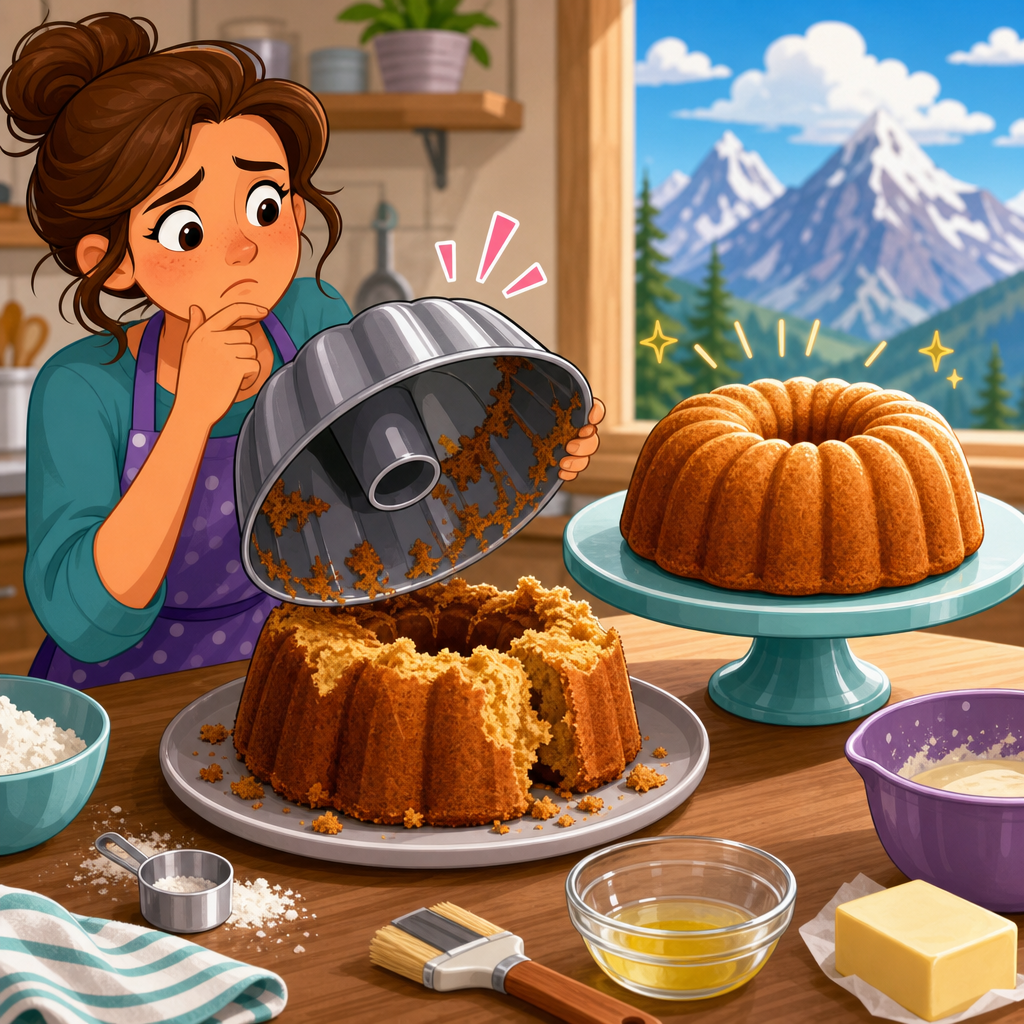
Bundt cakes at altitude fail in ways that frustrate even skilled bakers: they cling to the pan, tear around the ridges, dome unevenly, dry out before the center sets, or collapse after a promising rise. In mountain kitchens, these problems are rarely random. They come from the interaction between reduced air pressure, faster evaporation, pan geometry, batter chemistry, and release technique. A Bundt pan magnifies every weak point because its decorative curves increase surface area, its center tube changes heat flow, and its narrow crevices punish any lapse in preparation. If you bake above roughly 3,000 feet, understanding those forces is the difference between a clean release and a cake that stays welded to the pan.
For this Cakes & Cupcakes hub, the key terms matter. Altitude baking means adjusting formulas and methods to account for lower atmospheric pressure. Structure comes from flour, eggs, starch gelatinization, and protein coagulation. Leavening includes baking powder, baking soda, whipped egg foam, and steam. Release refers to the ability of a fully baked cake to separate intact from the pan after cooling for the correct interval. In my own high-altitude testing, Bundt cakes stick most often when three things happen together: the batter rises too fast, moisture leaves the batter too quickly, and the pan coating fails in detailed areas such as scrolls, flutes, or sharp inner corners.
This topic matters beyond a single recipe. Bundt cakes sit at the center of altitude cake baking because they expose the same issues that affect layer cakes, loaf cakes, cupcakes, pound cakes, coffee cakes, and sour cream cakes. If you can diagnose why a Bundt cake sticks at 5,000 or 7,000 feet, you can usually improve crumb texture, dome control, and moisture retention across your entire cake rotation. This hub explains the science, the common failure points, and the practical fixes, then points you toward the broader Cakes & Cupcakes decisions every altitude baker needs to make.
Why Bundt cakes stick more often at altitude
A Bundt cake sticks at altitude because lower air pressure changes how batter expands and how quickly moisture escapes. Gas bubbles enlarge more easily, so cakes often rise faster and more aggressively before the crumb has fully set. That expansion pushes tender batter into every groove of the pan. At the same time, water evaporates faster at altitude, increasing the risk that the exterior dries, firms, and grips the metal before the center finishes baking. If the cake is underbaked by even a few degrees in the center, steam continues to move outward during cooling and can glue fragile crumb to the pan walls.
Pan design makes the problem worse. A standard Bundt pan has many more edges and contact points than a round layer pan. More contact means more opportunities for sugar, milk solids, or fruit particles to caramelize and adhere. Dark nonstick pans can intensify this effect because they absorb heat efficiently, browning the outer crust sooner. Cast aluminum pans from makers such as Nordic Ware generally bake evenly, but even excellent pans will hold onto cake if the batter formula carries too much sugar, too little structure, or inclusions such as nuts and chocolate chips that sink into the detailed pattern.
Altitude also changes timing. At sea level, a baker might leave a Bundt cake in the pan for 10 to 15 minutes before unmolding. In a dry mountain climate, that same interval can be too long for some formulas and too short for others. Butter cakes with high sugar may need a slightly longer rest so the crumb stabilizes. Oil-based cakes or formulas heavy in fruit puree can become tacky if they sit too long. The correct release window depends on the recipe’s fat source, sugar level, and internal doneness, not on a universal rule.
The science behind rise, structure, and release
To fix sticking, start with the sequence of cake setting. In the oven, fat melts, sugar dissolves, gases expand, starches gelatinize, and egg and flour proteins coagulate. At altitude, the gas-expansion step gets ahead of the setting step. That means the batter can climb up the pan walls before starch and protein have formed enough support. The result is a weaker outer crumb that is more likely to tear when inverted. This is why many altitude cake formulas reduce chemical leavening by about 1/8 to 1/4 teaspoon per teaspoon called for, depending on elevation and recipe style.
Sugar is another major factor. Sugar tenderizes by interfering with gluten formation and delaying starch gelatinization. That creates a fine crumb in balanced formulas, but at altitude too much sugar can postpone setting so long that the cake overexpands, collapses slightly, then bonds to the pan. Liquid matters too. Because evaporation is faster, bakers often add 1 to 4 tablespoons of extra liquid at moderate altitude and sometimes more at higher elevations. The goal is not a looser batter for its own sake. The goal is to keep the cake moist enough to bake through before the crust becomes overly firm.
Oven temperature is the final control. Many altitude cake adjustments raise oven temperature by 15 to 25 degrees Fahrenheit so the structure sets earlier. That can work beautifully for layer cakes and cupcakes, but Bundt pans require nuance because the outer ring already bakes quickly. I usually recommend keeping the temperature increase modest and pairing it with leavening reduction, rather than pushing heat aggressively. A cake that sets slightly earlier without scorching the outer ridges releases far more cleanly than a cake with a dark crust and a damp core.
How to prepare the pan so the cake actually releases
Pan preparation is where many Bundt failures begin. For altitude baking, use a generous, complete coating that reaches every ridge, center tube seam, and decorative point. The most reliable method is softened butter applied with a pastry brush, followed by a thin dusting of flour or cocoa, depending on cake color. Baking spray with flour can work, but coverage must be thorough. Sprays often miss upper ridges or bead up on older nonstick surfaces. If the pan has elaborate detail, brush the spray around with a clean pastry brush instead of assuming the aerosol reached every recess.
Avoid pooling. Excess butter settles in low spots and can fry the crust into a sticky shell. Excess flour can clump and create a gummy paste. The coating should be visible but thin. In professional test kitchens, pan release pastes made from equal parts softened butter, neutral oil, and flour are widely used because they cling well to decorative pans. They are especially helpful at altitude, where reliable release matters more than speed. Brush the paste on just before filling the pan; if applied too early, it can slide or collect in the bottom depending on room temperature.
Pan condition matters. Scratched nonstick finishes, baked-on residue, and dishwasher wear all increase sticking. Wash Bundt pans gently, dry them completely, and inspect the inner tube and sharp corners before every bake. If a cake has stuck before in the same place, that is often a surface issue, not bad luck. For serious Bundt bakers, a heavy cast aluminum pan with crisp detail and no interior damage is worth keeping in dedicated rotation.
| Problem | Most likely cause at altitude | Best fix |
|---|---|---|
| Cake tears on unmolding | Underbaked center, weak structure, too much leavening | Reduce leavening slightly, bake to correct internal doneness, cool 10 to 15 minutes |
| Crust sticks in pan grooves | Incomplete greasing, sugary exterior, old pan surface | Use brushed butter-flour paste and inspect detailed areas carefully |
| Dry edges and damp middle | Heat too high for pan shape, fast evaporation | Add a little liquid, lower or moderate oven increase, avoid overbaking |
| Cake collapses after rising | Overexpansion before structure sets | Reduce baking powder or soda and strengthen batter with a bit more flour or egg |
| Dense, greasy band near crust | Too much pan coating or butter-sugar imbalance | Apply a thin coating and verify ingredient ratios |
Ingredient adjustments that improve Bundt cakes above 3,000 feet
Most altitude Bundt cakes benefit from small formula edits rather than total rewrites. First, reduce chemical leavening. If a sea-level recipe uses 2 teaspoons baking powder, try reducing by 1/4 teaspoon at 3,000 to 5,000 feet, and by 1/2 teaspoon or a little more at higher elevations, depending on batter richness. Second, consider adding 1 to 2 tablespoons extra liquid for moderate altitude and 2 to 4 tablespoons for higher elevations. Milk, buttermilk, coffee, or water can all work, but use the liquid already present in the formula when possible to preserve flavor balance.
Third, increase flour carefully if the cake is repeatedly fragile. One to two extra tablespoons of flour can strengthen crumb enough to support unmolding without making the texture tough. For cakes based on whipped egg whites, an extra egg white sometimes helps more than extra flour because it improves protein structure while keeping the crumb light. Fourth, reduce sugar slightly if the cake rises dramatically then sinks, or if the crust repeatedly sticks despite correct pan prep. A reduction of 1 to 3 tablespoons per cup of sugar can make a meaningful difference in setting.
Choose ingredients with release in mind. Finely ground nuts disperse better than coarse pieces in Bundt batters. Mini chocolate chips suspend more evenly than standard chips. Fruit should be well drained, and high-moisture add-ins such as apples or zucchini should be balanced with adequate flour. Sour cream, yogurt, and cream cheese bring tenderness and moisture, but they also slow setting, so recipes using them often need especially careful altitude tuning. For chocolate Bundt cakes, cocoa powder can help absorb excess moisture and strengthen structure, which is one reason they often adapt better than very delicate vanilla formulas.
Method changes for butter cakes, oil cakes, and pound cakes
Different cake families behave differently in a Bundt pan. Butter cakes made with the creaming method trap air in butter and sugar before baking even begins. At altitude, that initial air load combines with chemical leavening and steam, sometimes producing too much lift. Cream only until lightened and fluffy, not until the mixture is dramatically expanded. Overcreaming is a hidden altitude problem because it creates a batter that looks luxurious but bakes fragile. Alternate dry and liquid ingredients as directed, and stop mixing once the batter is combined.
Oil cakes are often more forgiving because liquid oil coats flour evenly and keeps crumb tender for days. They also tend to release well when fully baked. However, they can become gummy if overloaded with sugar or fruit puree. Measure by weight when possible. A pumpkin or banana Bundt at altitude often needs reduced leavening and sometimes a small flour increase because purees add both moisture and weight. Chiffon-style tube cakes are a separate category and usually belong in ungreased tube pans, not decorative Bundt pans, because they need wall traction to climb and cool upside down.
Pound cakes depend less on baking powder and more on eggs, butter, and careful mixing. That makes them natural candidates for altitude adaptation, but they can still stick if the crust overbrowns. A classic cream cheese pound cake in a dark Bundt pan may need a lower rack position or an insulated baking sheet underneath to moderate bottom heat. In testing, I have found that pound cakes release best when baked to a firm internal crumb, rested about 15 minutes, then inverted decisively rather than shaken repeatedly.
How Bundt cake troubleshooting connects to all Cakes & Cupcakes baking
This hub covers more than Bundt cakes because the same altitude principles shape every cake style. Cupcakes that peak then sink usually have the same overleavening issue that causes Bundt collapse. Layer cakes with tunneling often reflect overbeaten batter or too much baking powder. Loaf cakes that crack deeply before the center sets usually need better temperature control. Coffee cakes and snack cakes that seem dry on day one often lost too much moisture during baking and needed extra liquid or slightly shorter bake time.
The practical takeaway is to organize your troubleshooting by symptom. If cakes rise fast and fall, reduce leavening. If they dry out, add liquid and verify oven accuracy with a standalone thermometer from ThermoWorks, Taylor, or CDN. If they stick, improve pan prep and confirm full doneness. If crumbs are coarse, reduce mixing or sugar. This symptom-first approach helps across yellow cakes, chocolate cakes, red velvet, carrot cake, sour cream pound cake, cupcakes, and filled snack cakes.
For a sub-pillar structure, the most useful related articles under Cakes & Cupcakes are sea-level to altitude conversion basics, cupcake doming and overflow, layer cake sinking, chocolate cake adjustments, sour cream and cream cheese cake behavior, loaf cake cracking, and frosting stability in dry climates. Readers who master Bundt sticking issues usually find these other topics easier, because they have already learned to balance structure, evaporation, and heat.
Best practices for baking, cooling, and unmolding without damage
Fill the pan evenly, usually no more than two-thirds to three-quarters full unless the recipe states otherwise. Tap the filled pan lightly to settle thick batter, but do not slam it hard enough to destroy incorporated air. Bake on the oven rack, not on a thick sheet pan, unless you need to shield an overbrowning bottom. Check doneness with more than one cue: a skewer should come out with a few moist crumbs rather than wet batter, the top should spring back lightly, and the internal temperature for many butter-based cakes will land around 200 to 210 degrees Fahrenheit when fully baked.
Cooling is a release tool, not just a waiting period. Set the pan on a rack and let the cake rest long enough for steam pressure to settle and crumb to firm, but not so long that sugars harden against the metal. For many Bundt cakes, that sweet spot is 10 to 15 minutes. Run a thin flexible spatula around the center tube only if needed; do not gouge decorative outer edges unless you are already losing the cake. Invert onto a rack, give one firm downward tap, and lift the pan straight up. Twisting usually causes tearing.
If the cake resists, do not keep yanking. Cover the inverted pan with a towel dampened in warm water for a minute or two, or set the upright pan on a warm towel briefly to soften stuck fat and sugar. Then try again. Once released, cool completely before glazing. Glaze or ganache can hide minor surface flaws, but a clean release starts with correct formula and technique, not decoration. Keep notes on elevation, pan type, oven temperature, and exact adjustments. At altitude, one documented change is more useful than three guesses.
Bundt cakes at altitude stick for understandable reasons: lower air pressure encourages overexpansion, faster evaporation dries the crust early, and decorative pans increase the number of places where fragile crumb can cling. The fix is equally clear. Prepare the pan meticulously, reduce leavening when needed, add enough liquid to offset mountain dryness, avoid overmixing, and bake until the center is truly set. Then cool for the right interval and unmold with confidence. Those steps solve the immediate problem of a cake that refuses to release, but they also build the foundation for better cupcakes, layer cakes, pound cakes, and loaf cakes.
As the Cakes & Cupcakes hub within Cooking & Baking at Altitude, this page gives you the framework for every related recipe and troubleshooting guide. Start with symptom-based adjustments, use consistent tools, and change one variable at a time. If your Bundt cakes have been sticking, begin with pan preparation and leavening control on your very next bake. A clean release is not luck at altitude. It is the result of a formula and method that respect the conditions of your kitchen.
Frequently Asked Questions
Why do Bundt cakes stick so badly at high altitude, even when I grease the pan?
At altitude, sticking is usually caused by several small problems happening at once rather than one obvious mistake. Lower air pressure allows batters to rise faster and lose moisture more quickly, which means the outer layer of the cake can set differently against the pan than it does at sea level. In a Bundt pan, that matters even more because the design has deep ridges, narrow curves, and a central tube that create a lot of contact area. Every decorative detail is another place where batter can grip if the coating is thin, uneven, or begins to break down before the cake fully releases.
Greasing alone is often not enough in mountain baking because the batter may dry and cling before the crumb structure stabilizes. If your coating pools in some spots and misses others, or if flour dusting is inconsistent, the cake can tear exactly where the pan is most detailed. Baking sprays that contain flour can help, but they still need to be applied thoroughly, especially into seams, flutes, and the area around the center tube. A pastry brush is often more reliable than a quick aerosol pass because it pushes the fat into every contour.
Pan preparation also has to match the batter. Butter gives great flavor, but it contains water and milk solids that can sometimes encourage sticking if used alone. Shortening or a high-quality pan-release mixture often performs better for intricate Bundt designs because it creates a more stable barrier. Many experienced bakers use a homemade release made from equal parts shortening, oil, and flour, brushed on in a thin but complete layer. The goal is coverage, not thickness. Heavy buildup can actually bake into sticky patches.
Finally, release timing matters. If you try to unmold too soon, the structure may be too fragile and tear. If you wait too long, steam condenses and the cake can settle back onto the pan surface and adhere. For many Bundt cakes, a short resting window of about 10 to 20 minutes is ideal, but the exact timing depends on the formula. At altitude, where evaporation and setting happen differently, testing your timing can be just as important as adjusting your greasing method.
How should I prepare a Bundt pan to prevent tearing around the ridges and center tube?
The best approach is deliberate, detailed pan preparation. Start with a perfectly clean pan. Even tiny residues from previous bakes can act like glue, especially in older nonstick pans or ornate designs. Wash and dry the pan thoroughly, then inspect the ridges, seams, and center tube. If the finish is scratched or worn, release problems become much more likely because the batter has more opportunities to latch onto the surface.
Next, apply your release agent carefully rather than quickly. Use a pastry brush to coat every groove, inner curve, and edge. This is especially important on the top half of the sidewalls and around the center tube, where batter often climbs and sets early. If using a flour-based release, tap out excess. Too much loose flour can create gummy patches or visible residue on the crust, while too little coverage leaves vulnerable bare spots. The layer should be thin, even, and complete.
If your cake recipe is particularly high in sugar, fruit, or dairy, be extra attentive. These ingredients can caramelize and make sticking worse, especially at altitude where edges can bake and dry faster. In that case, a pan-release paste is often more reliable than melted butter. Some bakers also chill the prepared pan briefly so the coating adheres more evenly, though this works best in kitchens where the pan is not sitting long enough to collect condensation.
It also helps to avoid overfilling the pan. When batter rises too high, it can bake over the inner lip or cling aggressively to upper ridges, making unmolding rough and uneven. Fill the pan according to the recipe, usually around two-thirds full unless the batter is known to rise modestly. Once baked, cool the cake on a rack for the right amount of time before inverting. A gentle shake or a few light taps can help loosen it, but forcing it out usually guarantees tearing. Good release starts before the batter goes in, not after the cake comes out of the oven.
Why do Bundt cakes dome unevenly, dry out, or crack more at altitude?
These issues are classic signs that the batter is reacting to altitude without enough formula adjustment. In mountain kitchens, lower atmospheric pressure allows leavening gases to expand more rapidly, so cakes often rise faster and more aggressively. That sounds good at first, but it can cause the structure to lift before it is strong enough to support itself evenly. In a Bundt pan, the ring shape and center tube help distribute heat, but they also expose more batter surface to fast setting and moisture loss. The outside can firm up while the center mass is still trying to expand, leading to doming, cracking, or a dry outer crumb.
Dryness is often made worse by faster evaporation. Even before the cake is fully baked, moisture is leaving the batter more quickly than many standard recipes expect. That can produce a cake that looks done on the outside but still needs more internal baking time. By the time the center sets, the outer ridges may be overbaked. This is one reason Bundt cakes can feel especially unforgiving at altitude: the pan shape magnifies the tension between a decorative crust and a tender interior.
To reduce these problems, bakers often make several altitude adjustments together. Slightly reducing sugar can help prevent structural weakness. Increasing liquid can compensate for faster moisture loss. Reducing chemical leavening slightly can slow the rapid rise that leads to doming and collapse. Raising the oven temperature a little can help the structure set sooner, but that has to be balanced carefully so the crust does not overbake. The exact changes depend on elevation and recipe style, but the principle is always the same: control expansion and protect moisture.
Mixing method matters too. Overbeating can incorporate excess air, which becomes more problematic at altitude because those air cells expand readily. That can create a coarse crumb, peaked rise, or collapse after baking. For Bundt cakes, aim for a batter that is well-emulsified and smooth but not overaerated. If your cakes repeatedly dome or crack, the fix is rarely just baking longer or greasing better. It usually means the recipe needs altitude-specific tuning.
What recipe changes help Bundt cakes bake more evenly and release cleanly in mountain kitchens?
The most effective altitude fixes usually involve small, strategic adjustments rather than a complete rewrite of the recipe. Start by looking at leavening. If a Bundt cake rises beautifully and then falls, or if it climbs too quickly and forms weak, fragile ridges, there may be too much baking powder or baking soda for your elevation. A modest reduction can slow expansion and give the crumb more time to set. This makes the cake sturdier, which not only improves texture but also helps it survive unmolding without breaking.
Next, address moisture. Adding a bit more liquid can offset the faster evaporation that happens at altitude. This might mean a few extra tablespoons of milk, buttermilk, sour cream, or another recipe liquid, depending on the formula. Some bakers also increase egg slightly, since eggs contribute both moisture and structure. If the cake tends to dry out around the edges before the center finishes, this step can make a noticeable difference. A more balanced moisture level often leads to a cleaner release because the crust is less likely to bake into a hard, clingy shell.
Flour and sugar can also be adjusted carefully. A slight increase in flour can reinforce structure, while a slight decrease in sugar may reduce over-tenderness and collapse. Sugar weakens structure and promotes caramelization, both of which can work against you in a detailed Bundt pan at altitude. If a cake is very soft, very sweet, or loaded with fruit, syrups, or dairy, it may need extra support to hold its shape when inverted. The goal is not to make the cake heavy, but to keep it stable enough to release as one piece.
Finally, revisit baking temperature and doneness. Many altitude bakers raise oven temperature slightly so the cake sets before overexpanding. Use an oven thermometer to verify accuracy, because even a small temperature error can exaggerate sticking and dryness. Test doneness in more than one place, especially near the thickest section of the ring. A cake that is technically underbaked in the center is far more likely to tear during release. When the structure, moisture balance, and pan prep all work together, Bundt cakes become much more predictable, even at high elevation.
When should I unmold a Bundt cake at altitude, and what is the safest way to do it without breaking it?
Unmolding is one of the most overlooked parts of successful Bundt baking, and altitude makes timing even more important. If you invert the cake immediately out of the oven, the crumb may still be too delicate to support itself, especially if the batter rose quickly and has not fully stabilized. That can cause the cake to split, sag, or leave pieces behind in the pan. On the other hand, if you let it sit too long, moisture from the hot cake can condense inside the pan and effectively glue the crust