Mountain pass driving demands a different level of preparation than ordinary highway travel because elevation, weather, road grade, and rescue access all change at once. The best emergency kit for mountain pass driving is not a generic roadside bag bought on impulse; it is a purpose-built system designed for cold exposure, traction loss, visibility problems, mechanical delays, and long waits for help. I have packed kits for winter crossings in the Rockies and Cascades, and the difference between a useful kit and dead weight is simple: every item must solve a specific problem likely to happen above the valley floor.
Before choosing gear, define the setting. A mountain pass is a high route through elevated terrain, often marked by steep climbs, sharp descents, rapid weather shifts, avalanche control closures, and intermittent cell service. Emergency kit means the collection of safety, recovery, repair, and survival items kept in the vehicle to protect occupants and improve the odds of self-recovery until professional help arrives. For this Vehicles & Mountain Driving hub, the goal is broader than listing supplies. It is to explain what belongs in a serious kit, why it belongs there, how it should be stored, and how vehicle type, season, and route change the final loadout.
This matters because mountain incidents are rarely single-variable problems. A slide-off can become a cold exposure event. A simple puncture can turn critical if wheel nuts are frozen, daylight is gone, and shoulder space is narrow. According to Federal Highway Administration guidance, steep grades, snow, ice, and low visibility significantly increase crash and closure risk on mountain corridors. State departments of transportation from Colorado to Washington routinely impose chain rules and traction laws because conditions can deteriorate faster than many drivers expect. The right emergency kit supports safer decisions before departure, safer responses during breakdowns, and better outcomes if the road closes behind you.
As a hub page for Vehicles & Mountain Driving, this article covers the core framework that links every related topic: winter traction, tire management, cold-weather maintenance, mountain route planning, braking on descents, roadside visibility, and occupant survival. If you understand the logic behind the best emergency kit for mountain pass driving, you will also understand how to evaluate chains, snow tires, battery health, recovery tools, and communications gear in every season. The kit is the physical expression of mountain driving risk management.
What the best emergency kit for mountain pass driving must do
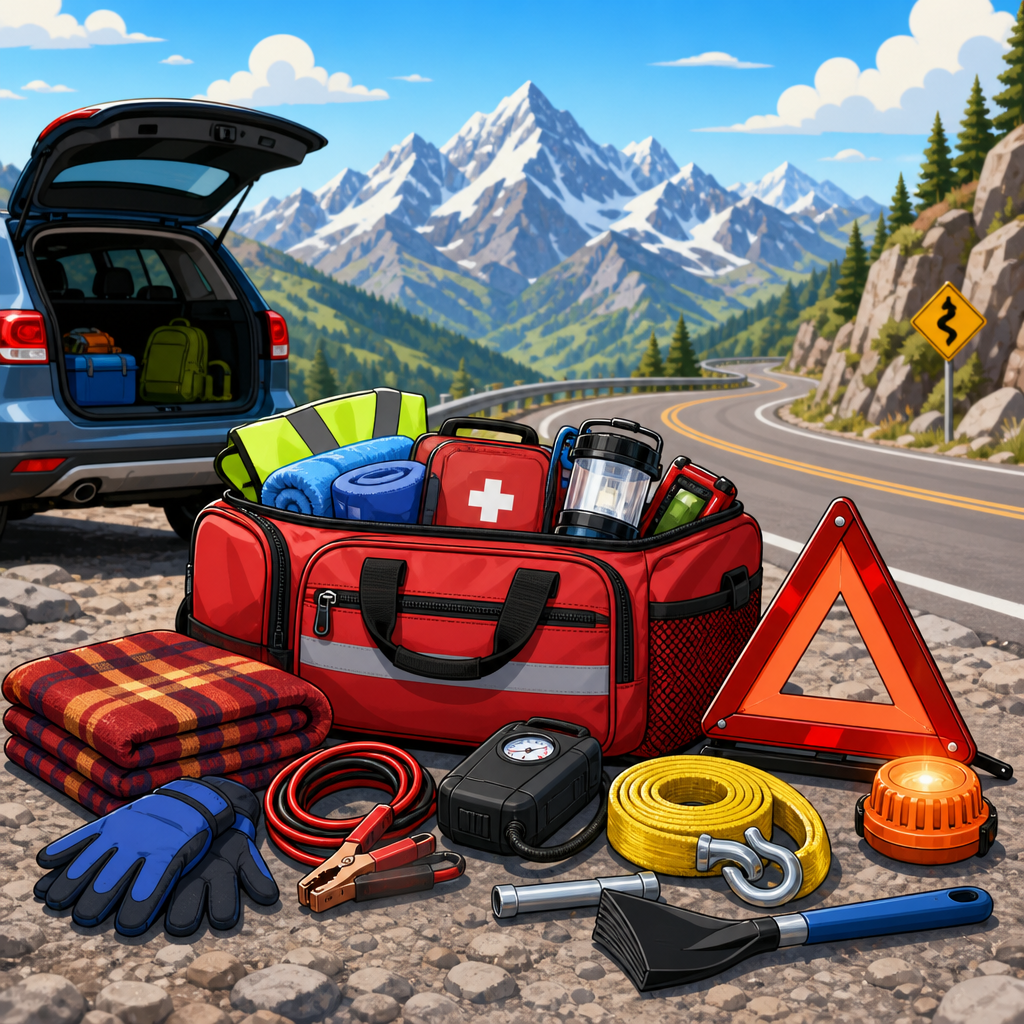
The best emergency kit for mountain pass driving has to perform across five jobs: keep people warm, keep the vehicle visible, restore basic mobility, support minor repairs, and sustain occupants during delays. Most weak kits overinvest in novelty items and underinvest in insulation, traction, lighting, and power. If you only remember one principle, remember this: in mountain terrain, preserving body heat and maintaining the ability to signal for help matter more than carrying ten low-quality tools.
Start with life safety. Pack insulated gloves, hats, spare socks, emergency blankets, and ideally a compact sleeping bag or cold-rated bivy for each frequent traveler. My standard mountain kit always includes a change of base layers because wet cotton after chain installation can accelerate heat loss fast. Add high-calorie food that tolerates freezing, such as energy bars, nuts, jerky, and shelf-stable drink mixes. Water should be stored in containers that allow expansion when frozen. A first-aid kit needs trauma dressings, adhesive bandages, pain relief, antiseptic wipes, blister care, and any personal medication.
Visibility and signaling are next. A reflective vest, LED road flares, a high-output flashlight, and a headlamp are nonnegotiable. Traditional incendiary flares still work, but in dry roadside environments they introduce fire risk and have a limited burn window. Rechargeable lights are excellent only if charging discipline is reliable, so I prefer a mixed system: one rechargeable headlamp plus lithium AA or AAA backup lights. A whistle and a brightly colored signal panel are lightweight additions that help if you must leave the vehicle for a short distance.
Mobility and basic recovery matter because many pass incidents are not catastrophic. They are small losses of traction, shallow snow trapping, dead batteries, and punctures. Carry tire chains or approved alternative traction devices matched to tire size, a shovel, a tire pressure gauge, and traction aids such as sand, grit, or traction boards if your vehicle has space. A portable jump starter is now more useful for most drivers than old-style jumper cables, especially when no second vehicle can safely stop. A quality air compressor can turn a slow leak into a manageable exit plan if the puncture is in the tread and the tire can hold pressure long enough to reach service.
Core kit checklist by function
The easiest way to build a complete kit is to organize by problem, not by aisle in an auto store. That prevents duplication and exposes weak points. The table below shows the categories I use when outfitting vehicles for regular mountain pass driving, from compact crossovers to full-size pickups. Quantities depend on passenger count and climate severity, but the functions do not change.
| Function | Essential items | Why it matters in mountain passes |
|---|---|---|
| Warmth | Insulated gloves, hats, spare socks, thermal blankets, compact sleeping bag, hand warmers | Cold exposure begins quickly during chain installation, recovery attempts, or road closures |
| Visibility | Reflective vest, LED flares, flashlight, headlamp, spare batteries | Snow, fog, and early darkness reduce driver detection on narrow shoulders |
| Traction | Tire chains or approved devices, shovel, traction sand or boards, tire gauge | Helps prevent becoming immobilized on grades, packed snow, or ice |
| Power | Jump starter, charging cables, 12-volt adapter, power bank | Cold weakens batteries and dead phones complicate rescue coordination |
| Repair | Air compressor, tire plug kit, multitool, duct tape, zip ties, basic hand tools | Minor failures are common and often fixable enough to reach a safer location |
| Survival | Water, shelf-stable food, first-aid kit, medications, toilet paper, wipes | Closures and crashes can create waits measured in hours, not minutes |
| Information | Paper map, route notes, emergency contacts, insurance details | Cell service can fail where detours and mile markers matter most |
Every item in that list should be tested before winter. Open the chains and confirm fit. Start the jump pack and check state of charge. Run the air compressor. Replace expired food and medications. Cheap tools often fail when cold-soaked, so buy fewer items and buy sturdier ones. Brands matter less than verified function, but tools from established makers such as NOCO, Viair, Streamlight, Petzl, and AutoSock generally perform more consistently than no-name kits.
Storage method also affects performance. Use two layers: a grab bag for immediate roadside use and a deep-storage bin for shelter and backup supplies. The grab bag should hold gloves, vest, headlamp, flares, chain gloves, and the traction device instructions. In a storm, you do not want to unpack your entire cargo area on the shoulder just to find a flashlight. Heavy items must be secured so they do not become projectiles during a collision or hard braking event.
Seasonal and vehicle-specific choices
No single emergency kit fits every pass, season, or vehicle. A front-wheel-drive sedan crossing Snoqualmie Pass in shoulder season needs a different emphasis than a diesel pickup towing through Colorado in January. The best emergency kit for mountain pass driving always starts with the vehicle’s limitations. Ground clearance, tire type, cargo room, drivetrain, and payload determine what the kit should prioritize.
For two-wheel-drive passenger cars, traction and tire condition are the main concerns. Carrying correctly sized chains and practicing installation in dry conditions is mandatory, not optional. Low-profile tires reduce sidewall flexibility and can complicate chain clearance, so always verify owner’s manual restrictions. Many modern vehicles have limited chain clearance on the inside sidewall, and using the wrong product can damage brake lines or wheel wells. In those cases, approved textile devices or low-clearance chains may be required by the manufacturer or transportation authority.
For crossovers and all-wheel-drive vehicles, overconfidence is the recurring problem I see. AWD improves launch traction, but it does not reduce stopping distance on ice. These vehicles benefit from the same cold-weather essentials plus a more capable shovel and compressor because owners are more likely to continue into changing conditions. If your AWD system is reactive rather than full-time, matching tire circumference is important. Uneven wear or mixed tire types can stress driveline components and degrade traction performance.
Trucks and body-on-frame SUVs usually have room for better kits, but they also pose weight-management issues. An unloaded pickup bed can reduce rear traction dramatically on snow. Ballast may help, but it must be secured and kept within manufacturer payload limits. For these vehicles, I usually add a tow strap only if recovery points are rated and the driver understands safe use. Unsafe towing is a common source of secondary damage and injury. A kinetic rope, shackles, and winch are not beginner tools and should not be treated as substitutes for route judgment.
Season changes the consumables. In winter, add chemical hand warmers, de-icer, an ice scraper, and extra insulation. In spring thaw, include waterproof gloves and boots because slush soaks clothing quickly. In summer, mountain passes still require emergency planning because wildfire smoke, rockfall, and sudden thunderstorms can cause closures or visibility loss. Heat also damages batteries and stored water, so inspect containers regularly. Year-round, maintain at least half a tank before committing to a major pass. Fuel is warmth, detour range, and margin for closure delays.
How to use the kit during real mountain pass emergencies
A well-stocked kit only helps if the response sequence is sound. When a problem starts, the first decision is whether to stay with the vehicle. In most mountain pass scenarios, staying with the vehicle is safer unless there is immediate danger from avalanche exposure, fire, unstable roadside position, or instruction from emergency personnel. A vehicle is easier for rescuers to spot than a person on foot, and it provides shelter from wind.
If you lose traction or become stuck, avoid spinning the tires aggressively. That polishes snow into ice and buries the drivetrain deeper. Clear snow from the drive wheels and the path ahead with your shovel, reduce tire pressure only if you understand the tradeoff and have a compressor to reinflate, install chains or traction devices, and apply smooth throttle. If the vehicle is high-centered, stop and reassess. Continuous attempts waste fuel and increase risk. In practice, many self-recoveries succeed because the driver pauses long enough to improve tire grip and wheel path.
During a mechanical breakdown, move as far off the travel lane as possible without risking a slide. Activate hazard lights, put on your reflective vest before exiting, and place LED flares upstream if conditions allow. Prioritize the simplest fixes first: battery restart, tire inflation, visible hose clamp issue, or loose battery terminal. Do not crawl under a vehicle on a narrow icy shoulder. If help is delayed, conserve battery by limiting accessory use, run the engine intermittently for heat only if the exhaust pipe is clear of snow, and crack a window slightly for ventilation.
Communication should be redundant. A charged phone is basic, but it is not enough in dead zones. Before departure, download offline maps and note mileposts, pass summits, chain-up areas, and service stations. In remote corridors, a satellite communicator such as a Garmin inReach or ZOLEO adds a real safety margin because it can transmit location and messages without cellular service. That is especially relevant for solo drivers, late-night crossings, and roads with low winter traffic. The emergency kit supports survival, but route awareness and timely communication often prevent emergencies from escalating.
Building this page into your mountain driving system
This Vehicles & Mountain Driving hub works best when the emergency kit is treated as one part of a complete operating system. The other parts are tires, maintenance, weather interpretation, route selection, and disciplined driving technique. I have seen excellent kits undermined by neglected tires and poor brake management on long descents. Dedicated winter tires marked with the three-peak mountain snowflake symbol provide measurable cold-weather grip advantages over all-season tires, especially below 45 degrees Fahrenheit. Good rubber shortens the list of emergencies your kit needs to solve.
Preventive maintenance belongs here too. Test the battery before winter, inspect coolant strength, verify washer fluid freeze protection, and confirm that wiper blades clear packed road film. Check brake pad thickness because mountain descents expose weak braking systems quickly. Learn engine braking or the proper use of lower gears if your transmission allows it. Review state DOT travel alerts before departure and obey chain controls early rather than late. In mountain travel, preparedness is cumulative. The best emergency kit for mountain pass driving is most effective when paired with a vehicle that is already ready for the pass.
The core takeaway is straightforward: build your kit around realistic mountain hazards, not generic roadside marketing. Warmth, visibility, traction, power, repair capability, and communication are the categories that matter. Tailor the loadout to your vehicle, season, passenger count, and route remoteness. Test everything before the weather turns, store it so the critical items are reachable first, and refresh consumables on a schedule. If you drive mountain passes regularly, use this hub as your starting point, then review your tires, chain plan, braking technique, and winter maintenance checklist before the next trip. A well-built kit does not guarantee an easy crossing, but it gives you options when the pass stops being forgiving.
Frequently Asked Questions
What should the best emergency kit for mountain pass driving include?
The best emergency kit for mountain pass driving should be built around the specific risks that come with steep grades, fast-changing weather, limited cell service, and longer rescue times. At a minimum, your kit should include insulation and cold-weather survival items such as emergency blankets, a sleeping bag or bivvy rated for winter conditions, extra hats and gloves, hand warmers, and waterproof outer layers. Food and water matter too, but in mountain conditions they should be selected carefully: shelf-stable, calorie-dense snacks are more practical than bulky items, and water should be stored in ways that reduce freezing risk.
You also need traction and recovery gear. Tire chains or approved traction devices are essential on many mountain passes, and they should be matched to your exact tire size and tested before you need them in a storm. A small shovel, traction boards or traction aid, sand or cat litter for grip, and a tow strap can make the difference between a delay and a dangerous overnight situation. Visibility and signaling supplies are just as important, including a headlamp with extra batteries, reflective triangles, a high-visibility vest, a flashlight, and a backup power bank for your phone. If your vehicle is disabled around a blind curve or in blowing snow, being seen matters.
Finally, include basic mechanical and medical essentials: jumper cables or a jump starter, windshield washer fluid rated for low temperatures, an ice scraper, a first-aid kit, tire pressure gauge, portable air compressor, multi-tool, duct tape, and any medications your family might need. In a mountain pass kit, the goal is not just roadside convenience. It is to stay warm, stay visible, maintain traction, and remain self-sufficient long enough for conditions or help to improve.
Why is a standard roadside emergency kit usually not enough for mountain pass driving?
A standard roadside emergency kit is often designed for common highway problems such as a dead battery, a flat tire, or a short breakdown near populated areas. Mountain pass driving introduces a much different set of conditions. Temperatures can drop quickly with elevation, storms can move in with very little warning, shoulders may be narrow or snow-covered, and a minor slide-off can become a serious exposure situation if help is delayed. That is why a generic kit bought at a big-box store often falls short. It may include basic jumper cables and a flashlight, but it usually lacks the cold-weather survival gear, traction equipment, and weather-specific tools needed in mountain terrain.
The biggest difference is time and environment. In ordinary driving, a breakdown might mean waiting 30 to 60 minutes for roadside service. On a winter pass, you may be waiting much longer, especially during chain-control periods, active storms, closures, or avalanche mitigation work. During that delay, cold exposure becomes a primary concern. A standard kit rarely includes enough insulation, extra clothing, food, or water planning for an extended stop in freezing conditions. It also may not include practical snow tools like a shovel, chain gloves, tire chains, or anti-fog and de-icing supplies.
Another issue is vehicle recovery. Losing traction on a steep grade or getting high-centered in roadside snow is far more common in mountain travel than on flat highways. A standard kit is not usually designed around regaining movement in snow, slush, or ice. For mountain pass driving, your emergency kit needs to function as a survival and recovery system, not just a roadside convenience package. That is the key distinction.
How much water, food, and warm clothing should I carry when driving through a mountain pass?
A good rule is to pack as if you may need to stay with your vehicle for several hours or even overnight, especially in winter. For water, many drivers underestimate the challenge of freezing conditions. Instead of tossing a few bottles in the trunk and forgetting about them, store water in insulated containers and rotate it regularly. You do not need to overload your vehicle, but you should carry enough for everyone in the car to remain hydrated during a prolonged delay. In cold weather, dehydration still happens, and it can make you feel colder and more fatigued.
For food, focus on compact, high-calorie items that hold up well in temperature swings. Protein bars, nuts, jerky, trail mix, dried fruit, nut butter packets, crackers, and similar shelf-stable foods are usually better than items that melt, spoil, or require preparation. Think in terms of sustained energy rather than convenience snacks. Mountain pass delays can become physically and mentally draining, especially if you are digging out tires, installing chains, or managing children in a cold car. A small reserve of practical food goes a long way.
Warm clothing should be packed beyond what you expect to wear during the drive. Every passenger should ideally have an extra insulating layer, spare socks, gloves, and a hat. If you need to step outside in snow, wet feet or bare hands become a serious problem quickly. A winter coat, waterproof shell, and blanket or sleeping bag are strong additions, particularly for families, older passengers, or anyone traveling at night. The best setup assumes the heater might fail, the road might close, and you may be stationary much longer than planned. That is the mindset that makes a mountain pass kit effective.
Do I really need tire chains, a shovel, and traction aids if I have all-wheel drive?
Yes. All-wheel drive improves your ability to move, but it does not eliminate the need for dedicated traction and recovery equipment. One of the most common mistakes drivers make in mountain passes is assuming that all-wheel drive is a substitute for preparation. It is not. All-wheel drive can help you start moving on slick surfaces, but it does not change the laws of physics when it comes to braking, cornering, or stopping on ice and packed snow. It also does not help much if your tires are not appropriate for winter conditions or if you become stuck in deeper snow.
Many mountain passes legally require chains or traction devices during certain weather events, even for vehicles with all-wheel drive, unless they meet specific tire and drivetrain exceptions. Those rules vary by region, so checking local department of transportation guidance before your trip is essential. Even where chains are not required, carrying them is still smart because conditions can worsen unexpectedly. A storm, spinout, or extended closure can trap vehicles in places where extra traction becomes necessary to get moving again safely.
A shovel and traction aids are equally important because getting stuck often happens at low speeds: pulling into a turnout, stopping on the shoulder, trying to restart on a grade, or sliding slightly off a plowed lane. A compact shovel helps clear snow from around tires and exhaust areas, while traction aids can give your tires enough bite to escape without needing a tow. In real mountain driving, these tools are not overkill. They are part of responsible preparation, even for capable vehicles.
How often should I check and update my mountain pass emergency kit?
You should inspect your mountain pass emergency kit at the start of each winter season and then do a quick review before any major trip through higher elevations. A kit is only useful if the contents still work, fit your vehicle, and match the conditions you are likely to face. Batteries die, food expires, water containers leak, clothing gets borrowed, and tools end up in the garage after routine use. Seasonal checks help catch those gaps before they matter.
During your review, check expiration dates on food, medications, and first-aid supplies. Replace weak batteries in flashlights and headlamps, recharge power banks and jump starters, and inspect traction gear for wear or damage. If you carry tire chains, confirm they still match your current tires, especially if you have changed wheel or tire sizes. Test your shovel, compressor, and lights, and make sure your gloves and extra layers are clean, dry, and complete. It is also wise to confirm that your windshield washer fluid is rated for freezing temperatures and that your ice scraper is still in the vehicle where you expect it to be.
You should also update your kit based on who is traveling with you. A solo commuter needs something different from a family with children, a driver with a pet, or someone crossing remote passes at night for work. Adjust food, clothing, medications, and charging options accordingly. The strongest emergency kits are not static. They are maintained systems that evolve with the season, your vehicle, and the route ahead.