Altitude sun is harder on the scalp than most people realize, and the combination of stronger ultraviolet exposure, thinner air, wind, sweat, and limited shade can turn an ordinary day outdoors into a fast track to burns, peeling, irritation, and long-term skin damage. Protecting your scalp from altitude sun means reducing ultraviolet radiation reaching the skin on your head through barriers, sunscreen, timing, and smart habits that fit hiking, skiing, running, driving mountain roads, or simply living at elevation. The scalp is easy to miss because hair creates a false sense of coverage, yet part lines, thinning areas, shaved heads, and exposed hairlines routinely burn first. In my work advising outdoor routines for people who spend long days in mountain climates, scalp protection is one of the most neglected pieces of sun safety, even among people who are diligent about sunscreen on the face.
Why does altitude change the risk? Ultraviolet intensity increases as elevation rises because there is less atmosphere to filter incoming radiation. A widely used rule of thumb is that UV levels increase by roughly 10 to 12 percent for every 1,000 meters gained, although cloud cover, latitude, season, time of day, and surface reflection all affect the exact number. Snow can reflect up to 80 percent of UV radiation, while water, pale rock, and concrete also bounce light back onto the underside of hats and the edges of the scalp. That means your scalp is not just getting direct sun from above; it may be getting reflected exposure from multiple angles.
Scalp sun protection matters for immediate comfort and for long-term skin health. Acute overexposure causes redness, tenderness, scaling, itching, and a feeling that even brushing your hair hurts. Repeated burns raise the risk of actinic keratoses and skin cancers, including squamous cell carcinoma, basal cell carcinoma, and melanoma. The scalp is also a practical problem area because sunburn can disrupt sleep, trigger flaking that looks like dandruff, and worsen inflammatory conditions such as seborrheic dermatitis. A good altitude routine solves both the short-term irritation and the cumulative damage. This hub explains how to protect your scalp from altitude sun, what products and gear work best, when to reapply, and how to adapt for bald scalps, thinning hair, braids, helmets, and snow sports.
Why the scalp burns faster at altitude
The scalp is uniquely vulnerable because it sits at the top of the body, receives direct overhead sunlight, and often gets less deliberate protection than the face. Hair helps, but coverage is uneven. A dense head of dark hair shields some areas well, while a center part, cowlick, receding hairline, crown thinning, or closely cropped cut creates narrow high-risk channels where UV reaches skin easily. At altitude, those channels matter more because UVB, the main driver of sunburn, and UVA, which contributes to aging and deeper skin damage, remain intense even when the air feels cool.
People often underestimate risk in mountain settings because temperature is a poor guide to ultraviolet exposure. I see this mistake constantly on spring ski days and summer hikes: cool wind, mild air, and no sensation of heat lead people to skip scalp sunscreen or remove hats during midday breaks. The result is a burn that shows up hours later. The ultraviolet index, not the thermometer, is the right tool. In many high-elevation areas, the UVI can reach very high or extreme levels, especially from late morning through midafternoon. Checking a weather app that reports UVI is one of the simplest and most reliable prevention steps.
Another reason altitude sun is dangerous is duration. Outdoor activities in mountain regions are often long: trail days, lift days, ridge runs, alpine lake outings, roof work, or long drives where the scalp and part line stay exposed through windows. UVA penetrates glass more effectively than UVB, so someone commuting or sightseeing at elevation may accumulate meaningful exposure even without obvious burning. For people using photosensitizing medications, including doxycycline, isotretinoin, some diuretics, and certain acne treatments, the threshold for scalp irritation can be lower still.
Best barriers: hats, helmets, fabrics, and hairstyles
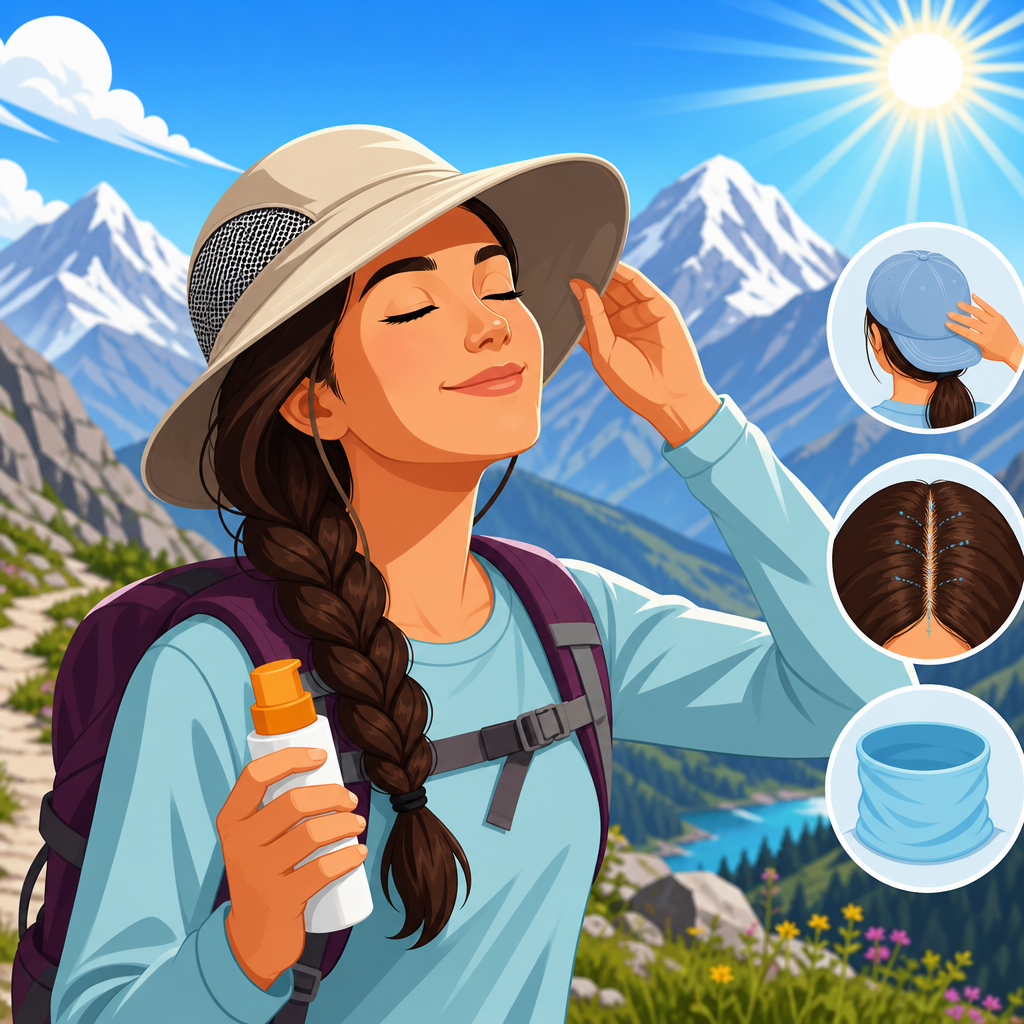
The most dependable way to protect your scalp from altitude sun is to block radiation before it reaches the skin. A hat with a solid, tightly woven fabric is more reliable than relying on hair alone. For hiking and daily wear, choose a hat with a brim of at least three inches and a crown that does not have large mesh openings over exposed scalp. Darker, denser fabrics generally block more UV than thin, pale weaves, and some outdoor brands publish an ultraviolet protection factor rating. UPF 50 fabric allows only a small fraction of UV through and is an excellent benchmark for mountain use.
Caps can work, but they have limits. A standard baseball cap shades the top of the scalp if the crown is opaque, yet it leaves ears, neck, and often parts of the hairline exposed. A bucket hat or wide-brim sun hat offers more complete coverage. For high-wind ridges or running, I prefer hats with chin cords, breathable side panels placed away from part lines, and moisture-wicking sweatbands that prevent salt sting in the eyes. Legionnaire-style caps with a neck cape are especially useful at high elevation because they protect the often-missed posterior scalp and neck without much extra heat burden.
Helmets are not automatic sun protection. Cycling, climbing, and ski helmets can leave vents directly above vulnerable scalp. If you wear one, use a helmet-compatible liner, skull cap, or buff made from UPF-rated fabric. The goal is full coverage under vented areas while preserving safe fit and ventilation. Hairstyles can help too. Moving a part, avoiding a fixed daily part line, wearing a fuller style over the crown, or using braids that reduce exposed channels can modestly reduce UV reaching the skin. None of these replaces a hat or sunscreen, but they lower risk when combined intelligently.
| Protection method | Best use at altitude | Main advantage | Main limitation |
|---|---|---|---|
| Wide-brim UPF hat | Hiking, gardening, town wear | Consistent scalp, face, ear coverage | Can be windy without a chin strap |
| Bucket hat | Travel, casual walks, fishing | Better side coverage than a cap | Brim may be shorter than ideal |
| Baseball cap | Running, quick errands | Easy to wear, shades crown and forehead | Leaves ears and neck exposed |
| Helmet liner or buff | Cycling, climbing, skiing | Protects through vents | Must not affect helmet fit |
| Scalp sunscreen spray or stick | Part lines, shaved heads, hairline | Reaches exposed skin precisely | Needs careful reapplication |
How to choose and apply sunscreen on the scalp
If the scalp is exposed, sunscreen should be treated as essential equipment. The right product depends on hair density and activity. For shaved heads or very short hair, a lotion or cream sunscreen is usually the most complete option because it forms an even film. For part lines, thinning crowns, and hairlines, sticks, compact lotions, and targeted sprays are more practical. Look for broad-spectrum SPF 30 or higher as a minimum, and use water-resistant formulas for exercise, humid weather, or snow sports. Mineral filters such as zinc oxide and titanium dioxide can be excellent for sensitive skin, while modern chemical filters may feel lighter and spread more easily through hair-bearing areas.
Application technique matters more than brand. Most underperformance comes from thin, uneven coverage. On a part line, separate the hair and run the product directly onto the skin, then gently tap it in rather than rubbing it all into the hair. On a thinning crown, apply in several passes from different angles to reach skin between hairs. On a shaved scalp, use the same quantity discipline you would use on the face, covering the ears and back of the head as well. Aerosol sprays can be helpful, but they should not be misted vaguely into the air. Spray close to the scalp, ensure visible wet coverage, and spread if needed.
Reapplication is where mountain conditions defeat many routines. Sunscreen should be reapplied at least every two hours during continued exposure and sooner after heavy sweating, towel drying, swimming, or repeatedly removing a hat. Powder sunscreens are convenient for touch-ups around hair, but they should be viewed as supplements, not your sole high-altitude defense, because it is hard to deposit enough product for true labeled protection. Lip balm with SPF and sunglasses with high UV protection also belong in the same routine, since scalp exposure often happens alongside facial and eye exposure on bright alpine days.
Special cases: bald scalps, thinning hair, children, and skin conditions
A bald or closely shaved scalp needs the same seriousness as the nose or shoulders because there is no natural barrier. In practice, this means broad-spectrum SPF 50 is often worth choosing for margin of safety, paired with a hat whenever possible. Water-resistant formulas help because a smooth scalp sweats and transfers product to hats quickly. People with thinning hair should assume that any place where the scalp is visible in indoor light is at risk outdoors, especially the crown. Crown burns are common because the area is hard to see and easy to miss during application.
Children need extra attention because they spend long periods outside and may not notice early discomfort. A child with a visible part line on a hike, playground visit, or ski lesson can burn surprisingly fast at elevation. Parents should use hats that stay on, apply sunscreen along parts and hairlines, and build reapplication into snack or water breaks. For infants, follow pediatric guidance on shade, protective clothing, and age-appropriate sunscreen use. For school-age children in mountain towns, a routine that combines a hat, sunscreen, and a teacher or caregiver reminder is far more reliable than expecting children to self-manage.
People with psoriasis, seborrheic dermatitis, eczema, recent scalp procedures, or a history of skin cancer should be especially careful. Inflamed or healing skin is less tolerant of ultraviolet stress and may sting with some formulations. Fragrance-free, alcohol-free, and mineral-based products are often easier to tolerate, though individual response varies. If you have actinic keratoses, prior Mohs surgery, or extensive scalp thinning, a dermatologist may recommend more aggressive protection, including daily year-round scalp sunscreen and scheduled skin checks. That is not excessive at altitude; it is standard risk management grounded in pattern and history.
Building an altitude sun routine that works every day
The best scalp protection plan is the one you can repeat without friction. Start by checking the day’s ultraviolet index and treating a rating of 6 or higher as a strong signal to use full protection; at altitude, even lower readings can matter during prolonged exposure. Next, decide on your primary barrier. If you will be moving steadily outdoors, wear a brimmed hat or helmet liner from the start rather than waiting until you feel hot. Apply sunscreen before leaving, not at the trailhead after you are already in direct sun. Most formulas need about fifteen minutes to set properly on the skin.
Then plan for maintenance. Carry a small stick sunscreen for part lines and hairlines, and keep a backup in a daypack, glove box, or ski jacket. Set a timer on your phone for reapplication, especially on long hikes or lift days when time passes unnoticed. If you sweat heavily, blot first, then reapply. If your scalp burns easily, build midday avoidance into your schedule by choosing earlier starts, lunching in shade, and using covered rest stops. None of this needs to be complicated. A compact kit of hat, sunglasses, SPF lip balm, and scalp sunscreen covers most situations effectively.
Finally, inspect your scalp the same way you inspect your face. After outdoor days, look for pinkness along the part, tenderness at the crown, and missed zones around the ears and neck. If you do get burned, cool compresses, gentle cleansing, a bland moisturizer, hydration, and avoiding further sun help recovery; severe blistering, systemic symptoms, or repeated burns should prompt medical advice. The larger goal is consistency. Protecting your scalp from altitude sun preserves comfort now and reduces cumulative damage later. Make scalp coverage part of your standard mountain routine, and revisit your setup before your next high-elevation day outside.
Frequently Asked Questions
Why does the scalp burn more easily at high altitude?
The scalp is especially vulnerable at high altitude because ultraviolet exposure becomes more intense as elevation increases, while the skin on top of the head is often directly exposed for hours at a time. Many people think only about their face, shoulders, or arms, but the scalp sits in one of the most sun-exposed positions on the body. At altitude, the atmosphere filters less UV radiation, so the skin receives a stronger dose even on cool, breezy, or partly cloudy days. That matters because temperature is a poor indicator of burn risk. You can feel comfortable and still accumulate enough UV exposure to damage the skin quickly.
Hair does provide some protection, but it is not a guarantee. Thin hair, fine hair, short haircuts, receding hairlines, cowlicks, parts, and shaved or closely cropped heads all leave areas of scalp exposed. Even people with thick hair can burn along the part line or at the crown, where sun hits most directly. Add wind, sweat, and dry air, and the scalp barrier can become irritated faster, making it more prone to tenderness, flaking, and inflammation. At altitude, a burned scalp is not just an uncomfortable nuisance. Repeated damage can contribute to premature skin aging and increase long-term skin cancer risk, which is why prevention deserves the same attention as protecting your face.
What is the best way to protect your scalp from altitude sun during hiking, skiing, or other outdoor activities?
The most reliable strategy is to combine physical coverage with sunscreen rather than relying on only one method. A hat is usually the first and best line of defense. For hiking, trail running breaks, fishing, or time around camp, a breathable hat with a solid crown and a brim helps block direct sunlight from the scalp, forehead, and ears. For high-output activities, lightweight technical fabrics that dry quickly and vent well are often more comfortable than standard cotton. If you are skiing or mountaineering, helmets can reduce direct exposure but they do not always cover the hairline, part, neck, or areas exposed by vents, so sunscreen is still important.
Sunscreen fills the gaps that hats, helmets, and hair miss. Apply a broad-spectrum SPF 30 or higher product to exposed scalp areas such as the part, temples, hairline, crown, and any thinning spots. Mineral powders, sticks, sprays, and lotions can all work, but the best choice is the one you will actually apply evenly and reapply consistently. If you sweat heavily, wear a helmet, or spend long hours outdoors, reapplication matters. It is also smart to build your day around UV intensity when possible. Midday exposure is typically strongest, so taking breaks in shade, using chairlift lodges or shelters, choosing a route with tree cover, or saving long exposed stretches for earlier or later in the day can make a real difference.
Good habits matter just as much as products. Check your scalp in a mirror before heading out, especially if you have a part or thin patch that is easy to forget. Keep a small sunscreen stick or powder in a pocket or pack so touch-ups are convenient. And remember that snow, water, pale rock, and bright pavement can reflect UV and increase exposure from below as well as above. In mountain environments, scalp protection works best when it becomes routine rather than something you do only on hot summer days.
What kind of sunscreen works best on the scalp without making hair greasy or difficult to manage?
The best scalp sunscreen is broad-spectrum, SPF 30 or higher, and easy to apply precisely where the skin is exposed. For many people, that means using different formats for different situations. If you have a visible part, thinning hair, or a shaved head, lotions and sticks often provide the most dependable coverage because you can see where the product is going and spread it evenly. Sticks are especially useful around the hairline, temples, and crown because they are portable, less messy, and less likely to run into the eyes when you sweat.
If you have thicker hair and mainly need protection along a part line or a few exposed areas, scalp-specific powders and lightweight sprays can be more cosmetically acceptable. Powders are popular because they reduce shine and can absorb some oil, which helps hair look more natural. Sprays can be convenient, but they need careful use. A quick mist from too far away may not deposit enough product to provide meaningful protection. If you use a spray, hold it close enough to target the scalp, apply generously, and rub it in if the instructions recommend doing so. Wind can also interfere with spray application outdoors, so it is often better to apply before you leave rather than after you are already on the trail or slope.
People with sensitive skin may prefer mineral sunscreens with zinc oxide or titanium dioxide because they are often less irritating, especially on a scalp that is already dry, reactive, or recently burned. If sweat stings your eyes, choose a water-resistant formula and avoid overapplying runny lotion near the forehead. Whatever you choose, test it before a big outdoor day. A sunscreen that protects well but feels sticky, leaves too much residue, or disrupts your hairstyle is one you may avoid using consistently. The ideal product is the one that gives solid UV protection and fits your real routine.
Is a hat enough, or do you still need sunscreen on the scalp at high altitude?
A hat is an excellent protective tool, but it is not always enough by itself. If the hat has a tightly woven fabric and a solid top, it can block a large amount of UV from reaching the scalp directly. That said, many outdoor situations still leave some skin exposed. Parts, hairlines, ears, the back of the neck, and areas around helmet edges often remain vulnerable. Mesh panels, vent holes, loose weaves, and shifting fit can also reduce protection. If you bend over, remove your hat during a break, or wear it inconsistently because of heat or wind, your scalp may get more exposure than you realize.
Using sunscreen along with a hat gives you a margin of safety, especially in mountain conditions where UV is stronger and reflection can increase exposure. Sunscreen is particularly important if you have thin or sparse hair, a shaved head, a visible part, or a hairstyle that exposes the scalp as you move. It is also a smart backup if your hat gets soaked with sweat, blows off, or has limited coverage. Think of hats as your primary barrier and sunscreen as the layer that protects the spots barriers miss. That combination is much more dependable than either method alone.
Fit and fabric matter too. A floppy or loosely woven hat may be comfortable, but it may not shield as well as a structured cap or technical sun hat made from UPF-rated material. Darker, denser fabrics often block more UV than thin, lightweight materials, though breathability still matters for comfort. The goal is not simply to wear something on your head, but to use coverage that stays on, covers well, and works with your activity level so you are not tempted to remove it when the sun is strongest.
What should you do if your scalp gets sunburned at altitude?
If your scalp is already burned, the priority is to reduce further damage, calm inflammation, and support healing. Get out of direct sun as soon as possible and protect the area from additional exposure with a hat or shade. Cool the scalp gently with a cool, damp cloth or a cool shower, but avoid ice directly on the skin, which can worsen irritation. Use a gentle, fragrance-free moisturizer or soothing after-sun product to help reduce dryness and tightness. Aloe vera can help some people, but choose a simple formula without heavy fragrance or a high alcohol content, since those ingredients can sting and dry the skin further.
For the next several days, treat the scalp carefully. Avoid harsh shampoos, strong exfoliants, hot water, and vigorous scrubbing. A burned scalp can become very tender, and aggressive washing can increase peeling and discomfort. If the area is painful, over-the-counter anti-inflammatory medication may help, if appropriate for you. Hydration also matters, especially at altitude, where dry air and exertion can make dehydration more likely. Peeling may happen as the damaged skin sheds, but try not to pick at flakes or blisters. Let the skin recover naturally.
Pay attention to signs that need medical evaluation. Severe pain, extensive blistering, swelling, fever, chills, nausea, dizziness, or symptoms of heat illness warrant prompt attention. If a scalp burn is recurrent, unusual, or focused on one persistent spot, it is also worth discussing with a dermatologist, particularly if you have thinning hair or a history of significant sun exposure. A scalp sunburn is easy to dismiss, but it signals that your current protection strategy is not enough. Once you heal, adjust your routine with better coverage, more consistent sunscreen use, and earlier prevention next time.