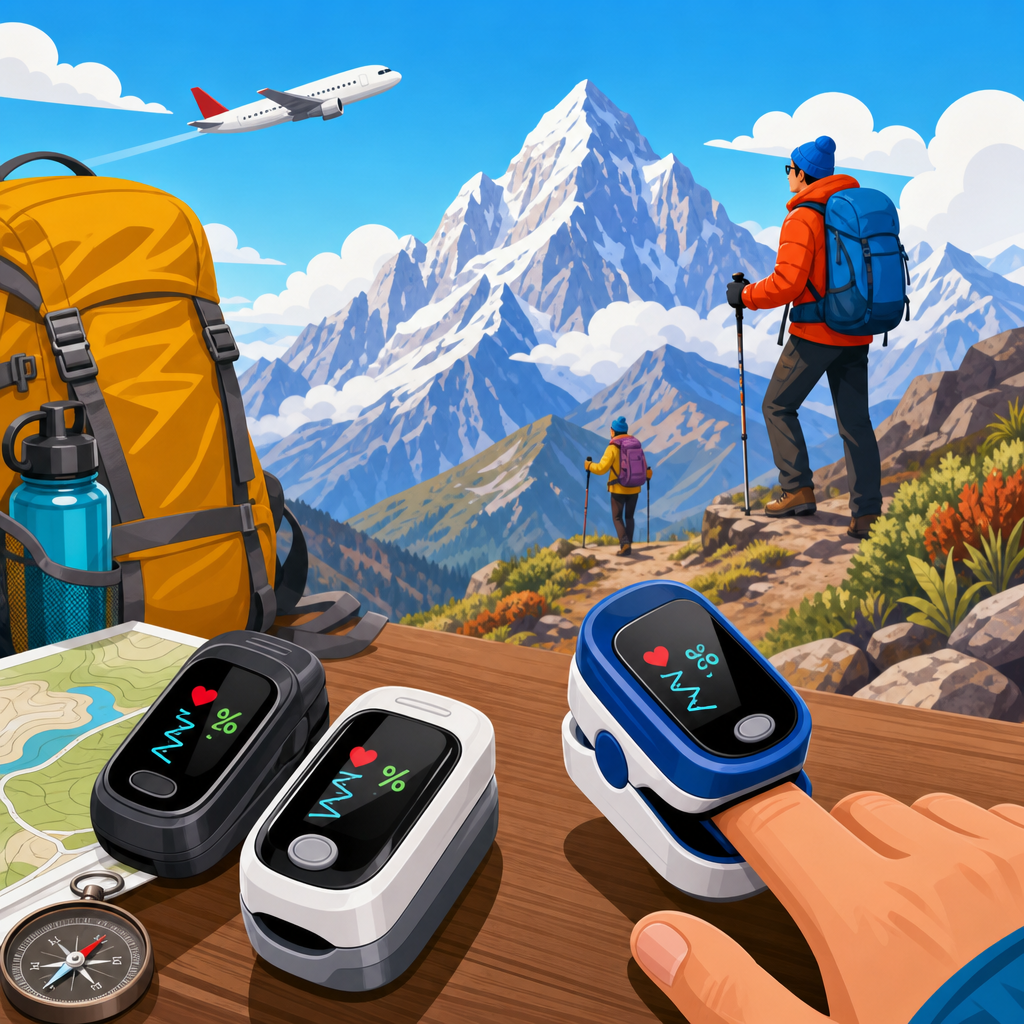
Best pulse oximeters for altitude travel are the models that stay accurate in cold, dry, low-oxygen environments, display readings quickly, and remain easy to use when your hands are tired or gloved. For trekkers, climbers, guides, and high-elevation travelers, a pulse oximeter is a compact device that estimates blood oxygen saturation, usually shown as SpO2, and pulse rate by shining red and infrared light through a fingertip. At sea level, healthy adults often read between 95 and 100 percent, but altitude changes that baseline fast. As elevation increases, oxygen pressure drops, saturation falls, and interpretation becomes more important than any single number. I have used pulse oximeters on multiday trekking routes and during acclimatization checks in mountain towns, and the difference between a reliable unit and a cheap, laggy one becomes obvious when you are deciding whether to rest, ascend, or descend.
This matters because altitude illness develops from physiology, not guesswork. A pulse oximeter does not diagnose acute mountain sickness, high-altitude cerebral edema, or high-altitude pulmonary edema on its own, yet it gives a useful objective signal when paired with symptoms, exertion level, sleep quality, and ascent profile. Travelers often ask which pulse oximeter is best for altitude travel, how accurate fingertip oximeters are at elevation, and what features matter most. The short answer is straightforward: choose an FDA-cleared or medically validated fingertip unit with strong low-perfusion performance, a clear OLED display, dependable battery life, and a shape that works on cold fingers. This hub explains what to buy, how to compare leading options, how to use a pulse oximeter correctly at altitude, and when oxygen readings should prompt caution rather than reassurance.
What makes a pulse oximeter good for high altitude
A good altitude pulse oximeter must solve problems that are less noticeable at home. Cold causes vasoconstriction, which reduces blood flow to the fingertips and makes weak sensors fail. Dry air, dehydration, fatigue, and recent exertion can also distort readings. In practice, the best units give a stable number within ten to twenty seconds, include a plethysmograph or signal strength indicator, and allow the screen to rotate so multiple people can read it easily in a tent, lodge, or vehicle. Weight matters for backpackers, but durability and reliability matter more. An ultralight device that throws error codes every morning is dead weight.
Accuracy language deserves attention. Most reputable fingertip oximeters cite an SpO2 accuracy range of about plus or minus 2 percent in the 70 to 100 percent range under test conditions. That does not mean every reading is equally trustworthy in the field. Motion, nail polish, dark pigmentation effects in some devices, low perfusion, and poor finger fit can all reduce confidence. For altitude travel, I prioritize consistency over marketing claims. If the same validated unit gives repeatable resting readings across several mornings, it is more useful than a flashy model with app features but inconsistent numbers.
Several features separate travel-ready models from generic online listings. A bright display is essential because many dawn assessments happen in dim rooms. Automatic power-off saves batteries, and standard AAA cells are usually better than obscure rechargeables on long trips because replacements are easier to find in small towns. A pulse bar, perfusion index, or waveform helps confirm whether the device is locking onto a real signal. Audible beeps are optional; many travelers prefer silent operation in shared sleeping spaces. Lanyards and hard cases sound minor, but they reduce drops and dust damage, especially during jeep transfers and lodge-based trips.
Best pulse oximeters for altitude travel: top categories and use cases
The best overall choice for most travelers is a medically validated fingertip model from a recognized manufacturer such as Nonin, Masimo, Zacurate, Innovo, or Contec, depending on market availability and regional certification. Nonin devices have long held a strong reputation for low-perfusion performance and durability, which is why many guides, expedition doctors, and clinics trust them. Masimo is respected for signal processing and hospital-grade monitoring technology, though some consumer options are pricier. Innovo and Zacurate have become popular among travelers because they balance readability, ease of use, and cost well when purchased from legitimate sellers. Contec units are common in travel medicine kits and can be practical if sourced carefully.
For expedition leaders and remote guides, the best pulse oximeter is usually a premium, rugged unit with strong low-perfusion reading capability, not the cheapest consumer model. These users check multiple people in fast-changing conditions and need quick stabilization, clear displays, and dependable hinges after months of use. For trekkers on a budget, a midrange fingertip unit can work well if it has a proven track record, fresh batteries, and a display that remains readable in bright sun and dark interiors. For family travel, simplicity matters most: one-button operation, a large screen, and comfortable finger fit are more valuable than Bluetooth syncing.
| Traveler type | Best oximeter profile | Why it fits altitude travel |
|---|---|---|
| Backpackers and trekkers | Midrange fingertip model with OLED display and AAA batteries | Light, easy to replace batteries, reliable daily acclimatization checks |
| Guides and expedition staff | Premium validated unit with strong low-perfusion performance | Faster stable readings on cold fingers and repeated group use |
| Family or lodge-based travelers | Simple one-button model with large rotating display | Easy for nontechnical users and quick symptom cross-checks |
| Travel medicine or rescue kits | Clinic-trusted brand with waveform or perfusion indicator | Better signal verification when decisions carry higher stakes |
How to compare leading brands and models
When I compare pulse oximeters for mountain trips, I start with validation, not star ratings. Look for devices that are FDA-cleared in the United States or sold through established medical suppliers with transparent specifications. Consumer marketplaces are crowded with rebranded units using identical housings but inconsistent sensors and quality control. That is why model reputation matters. Nonin Onyx lines are known for durability and strong performance in low perfusion. Masimo designs are tied to advanced signal extraction methods that perform well during challenging monitoring conditions. Innovo and Zacurate consumer models often include plethysmograph displays that help users judge signal quality, a genuinely useful feature at altitude.
Display quality is the next filter. A crisp OLED panel with large numerals reduces reading errors when you are tired. Some models cycle quickly between screen orientations, which helps when monitoring a partner. Clamp tension also matters. Too loose, and readings drift. Too tight, and comfort drops, especially on swollen or cold fingers. Battery compartment design is another overlooked point. I have seen cheap doors crack on the first week of travel. A sturdier hinge and positive snap closure are small engineering details that matter more than packaging claims about sports performance.
Do not overvalue smartphone connectivity. Bluetooth can be useful for logging trends, but for altitude travel it is secondary to immediate readability and stable signal acquisition. Most travelers need a morning resting reading, an occasional check after symptoms develop, and maybe one evening comparison after a rest day. Those tasks do not require an app. If you want trend tracking, write readings with date, altitude, symptoms, and resting heart rate in a notes app or paper log. That method is faster, survives dead phones, and often reveals the pattern that actually matters: whether your oxygen saturation is recovering after acclimatization or continuing to slide alongside worsening symptoms.
How to use a pulse oximeter correctly at altitude
The best pulse oximeter becomes misleading if used badly. To get a useful reading, sit quietly for several minutes, warm your hands, remove nail polish if possible, and keep the measuring hand still at heart level. Insert one finger fully, usually the index or middle finger, then wait for the display to stabilize rather than chasing the first number shown. If the pulse rate displayed seems implausible or the waveform is erratic, repeat the reading after warming up. On cold mornings above 3,000 meters, I often tell people to rub hands together, hold a mug, or place hands under layers first. That simple step can improve reliability more than switching devices.
Timing matters too. Compare like with like. A resting morning reading before caffeine and before packing gives a better acclimatization benchmark than a number taken immediately after climbing stairs. If someone feels unwell, note the context: recent exertion, hydration, headache severity, appetite, dizziness, cough, and sleep. Saturation values vary considerably by altitude and person, so the trend is more meaningful than a single result. At 2,500 meters, many healthy travelers still read in the low to mid-90s. At 3,500 to 4,500 meters, values in the 80s are common, especially early in acclimatization. What matters is whether the person is stable, improving, or deteriorating.
A pulse oximeter should support decisions, not replace them. If a traveler has severe headache, vomiting, confusion, ataxia, breathlessness at rest, or a wet cough, descending and seeking medical assessment take priority even if the number does not look dramatic. Conversely, a surprisingly low reading in someone who feels well may reflect cold fingers or a bad signal. Recheck after rest and warming. The device is most useful when its limitations are respected and its readings are integrated with established altitude illness guidance, including conservative ascent rates, rest days, and attention to red-flag symptoms.
Interpreting oxygen readings: what is normal, what is concerning
Many travelers want a simple chart of normal oxygen levels at altitude, but real physiology resists neat thresholds. Sea-level norms do not apply in the mountains. As barometric pressure falls, arterial oxygen saturation declines even in healthy, acclimatizing people. Age, fitness, lung conditions, sleep, exertion, and genetics all influence readings. Some high performers maintain unexpectedly strong numbers; others acclimatize well despite lower readings. That is why experienced altitude practitioners avoid rigid cutoffs and focus on pattern recognition.
Still, practical guidance helps. If someone’s resting saturation drops steadily over successive days while headache, fatigue, nausea, or breathlessness increase, risk is rising. A persistently elevated resting pulse can reinforce that signal. If saturation improves after a rest day and symptoms ease, acclimatization is probably catching up. High-altitude pulmonary edema often presents with falling exercise tolerance, cough, crackles, and low readings that do not recover normally with rest. High-altitude cerebral edema is more about neurological change such as confusion or loss of coordination; an oximeter may support concern but must never delay descent. In field use, I trust the combination of symptoms, trend, and objective measures more than any isolated percentage.
Pulse oximeters within a complete monitoring and oxygen strategy
A Monitoring & Oxygen hub should make one point clear: a pulse oximeter is just one layer of altitude safety. It works best alongside daily symptom scoring, conservative itineraries, hydration awareness, and clear descent rules. For higher-risk trips, travelers may also carry a thermometer, blood pressure cuff, rescue medications prescribed by a clinician, and emergency oxygen planning. Supplemental oxygen, oxygen concentrators in fixed lodges, and portable cylinders all serve different roles. They are not interchangeable, and none replaces acclimatization. Oxygen can relieve hypoxemia and buy time, but if serious altitude illness is suspected, descent remains definitive treatment whenever feasible.
This is also where gear choices connect. The best pulse oximeter for altitude travel should live in an accessible pocket, not buried deep in a duffel. Spare batteries should be packed in an inner pouch to protect them from cold. If the trip includes remote trekking, build a simple monitoring routine: morning resting SpO2 and pulse, symptom check, and notes on sleep and appetite. For guided groups, use the same device on the same finger type when possible to reduce variability. Standardization sounds fussy, but it prevents false reassurance and unnecessary alarm.
Choosing the best pulse oximeter for altitude travel comes down to reliability, readability, and realistic use in mountain conditions. Buy from a reputable brand, prioritize validated accuracy and low-perfusion performance, and treat trend data as more valuable than isolated numbers. Use the device at rest, with warm hands, and always interpret readings alongside symptoms and ascent history. That approach turns a small gadget into a meaningful safety tool rather than a novelty.
For most travelers, the right fingertip pulse oximeter adds confidence during acclimatization, helps identify when a rest day is working, and supports quicker decisions when someone feels off. It will not diagnose altitude illness by itself, and it cannot justify pushing higher when warning signs are present. What it does well is provide objective context in an environment where judgment can be clouded by fatigue and excitement.
If you are building your mountain safety kit, start with a dependable pulse oximeter, learn how to use it before your trip, and pair it with a conservative altitude plan. Then review your broader Monitoring & Oxygen setup so every reading leads to a clear, safer decision.
Frequently Asked Questions
What makes a pulse oximeter good for altitude travel instead of everyday home use?
The best pulse oximeters for altitude travel are built to perform reliably in conditions that are much less forgiving than a bedroom or clinic. At higher elevations, travelers often deal with cold temperatures, dry air, wind, fatigue, reduced circulation in the fingers, and lower oxygen levels overall. A good altitude-ready device should be able to produce stable readings quickly even when your hands are cold or you have just stopped hiking. That usually means strong sensor performance, a clear display, dependable signal processing, and a design that is easy to clip on and read in bright daylight or low-light camp conditions.
Ease of use matters just as much as raw accuracy. On a trek or climb, you do not want a device with confusing menus, tiny buttons, or a dim screen. Many travelers prefer models with a bright OLED or LED display, automatic power-on when clipped to a finger, and a rotating screen so readings can be viewed from different angles. Battery life is also important because charging options may be limited for days at a time. Rugged construction, a protective case, and resistance to light moisture or dust can add practical value in the field.
Another key difference is consistency. At altitude, readings may fluctuate more because of movement, colder skin, or lower perfusion, which is the amount of blood reaching the fingertips. Better travel models tend to handle low-perfusion situations more effectively and recover faster from brief signal loss. In short, a pulse oximeter that works well for altitude travel is one that combines accuracy, speed, readability, durability, and simplicity when environmental conditions are working against you.
What is a normal SpO2 reading at high altitude, and when should travelers be concerned?
At sea level, healthy adults often read between 95 and 100 percent, but that range usually drops as elevation increases because there is less oxygen available in the air. This is a normal physiological response, and it is one reason altitude travelers should not judge their numbers by sea-level expectations alone. Depending on elevation, acclimatization, fitness, and individual response, a healthy person may see lower readings than they are used to, especially during the first days at altitude.
What matters most is not just a single number, but the overall pattern and how the person feels. A reading that is modestly lower than usual may be expected if you have recently ascended. However, a trend of falling SpO2, especially when paired with symptoms such as severe headache, unusual fatigue, shortness of breath at rest, confusion, poor coordination, chest tightness, or persistent cough, deserves attention. These symptoms can suggest poor acclimatization or potentially serious altitude illness. A pulse oximeter is useful because it gives objective information, but it should never replace symptom awareness and sound decision-making.
Travelers should also remember that pulse oximeter readings can be affected by cold fingers, motion, dehydration, nail polish, and poor placement on the finger. If a reading looks unexpectedly low, warm the hands, sit still, and repeat the measurement after a few minutes. If low readings persist or symptoms worsen, the safest response may be to stop ascending, rest, seek medical guidance, or descend. The device is best used as a decision-support tool, not as a guarantee that everything is fine.
How can I get the most accurate pulse oximeter reading while trekking or climbing at altitude?
To get the most accurate reading, start by improving circulation before you measure. Cold fingers are one of the biggest reasons pulse oximeters give delayed, unstable, or inaccurate results in the mountains. Warm your hands inside gloves or pockets, shake them out gently, and wait until your fingertips feel less numb. Sit or stand still for a minute or two after exertion rather than checking immediately while breathing hard and moving. Motion can interfere with the sensor and produce erratic readings.
Make sure the device is positioned correctly on a clean, dry fingertip. Remove heavy nail polish if possible, and avoid placing the oximeter over dirty or wet skin. Insert the finger fully so the sensor aligns properly, then keep the hand relaxed and still at about chest level. Most quality units take a few seconds to settle. Instead of recording the first number that flashes, wait for the reading to stabilize and watch for consistency over several seconds. If the display shows pulse strength or a waveform, that can help you judge whether the signal is solid.
It is also smart to use the same finger and similar conditions each time if you are tracking trends across a trip. Morning measurements at rest, for example, are often more comparable than random checks taken after steep climbs. If a result seems out of line with how you feel, repeat the test after warming up and resting. In field use, consistency and good technique can be just as important as the brand of pulse oximeter you carry.
Which features should I prioritize when choosing the best pulse oximeter for high-elevation trips?
For altitude travel, prioritize fast readings, reliable performance in low-perfusion conditions, and a display you can read instantly outdoors. High-elevation environments are demanding, so sensor quality should come first. A model that can hold a stable reading when your fingers are cool or circulation is reduced is more valuable than one packed with extra features that do little in the field. Readability is another major factor. Look for a bright screen, large numbers, and ideally adjustable brightness or a multidirectional display so you can check readings without awkward positioning.
Battery performance is also essential. Long treks and remote travel often mean limited access to charging, so efficient power use and easy battery replacement can matter more than advanced connectivity. Some users like rechargeable models, while others prefer standard replaceable batteries they can pack as spares. The best choice depends on your itinerary. Weight and size should be considered too, but most fingertip pulse oximeters are compact enough that usability should take priority over shaving a few grams.
Other helpful features include automatic shutoff to preserve battery, a secure finger clip, carrying case, lanyard, and simple one-button operation. Water resistance and shock resistance can be useful for rough travel, though they are not always standard. If you are comparing models, pay attention to user feedback about cold-weather use, response speed, screen visibility, and consistency rather than marketing claims alone. For serious altitude travel, a straightforward device that performs dependably under stress is usually the best investment.
Can a pulse oximeter help detect altitude sickness, and should it be the main tool I rely on?
A pulse oximeter can be a very helpful tool for monitoring how your body is responding to elevation, but it should not be your only method for judging altitude illness. The device estimates blood oxygen saturation and pulse rate, which can provide useful context during ascent, rest days, or symptom checks. If your SpO2 is significantly lower than expected for your usual pattern and it is accompanied by worsening symptoms, that information can support a more cautious decision. In that sense, it is valuable for trekkers, climbers, guides, and anyone traveling in high mountains.
That said, altitude sickness is diagnosed by symptoms and overall clinical judgment, not by SpO2 alone. Some people can have relatively decent oxygen readings and still develop concerning symptoms, while others may show lower numbers yet remain stable and functional as they acclimatize. Headache, nausea, dizziness, poor sleep, weakness, confusion, breathlessness at rest, and reduced coordination often tell you more than a single fingertip measurement. A pulse oximeter cannot replace paying attention to how you feel, how quickly symptoms are progressing, and whether rest or descent is needed.
The smartest approach is to use the oximeter as one part of a broader safety strategy. Track trends instead of obsessing over isolated numbers. Take readings under similar conditions, note symptoms honestly, and avoid using a “good” number to justify pushing higher when your body is clearly struggling. If symptoms suggest moderate or severe altitude illness, the priority is appropriate action, which may include stopping ascent, seeking medical help, using supplemental oxygen if available, or descending. A pulse oximeter is a practical mountain companion, but it is not a substitute for caution, experience, and common sense.