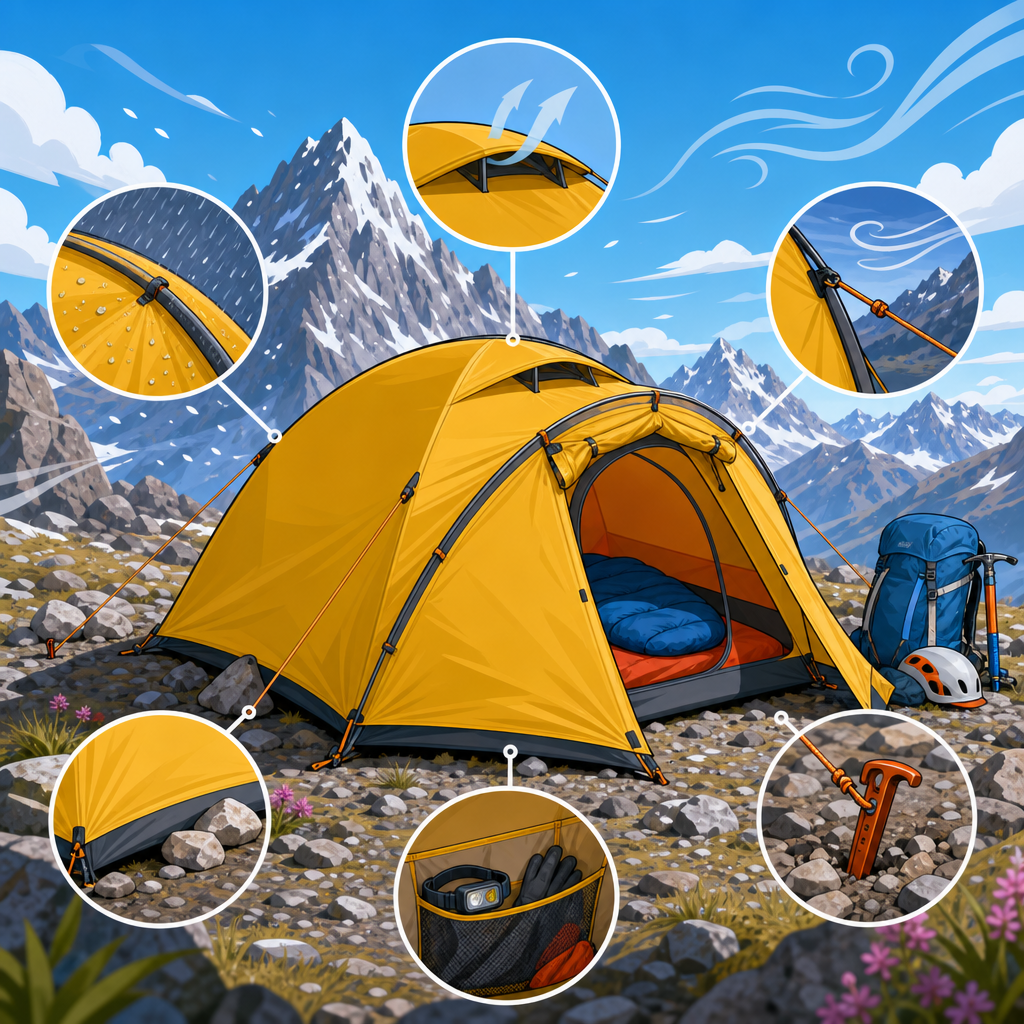
Choosing a tent for exposed alpine camps is not a matter of comfort alone; it is a risk management decision that affects warmth, sleep quality, storm resilience, and ultimately whether a trip stays enjoyable or turns dangerous. In the alpine, “exposed” means camps set above tree line or on terrain with little natural wind protection, where weather shifts fast, temperatures drop sharply after sunset, and tents absorb sustained gusts instead of occasional breezes. “Clothing, sleep, and shelter” are tightly linked in these environments because no tent performs well if the sleeper is underinsulated, wet, or carrying clothing systems that fail to support camp life. This hub article explains the tent features that matter most, while connecting them to the broader shelter and sleep decisions that experienced mountain travelers make before they ever leave the trailhead.
I have seen otherwise strong hikers struggle simply because they brought a backpacking tent designed for sheltered forest sites into a rocky basin at 11,500 feet. The issue was not brand prestige or packed weight on paper. The issue was geometry, fabrics, guy-out options, pitching flexibility, condensation control, and how the tent integrated with pads, sleeping bags, and camp clothing after a long day in mixed weather. A good alpine shelter does three jobs at once: it resists wind, manages internal moisture, and protects recovery. Those jobs matter because poor sleep compounds decision fatigue, cold stress slows reaction time, and damp insulation can turn a manageable night into an emergency.
For most buyers, the challenge is separating marketing language from features that genuinely improve performance in exposed camps. Terms like “four-season,” “stormworthy,” and “ultralight” are useful only when tied to measurable design choices. Pole architecture determines structural stability. Fabric denier and coatings influence tear strength and hydrostatic head, but also affect packed weight and longevity. Vestibule shape changes how you store wet layers and cook safely. Interior dimensions matter because thick winter pads, puffy clothing, and a large sleeping bag consume more livable space than summer setups. If this page does its job, you will finish with a clear framework for evaluating alpine tents and a better understanding of how shelter choices connect to clothing systems, sleep systems, site selection, and backcountry safety.
Why tent geometry and pole structure matter first
If you evaluate only one category before buying a tent for alpine use, evaluate structure. In exposed camps, the first question is not how light the tent is; it is how the tent sheds and absorbs wind from changing directions. Freestanding tents with multiple crossing poles generally outperform simple ridge or low-support designs because they distribute stress across more points. Semi-geodesic and geodesic structures have a long track record in mountaineering because intersecting poles increase rigidity and reduce panel deflection. When gusts hammer broad unsupported fabric, the noise is exhausting, but the larger problem is repeated stress on seams, clips, sleeves, and anchor points.
Shape matters as much as raw strength. Low-profile tents with tapered ends and reduced sidewall area present less surface to the wind. A dome can work well if the pole architecture is robust, but steep-walled lightweight backpacking domes often suffer in sustained alpine gusts because large fabric panels flex excessively. Tunnel tents can be exceptionally weather resistant when pitched correctly and aligned into prevailing wind, which is why they remain popular in Scandinavian and polar travel. Their limitation is directional dependence and a stronger need for excellent anchoring. In rocky alpine sites where ideal orientation is hard to achieve, a fully freestanding, multi-pole shelter is often more forgiving.
Look closely at pole materials and hub design. DAC Featherlite and Easton aluminum poles are common in high-end shelters for a reason: aluminum handles cold, repeated stress, and field repair better than cheaper alternatives. Carbon poles save weight but are less common in severe-weather tents because they can fail more abruptly under side loads. Pole sleeves usually spread force better than clip-only systems, though clips pitch faster and vent well. Many strong alpine tents combine both. Also check whether the tent can accept external crossing poles or optional brow poles. Those additions are not gimmicks; they can materially improve snow shedding, headroom, and storm stability.
Fabric strength, weatherproofing, and the real meaning of four-season
Buyers often misunderstand fabric specifications. Denier alone does not tell you whether a tent is alpine capable, but it does indicate yarn thickness, which generally correlates with abrasion and tear resistance. A 15D fly can work on a carefully used ultralight shelter, yet exposed camps often justify stronger 20D, 30D, or 40D fabrics, especially on floors and high-stress panels. Silicone-coated nylon, silpoly, and proprietary composite fabrics each involve tradeoffs. Silnylon is strong for its weight but stretches when wet, which can cause sagging overnight. Silpoly absorbs less water and sags less, which is an advantage in prolonged precipitation. Composite laminates cut weight and resist water well, but they are expensive and less common in true alpine tents intended for repeated abrasion and multi-season durability.
Hydrostatic head numbers are useful, but they are not the whole story. A fly rated around 1,200 to 3,000 millimeters can be perfectly adequate when paired with steep wall angles and good seam construction. Floors usually need higher ratings because kneeling pressure can force moisture through weaker coatings. Factory-taped seams improve reliability, though some expedition shelters still rely on manual seam sealing in specific areas. Reinforcement patches at guy points, robust zipper garages, and quality stitching often matter more in real storms than headline waterproof ratings. I trust tents that show careful reinforcement at stress points and use components from recognized suppliers such as YKK for zippers and DAC for poles.
The term “four-season tent” is especially slippery. In practice, a true severe-weather shelter usually has stronger poles, less mesh, a fly that reaches close to the ground, and enough guy-out points to secure every major panel. That does not mean every four-season model is best for all alpine trips. On summer and shoulder-season objectives, a very enclosed tent can trap condensation and feel oppressively warm. Many experienced climbers now prefer robust “three-plus season” shelters for fast alpine missions where wind resistance matters more than heavy snow loading. The right question is not whether a tent has a four-season label. The right question is what specific weather loads it is designed to handle and in what conditions you actually camp.
Ventilation, condensation control, and livability at altitude
In exposed alpine camps, interior moisture management matters almost as much as rain protection. Every person exhales significant moisture overnight, and wet boots, damp shells, and melting frost can quickly saturate the inside environment. When temperatures drop, warm humid air condenses on the inner wall or fly, then transfers to sleeping bags and clothing. That is why a tent with smart venting routinely feels warmer in practice than a sealed shelter. Dry insulation lofts fully; damp insulation does not. The result is better sleep, fewer cold spots, and less need to wear tomorrow’s hiking layers to bed.
Good alpine ventilation starts with a double-wall or hybrid design that separates the sleeper from the outer shell. Single-wall tents can be lighter and strong, especially in mountaineering, but they demand disciplined vent management and are less forgiving for humid conditions or novice users. I look for high and low vents that can be adjusted from inside, vestibule doors that open in multiple configurations, and enough fly clearance or protected intake space to sustain airflow without inviting spindrift or rain. Mesh is not always the answer above tree line. Solid fabric inner panels reduce drafts and trap warmth better, while still allowing moisture transfer to the fly cavity.
Livability is not a luxury in this context. A tent that is barely long enough for your sleeping bag can lead to footbox wet-out when the bag brushes condensation-coated walls. Steep end walls, adequate internal length, and usable peak height matter more for alpine users who carry thicker pads and bulkier cold-weather bags. Vestibules matter because they create a protected transition zone for boots, crampons, wet shells, and packs. They also make stormbound mornings far safer and calmer. On longer traverses, the ability to sit up, organize layers, and manage damp gear without exposing the sleeping area pays back every day.
| Feature | Why it matters in exposed alpine camps | What to look for |
|---|---|---|
| Pole architecture | Controls wind stability and panel deflection | Multiple pole intersections, strong aluminum poles, full guy-out support |
| Fly coverage | Blocks wind-driven rain and spindrift | Full-coverage fly reaching low to the ground |
| Ventilation | Reduces condensation that wets insulation | Adjustable high and low vents, dual-door venting options |
| Interior length | Prevents sleeping bag contact with wet walls | Extra clearance beyond listed body length, steep end geometry |
| Vestibules | Protect gear and improve storm-time organization | Functional covered storage on at least one side, ideally two |
| Pitching flexibility | Determines setup success on rock, snow, and poor soil | Freestanding base, multiple anchor methods, fly-first or all-in-one pitch |
Pitching systems, anchors, and site adaptability
A shelter is only as reliable as its pitch. In alpine terrain, that means more than staking four corners into friendly ground. You may be working with fractured talus, thin alpine turf, frozen soil, packed snow, or tent platforms hacked from uneven terrain. For that reason, pitching flexibility is a core shelter feature, not a nice extra. Freestanding tents offer a major advantage because they can be assembled and then anchored with rocks, deadman systems, skis, or dedicated snow stakes when conventional stakes fail. Non-freestanding tents can still work beautifully, but they require more precision and better anchor opportunities than many exposed sites provide.
Pay attention to whether the tent pitches inner-first, fly-first, or simultaneously. In windy precipitation, an inner-first pitch can soak the canopy before the shelter is fully erected. Simultaneous pitch systems, or tents that allow the fly and inner to remain connected, reduce exposure and speed setup under pressure. This is one reason Hilleberg, Mountain Hardwear Trango, and similar expedition-oriented designs have such strong reputations. Their systems were built around adverse weather handling, not showroom simplicity. Quick pitch time matters because cold fingers, low visibility, and incoming weather degrade judgment fast.
Guy lines deserve more respect than they receive. In field use, many tent failures are anchor failures, not pole failures. A tent with numerous well-placed guy-out points can be tuned to terrain and wind angle, reducing strain on the main frame. Reflective lines help at night, line tensioners save time with gloves on, and replacing thin stock cord with lower-stretch alternatives can improve performance. Carry a mixed anchor kit: standard stakes, a few longer Y-beam stakes, and extra cord for rocks or buried deadmen. If you camp on snow, know how to build deadman anchors with stuff sacks, snow flukes, or buried stakes set horizontally.
How shelter connects to clothing and sleep systems
This hub sits under clothing, sleep, and shelter because alpine comfort is a system, not a product category. Tent performance depends partly on what comes inside it. If your shell jacket wets through, your vestibule becomes a drying room and condensation load increases. If your insulating layers are too light for long evenings, you retreat to the sleeping bag too early and moisture from breathing accumulates inside a tightly sealed tent. If your sleeping pad has inadequate R-value, the warmest shelter in the world will not stop conductive heat loss to the ground. The tent should be chosen alongside the sleep system and camp clothing, not after them.
For sleep, prioritize pad insulation first. The ASTM F3340 standard gives R-values that make comparisons more meaningful than old marketing claims. In exposed alpine camps, many sleepers are comfortable with combined pad R-values around 4 to 6 in shoulder seasons, with higher totals for snow camping. A thick inflatable pad improves comfort, but it also increases the effective height of the sleeper, making interior tent length more important. Pair that with a sleeping bag or quilt whose temperature rating reflects realistic use, not survival-only assumptions. EN and ISO ratings are useful baselines, but individual metabolism and altitude matter. I consistently sleep colder after hard efforts and calorie deficits, so I build margin into my system.
Clothing at camp should support the shelter strategy. A dry baselayer reserved for sleeping, insulated socks, and a dependable belay-style puffy often do more for alpine recovery than shaving a few ounces from the tent. Gloves matter too, because pitching in wind with bare hands is where simple tasks become errors. Wet layers should be isolated in the vestibule or hung where they do not drip onto insulation. The best alpine tent supports these routines with interior pockets, attachment points, and doors that allow controlled entry and exit. When shelter, clothing, and sleep gear complement each other, exposed camps feel efficient instead of chaotic.
Weight, durability, and choosing the right tent for your objective
The best alpine tent is objective-specific. On a two-night summer ridge traverse with a stable forecast, a strong sub-three-pound shelter may be the right call if it has proven wind performance and enough room to protect your sleep system. On glaciated routes, shoulder-season base camps, or multiday trips with uncertain weather, extra structure and fabric margin are worth carrying. Ultralight shelters reduce pack strain and help speed, but they narrow your safety buffer. Heavier expedition tents provide confidence in prolonged storms, though they can be excessive for fair-weather alpine backpacking and may encourage overpacking elsewhere.
Use a simple decision filter. First, define expected wind exposure, precipitation type, and whether snow loading is plausible. Second, identify surface conditions for pitching: rock, dirt, snow, or mixed. Third, match interior space to your actual sleep kit, not a summer-minimal setup. Fourth, consider party size honestly. Two-person alpine tents are often comfortable for one person plus gear, but tight for two large adults using winter pads. Finally, evaluate repairability. Can you splint a pole with the included sleeve? Are buckles, zipper sliders, and guy points field serviceable? In remote terrain, the tent you can repair is often the tent that gets you home without escalation.
As you explore related articles in this section, use this page as your framework. Compare tents by structure, weatherproofing, ventilation, pitching adaptability, and system compatibility with clothing and sleep gear. Then refine your choices based on trip style and season. Exposed alpine camps punish weak design but reward thoughtful preparation. Choose a shelter that stays stable in wind, keeps insulation dry, and gives you enough livable space to recover well. Build the rest of your kit around that reality, review the deeper guides in this hub, and upgrade the weakest link in your camp system before your next high-country night.
Frequently Asked Questions
1. What tent features matter most when camping in exposed alpine conditions?
In exposed alpine camps, the most important tent features are wind stability, weather protection, structural strength, and dependable livability under stress. Above tree line, the tent is not just a place to sleep; it becomes a primary safety system when temperatures drop, gusts build, and storms move in faster than expected. A tent that performs well in sheltered forest camps may struggle badly when it has to absorb sustained wind through the night.
Start with the structure. A low-profile shape, strong pole architecture, and multiple pole intersections usually matter more in alpine wind than floor space alone. Tents designed for exposed terrain often use geodesic, semi-geodesic, or otherwise reinforced designs because they distribute force better and resist deformation when gusts hit from changing directions. Fabrics and pole materials also matter. Strong aluminum poles, durable canopy and fly fabrics, quality stitching, and reinforced anchor points all contribute to whether the tent keeps its shape and stays secure.
Weather protection is the next priority. A full-coverage rainfly, minimal mesh in key wind-exposed areas, a bathtub floor, and the ability to pitch the tent tightly are all important. In alpine camps, blowing rain, spindrift, and cold air intrusion can quickly reduce warmth and sleep quality. Vestibules are also more valuable than many people realize because they create protected space for wet gear, cooking tasks where appropriate and safe, and cleaner entry during poor weather.
Finally, focus on the details that support a long, rough night: good ventilation control to reduce condensation, enough interior room to avoid touching wet walls, and guy-out points that actually improve stability rather than simply adding complexity. In short, the best alpine tent features are the ones that help the shelter stay standing, stay dry, and stay functional when the campsite offers no natural protection.
2. How important is tent shape and pole design for wind resistance in alpine camps?
Tent shape and pole design are among the most important factors for alpine performance because wind is often the dominant stressor in exposed camps. When a tent is pitched above tree line, it may face hours of direct pressure rather than occasional gusts. In that environment, the shape of the shelter determines how wind flows over it, while the pole structure determines how well it resists bending, collapsing, or repeatedly flexing to the point of failure.
Generally, lower-profile tents with aerodynamic silhouettes perform better than tall, boxy designs. Steep walls can create more usable interior volume, but they also present more surface area to the wind. Rounded or tapered shapes tend to shed gusts more effectively. This does not mean every alpine camper needs an expedition-grade dome, but it does mean that a shelter intended for exposed conditions should prioritize controlled flex and structural integrity over maximum headroom.
Pole design is where many tents separate themselves. More pole crossings typically create a stronger frame because the load is shared across the structure instead of concentrated in a few unsupported panels. Geodesic and semi-geodesic tents are valued for exactly this reason. Pole sleeves can offer excellent stability in high wind, while clip-based systems may pitch faster and ventilate well, though execution matters more than category alone. High-quality aluminum poles are preferred over weaker materials because they offer a better balance of strength, resilience, and field reliability.
Also look closely at guy-out integration. A strong pole set can still underperform if the tent lacks well-placed external guy points or if the fly cannot be tensioned cleanly. In real alpine use, wind rarely arrives from one ideal direction all night. A tent with a robust pole structure and multiple functional guy-out options is better equipped to handle those shifting forces without excessive flapping, deformation, or sleeplessness.
3. Is a four-season tent necessary for exposed alpine camping, or can a three-season tent work?
A four-season tent is not always mandatory for exposed alpine camping, but the answer depends heavily on expected weather, elevation, season, and your margin for error. The term “four-season” can be a helpful shorthand, but it is not a perfect performance guarantee. Some four-season tents are built for true winter and severe storms, while some three-season tents are sturdy enough for shoulder-season alpine use if conditions are moderate and the campsite is chosen carefully.
What matters most is whether the tent is actually designed to handle sustained wind, cold nights, and rapidly changing weather. Many lightweight three-season tents use large mesh panels, high-cut flies, and pole structures optimized for ventilation and low weight rather than storm resilience. Those features can be excellent in milder climates, but in an exposed alpine camp they may allow too much draft, flap loudly in strong wind, and feel far less secure once the forecast deteriorates.
A true alpine-capable shelter usually offers a stronger frame, more complete fly coverage, reduced mesh in critical areas, and better fabric tension when fully pitched. Those are the characteristics that matter when trying to protect warmth and preserve sleep quality through a rough night. If you regularly camp above tree line, expect cold wind, or travel where a storm could trap you in camp for many hours, a sturdier tent is often the wiser choice even if it costs more in weight.
That said, experienced users can absolutely make select three-season tents work in alpine settings when forecasts are stable, camps are carefully chosen, and the shelter has proven wind resistance. The key is to avoid thinking in labels alone. Evaluate the specific tent’s structure, fly coverage, guying options, and real-world storm performance. In exposed alpine terrain, the right question is less “Is it called four-season?” and more “Can this shelter reliably protect me if conditions turn worse than planned?”
4. Why do ventilation and condensation control matter so much in cold, exposed camps?
Ventilation and condensation control matter in alpine camps because staying dry is directly tied to staying warm. In cold, exposed conditions, moisture from breathing, damp gear, and temperature differences between the tent interior and outside air can build up quickly on the inside of the fly or canopy. Once that moisture starts dripping, misting, or transferring onto sleeping bags and clothing, comfort declines fast and safety can follow. A wet sleep system loses insulating performance, and that becomes a much bigger problem when temperatures plunge overnight.
Many campers assume that the best storm tent is the most sealed tent, but that is only partly true. A shelter needs enough weather protection to block wind-driven rain and cold drafts, yet enough airflow to let humid air escape. Good alpine tents balance these needs with adjustable vents, thoughtful fly geometry, and the ability to maintain some airflow even when the tent is battened down. Dual doors and vestibules can help as well, since they improve cross-ventilation and make it easier to manage entry without flooding the interior with wet air and snow.
Interior space also affects condensation management. If the tent is so small that your sleeping bag constantly brushes the walls, then even moderate condensation becomes more problematic. A little extra clearance between occupants and the tent walls can make a meaningful difference over several nights. Likewise, a taut pitch matters. Loose fabric collects moisture more readily, flaps more in wind, and is more likely to shed condensation onto you when hit by gusts.
In practical terms, the best condensation-control features are adjustable rather than fixed. Alpine weather changes quickly, so a tent that lets you fine-tune vents, doors, and fly tension gives you better control over the interior environment. In exposed camps, dryness is not a luxury feature. It is part of the shelter’s core job.
5. What smaller tent details make a big difference in exposed alpine camps?
Beyond the headline features like pole strength and fly coverage, several smaller design details can have a surprisingly large impact in alpine conditions. One of the most important is the quality and placement of guy-out points. In exposed camps, guy lines are not optional accessories; they are often essential to unlocking the tent’s advertised stability. Reinforced attachment points, intuitive angles, and enough anchor options for changing wind directions all improve real-world performance.
Zippers are another overlooked detail. In cold, wet, windy conditions, a zipper that snags constantly or requires excessive force becomes more than an annoyance. Durable, smooth-operating zippers on doors and vestibules help preserve warmth, speed entry and exit, and reduce frustration when your hands are cold or you are wearing gloves. Vestibule design itself matters too. A well-shaped vestibule provides protected gear storage, keeps wet equipment out of the sleeping area, and creates a more controlled transition between harsh weather and the tent interior.
Stake compatibility is also worth attention. Alpine camps often involve rocky ground, thin soils, or hard-packed surfaces where standard lightweight stakes are not ideal. A tent with versatile anchor points and tensioning systems is easier to secure using a mix of stakes, rocks, deadman anchors, or trekking poles when necessary. Tension adjusters that are easy to use in gloves and in the dark are genuinely valuable in bad weather.
Finally, consider usability when tired. Interior pockets, easy door management, reflective guy lines, color-coded pitch systems, and a fast, intuitive setup all matter more in exposed terrain than they might on casual trips. If weather is moving in, a tent that pitches cleanly and securely without confusion reduces exposure time and helps protect insulation, morale