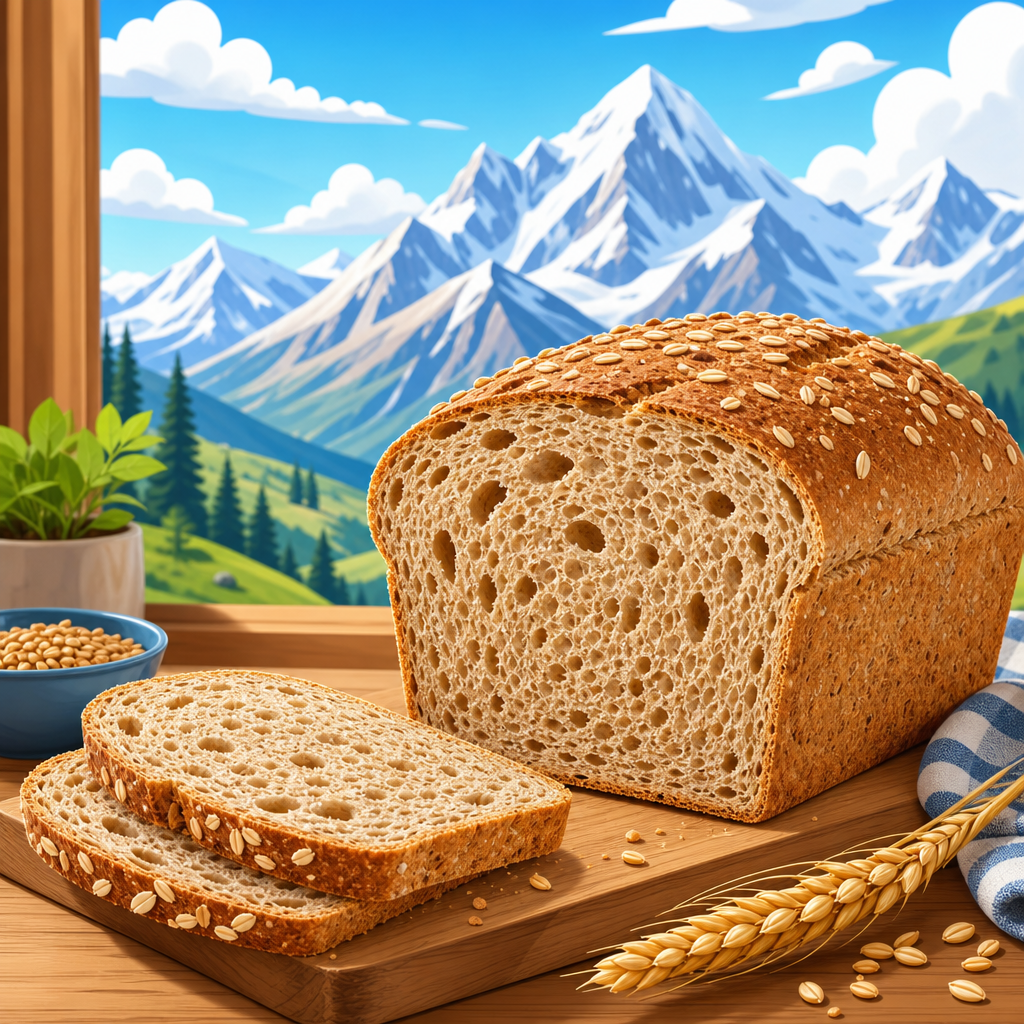
Whole wheat bread at altitude without a dense crumb is absolutely achievable, but it requires understanding how elevation changes fermentation, hydration, structure, and baking time. In mountain kitchens, lower air pressure causes dough to rise faster, water to evaporate sooner, and gas cells to expand more aggressively than they do at sea level. Whole wheat flour adds another layer of difficulty because bran particles can cut gluten strands and the germ can weigh down the dough. The result, if you use a standard recipe unchanged, is often a loaf that rises quickly, then bakes up compact, dry, or slightly collapsed. I have baked yeast breads and sourdough in high-altitude climates for years, and the consistent lesson is that altitude is not one problem. It is a stack of small shifts that must be managed together.
This hub article covers the full landscape of yeast breads and sourdough for high-altitude bakers, with a special focus on whole wheat bread that stays light enough for sandwiches and toast. In practical terms, “altitude” usually starts affecting bread noticeably above 3,000 feet, becomes more demanding around 5,000 feet, and turns highly recipe-sensitive above 7,000 feet. “Dense crumb” means the interior is tight, heavy, or gummy instead of open, evenly aerated, and resilient. “Whole wheat” usually refers to flour containing the entire bran, germ, and endosperm, whether hard red, hard white, or freshly milled. Each of those definitions matters because the fix for a dense whole wheat boule at 7,200 feet is not the same as the fix for a pan loaf made with 30 percent whole grain at 4,000 feet.
As a sub-pillar hub under Cooking & Baking at Altitude, this page explains the core adjustments that connect all high-altitude yeast bread and sourdough recipes: flour choice, water percentage, mixing intensity, autolyse, preferments, starter management, proofing control, shaping tension, steam, oven spring, and crumb setting. It is designed to answer the questions bakers usually ask first. Why does my dough overproof so fast? Why is whole wheat bread heavier at altitude? Should I add more flour or more water? Is sourdough easier or harder than commercial yeast in the mountains? And how do I get better rise without sacrificing flavor? Once you understand those mechanisms, every related recipe becomes easier to troubleshoot.
The central principle is straightforward: at altitude, you usually need slightly less yeast, slightly more water, tighter fermentation control, and stronger gluten development than the same dough would need at sea level. With whole wheat, that usually means combining proper hydration with enough rest time for the bran to soften and enough structure-building to hold expanded gases. Good mountain bread is not made by forcing dough to rise bigger. It is made by helping it rise more predictably, then baking it before the structure weakens.
Why whole wheat bread turns dense at altitude
Whole wheat bread becomes dense at altitude for three main reasons. First, the dough ferments faster because carbon dioxide expands more readily in lower atmospheric pressure. Second, whole grain flour absorbs more water, but mountain air and lower boiling temperatures increase moisture loss during mixing, proofing, and baking. Third, bran interferes with gluten formation, so the dough has less structural support precisely when gas expansion is more aggressive. That combination often creates a loaf that looks puffy during proofing but lacks the strength to keep expanding in the oven.
Dense crumb is not always underproofing. In high-altitude whole wheat baking, a tight loaf can come from underhydration, weak gluten, overproofing, or insufficient bake time. I see bakers misdiagnose this constantly. They assume a heavy loaf means it needed more yeast, when the real issue was that the dough rose too quickly, exhausted itself, and set before the interior developed a stable network. A gummy line near the bottom, a domed top with a compressed center, or large random holes surrounded by tight crumb are clues that timing and structure, not just ingredient quantity, need attention.
Flour type matters more than many recipes admit. Hard white whole wheat usually produces a lighter texture and milder flavor than hard red whole wheat, which can help sandwich loaves feel less heavy. Freshly milled flour often needs either more hydration or a short resting period because particle size and bran sharpness differ from bagged flour. Many successful high-altitude bakers also improve crumb by using a percentage blend, such as 50 to 80 percent whole wheat with bread flour, especially for enriched loaves or everyday pan bread.
Altitude adjustments that matter most for yeast breads
If you want whole wheat bread at altitude without a dense crumb, prioritize four adjustments before anything else: reduce yeast modestly, increase hydration modestly, shorten proofing based on dough behavior rather than the clock, and bake until the crumb fully sets. Those are the variables that solve most mountain bread failures. A recipe written for sea level often calls for too much yeast and too little water for a dry, high-elevation kitchen. The loaf races upward, then dries and tightens before it can expand evenly.
For commercial yeast breads above 5,000 feet, a common starting point is reducing instant or active dry yeast by about 10 to 25 percent. The exact amount depends on dough temperature, sugar level, and fermentation time. Sweet doughs may still need significant yeast because sugar slows fermentation, while lean hearth loaves usually do not. Hydration often needs to increase by 2 to 5 percentage points. In practical terms, that can mean 20 to 50 additional grams of water per 1,000 grams of flour. Whole wheat dough should feel supple and slightly tacky, not dry and stiff.
Proofing should be judged by volume, elasticity, and gas retention, not by a recipe’s stated minutes. At altitude, a first rise can finish much earlier, and the final proof can move from perfect to overdone surprisingly fast. For pan loaves, I usually bake when the dough crowns about 1 inch above the rim, not when it looks dramatically expanded. For free-form loaves, the finger-dent test helps, but it should be interpreted carefully because high-hydration whole wheat dough often springs back differently than white dough.
| Issue | Common Cause at Altitude | Best First Adjustment |
|---|---|---|
| Dense, tight crumb | Low hydration or weak gluten | Add water and improve mixing or folds |
| Loaf rises fast then collapses | Overproofing from rapid fermentation | Reduce yeast and shorten proof |
| Dry loaf with thick crust | Moisture loss during proofing and bake | Increase hydration and monitor bake closely |
| Gummy center | Underbaked crumb or slicing too soon | Bake to final temperature and cool fully |
Building structure in whole wheat dough
Whole wheat bread needs deliberate structure-building because the bran and germ weaken the gluten matrix. At altitude, that requirement becomes more important because fermentation pressure is higher. The most reliable methods are autolyse, bassinage when needed, stronger initial mixing, and one or more folds during bulk fermentation. An autolyse of 20 to 45 minutes lets the flour hydrate before salt and yeast are fully incorporated. This softens bran, improves extensibility, and often makes the dough feel dramatically stronger without additional kneading.
Mixing intensity depends on the style of bread. For sandwich loaves, moderate gluten development is usually beneficial, especially when the dough is at least 70 percent whole wheat. For rustic hearth bread, a shorter mix followed by stretch-and-folds may preserve a more open crumb. Either way, the goal is the same: a dough that can trap gas evenly. If the dough tears easily during shaping, spreads outward instead of upward, or feels granular after bulk fermentation, it likely needs better hydration, more rest, or more development.
Vital wheat gluten can help, but it should not be your first fix. In many formulas, 1 to 3 percent of flour weight improves lift in high-percentage whole wheat loaves, especially with weaker grocery-store flour. Yet strong bread flour in a partial blend, better fermentation control, and adequate hydration usually deliver better flavor and more natural texture. A tangzhong or cooked flour paste can also improve softness and moisture retention in whole wheat pan bread, and it performs especially well in dry mountain climates.
Sourdough at altitude: strengths, risks, and practical control
Sourdough is neither automatically easier nor harder at altitude; it is simply more responsive to temperature, feeding ratio, and timing. A mature starter can produce excellent whole wheat bread with deep flavor and a less dense crumb because organic acids strengthen dough in useful ways. However, at elevation, starters often peak faster, acidify faster, and lose strength faster if they are not fed appropriately. That means your starter schedule matters just as much as your final dough schedule.
For whole wheat sourdough, I prefer using a levain that is ripe but not collapsing. If the levain has domed, become airy, and just started flattening, it usually contributes strong fermentation without excessive acidity. Overripe levain can weaken gluten, which is especially risky in bran-rich dough at altitude. If your kitchen is warm and dry, feeding at higher ratios such as 1:4:4 or 1:5:5 often gives better timing control than low-ratio feeds. Cooler water can also help moderate speed.
Bulk fermentation in sourdough should usually end earlier at altitude than many sea-level recipes suggest. Bakers often wait for a dramatic increase in volume, but with whole wheat dough at 5,000 to 8,000 feet, that can lead to overexpansion and a baked loaf with a compressed base. Watch for aeration, smoother surface texture, visible bubbles at the edge of the container, and moderate rise rather than maximum rise. Cold proofing is especially useful in mountain baking because it slows fermentation, firms the dough for scoring, and improves scheduling consistency.
Hydration, temperature, and timing as a connected system
Bread formulas work best when hydration, dough temperature, and fermentation time are treated as one system. If you increase water in a whole wheat loaf but do nothing to strengthen structure or cool the dough, the result may be sticky and weak rather than light. If you reduce yeast but let dough run too warm, fermentation may still move too fast. Good mountain bakers stop thinking in isolated tweaks and start tracking dough temperature and fermentation milestones together.
A practical target for many whole wheat pan loaves is a final dough temperature around 75 to 78 degrees Fahrenheit, though enriched doughs and sourdough may vary slightly. Above that range, fermentation can accelerate enough to narrow your margin for error. An instant-read thermometer is one of the most useful bread tools at altitude, along with a digital scale and a straight-sided container for monitoring volume. When I troubleshoot dense crumb, I ask for those measurements before I ask about recipe brand names or mixer models.
Hydration targets vary by flour and style, but many successful whole wheat loaves land between 75 and 90 percent total hydration, especially with freshly milled flour or long soakers. That sounds high to bakers used to white sandwich bread, yet much of that water is needed for bran absorption. The correct feel is more important than the number. The dough should become smoother and more elastic as it rests. If it stays shaggy and tight, it likely needs more water or more time.
Baking, cooling, and the signs of a finished crumb
Even a well-fermented loaf can seem dense if it is underbaked or sliced too early. At altitude, water boils at a lower temperature, so moisture leaves the loaf more readily, yet crumb setting can still lag if the oven is too cool or the loaf is removed too soon. For pan loaves, baking slightly hotter at the start can support better oven spring, then lowering the heat if the crust darkens too quickly can help the interior finish. Steam remains useful for hearth loaves because it delays crust set and allows fuller expansion.
Internal temperature is a reliable checkpoint. Lean whole wheat hearth bread usually benefits from reaching about 205 to 210 degrees Fahrenheit. Enriched whole wheat pan bread may be done a few degrees lower, but color alone is not enough. A loaf should feel lighter than expected for its size, sound hollow when tapped, and release from the pan cleanly. If the sides wrinkle as it cools, the structure may have been underbaked or the loaf may have overproofed before baking.
Cooling is part of the bake. Cutting a whole wheat loaf while the crumb is still setting can make it seem gummy and compressed even when the formula was sound. Waiting at least one to two hours for pan bread and longer for larger hearth loaves gives starches time to stabilize and moisture to redistribute. That final patience often makes the difference between “dense” and “pleasantly tender” in a baker’s evaluation.
How this yeast breads and sourdough hub helps you bake better at altitude
This page is the foundation for every high-altitude bread article in the Yeast Breads & Sourdough section. Use it as the reference point for sandwich loaves, dinner rolls, cinnamon rolls, pizza dough, no-knead bread, artisan boules, enriched brioche-style doughs, and naturally leavened country loaves. The core pattern stays consistent across them: manage fermentation speed, hydrate whole grains well, strengthen the dough appropriately, and bake until the crumb fully sets. Once those principles become routine, dense whole wheat bread stops being a mystery and becomes a solvable process.
The biggest benefit is confidence. Instead of guessing, you can identify whether the real problem is too much yeast, too little water, insufficient gluten development, overproofing, or incomplete baking. That diagnosis matters because the wrong fix often makes the next loaf worse. Adding flour to a dry mountain dough tightens crumb. Extending proof on an already overactive dough increases collapse risk. More starter is not always better. Better timing, better structure, and better observation usually win.
If you are building your own high-altitude baking system, start with one dependable whole wheat loaf formula, record flour type, room temperature, dough temperature, rise times, and baked result, then adjust one variable at a time. That simple habit teaches more than chasing dozens of inconsistent recipes. Use this hub as your guide for the broader world of altitude yeast breads and sourdough, and keep baking until your loaves rise high, slice cleanly, and stay light where it counts: in the crumb.
Frequently Asked Questions
Why does whole wheat bread often turn out dense at high altitude?
Whole wheat bread tends to become dense at altitude because several factors are working against loaf volume at the same time. First, lower air pressure allows dough to rise more quickly, which sounds helpful but often leads to overproofing before the gluten structure is strong enough to hold the expanding gases. Once that structure weakens, the loaf can collapse slightly in the oven or set with a tight, heavy crumb. Second, moisture evaporates faster in mountain climates, so dough that would feel properly hydrated at sea level may actually be too dry to expand well. Whole wheat flour makes this even more challenging because the bran and germ absorb more water than white flour and can interfere with gluten development. Bran particles also physically disrupt the gluten network, making it harder for the dough to trap gas efficiently. If fermentation is not carefully controlled and hydration is not increased enough, the loaf will often bake up compact rather than light and open.
How should I adjust hydration when making whole wheat bread at altitude?
In most cases, whole wheat dough at altitude benefits from more water than the same formula would need at sea level. Because water evaporates faster and whole wheat flour absorbs more moisture, slightly increasing hydration helps create a dough that can expand instead of stiffening too early. A common mistake is adding extra flour during mixing or kneading because the dough feels sticky at first. Whole wheat flour needs time to fully absorb water, so it is usually better to mix the dough, let it rest for an autolyse or short hydration period, and then reassess texture before making corrections. The goal is a dough that feels supple, elastic, and a little tacky rather than dry and firm. If the dough is too stiff, it will struggle to rise fully and the crumb will bake up tight. Small changes matter, so increasing water gradually is the safest approach. Even an extra tablespoon or two per loaf can improve oven spring, softness, and overall crumb structure in a high-altitude kitchen.
Do I need to reduce the yeast or shorten the rise time at higher elevations?
Yes, high-altitude baking often requires reducing yeast slightly, shortening rise times, or both. At elevation, fermentation moves faster because gases expand more readily in the lower-pressure environment. If you use the same amount of yeast and the same proofing schedule you would use at sea level, the dough can overrise before it has enough strength to support itself. That leads to poor oven spring, a fragile top crust, or a loaf that sinks and becomes dense as it cools. With whole wheat dough, this is especially important because the gluten network is already less resilient than in white bread. Watching the dough is far more reliable than watching the clock. Instead of waiting for a dramatic doubling, aim for a controlled rise that leaves the dough airy but still springy and structured. Many bakers at altitude find better results by reducing yeast modestly and proofing in a slightly cooler environment. This slows fermentation just enough to let flavor develop while preserving the loaf’s ability to hold its shape and bake up lighter.
What mixing and kneading techniques help create a lighter crumb in whole wheat bread at altitude?
Gentle but effective gluten development is one of the best ways to prevent a dense crumb. Because whole wheat flour contains bran that can interfere with structure, the dough benefits from techniques that build strength without tearing it apart. An autolyse is especially useful: mixing the flour and water first and allowing them to rest before adding yeast and salt gives the flour time to hydrate and improves extensibility. After that, many bakers get better results with moderate mixing followed by stretch-and-folds during bulk fermentation rather than aggressive kneading with lots of extra flour. Stretch-and-folds strengthen the dough gradually while preserving gas bubbles, which supports a more open crumb. It also helps to avoid making the dough too tight. Overworking whole wheat dough can make it feel smoother, but it may also increase oxidation and reduce its ability to expand naturally. If you want even more lift, some bakers use a portion of bread flour alongside whole wheat flour to improve gluten strength while still keeping a hearty whole grain character. The main objective is to create a dough that is strong enough to retain gas yet soft enough to rise freely in the oven.
How should I change baking temperature and time so whole wheat bread sets properly at altitude?
At altitude, bread often benefits from baking slightly hotter, or at least from making sure the oven is fully preheated and stable before the loaf goes in. The reason is that gas expansion happens quickly, and the loaf needs its structure to set before it overexpands and weakens. A properly heated oven helps create better oven spring early in the bake while setting the crust and crumb before the loaf can collapse. At the same time, moisture escapes faster in mountain environments, so baking too long without monitoring internal doneness can dry out the bread even if the crust color looks correct. Whole wheat loaves are already more moisture-sensitive than white loaves, so balancing heat and bake time matters. Steam at the beginning of the bake can help delay crust formation and support expansion, but it should not be excessive or prolonged. The best way to judge doneness is to use both visual and internal cues: the loaf should feel lighter for its size, sound hollow when tapped, and reach a fully baked internal temperature appropriate for yeast bread. Allowing the loaf to cool completely before slicing is also essential, because the crumb continues to set after it comes out of the oven. Cutting too soon can make even a well-baked loaf seem gummy or dense.