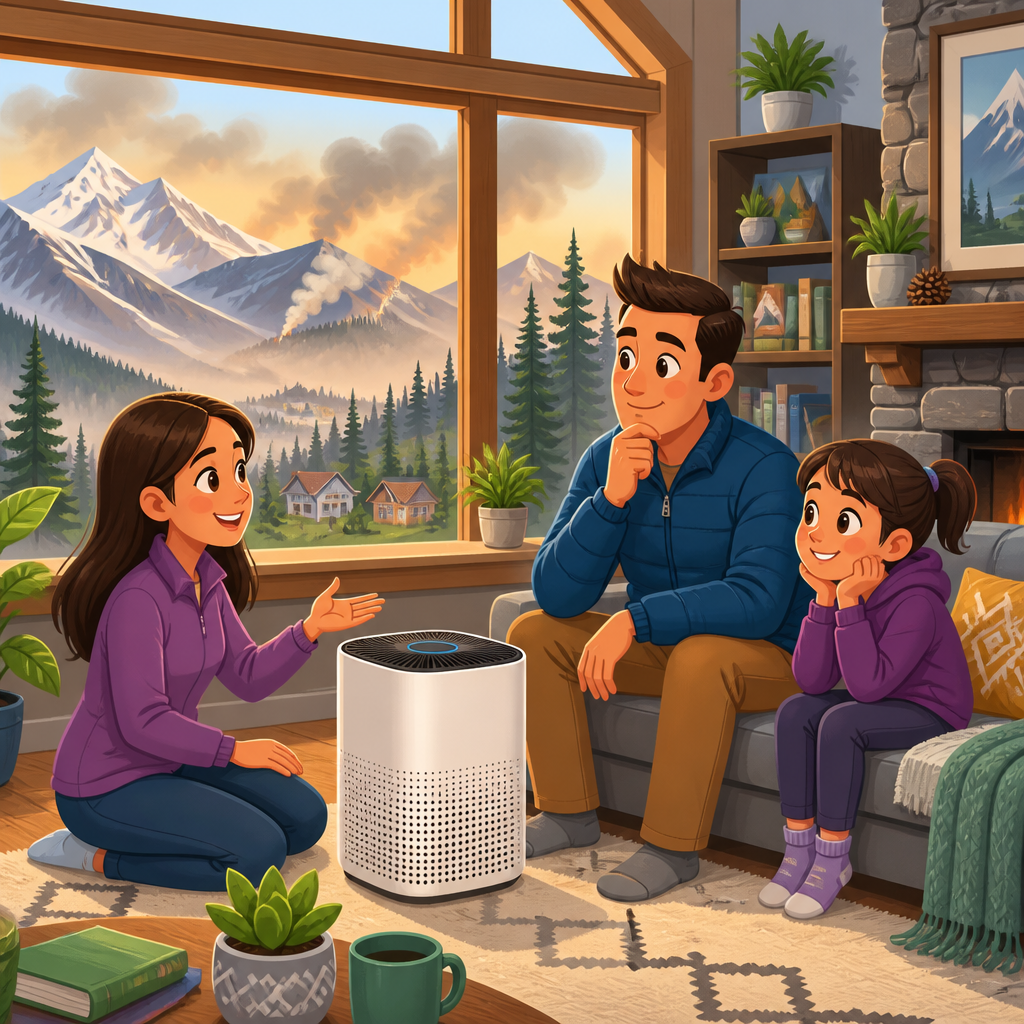
Air purifier sizing for high-altitude homes during smoke season requires a different approach than sizing a unit for a sea-level house in a mild climate. In mountain regions, wildfire smoke arrives fast, outside air density is lower, homes often have unique leakage patterns, and HVAC systems may be smaller or absent altogether. I have sized filtration systems for cabins above 7,000 feet, newer mountain builds with tight envelopes, and older chalets with wood heat, and the same lesson comes up every season: buying by room label alone is a mistake. Correct sizing starts with airflow, particle removal rate, and real building conditions. For homeowners focused on mountain home maintenance, this topic matters because smoke is not only a comfort issue. Fine particulate matter, especially PM2.5, can penetrate deep into the lungs, aggravate asthma, reduce sleep quality, and settle into fabrics, electronics, and ventilation systems. A purifier that is too small may run constantly yet leave indoor air unhealthy. A purifier that is sized correctly can keep a safe room clean, reduce odor, and support the rest of the home’s maintenance strategy during fire season.
Three terms define the decision. CADR, or Clean Air Delivery Rate, measures how much filtered air a purifier delivers, usually in cubic feet per minute. ACH, or air changes per hour, describes how many times the purifier can effectively clean the volume of a room in one hour. PM2.5 refers to particles 2.5 microns and smaller, the fraction most associated with wildfire smoke health risk. For smoke season in a high-altitude home, I recommend targeting a true smoke-focused CADR that can deliver at least five ACH in the intended space, and six to eight ACH for a designated clean room. That target is more demanding than many product pages imply, but it aligns with what actually works when outdoor air quality index readings turn hazardous and windows must remain shut for days.
This mountain home maintenance hub covers the broader context around purifier sizing because the machine alone is never the whole answer. The right unit depends on altitude, room volume, leakage, filter type, noise tolerance, backup power, and how the purifier fits with heating systems, vehicles, garages, mudrooms, and off-grid constraints. It also connects to related mountain home maintenance priorities such as weatherization, HVAC filter upgrades, moisture control, generator planning, and post-smoke cleaning. If you understand how to size a purifier correctly, you can make better decisions across the whole home, from where to place it to how to seal a bedroom, protect ductwork, and keep interior air cleaner throughout smoke season.
Why high-altitude homes need a different smoke strategy
High altitude changes both the environment and the building. Air is less dense at elevation, which affects fan performance and combustion appliances, while mountain weather can swing from cool nights to hot, dry afternoons that push residents to open windows at exactly the wrong time. Many mountain homes also sit in windy exposures or forested valleys where smoke pools overnight. In practice, I often see homeowners underestimate infiltration. A house may feel solid in winter yet pull smoke through recessed lights, attic hatches, crawlspace penetrations, fireplace surrounds, and under exterior doors once pressure differences change. That means purifier sizing in mountain home maintenance must account for outside smoke entering continuously, not just the volume of the room.
Construction style matters too. Log homes, A-frames, and older seasonal cabins often leak more than newer builds tested with blower doors. Homes heated with wood stoves may already have ash and ultrafine particle issues indoors, and ductless mini-split homes may lack whole-house recirculation that could otherwise help distribute cleaned air. At the same time, many mountain residents rely on portable purifiers because central HVAC is limited, turned off in summer, or connected to duct runs that serve only part of the house. These factors make room-by-room planning essential. If your home has bedrooms on an upper loft, a mudroom connected to a garage, or a walkout basement used during storms, each zone may need a different strategy. Good mountain home maintenance means identifying the rooms where people sleep, work, or shelter and treating those as priority spaces.
How to size an air purifier correctly during smoke season
The most reliable method is simple: calculate room volume, choose an ACH target, and convert that need into CADR. Start with room area and ceiling height. A 250-square-foot bedroom with an 8-foot ceiling holds 2,000 cubic feet of air. If you want five ACH, multiply 2,000 by 5 and divide by 60. The result is about 167 cubic feet per minute, so you need a smoke CADR near or above 167. For a six-ACH clean room target, the same room needs about 200 CADR. If the room has vaulted ceilings, open stair connections, frequent door opening, or obvious leakage, add margin rather than trusting the minimum number.
Manufacturer coverage claims can mislead because they may assume a low ACH target, often two or fewer air changes per hour, or a favorable test method. During wildfire smoke events, that is not enough. The better benchmark comes from the Association of Home Appliance Manufacturers Verifide program, which lists tested CADR values for smoke, dust, and pollen. When comparing units, use smoke CADR specifically, because smoke particles are smaller and harder to capture effectively than lint or coarse dust. I routinely tell homeowners to ignore “covers up to 1,000 square feet” unless the company also states the ACH behind that claim. In mountain home maintenance, conservative sizing prevents expensive disappointment when a smoke plume settles in for a week.
| Space type | Example size | Ceiling height | Room volume | Target ACH | Recommended smoke CADR |
|---|---|---|---|---|---|
| Small bedroom | 150 sq ft | 8 ft | 1,200 cu ft | 5 to 6 | 100 to 120 |
| Primary bedroom | 250 sq ft | 8 ft | 2,000 cu ft | 5 to 6 | 167 to 200 |
| Great room | 400 sq ft | 10 ft | 4,000 cu ft | 4 to 5 | 267 to 333 |
| Open living area with vaulted ceiling | 500 sq ft | 14 ft | 7,000 cu ft | 4 to 5 | 467 to 583 |
These numbers show why many single portable units fail in mountain great rooms. A dramatic vaulted living space may need two purifiers working together, not one oversized box in a corner. If budget is limited, prioritize bedrooms first. A correctly sized bedroom purifier offers the greatest health return because people spend the longest continuous time there. Then add a unit in the main living area where doors open most often. That sequence fits real mountain home maintenance budgeting: protect sleeping spaces, then improve shared zones as funds allow.
Filter types, performance limits, and what to buy
For wildfire smoke, choose a purifier with a true mechanical particle filter, ideally HEPA or a well-documented equivalent that captures fine particles efficiently across the fan’s operating range. Activated carbon helps with odor and some volatile organic compounds, but carbon is secondary to particulate removal. A purifier with excellent carbon and weak airflow will still perform poorly during smoke events. In my field experience, the strongest consumer options combine high smoke CADR, sealed filter frames, and tolerable noise at medium-high speed. Brands vary year to year, but the selection criteria do not: verified CADR, replacement filter availability, transparent noise ratings, and a cabinet design that prevents bypass around the filter.
Be cautious with ionizers, ozone-generating devices, and vague claims about plasma or active purification. California Air Resources Board certification is worth checking because it limits ozone emissions for air cleaning devices sold in that market. That does not guarantee superior smoke removal, but it helps screen out problematic designs. Also consider long-term operating cost. A purifier used heavily through an eight- to twelve-week smoke season may run nearly nonstop. Replacement filters for premium models can cost substantially more than the machine’s advertised bargain price suggests. Mountain home maintenance is not just purchase price; it is season-after-season serviceability. Before buying, verify filter stock, expected life under smoke load, and whether prefilters are washable or disposable. Heavy smoke can saturate filters far sooner than the generic six- or twelve-month interval printed on the box.
Placement, room setup, and creating a clean room
Placement affects performance more than many homeowners expect. Put the purifier in the room where people spend time, not out in a hallway hoping it will clean adjacent spaces. Keep intake and discharge clear by at least several inches, preferably more, and avoid hiding the unit behind furniture. In bedrooms, place it where airflow crosses the occupied zone without blowing directly into bedding if noise or draft is disruptive. During severe smoke, create a designated clean room by shutting doors, sealing obvious gaps with weatherstripping or painter’s tape where practical, and running the purifier continuously on a higher setting before occupancy.
In mountain homes with entry mudrooms, garages below living areas, or attached workshops, pressure management matters. Do not run bath fans, range hoods, or whole-house exhaust systems longer than necessary if outside smoke is intense, because they can pull smoky air through leaks. If cooking is required, use lids, back burners, and shorter exhaust cycles. I have seen indoor PM2.5 spike more from pan frying during smoke season than from outdoor leakage for a brief period, overwhelming a right-sized purifier. As part of mountain home maintenance, treat indoor sources seriously: candles, fireplaces, smoking, incense, and vacuuming without a sealed HEPA vacuum all add unnecessary particle load when the house is already under stress from wildfire smoke.
Integrating purifiers with the rest of mountain home maintenance
Portable air cleaners work best when paired with broader building measures. Upgrade central HVAC filters if the system can handle the pressure drop; many systems perform well with MERV 13 filters, but blower capability and manufacturer guidance should be checked first. Seal return leaks in attics or crawlspaces so the system does not pull contaminated air from unwanted areas. Replace worn door sweeps, weatherstrip attic accesses, and seal top-plate and plumbing penetrations where practical. In mountain homes that depend on generators or battery backup, include purifier wattage in emergency power planning. Many efficient portable units draw modest power on medium settings, making them realistic loads for inverter generators or solar-plus-battery systems during outages that coincide with fire events.
Vehicles and outbuildings also belong in the conversation because mountain home maintenance rarely stops at the front door. If you commute through smoke, replace the cabin air filter in your vehicle with a quality particulate filter and run recirculation mode. If gear stored in the garage smells smoky, avoid bringing it directly into sleeping spaces. After smoke season, clean supply registers, wipe horizontal surfaces with damp microfiber cloths, and inspect purifier prefilters for residue that may indicate unusual infiltration pathways. The larger lesson is that purifier sizing is the hub decision, but smoke resilience is the system. When homeowners understand airflow, leakage, and filtration together, they make smarter choices across the house, the vehicle, and the backup-power plan.
Common mistakes and a practical buying plan
The most common mistake is undersizing because of marketing language. The second is buying a powerful unit, then running it only on low because the high setting is too loud. That is a real tradeoff, so read independent noise data and user reports before purchasing. Another mistake is assuming one purifier will clean an entire multistory cabin through open doors and stairwells. Air does move between rooms, but not efficiently enough during a serious smoke event. I also see homeowners forget ceiling height, especially in lofted great rooms, or neglect the effect of a frequently opening exterior door at a mudroom entry. All of these errors lead to the same result: indoor air that never gets as clean as expected.
A practical buying plan is straightforward. First, measure your priority rooms and calculate CADR needs based on five ACH minimum, six or more for a clean bedroom. Second, shortlist units with verified smoke CADR near that target. Third, compare replacement filter cost, noise at relevant fan speeds, and power draw. Fourth, decide whether two medium units would outperform one large unit in an open area. Fifth, prepare the room with sealing and source control before smoke arrives. For mountain home maintenance, planning in spring is far easier than emergency shopping when regional fires have already driven up prices and depleted filter inventory. If you need one simple rule, it is this: buy for the room volume you actually have, add margin for altitude-era leakage and vaulted ceilings, and prioritize bedrooms first. Do that, and your home will be safer, more comfortable, and better prepared for the realities of smoke season in the mountains.
Frequently Asked Questions
How does high altitude affect air purifier sizing during smoke season?
High altitude changes the way air moves through a home and through a purifier, so sizing cannot be treated exactly the same as it would be at sea level. At elevation, outdoor air is less dense, which means fans, filters, and HVAC components may not behave quite the way their standard ratings suggest. Wildfire smoke also tends to arrive quickly in mountain areas, and once it does, homes can pull in polluted air through rooflines, crawlspaces, wood-stove penetrations, attic bypasses, and other leakage points that are especially common in cabins and older mountain construction.
In practical terms, this means you should be more cautious about relying on a purifier that is only barely large enough for the square footage listed on the box. Manufacturer coverage claims are often based on ideal assumptions, such as standard ceiling height, closed windows, and a relatively controlled air exchange rate. In a high-altitude home during smoke season, those assumptions frequently break down. A better approach is to focus on clean air delivery rate, or CADR, and aim for enough capacity to achieve strong air changes per hour in the rooms where people spend the most time. For smoke, a target of roughly 4 to 6 air changes per hour is a solid baseline, and in severe wildfire conditions or leakier homes, sizing even higher can make sense.
Altitude itself is only one factor, but it often comes packaged with others: larger open rooms, vaulted ceilings, intermittent occupancy, and limited central ductwork. That combination is why oversizing slightly is usually smarter than undersizing. A unit with more capacity can run at a lower, quieter fan speed most of the time and still keep up when smoke worsens. In mountain homes, resilience matters more than bare-minimum sizing.
What is the best way to calculate the right purifier size for a mountain home or cabin?
The best method is to calculate by room volume and desired air changes per hour rather than using square footage alone. Start by measuring the length and width of the room, then multiply by the ceiling height to get cubic feet. This step is especially important in high-altitude homes because many have cathedral ceilings, lofts, or open floor plans that make a simple square-foot estimate misleading. Once you have the room volume, decide how many air changes per hour you want. For wildfire smoke, 4 to 6 air changes per hour is a good target, while households with asthma, COPD, or strong smoke sensitivity may want to aim toward the higher end.
To estimate the airflow needed in cubic feet per minute, multiply the room volume by the target air changes per hour and divide by 60. For example, a 300-square-foot room with an 8-foot ceiling contains 2,400 cubic feet of air. If you want 5 air changes per hour, you would need about 200 CFM of effective smoke-cleaning airflow. That is where CADR becomes important. For smoke, use the smoke CADR rating rather than a generic maximum airflow number, because smoke CADR is more relevant to wildfire particles.
In mountain homes, it is wise to add a safety margin. If the room is leaky, frequently used, connected to a kitchen, or part of an open great-room layout, the purifier should be sized above the minimum calculation. If the home has no forced-air system and depends entirely on portable units, that extra margin becomes even more valuable. Many homeowners do best by using one properly sized purifier in each priority room, such as bedrooms and the main living area, instead of expecting one machine to clean the entire home from a central location.
Should I size for the whole house or focus on individual rooms during wildfire smoke events?
In most high-altitude homes, especially cabins, chalets, and houses without robust central HVAC, it is usually more effective to focus on individual rooms rather than trying to clean the entire house with one unit. Smoke control works best when you create cleaner zones. Bedrooms are the first priority because that is where people spend long stretches of time, and the main living area typically comes next. If someone in the home has asthma, heart or lung disease, or heightened smoke sensitivity, protecting the sleeping area becomes even more important.
Whole-house strategies can work well if the house has a well-designed forced-air system that can support high-efficiency filtration and adequate air circulation, but many mountain homes do not. Some have hydronic heat, mini-splits, wood stoves, or older furnaces with limited fan capacity. In those homes, portable purifiers are often the most dependable option during smoke season. The key is placing them where occupancy is highest and keeping doors and windows closed as much as possible so the purifier is not constantly fighting uncontrolled infiltration.
If the home has an open plan, you may need more than one unit even in the main living space. One oversized purifier placed in a distant corner rarely performs as well as two units positioned to support airflow through the occupied zone. Think of purifier sizing as part of a room-by-room smoke plan: seal obvious leaks, close up the house, run filtration continuously during smoke events, and concentrate capacity where it protects people most. That approach is usually more realistic and more effective than chasing an all-at-once whole-house number.
Why do mountain homes often need more purification capacity than newer homes in milder climates?
Mountain homes often face a combination of challenges that increase the need for purification capacity. First, smoke intrusion can be more severe because wildfire activity is often closer, topography can trap smoke in valleys and basins, and weather shifts can send smoke into the home very quickly. Second, many high-altitude houses have construction details that increase air leakage, including recessed lighting, attic transitions, aging window assemblies, crawlspace connections, and wood-stove or chimney penetrations. Even homes that feel solid in winter can leak enough during smoke events to overwhelm a marginally sized purifier.
Third, the heating and cooling systems in mountain homes are often different from those in suburban low-elevation houses. Some homes rely on baseboard heat, radiant systems, or wood heat, which means there is little or no central fan-driven filtration. Even where there is ductwork, it may serve only part of the house or may not be intended to run continuously. That puts more of the smoke-control burden on portable air cleaners. Newer homes in mild climates may benefit from tighter envelopes, balanced ventilation, and central systems designed for better circulation, all of which make purifier sizing more straightforward.
Another issue is room geometry. Great rooms, lofts, and vaulted ceilings are common in mountain construction, and they increase air volume substantially. A purifier sized only from floor area can end up undersized by a wide margin. Add in occupancy swings, pets, cooking emissions, ash tracked indoors, and door openings to decks or mudrooms, and it becomes clear why extra capacity pays off. In short, mountain homes usually need more purification not because altitude alone is dramatic, but because altitude comes with a cluster of real-world conditions that raise the filtration load.
What features should I look for in an air purifier for a high-altitude home during smoke season?
Start with verified smoke CADR, because wildfire smoke consists largely of fine particles and that rating tells you far more than a vague coverage claim. A true HEPA filter or an equivalent high-efficiency particle filter is a strong choice for smoke removal, and a unit with enough fan power to maintain meaningful airflow through that filter matters just as much as the filter label itself. Look for performance data that is transparent and easy to compare, ideally with CADR values, recommended room size tied to air changes per hour, and replacement filter information that is easy to find.
Noise matters more than many people expect. During smoke season, the purifier may need to run continuously for days or weeks, including overnight. A unit that only delivers acceptable cleaning at an intolerably loud top speed often ends up underused. This is one reason a somewhat oversized purifier is so useful: it can deliver strong cleaning at lower, quieter settings. Also pay attention to filter replacement cost and availability. In mountain regions, delays in shipping and seasonal stock shortages are common, so it helps to choose a model with readily available filters and to keep spares on hand before peak fire season.
For homes with no central filtration, portability and placement flexibility are important. Units with simple controls, dependable continuous-run operation, and no unnecessary complexity are often the best fit. If odor from smoke is a major concern, an activated carbon stage can help somewhat, but the top priority should still be particle removal. Smart sensors can be useful, but they should not replace proper sizing. In smoky, high-altitude conditions, the best purifier is usually one that is clearly large enough, easy to live with, easy to maintain, and capable of running hard when the air outside turns bad fast.