Whipped cream can look perfectly stable in one kitchen and collapse, crust, or overwhip in another, and very dry climates are often the reason. In altitude-focused baking work, I have seen the same cream, bowl, sugar level, and mixer produce different textures simply because the air was drier and pressure was lower. For anyone making pies, pastries, and meringues, that difference matters because whipped cream is not an isolated topping. It sits on custard pies, fills cream puffs, supports layered pastries, and often shares the table with meringue-based desserts that react to humidity and evaporation in their own ways.
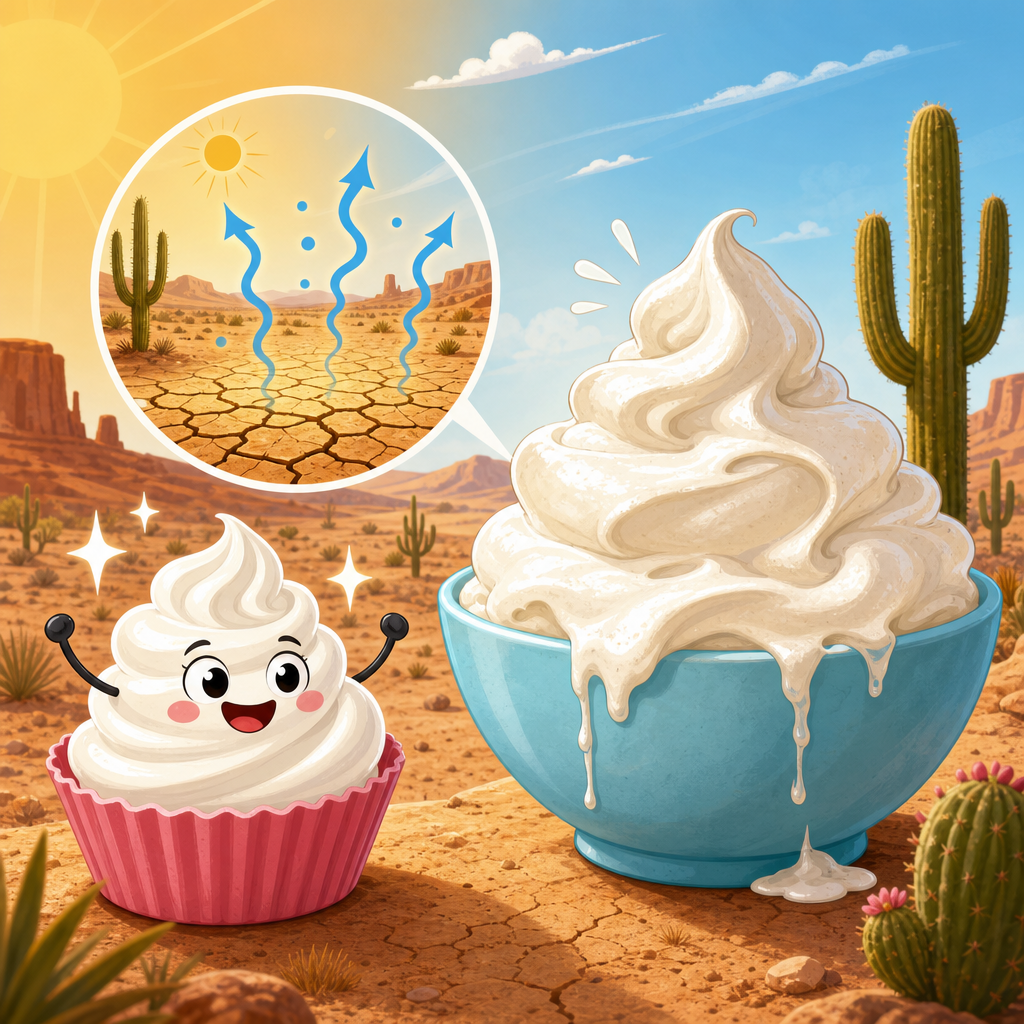
Very dry climates change how water moves through ingredients and across surfaces. Relative humidity is low, so moisture evaporates faster from bowls, baked shells, fillings, and finished desserts. In many mountain regions, dry air also comes with lower atmospheric pressure, which changes boiling points, whipping behavior, and baking times. Whipped cream itself is a foam: tiny air bubbles trapped in a network of partially coalesced milk fat, water, and milk proteins. When that foam forms in dry, high-elevation conditions, it can thicken quickly, feel fluffy sooner than expected, and then tip into graininess if the mixer keeps running.
This matters beyond one bowl of cream because the entire category of pies, pastries, and meringues depends on moisture control. Pie dough loses water during mixing and resting. Blind-baked crusts can dry too fast at the edges. Custards set differently when more water evaporates in the oven. Choux pastry relies on steam generation, so low humidity and altitude can alter shell expansion and drying. Meringues are especially sensitive because sugar is hygroscopic and egg-white foams are affected by both moisture in the air and oven drying rates. Understanding why whipped cream behaves differently gives you a practical framework for this whole baking subtopic.
In plain terms, dry climates speed evaporation, intensify perceived thickening, and shorten the margin between underwhipped and overwhipped cream. They also make storage and assembly more critical. A lemon meringue pie topped in Denver behaves differently from one finished near sea level in a coastal city. The goal of this hub is to explain those mechanisms and connect them to the broader techniques that make pies, pastries, and meringues reliable at altitude.
What dry air changes in whipped cream
Whipped cream is mostly water, with fat globules dispersed through it. As you whip, those fat globules partially break and link together around air bubbles, creating structure. In very dry climates, surface evaporation starts immediately. While the total water loss during whipping is not enormous, it is enough to influence how quickly the foam looks finished, especially when combined with colder ambient temperatures and lower pressure at elevation. I routinely tell bakers to stop judging only by volume and start judging by texture and sheen. In dry air, cream often reaches soft peaks earlier than expected, but the foam may be less forgiving a minute later.
Powdered sugar, common in stabilized whipped cream, adds another variable. It contains starch and attracts moisture, which can help stabilize cream, but in arid conditions it can also contribute to a slightly tighter, drier mouthfeel if overused. The same is true for instant pudding mix, milk powder, and some commercial stabilizers. A formula that works in a humid kitchen may need less stabilizer in a very dry climate because the environment is already favoring quicker apparent thickening. This is one reason professional pastry kitchens rely on precise percentages instead of generic advice like “whip until fluffy.”
Temperature remains the strongest control point. Heavy cream whips best when very cold, ideally around 35 to 40 degrees Fahrenheit. In dry climates, chilled metal bowls lose condensation quickly, so visual cues can be misleading; the bowl may look dry while the cream is still cold enough to whip well. That matters because many home bakers associate visible condensation with readiness. Focus instead on ingredient temperature, fat percentage, and stop point. Heavy cream at 36% fat will whip more reliably than whipping cream at 30%, especially when environmental conditions narrow your margin for error.
Why altitude amplifies the problem for pies and pastries
Many very dry climates are also high-altitude climates, and altitude introduces a second set of variables. Atmospheric pressure decreases as elevation increases, which lowers the boiling point of water. At 5,000 feet, water boils at roughly 202 degrees Fahrenheit instead of 212. That means moisture escapes more readily from fillings, doughs, and foams during cooking and cooling. For whipped cream, the issue is less boiling and more evaporation, but the broader dessert system is affected from start to finish. If your pie filling loses moisture faster in the oven and your topping dries faster after assembly, the dessert changes on both sides of the process.
Pie dough is a good example. Flour hydration that feels correct at sea level can seem crumbly in a dry mountain kitchen because the flour itself may be drier and the mixed dough loses moisture quickly on the bench. I often need an extra teaspoon or two of water in a standard double-crust recipe just to achieve the same cohesion. Then, during baking, the crust can brown faster because moisture is leaving the surface sooner. That can be useful for crispness, but it can also overdry delicate pastry before fruit fillings have fully thickened.
Custard pies and cream pies create a different challenge. A pastry cream or coconut cream filling may set firmer in a dry climate simply because more water is evaporating during cooking and cooling. Bakers sometimes misread that firmness as proper starch gelation when it is partly dehydration. Later, once whipped cream is added, the contrast between a firm filling and a quickly whipped topping can create slicing issues: the top looks lofty, but the interface is weak. In practical terms, altitude and dryness compress your decision window. You need to stop cooking, whipping, and assembling a little earlier than instinct suggests.
How whipped cream connects to the full pies, pastries, and meringues workflow
This subtopic works best when treated as one moisture-management system rather than separate recipes. In my own altitude baking notes, whipped cream quality is often determined long before the mixer starts. If a tart shell is baked too dry, it pulls moisture from pastry cream. If pastry cream is undercovered while cooling, it forms a skin and loses water. If fruit pie filling vents too aggressively, it reduces beyond target and leaves less moisture to balance a whipped topping. The apparent problem may be “bad cream,” but the root cause is often cumulative water loss across the dessert.
Meringues make the connection even clearer. French, Swiss, and Italian meringues all involve sugar, protein, and air, but their stability depends heavily on how moisture behaves after whipping. In humid weather, meringues can weep because they absorb moisture. In very dry climates, they more often dry quickly, crack, or separate from pie fillings if overbaked. Whipped cream sits at the opposite end of that spectrum: instead of becoming sticky from atmospheric moisture, it can become firmer and then grainier as free water leaves the foam or redistributes. Both cases are governed by water activity and structural balance.
For a useful hub mindset, think in layers: dough or shell, filling, foam topping, and storage environment. Each layer exchanges moisture with the next. That is why successful altitude bakers use covered cooling, accurate thermometer readings, and tighter assembly timelines. A banana cream pie, for example, benefits from a fully chilled filling, a crisp but not overbaked crust, and whipped cream added shortly before serving. A pavlova with whipped cream and fruit requires the opposite schedule for some components: the shell should be dried thoroughly, but the cream and fruit should be added at the last possible moment to prevent structural loss.
Practical adjustments for whipped cream, pie fillings, shells, and meringues
The most reliable way to handle dry climates is to make small, measured changes instead of rewriting every recipe. Start with whipped cream. Use heavy cream, chill the bowl and whisk, and whip on medium rather than high speed for better control. Add sugar after the cream begins to thicken so you can see the foam developing. If you need stability for piping or make-ahead service, add a modest stabilizer such as mascarpone, crème fraîche, gelatin, or a commercial whipped cream stabilizer, but reduce the amount slightly if your usual result in dry air is already on the firm side.
For pie dough, protect hydration. Weigh flour, keep dough covered, and expect to add a little more water than a sea-level formula suggests. Rest dough long enough for flour to absorb water evenly, then roll quickly to limit surface drying. For custard and cream fillings, cook to temperature rather than visual thickness alone. Pastry cream typically finishes around 200 to 205 degrees Fahrenheit after the starch has fully gelatinized; lemon curd usually thickens in the mid- to high-170s depending on formula. Cover fillings directly with plastic or reusable wrap while cooling to reduce evaporation and skin formation.
Meringues require a different adjustment strategy. Because dry climates encourage rapid drying, lower and steadier oven settings are usually safer than pushing heat to “finish faster.” For pie meringue, spread it so it touches the crust and seals to the filling, which reduces shrinkage and beading. For crisp shells such as pavlova or dacquoise components, use carryover drying in a turned-off oven when appropriate. Choux pastry benefits from thorough panade cooking and complete shell drying, but avoid overdrying the interior if the shells will hold cream later. The point across all these products is consistent: preserve needed moisture, release excess moisture deliberately, and never let the environment make those decisions for you.
| Component | Common dry-climate issue | Best adjustment |
|---|---|---|
| Whipped cream | Reaches stiff peaks too fast, then turns grainy | Use colder cream, medium speed, stop at soft-to-medium peaks |
| Pie dough | Crumbly mixing and cracking while rolling | Add water by weight in small increments and keep covered |
| Custard filling | Sets too firm from extra evaporation | Cook by temperature and cool covered |
| Meringue topping | Dries, cracks, or shrinks | Use moderate heat and seal meringue to crust and filling |
| Choux shells | Exterior dries before ideal expansion | Balance oven venting and finish drying after structure sets |
Tools, standards, and real-world dessert examples
Reliable results come from measurement and a few well-chosen tools. A digital scale is nonnegotiable for pastry because flour volume varies and dry climates magnify small hydration errors. An instant-read thermometer helps with pastry cream, curds, Swiss meringue, and Italian meringue syrups. An oven thermometer matters because home ovens often drift 25 degrees or more from the set point. For whipped cream, a stand mixer is convenient, but a hand mixer can actually offer better control in dry conditions because you can stop and assess texture more often. The standards I rely on are simple: weigh ingredients, monitor temperature, and document environmental conditions when troubleshooting.
Consider three desserts. First, banana cream pie. In a dry climate, blind-bake the crust until crisp but not deeply browned, cool it fully, fill with pastry cream that has been covered during chilling, then top with whipped cream just before service. Second, cream puffs or éclairs. If the shells are too dry, they may crack; if they are underdried, they soften as soon as filling is added. I bake until the shells are uniformly set, then dry briefly with the oven cracked if needed. Third, lemon meringue pie. The filling should be hot when topped, the meringue should seal to the crust, and the bake should dry the surface without overdrying the foam.
Storage is the final variable many bakers underestimate. Refrigerators are drying environments because cold moving air removes moisture. That is useful for some crusts and meringue shells, but hard on whipped cream and cut pies. Use cake domes, pie keepers, or lightly tented covers to reduce dehydration. Avoid storing finished whipped cream desserts near strong-smelling foods because cream fat absorbs odors easily. If you need a make-ahead plan, store components separately whenever possible: shells airtight, fillings covered, whipped cream stabilized and chilled, and fruit added at the end. That single change solves many “mystery” texture failures.
Whipped cream behaves differently in very dry climates because moisture leaves the system faster, foams tighten sooner, and the line between ideal structure and overworked texture becomes narrow. Once you understand that principle, the rest of pies, pastries, and meringues becomes easier to control. Dryness affects dough hydration, crust browning, custard setting, choux expansion, meringue drying, and finished-dessert storage. The desserts are different, but the management strategy is the same: measure carefully, protect moisture where you need tenderness, and encourage evaporation only where structure depends on it.
For home bakers working through altitude challenges, the biggest gain comes from treating each recipe as an environment problem, not a personal failure. If whipped cream overwhips quickly, shorten mixing time and reduce stabilizer. If pie dough cracks, increase hydration slightly and keep it covered. If meringue dries too hard, lower the oven and shorten the final bake. Small changes compound into reliable results. That is why this hub matters within Cooking & Baking at Altitude: pies, pastries, and meringues all reward the baker who notices water movement and responds deliberately.
Use this page as your starting point for the subtopic, then apply the same logic to individual recipes and techniques. Audit your cream, dough, filling, foam, and storage method one layer at a time. With that approach, desserts that once felt unpredictable in a very dry climate become repeatable, cleanly sliced, and balanced in texture. The next step is simple: test one dessert this week, take notes on humidity, temperature, and timing, and let those observations guide every adjustment you make.
Frequently Asked Questions
Why does whipped cream behave differently in very dry climates?
Whipped cream changes behavior in very dry climates because the air around it pulls moisture away faster than many people realize. As cream is whipped, it forms a delicate foam made of air bubbles surrounded by water, milk solids, and partially destabilized fat. In a dry environment, that foam can lose surface moisture more quickly, which changes how the cream feels and holds shape. The outside may start to seem slightly crusted or rough even while the inside is still softer, and that can make the cream look overwhipped sooner than expected.
Dry climates also often overlap with high-altitude conditions, and lower air pressure adds another variable. At altitude, air incorporates differently, evaporation happens faster, and whipped cream can move from soft peaks to grainy peaks with surprising speed. That means the same recipe, mixer speed, bowl, and sugar amount can produce a noticeably different texture from one kitchen to another. In practical baking, this matters because whipped cream is rarely used alone. It tops pies, fills pastries, supports cake layers, and sits next to meringue and custard components, so even small changes in texture can affect the final dessert.
Why does whipped cream sometimes collapse, crust, or become grainy faster in dry air?
These are related problems, but they are not exactly the same thing. Collapse usually means the foam structure was not stable enough to hold the air that was whipped into it. That can happen when the cream was underwhipped, when it warmed too much, or when the environment encouraged faster moisture loss after whipping. In dry air, the whipped structure can lose balance more quickly, especially if the cream is then spread on a pie, piped onto pastries, or held in the refrigerator uncovered.
Crusting happens when the surface dries out before the interior does. This is especially noticeable on piped rosettes, cake borders, and exposed whipped-cream toppings in low-humidity kitchens. The outside can develop a dull, slightly firm layer, while the interior remains tender. Graininess, on the other hand, is usually a sign that the cream has been whipped too far and the fat has begun clustering too aggressively. Dry climates make this easier to do because visual cues can be misleading. The cream may appear firm earlier due to surface drying or faster aeration, so a baker keeps going just a little too long. The result is a texture that looks less smooth, less glossy, and closer to the early stage of butter formation.
How does altitude make dry-climate whipped cream even trickier?
Altitude and dryness often work together, which is why whipped cream can be particularly unpredictable in mountain regions and arid environments. Lower atmospheric pressure affects how gases expand and how foams behave. When you whip cream at altitude, the air incorporated into the mixture may create a foam that seems to build volume quickly, but that volume is not always as durable as it looks. At the same time, the dry air increases evaporation and can change the cream’s surface texture faster than expected.
This combination matters for consistency. A bowl of cream can reach visible peaks sooner, but those peaks may not have the same internal strength they would in a more humid, lower-altitude kitchen. That is why bakers often report that whipped cream at altitude can go from loose to ideal to overwhipped in a narrow window. It is also why desserts with multiple moisture-sensitive components, such as cream-filled pastries, layered cakes, and meringue-based desserts, require closer timing and gentler handling. In these settings, whipped cream is not just a topping; it is a structural and textural element that has to cooperate with the rest of the dessert.
What can I do to make whipped cream more stable in a very dry climate?
Start with temperature control. Use very cold cream, a chilled bowl, and chilled beaters, because colder fat helps create a more stable foam. Whip on medium or medium-low rather than going straight to maximum speed, since slower, more controlled whipping gives you better texture and a wider margin before overwhipping. Watch the cream constantly near the end and stop at soft peaks if it will be folded into another component, or at medium peaks if it will be piped or used as a topping. In dry climates, it is often better to stop slightly earlier than you think and finish by hand with a whisk if needed.
Stabilizers can help a great deal when the cream needs to hold for more than a short service window. Powdered sugar is useful because it contains a little starch, which can improve stability. Some bakers use mascarpone, cream cheese, gelatin, milk powder, or commercial whipped-cream stabilizers for longer holding and cleaner piping. Cover finished desserts well so the exposed cream does not dry out in the refrigerator. If possible, pipe or spread whipped cream closer to serving time rather than hours in advance. The key is to treat dry air as an active ingredient in the room: it influences moisture loss, texture, and holding quality, so your process should account for it from the start.
How can I tell whether my whipped cream is underwhipped, properly whipped, or overwhipped in a dry kitchen?
In a dry kitchen, visual cues can be slightly deceptive, so it helps to pay attention to texture, sheen, and movement rather than relying on volume alone. Underwhipped cream looks loose and silky but does not hold lines well from the whisk. It may slump quickly off a spoon or spread too easily on a pie. Properly whipped cream should look smooth, slightly glossy, and uniform, with peaks that hold their shape without looking rough or curdled. For most finishing work, medium peaks are ideal because they are strong enough to hold shape but still supple enough to spread or pipe attractively.
Overwhipped cream starts losing that smooth gloss. It becomes thicker, duller, and more ridged, and the texture can turn grainy or heavy. In dry conditions, the outer edges and surface may look firmer before the whole bowl is actually at the ideal stage, which is why bakers often overshoot. A useful habit is to stop the mixer early and test by hand. Lift the whisk, check the peak, and stir once or twice with a spatula. If the cream still looks smooth and cohesive, you are in a good zone. If it appears clumpy, rough, or on the verge of separating, stop immediately. If you catch it only slightly overwhipped, you can sometimes rescue it by folding in a small amount of cold liquid cream until the texture relaxes.