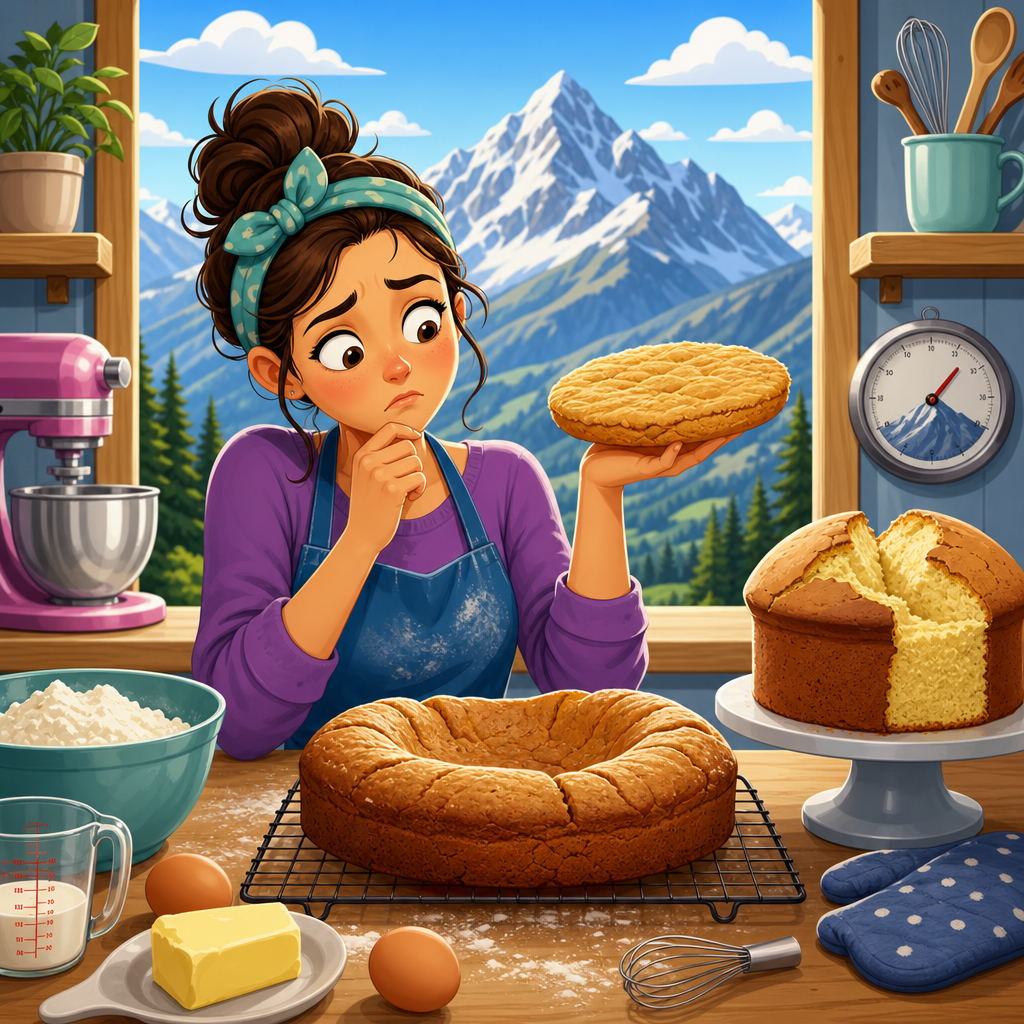
Flour that performs perfectly at sea level can become unpredictable in dry mountain air because altitude changes moisture balance, gas expansion, starch behavior, and gluten development all at once. In practical baking terms, that means doughs feel drier, batters lose structure faster, cookies spread differently, and bread can rise quickly before collapsing. When I started testing recipes above 5,000 feet, the biggest surprise was not the oven temperature or yeast speed; it was how often the flour itself seemed to “change” from day to day. It was not actually changing. The environment around it was.
Understanding why flour behaves differently in dry mountain air is the foundation of successful altitude baking. Flour is hygroscopic, meaning it absorbs and releases moisture depending on the surrounding humidity. In mountain climates, relative humidity is often low, so flour, sugar, and even packaged baking mixes hold less moisture than the same products in coastal kitchens. At the same time, lower air pressure affects evaporation and the way leavening gases expand. Those two forces together explain most baking failures at elevation. This hub article covers the fundamentals: how altitude and humidity change flour, what that means for common baked goods, how to choose and store flour, and which adjustments consistently improve results.
What dry mountain air does to flour before you even start mixing
Dry air begins influencing flour long before it meets water, eggs, or butter. Wheat flour naturally contains a small amount of moisture, typically around 10 to 14 percent by weight depending on the type, milling conditions, and storage environment. In a dry mountain kitchen, that moisture level can trend lower over time once a bag is opened. The result is subtle but important: one cup of flour may look normal yet require more liquid to reach the same dough consistency you expect at lower altitude.
This matters because baking formulas are built around hydration ratios. Bread bakers track baker’s percentages for a reason. If flour is drier, a dough mixed at 68 percent hydration may behave more like a lower-hydration dough, tightening crumb and slowing extensibility. In cakes and muffins, lower effective hydration can limit starch swelling and produce dense texture. In pie dough, it can make the mass crumbly, leading bakers to overwork it while trying to force cohesion. I see this most clearly when teaching quick breads at altitude: students often assume they measured incorrectly, when the real issue is that the flour has absorbed less ambient moisture than the recipe developer expected.
Particle size and protein content shape the effect. Cake flour, all-purpose flour, bread flour, and whole wheat flour do not absorb water equally. Higher-protein flours generally bind more water because gluten-forming proteins interact strongly with moisture. Whole grain flours also absorb more because bran and germ act like sponges, though they can hydrate slowly and unevenly. In dry mountain air, those differences become more pronounced. A whole wheat dough that seemed manageable at sea level may feel thirsty for an extra 2 to 5 percent water. A biscuit dough made with low-protein flour may appear dusty and cracked unless you increase buttermilk slightly or allow a short resting period for full hydration.
Why altitude magnifies hydration problems during mixing and baking
Low humidity is only half the story. The other half is altitude itself. As elevation increases, atmospheric pressure decreases. Water boils at a lower temperature, liquids evaporate faster, and gases in batters and doughs expand more readily. This combination puts pressure on structure-forming ingredients, especially flour. If the flour begins drier and the batter loses moisture faster in the oven, the window for proper starch gelatinization and protein setting becomes narrower.
That is why bakers at altitude often need more liquid, less leavening, higher oven temperatures, or some combination of all three. More liquid compensates for faster evaporation and drier flour. Reduced baking powder, baking soda, or yeast helps prevent overexpansion before the crumb sets. A modestly higher oven temperature can set structure sooner. The classic guidance from extension programs in Colorado and Wyoming follows this logic: above roughly 3,000 feet, adjustments become increasingly useful, and above 5,000 feet they are often necessary for consistency.
In my own tests with yellow cake at 7,200 feet, simply adding liquid without reducing leavening solved only part of the problem. The batter still rose quickly, then sank near the center because the flour-and-egg network could not support the rapid gas expansion. When I cut baking powder by about 15 percent, increased milk by a few tablespoons, and raised the oven by 15 degrees Fahrenheit, the crumb stabilized. Flour was central to the fix, but flour never acts alone. It interacts with heat, sugar concentration, egg proteins, and gas production, so adjustments must be balanced rather than isolated.
How flour type changes baking results at elevation
Different flours respond differently in dry mountain air because they contain varying levels of protein, damaged starch, bran, and natural oils. Choosing the right flour is often the simplest altitude adjustment. All-purpose flour is the default for most home bakers, but “all-purpose” is not standardized to one exact protein level. National brands can vary, and regional flours sometimes shift from soft to hard wheat blends by market. If your cookies suddenly puff and dry out after moving to a mountain town, a new flour brand may be part of the reason.
Bread flour, usually around 12 to 13 percent protein, can help lean yeasted doughs hold shape at altitude because it builds stronger gluten. That strength is useful when carbon dioxide expands faster. However, in enriched breads or cinnamon rolls, too much strength can reduce tenderness unless hydration also increases. Cake flour, with lower protein and finer texture, supports tender cakes, but in dry air it can leave batters more fragile. Many altitude bakers get better results using a blend of all-purpose and cake flour rather than cake flour alone for layer cakes.
Whole wheat flour deserves special attention. Bran cuts gluten strands and increases water absorption, both of which matter more in mountain climates. A 100 percent whole wheat loaf that worked in a humid region may become squat and dry unless you increase water, autolyse the flour, and avoid overproofing. Freshly milled flour adds another variable because it often absorbs differently from aged commercial flour. Rye flour behaves differently again, relying more on pentosans and starch gel structure than gluten. At altitude, rye breads can benefit from covered baking or steam to protect surface moisture while the crumb sets.
| Flour type | Typical behavior in dry mountain air | Useful adjustment |
|---|---|---|
| All-purpose | Reliable but may feel drier than expected in batters and doughs | Add small increments of liquid; weigh flour instead of scooping |
| Bread flour | Builds strong structure, helpful for fast gas expansion | Increase hydration slightly to keep crumb from tightening |
| Cake flour | Produces tenderness but can weaken structure in high-rising cakes | Reduce leavening and consider blending with all-purpose flour |
| Whole wheat | Absorbs more water and can dry out quickly | Rest dough after mixing and add extra liquid |
| Rye | Sets differently and can dry on the surface before interior stabilizes | Use steam or covered baking for better moisture retention |
What flour behavior means for breads, cakes, cookies, and pastries
The phrase “flour behaves differently” becomes clearer when you look at specific products. In yeast bread, dry mountain air usually shows up first as stiff dough and accelerated fermentation. Because dough loses moisture quickly and yeast works efficiently in warm kitchens, bakers often mistake overproofing for underhydration or vice versa. The dough may feel firm during mixing, then expand rapidly, then bake up with torn sides or a dry crumb. The remedy is usually to increase water modestly, monitor proof by dough volume rather than the clock, and bake before the gluten network overextends.
In cakes, flour’s job is to provide enough structure for the batter to rise and set without becoming tough. At altitude, excessive leavening and fast evaporation can overpower that structure. The symptoms are peaked tops, tunnels, coarse crumb, or a center that falls. Flour alone does not fix this, but flour choice and measurement are major variables. Weighing flour instead of using volume is especially valuable because scooped cups can vary by 20 percent or more, a difference large enough to push an altitude cake from tender to dry.
Cookies create a different challenge. Dry flour and rapid moisture loss can limit spread, yet lower air pressure can also encourage early puffing. That is why one batch may bake up thick and pale while another spreads too fast after a small butter or sugar change. Chilling dough helps, but so does controlling flour quantity accurately. For pastry and pie dough, mountain air increases the risk of crumbly texture before lamination or rolling even begins. A short rest after adding water is often more effective than adding water endlessly, because flour needs time to hydrate fully. That single habit improves biscuits, scones, tart dough, and rough puff more than many bakers expect.
How to adjust formulas: moisture, mixing, leavening, and heat
Successful altitude baking starts with diagnosing the product, then adjusting in a disciplined order. First, weigh flour and track actual hydration. A digital scale matters more at elevation because low humidity exaggerates small measurement errors. If a dough feels dry, add liquid in measured increments, usually 1 to 2 percent of flour weight at a time for bread and one tablespoon at a time for cakes or muffins. Second, review mixing. Overmixing a dry batter develops gluten unevenly and produces toughness; undermixing leaves dry pockets that never fully hydrate.
Third, control leavening. For chemically leavened goods, many reliable altitude formulas reduce baking powder or soda as elevation rises. For yeast doughs, the goal is not necessarily less yeast but better fermentation management: cooler dough temperatures, shorter rises, and stronger shaping. Fourth, use heat strategically. A slightly hotter oven can set structure sooner and reduce collapse, but too much heat hardens the exterior before expansion finishes. The adjustment is usually modest, not dramatic.
Ingredient sequencing also helps. I often let flour hydrate before full mechanical mixing when working with whole grain doughs. In cakes, alternating dry and wet ingredients prevents clumping and reduces the temptation to overbeat. For cookies, resting dough overnight improves hydration and flavor, especially with high-protein or whole grain flours. If you use stand mixers, note the difference between planetary mixers and spiral mixers in bread work: a spiral mixer develops gluten with less oxidation, which can preserve dough strength and color. Most home bakers do not need specialized equipment, but they do benefit from treating flour as a dynamic ingredient rather than an inert powder.
Storage, measurement, and troubleshooting in a mountain kitchen
Because flour exchanges moisture with the air, storage conditions influence results. Keep flour in airtight containers, not loosely clipped bags. If your climate is exceptionally dry, divide large bags into smaller sealed containers so repeated opening does not expose the full supply. Whole grain flour should be refrigerated or frozen for freshness because the oils in the germ oxidize faster than white flour. Let chilled flour return close to room temperature before delicate mixing so fat emulsions and batter temperatures stay predictable.
Measurement discipline is equally important. Use gram weights whenever possible. If a recipe gives cups only, fluff flour lightly, spoon it into the cup, and level it off rather than scooping directly. Scooping compresses flour and can add enough extra dry matter to create problems that resemble altitude failure. Troubleshooting should be symptom based. If bread is dry and tight, look first at hydration and proofing. If cake sinks, review leavening, oven temperature, and sugar level before blaming the pan. If cookies do not spread, check flour amount, dough temperature, and sugar state. Mountain baking becomes much easier once you keep notes because patterns emerge quickly across recipes.
This hub page should guide the rest of your baking fundamentals work at altitude. From here, the most useful next steps are deeper articles on measuring flour accurately, choosing between all-purpose and bread flour, adjusting baking powder and soda by elevation, managing yeast proofing in mountain climates, and storing whole grain flour in dry air. Master those fundamentals and flour stops feeling unpredictable. It becomes readable. That is the real advantage: better texture, fewer failures, and a kitchen process you can trust. Start by weighing flour, adjusting liquid deliberately, and recording what changes at your elevation.
Frequently Asked Questions
Why does flour seem drier and thirstier in mountain air?
At higher elevations, the air is usually much drier, and that changes how flour behaves before you even begin mixing. Flour is naturally hygroscopic, which means it pulls in and releases moisture depending on the surrounding environment. In dry mountain air, flour tends to hold less ambient moisture than it would at sea level, so it often behaves like a thirstier ingredient. The same measured cup or weighed portion can suddenly absorb more liquid, making doughs feel tighter, rougher, and less flexible than expected.
This is one of the main reasons bakers at altitude often feel as though a familiar recipe has become unreliable overnight. A bread dough that should feel soft and tacky may seem stiff. A muffin batter that should be loose and scoopable may look thicker than normal. Pie dough can crack more easily. Even cookie dough can appear firmer at first, then bake in a way that does not match the original recipe. In many cases, the flour itself is not defective; it is simply starting from a drier baseline.
The practical fix is to watch texture more closely than the written quantity. You may need slightly more liquid, a longer resting period for hydration, or both. Letting flour sit for a few minutes after initial mixing can make a big difference because it gives starches and proteins time to absorb moisture fully. In mountain baking, learning the feel of properly hydrated dough often matters more than following the exact original measurement.
How does altitude change the way flour interacts with yeast, baking powder, and baking soda?
Altitude affects leavening dramatically because lower air pressure allows gases to expand more easily and more quickly. That means carbon dioxide produced by yeast, baking powder, or baking soda can inflate a dough or batter faster than it would at sea level. Flour is responsible for helping create the structure that holds those gases in place. When gas expansion speeds up before the flour has fully hydrated, before gluten has strengthened enough, or before starches and proteins have set in the oven, the structure can overextend and then collapse.
That is why bread at altitude may rise beautifully in the bowl and then sink during proofing or baking. It is also why cakes can puff up rapidly and then fall in the center. The flour is being asked to support a faster, more forceful expansion under drier conditions, and that combination is harder to control. If the batter or dough is already a little dry because the flour absorbed more moisture from the recipe, the problem gets worse. Dry mixtures often lack the flexibility and balance needed to trap gas evenly.
In practice, bakers usually improve results by reducing leavening slightly, shortening rise times, increasing liquid, or strengthening structure with a bit more flour or an extra egg depending on the recipe. The key idea is that flour is not working alone. At altitude, it has to coordinate with moisture, gas production, and heat setting, and small imbalances become very visible very quickly.
Why do bread doughs rise fast at high altitude but still end up collapsing or drying out?
Fast rising is one of the most misleading signs in mountain baking. Many people assume a quicker rise means the dough is healthy and active, but at altitude, rapid expansion can actually be a warning. Lower atmospheric pressure lets gas bubbles enlarge sooner, so dough can appear ready before its internal structure has developed enough strength. At the same time, dry air encourages moisture loss from the surface and can make the dough feel deceptively firm, even when the inside still needs better hydration and gluten development.
Flour plays a central role here because bread structure depends on the balance between water absorption, gluten formation, fermentation, and heat. If flour is underhydrated, gluten may not develop as smoothly or stretch as well. If fermentation moves too fast, gas pressure can outrun the dough’s ability to hold shape. Then, once the loaf goes into the oven, the dough may expand rapidly, weaken, and sink rather than maintaining a stable oven spring. Surface drying can also create a skin that restricts even expansion, leading to tearing, lopsided shape, or dense patches.
Better results usually come from controlling the rise instead of chasing volume alone. Slightly increase liquid if the dough feels tighter than normal, cover it well to prevent moisture loss, and proof based on feel rather than waiting for it to double dramatically. Many high-altitude bakers stop fermentation a little earlier than sea-level instructions suggest. That gives the flour and gluten network a better chance to hold their structure through baking rather than overinflating and collapsing.
Why do cookies, cakes, and muffins behave differently when the flour seems to measure the same?
The measurement may be the same, but the functional balance is not. Flour does much more than add bulk. It absorbs water, helps set structure, influences spread, and determines how quickly a batter or dough stabilizes during baking. In dry mountain air, flour often begins with lower moisture content, so it can pull more water from the rest of the formula. That shifts the texture of the entire mixture, even if you used the exact same amount by weight or volume.
In cookies, that can mean dough that starts out stiff but spreads unpredictably because sugar melts, butter softens, and structure sets at a different pace. In cakes and muffins, the batter may rise quickly from expanded gases but fail to hold because the flour did not hydrate in time to support the structure. The result can be tunneling, doming, coarse crumb, or collapse. Batters that seemed perfectly normal at sea level can suddenly feel fragile and overactive in the mountains.
This is why successful high-altitude baking often depends on adjusting more than one variable at once. A small increase in liquid, a slight reduction in sugar or leavening, a touch more flour, or a modestly higher oven temperature may all help, depending on the product. Flour is part of a system, not an isolated ingredient. When altitude changes evaporation, gas expansion, and setting speed, flour’s role becomes more obvious because any weakness in hydration or structure shows up immediately in the final bake.
What is the best way to adjust recipes when flour keeps behaving unpredictably at high altitude?
The most reliable approach is to treat flour behavior as a texture problem first and a measurement problem second. Start by observing how the dough or batter looks and feels compared with what the recipe intends. If a bread dough is unusually stiff, a muffin batter is thicker than normal, or cake batter seems to lose volume quickly, the flour may be absorbing moisture more aggressively than expected. In that case, adding a small amount of extra liquid is often the first useful correction.
Beyond hydration, make adjustments in small, controlled steps. At altitude, it is common to reduce yeast slightly or shorten proofing time for breads, reduce baking powder or baking soda in cakes and quick breads, and increase oven temperature a little so structure sets before overexpansion causes collapse. Some recipes also benefit from a slight increase in flour, but that only works well if there is enough liquid to support it. More flour without enough moisture can make dryness and toughness worse.
It also helps to standardize your method. Weigh flour instead of relying on cup measurements, rest doughs and batters briefly after mixing to allow full hydration, and keep notes on temperature, timing, and texture. Mountain baking rewards repeatable observation. The biggest shift for most bakers is realizing that flour is not suddenly inconsistent; it is reacting honestly to a new environment. Once you begin adjusting for dry air, faster gas expansion, and quicker moisture loss, flour becomes much more predictable again.