How altitude changes paint and stain drying times is a practical question for anyone maintaining a mountain home, cabin, garage, fence, or outbuilding. At higher elevations, coatings do not behave exactly the way they do at sea level, and the difference is large enough to affect project schedules, finish quality, product choice, and long term durability. In mountain home maintenance, “drying time” refers to the period when solvents or water leave a coating and the film becomes safe to touch, recoat, or expose to weather. “Cure time” is different. Cure describes the chemical process that lets paint, stain, varnish, or sealant reach full hardness and adhesion. I have had projects in foothill towns dry almost on schedule, then watched the same products flash too fast on a sun exposed deck at 8,000 feet and stay unexpectedly soft overnight once temperatures dropped.
Altitude matters because it changes several environmental variables at once. Air pressure decreases, humidity often drops, ultraviolet exposure rises, wind speeds tend to increase, and day to night temperature swings become much wider. Each factor affects evaporation, film formation, penetration into wood fibers, and the rate at which binders crosslink. That means mountain homeowners need more than a simple label reading of “dries in one hour” or “recoat in four.” They need a weather based plan. This hub article explains what changes at elevation, how those changes affect paint and stain drying times, and how to manage common mountain maintenance jobs on siding, decks, trim, railings, sheds, metal roofs, and vehicle related structures. It also serves as the central guide for the broader Mountain Home Maintenance topic by connecting drying time decisions to substrate prep, moisture control, storage, seasonal timing, and safe finishing practices.
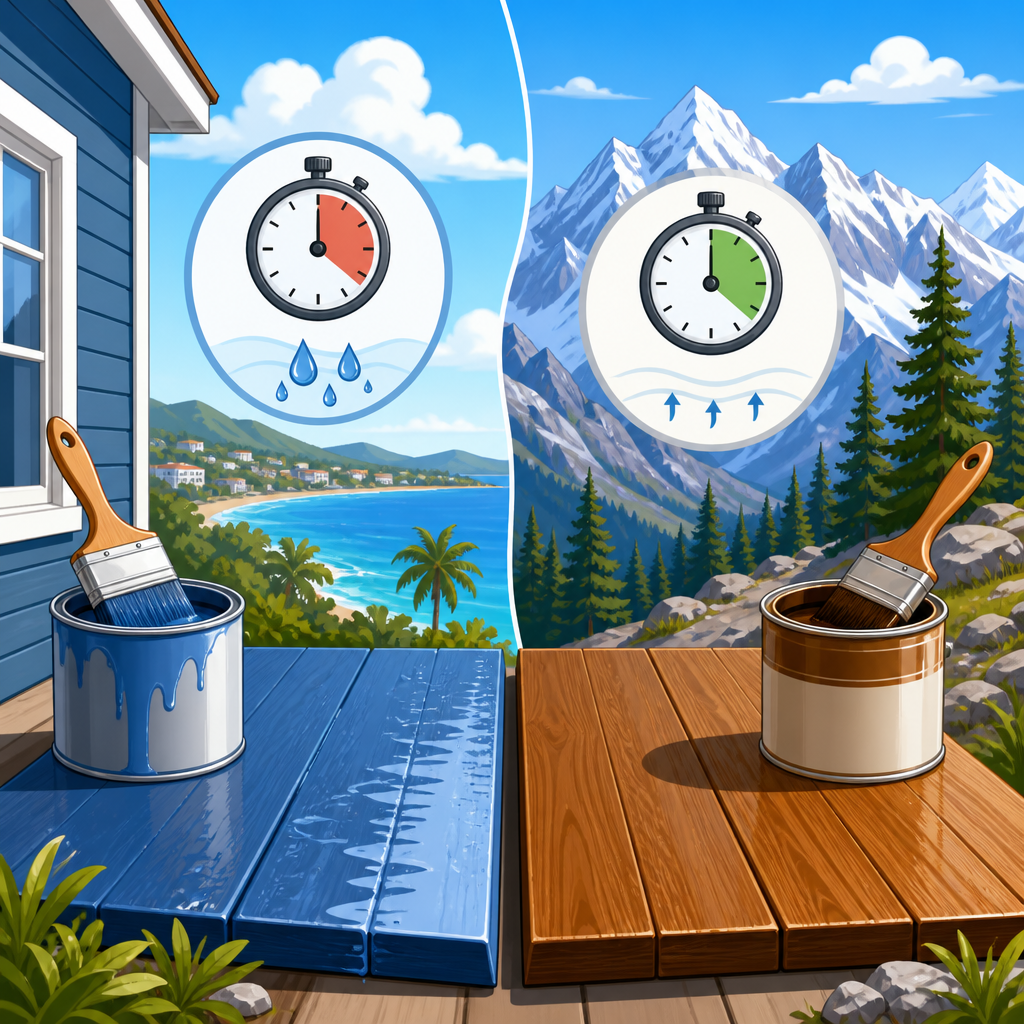
The short answer is this: higher altitude can make the surface of many coatings dry faster while making full cure less predictable. Lower humidity and stronger sun can speed initial evaporation, but cool nights, thin air, and substrate temperature swings can interfere with leveling, adhesion, and through cure. Oil based products may skin over too quickly. Waterborne paints can lose open time, leading to lap marks. Penetrating stains may absorb unevenly into sun baked wood. On the other hand, enclosed spaces such as mountain garages, mechanical rooms, and unheated cabins can slow curing dramatically if the temperature remains low. Understanding these tradeoffs helps you choose the right application window and avoid expensive failures like blistering, premature peeling, tacky finishes, or blotchy stain.
Why altitude changes drying behavior
Altitude affects coatings through physics and material science, not guesswork. Lower atmospheric pressure changes how volatile compounds leave a wet film. In practice, the bigger effect most homeowners notice comes from the environmental package that usually accompanies elevation: lower relative humidity, more intense solar radiation, thinner cloud cover, and stronger airflow. When air is dry, waterborne acrylic paint can lose moisture quickly. When the sun is intense, the surface temperature of cedar siding or a south facing deck board can rise far above ambient air temperature. I have measured deck surfaces more than 20 degrees hotter than the reported forecast, which is enough to shorten wet edge time and make a stain set before it has penetrated evenly.
Wood adds another layer of complexity. In mountain regions, lumber often cycles between very dry afternoons and moisture pickup overnight from dew, snowmelt, or shaded condensation. A board can look dry at noon and still contain too much internal moisture for a stable finish. Most paint manufacturers want wood moisture content below about 15 percent, and many stain makers prefer 12 percent or lower for best penetration. A handheld moisture meter is one of the most useful tools in mountain home maintenance because it verifies conditions that the eye cannot. Dry mountain air may accelerate surface drying, but trapped moisture under the coating will still cause failure.
Paint versus stain at elevation
Paint and stain do not respond identically to altitude because they are built to do different jobs. Exterior paint forms a protective film on the surface. Exterior stain either penetrates the wood, leaves a light film, or does both depending on whether it is transparent, semi transparent, or solid body. At higher elevations, a film forming paint is vulnerable to rapid skinning when exposed to wind and direct sun. That can reduce leveling and create brush drag, roller stipple, and visible lap lines. However, a properly chosen 100 percent acrylic exterior paint still performs well in mountain climates because it remains flexible during freeze thaw cycles and handles ultraviolet exposure better than many older resin systems.
Stains are heavily influenced by wood temperature and porosity. On a high altitude deck, boards may be dry enough to accept stain in the morning, then become so hot by early afternoon that the carrier flashes before it can soak in. The result is uneven color and reduced water repellency. Semi transparent oil modified stains are especially sensitive to overapplication at altitude because the surface may look ready while excess material remains in low spots or around knots. Waterborne deck stains can dry quickly and be easier to clean up, but they often demand tighter control of sun exposure. For mountain fences, railings, and siding, the right choice depends on species, prior coatings, orientation, and maintenance interval, not just label claims.
Environmental factors that matter most
Homeowners often ask which variable matters most: temperature, humidity, sun, wind, or elevation itself. The honest answer is that all of them interact, but some are easier to manage than others. Surface temperature is usually the most overlooked. Product labels may specify application between 50 and 90 degrees Fahrenheit, yet the siding or deck can exceed that range even when the air feels mild. Relative humidity governs how quickly water leaves latex products, while wind can accelerate evaporation enough to shorten open time across large walls. Overnight lows determine whether curing continues or stalls. If a coating drops below its minimum film formation temperature, defects can appear even if the daytime application seemed perfect.
| Factor | What changes in mountain areas | Effect on paint or stain | Best response |
|---|---|---|---|
| Air pressure | Lower at higher elevation | Can speed solvent release and alter open time | Work in smaller sections and follow recoat windows closely |
| Humidity | Often lower during the day | Faster evaporation, shorter wet edge, quicker surface dry | Apply during moderate humidity periods, not peak dryness |
| UV intensity | Higher with elevation | Hotter surfaces, faster skinning, more long term degradation | Avoid direct midday sun and use UV resistant products |
| Wind | Common on ridges and exposed lots | Rapid flash off, dust contamination, overspray drift | Use shields, brush where needed, and stop in gusty conditions |
| Day-night swing | Often large | Day dries fast, night slows cure or causes condensation | Finish early enough for film set before evening cool down |
Weather services help, but they are not enough by themselves. For mountain home maintenance, I plan around the substrate, not just the forecast. An infrared thermometer, hygrometer, and moisture meter tell you more than a phone app. North facing walls, shaded soffits, and canyon side decks may stay cool and damp long after the driveway looks dry. South and west exposures can become too hot for proper application surprisingly early in the day. This is why mountain painters often move around the structure with the sun, coating east walls after the chill lifts, shifting north at midday, then finishing west only when the surface cools again.
How to schedule exterior projects in mountain climates
The best schedule usually starts earlier and ends sooner than homeowners expect. At altitude, the safest exterior painting and staining window is often mid morning through early afternoon, after overnight moisture has evaporated but before strong sun and wind peak. Spring and fall can be excellent seasons if temperatures remain above the product minimum long enough for curing to continue after sunset. Summer offers longer days, yet afternoon thunderstorms, smoke, and intense surface heat create their own risks. Winter work is limited unless the product is specifically designed for cold weather application and the substrate is clean, dry, and within range.
Preparation takes on added importance in mountain settings. Clean surfaces thoroughly, let them dry fully, then confirm moisture content before opening a can. For decks, that usually means washing well ahead of staining, not the day before. For peeling siding, scrape, feather sand, spot prime bare wood, and seal vulnerable end grain. On metal railings or exposed fasteners, remove rust and use the correct primer because freeze thaw cycles will exploit any weak bond. If you are maintaining a cabin that sits vacant part of the year, inspect for snow splash, ice dam staining, and UV fading on high exposure sides. Coating failure patterns often tell you which elevations and orientations need a different maintenance cycle.
Product selection for mountain homes, outbuildings, and garages
The right coating system matters as much as timing. For painted siding and trim, high quality exterior acrylic latex remains the default recommendation because it tolerates movement, resists cracking, and stands up well to ultraviolet stress. Look for products from established lines such as Sherwin-Williams Duration, Benjamin Moore Aura Exterior, or BEHR Marquee Exterior, then verify the technical data sheet for application range, recoat interval, and rain resistance time. Technical data sheets are more reliable than shelf labels. For stains, choose a system matched to the wood and exposure. Penetrating oil based formulas can perform very well on rough sawn cedar in dry mountain air, while premium waterborne deck stains may be better where cleanup, lower odor, and color retention matter more.
Do not ignore related structures under the Home Systems, Vehicles & Off-Grid Living umbrella. Mountain home maintenance includes detached garages, equipment sheds, trailer pads, solar battery enclosures, wood storage racks, livestock fencing, and utility rooms. These spaces often combine dust, cold nights, and intermittent heat, all of which complicate drying times. If you are coating a garage floor, for example, epoxy and polyaspartic systems have strict substrate moisture and temperature requirements. If you are painting an off grid power shed, generator vibration, fuel odors, and limited ventilation may call for a different primer and longer cure period before closing the building up. Vehicle adjacent surfaces also face road salt, mud, and freeze thaw abuse, so adhesion and full cure matter more than a quick dry label.
Common mistakes and how to avoid them
The most common altitude related mistake is assuming fast surface dry means the coating is ready for recoating or weather exposure. A board that feels dry to the touch can still be soft underneath, especially with heavier body stains, alkyd products, and cool overnight conditions. Recoating too soon traps solvents or moisture and can cause wrinkling, poor adhesion, or glossy patches. The second major mistake is applying in direct sun on overheated surfaces. That leads to brush marks, lap marks, flashing, and premature failure. The third is skipping moisture testing after rain, pressure washing, or snowmelt. Wood can hold water much longer than the surface appearance suggests.
Other avoidable errors include thinning products without manufacturer guidance, stretching coverage beyond the recommended spread rate, and ignoring dew point. Dew can land on fresh coatings in mountain valleys even when the afternoon was warm and dry. I have also seen homeowners close up a cabin too soon after interior painting, assuming dry mountain air would finish the job. Without ventilation and stable temperature, cure can stall and odors can linger for weeks. Read the technical data sheet, not just the can. Verify the minimum application temperature, minimum recoat time, full cure estimate, and rain resistance threshold. When conditions are marginal, wait. In mountain maintenance, patience is often cheaper than repair.
Mountain home maintenance checklist for lasting results
Altitude changes paint and stain drying times by speeding some parts of the process and destabilizing others, so success comes from managing conditions rather than chasing the fastest product. Check surface temperature, wood moisture, forecast highs and lows, wind, and shade pattern before you start. Choose coatings designed for exterior ultraviolet exposure and freeze thaw movement. Work with the sun, keep coats even, and give the finish enough time to set before evening cool down. Treat decks, siding, trim, fences, garages, sheds, and utility structures as parts of one maintenance system, because failures often begin where moisture, heat, and exposure meet.
For mountain homeowners, the benefit of understanding drying time is simple: better finish performance with fewer callbacks, fewer redos, and longer service life between maintenance cycles. Use this hub as your starting point for every Mountain Home Maintenance project, from deck staining and siding repainting to outbuilding protection and vehicle area coatings. Build your schedule around measured conditions, not assumptions, and your results will improve immediately. Before your next project, review the product data sheet, test moisture, and map the day’s sun and temperature shifts. That single habit will prevent most altitude related coating problems.
Frequently Asked Questions
How does higher altitude affect paint and stain drying times?
Higher altitude changes drying behavior because the air is typically thinner, drier, and often more intense in sunlight than it is at sea level. Those conditions can speed up the evaporation of water and solvents from paint and stain, which may make a coating feel dry to the touch sooner. However, that faster surface drying does not always mean the finish has cured properly underneath. In practical terms, a mountain homeowner may see paint skin over quickly while deeper layers are still soft, which can create issues with adhesion, lap marks, uneven sheen, or premature wear.
Altitude also tends to come with wider temperature swings between day and night. A surface might warm rapidly in direct sun and then cool quickly in the evening, which affects how evenly a coating dries and hardens. Wind exposure is another factor in many elevated areas, and moving air can increase evaporation even more. The result is that projects at higher elevations often require more attention to timing, surface temperature, and product selection than similar jobs at lower elevations. Instead of assuming a label’s drying time will apply exactly as printed, it is smarter to treat those times as a baseline and adjust for local mountain conditions.
Does paint dry faster or slower in the mountains?
In many cases, paint dries faster at higher elevations, at least on the surface. Lower humidity and stronger sun exposure often cause moisture or solvents to leave the coating more quickly. That can be helpful if you are trying to avoid dust pickup or light rain exposure, but it can also reduce the amount of time the paint has to level out smoothly. When paint loses moisture too quickly, brush marks, roller lines, and overlap marks are more likely, especially on large siding walls, trim, doors, and garage exteriors.
That said, “faster” does not always mean “better,” and it does not always apply to every stage of drying. Dry-to-touch time may be shorter, while full cure time can still depend heavily on temperature, film thickness, and the chemistry of the product. If nights are cold, if the coating is applied too thickly, or if the substrate is shaded and cool, the overall process can still slow down. For mountain homes and cabins, the safest approach is to think of altitude as one variable among several. Dry mountain air may accelerate evaporation, but cold mornings, cold nights, and rapid weather shifts can still delay proper curing and affect long-term durability.
Why do altitude-related drying changes matter for finish quality and durability?
Drying time affects much more than convenience. It directly influences how well paint or stain bonds to the surface, how evenly it looks, and how long it will hold up outdoors. When a coating dries too quickly at the surface, it may not have enough open time to flow, penetrate, or coalesce the way the manufacturer intended. On paint, that can mean visible lap marks, poor leveling, reduced adhesion, and inconsistent sheen. On stain, especially exterior wood stain, rapid drying can limit penetration into the wood and leave the finish looking blotchy or wearing away sooner than expected.
For mountain properties, durability is especially important because coatings are often exposed to stronger UV radiation, freeze-thaw cycles, snow, wind, and abrupt moisture changes. A finish that went on under poor drying conditions may start failing early through peeling, cracking, fading, or flaking. That is why project schedules at altitude need to account not just for when the coating is touch-dry, but also for when it is ready for recoating, weather exposure, and full service. Paying attention to altitude-related drying behavior helps protect the appearance of the job today and the lifespan of the finish over the next several seasons.
How should I adjust my painting or staining schedule at higher elevations?
The best adjustment is to work around the actual conditions on the surface, not just the clock. At higher altitudes, it is often wise to avoid painting or staining during the hottest, brightest part of the day, when direct sun can overheat the substrate and cause the coating to dry too fast. Early to mid-morning after dew has evaporated, or later afternoon when surfaces are out of direct intense sun, is often more manageable. You also want enough daylight and warmth afterward for the coating to set up before evening temperatures drop too far.
Check both air temperature and surface temperature, because siding, decking, trim, and fencing can be much hotter than the surrounding air in mountain sun. Watch the overnight forecast as well. Even if the product seems dry by late afternoon, a cold night can interfere with curing. For larger projects, break the work into smaller sections so you can maintain a wet edge and avoid overlap marks. It also helps to read the manufacturer’s recoat and cure guidance carefully, then add a margin of caution when local conditions are extreme. For a mountain home, cabin, fence, or outbuilding, smart scheduling is often the difference between a finish that looks professional and one that has to be redone sooner than expected.
What products and techniques help coatings perform better at high altitude?
Choose products that are specifically rated for exterior conditions and compatible with the material you are coating, whether that is wood siding, log surfaces, fiber cement, metal, trim, fencing, or a detached garage. High-quality paints and stains usually offer better workability and more predictable drying behavior across changing conditions. For mountain environments, UV resistance, flexibility, and strong adhesion are particularly valuable. If you are staining exterior wood, a product designed to penetrate properly and tolerate rapid weather shifts is usually a better choice than a bargain coating that dries unpredictably or forms a weak film.
Technique matters just as much as product choice. Apply coatings at the manufacturer’s recommended spread rate rather than too thin or too thick, and avoid working in strong direct sun or gusty wind whenever possible. Maintain a wet edge, use the recommended applicator, and follow recoat windows closely. On porous or weathered surfaces, proper prep is essential because dry mountain air can magnify problems caused by dust, chalking, or uneven absorption. If conditions are changing quickly, test a small area first and evaluate how the coating levels, penetrates, and dries before committing to the entire project. In short, the most successful high-altitude jobs combine the right product, careful timing, and disciplined application methods rather than relying on sea-level expectations.