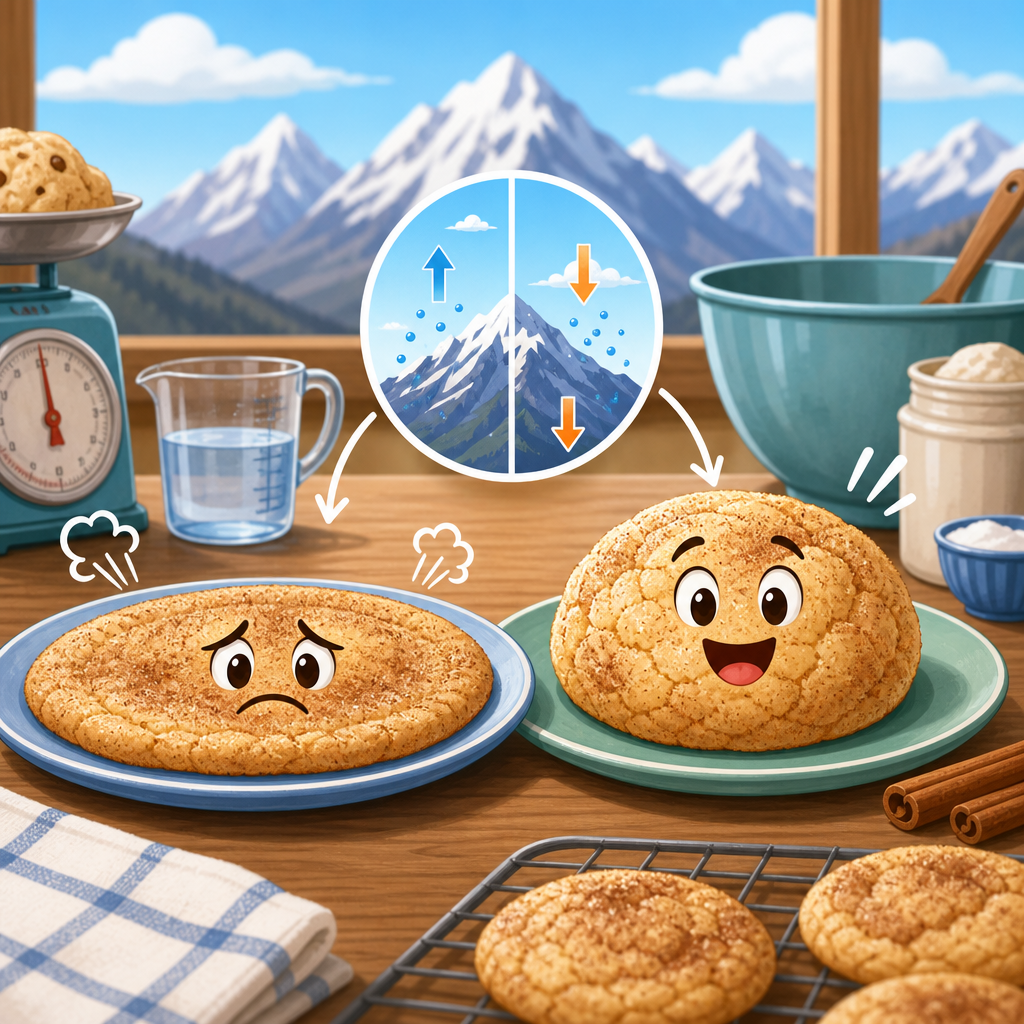
Snickerdoodles at altitude often flatten because lower air pressure changes how butter melts, sugar dissolves, leavening expands, and flour hydrates, turning a normally thick cinnamon-sugar cookie into a thin, fragile round with weak crinkles. In high-altitude baking, usually defined as 3,000 feet and above, recipes behave differently because water boils at lower temperatures, moisture evaporates faster, and gas bubbles from baking powder or baking soda expand more aggressively. I have tested cookie formulas in mountain kitchens where a dependable sea-level dough spread like lace on one sheet and baked up pale and dry on the next, and snickerdoodles are one of the clearest examples of why altitude matters. This hub covers cookies and bars through the lens of snickerdoodles: what causes flattening, how to correct it, and how the same principles apply to drop cookies, slice-and-bakes, blondies, brownies, and bar cookies. If you understand the mechanics behind spread, structure, and moisture retention, you can fix one recipe and improve an entire category of altitude baking. The goal is not guesswork. It is controlled adjustment, based on ingredient function, dough temperature, pan choice, and oven performance, so your cookies keep their signature soft centers, crackled tops, and balanced cinnamon tang at elevation.
Why snickerdoodles flatten at altitude
Snickerdoodles flatten at altitude because several small effects stack on top of one another. First, leavening becomes more forceful. Most classic snickerdoodle recipes rely on cream of tartar plus baking soda, or sometimes baking powder, to create lift and tang. At elevation, those gases expand more before the dough structure has time to set, so cookies rise early and then collapse outward. Second, butter melts before the flour and egg proteins can form enough support. Lower atmospheric pressure and faster heat transfer encourage spread, especially when dough starts warm. Third, sugar attracts and holds water, but altitude increases evaporation, so dough can move from overly loose to oddly dry during baking. That creates a cookie that spreads too much at first, then finishes with thin, crisp edges and a flat middle. Fourth, flour is often under-adjusted. A sea-level ratio may not provide enough starch and protein to absorb available moisture at 5,000 or 7,000 feet. Finally, many home ovens run cool, and a cool oven is a hidden cause of flat cookies because fat liquefies long before the outer structure sets.
The classic visual symptom is broad diameter with little dome, faint crinkles instead of deep fissures, and bottoms that brown before the centers thicken. If your snickerdoodles look greasy or shiny on the sheet pan, the dough likely lacks structural resistance for your altitude. If they flatten and also taste cakey, the leavening may be excessive rather than insufficient. Those distinctions matter, because the fix is rarely a single change. At altitude, good cookie troubleshooting means identifying whether spread comes primarily from fat, sugar, leavening, hydration, or heat.
Ingredient adjustments that actually work
The fastest route to better high-altitude snickerdoodles is a controlled ingredient adjustment. Start with flour. In most home formulas, adding 1 to 3 tablespoons of flour per batch at 3,000 to 7,000 feet improves thickness without making the cookie bready. The extra flour increases starch gelation and protein support, helping the cookie set before it runs. Next, reduce leavening modestly. If a recipe uses baking powder, cut it by about 1/8 to 1/4 teaspoon, depending on batch size and altitude. If it uses the traditional cream of tartar and baking soda combination, reduce the soda slightly first, because too much soda can exaggerate spread and browning. Keep enough cream of tartar to preserve the characteristic tang and chewy texture.
Sugar also deserves attention. A slight reduction, often 1 to 2 tablespoons total, can reduce spread because dissolved sugar contributes to fluidity as the dough heats. I usually reduce only the granulated sugar in snickerdoodles, not all sweetness, because the cinnamon coating already contributes exterior sweetness and texture. Fat is the next lever. Using butter that is cool, around 65 degrees Fahrenheit rather than very soft, makes a meaningful difference. Some bakers replace 1 to 2 tablespoons of butter with shortening for less spread, but that tradeoff reduces flavor. I prefer keeping all butter and strengthening the dough through flour, chill time, and oven temperature first. Eggs can help, too. At higher elevations, an extra yolk occasionally improves chew and structure in larger batches, though too much yolk can create a denser cookie. The key is to adjust one variable at a time and keep notes.
| Issue | Likely cause at altitude | Practical fix |
|---|---|---|
| Cookies spread into thin rounds | Too little flour, warm butter, oven too cool | Add 1 to 3 tablespoons flour, chill dough, verify oven with thermometer |
| Cookies rise then collapse flat | Leavening too strong for elevation | Reduce baking powder or soda slightly |
| Edges brown too fast | High sugar exposure, dark pans, overactive soda | Use light pans, reduce sugar slightly, adjust soda |
| Pale cookies with weak crinkles | Underheated oven or under-creamed dough | Bake 15 to 25 degrees hotter, cream butter and sugar properly |
| Dry, fragile texture | Overbaked or over-corrected with flour | Shorten bake time, add only small flour increments |
Method matters as much as the formula
Altitude baking rewards disciplined technique. Creaming butter and sugar is not just mixing; it creates an emulsion and traps fine air cells that influence spread and texture. For snickerdoodles, cream until the mixture is lighter in color and slightly fluffy, usually two to four minutes, not until it turns greasy and slack. Add eggs at room temperature so the emulsion stays stable. Once flour goes in, mix only until no dry streaks remain. Overmixing develops excess gluten, which can toughen cookies without truly preventing spread.
Dough temperature is one of the most reliable fixes I use in mountain kitchens. After scooping, chill the dough balls for 20 to 45 minutes. That pause firms the butter, hydrates the flour, and gives sugar more time to dissolve evenly. The result is better crackling, thicker centers, and more consistent diameter from tray to tray. Coat the dough generously in cinnamon sugar just before baking, not long in advance, or the coating can draw moisture and become patchy. Pan choice matters as well. Light-colored aluminum sheet pans promote even heat and controlled browning. Dark nonstick pans absorb more heat and can set the bottoms too fast while the tops continue to spread. Parchment paper usually gives better results than silicone mats for snickerdoodles at altitude because mats can encourage extra spread in already soft doughs.
Portioning should be precise. A medium cookie scoop produces more even baking than hand-rolling random sizes. Leave ample space, because cookies that spread into each other are harder to evaluate and harder to fix. When testing, bake a two-cookie sample first. That micro-batch method saves ingredients and shows whether your latest adjustment is working before you commit to a full tray.
Oven settings, pans, and timing for high-altitude cookies and bars
For many altitude cookie recipes, a slightly higher oven temperature works better than the sea-level instruction. Raising the oven by 15 to 25 degrees Fahrenheit helps the outer structure set before the butter fully liquefies. In practice, that often means baking snickerdoodles at 375 degrees instead of 350, though exact results depend on your oven calibration, pan material, and dough size. An inexpensive oven thermometer is essential. In my experience, many home ovens miss the set temperature by 15 degrees or more, which is enough to turn a good high-altitude dough into a flat batch.
Bake time often gets shorter when temperature goes up, but only slightly. Pull snickerdoodles when the edges are set and the centers still look soft and puffed. They will settle as they cool. If you wait for the center to look fully done in the oven, you will usually end up with dry cookies. Cooling on the pan for three to five minutes allows carryover heat to finish the interior without overbaking. Then move them to a rack. The same principle applies to bars, but the structural goal is different. Brownies and blondies at altitude benefit from pans that encourage even center baking without scorching the perimeter. Metal pans outperform glass in most cases because they heat more predictably. For gooey bars, line the pan with parchment so you can lift and cool them cleanly, which reduces breakage in formulas that are more fragile at elevation.
If your cookie bottoms overbrown, double-pan the sheets or move the rack one level higher. If the tops remain pale while the bottoms set, your oven may have stronger bottom heat. Rotating the tray once, halfway through, can help, but only after the cookie structure has started to set. Rotate too early and a weak dough may collapse.
Using snickerdoodles as a hub for cookies and bars at altitude
Snickerdoodles teach nearly every core lesson needed for altitude cookies and bars. In drop cookies like chocolate chip or oatmeal, the spread problem is usually similar: too-soft fat, too much sugar relative to flour, and overactive leavening. In peanut butter cookies, fat composition adds another variable because peanut butter can increase looseness; altitude formulas often need more flour or colder dough. Ginger cookies and molasses cookies can crack beautifully at elevation if the dough is firm and the oven is hot enough to set the shell early. Sugar cookies for rolling often need extra flour and thorough chilling, but too much added flour makes them tough, so precise measurement matters.
Bars follow the same science with different geometry. Brownies flatten less because they are contained by a pan, but altitude can make them dry, sunken, or over-aerated. Reducing leavening, adding a touch more liquid, and avoiding overbeating eggs usually helps. Blondies often need careful bake timing because high sugar and butter content can leave the center underdone while edges overbake. Shortbread and pressed bars can become crumbly from moisture loss, so weighing flour is especially useful. In fruit bars, fillings cook faster at altitude because moisture evaporates readily; a thickener such as cornstarch or tapioca starch often needs slight adjustment to avoid leaking or toughness.
As a subtopic hub, cookies and bars at altitude are best organized by dough type and structure: drop cookies, rolled cookies, sandwich cookies, brownies, blondies, shortbread bars, fruit bars, and layered bars. The troubleshooting framework remains consistent across all of them. Control spread with flour, temperature, and pan choice. Control lift by moderating leavening. Protect moisture with shorter bake times, accurate measuring, and proper storage. Once you can diagnose a flat snickerdoodle, you can usually diagnose a thin chocolate chip cookie or a dry blondie within one test batch.
A reliable high-altitude snickerdoodle workflow
For bakers who want a repeatable process, use this sequence every time. Weigh ingredients when possible, especially flour. Start with butter that is pliable but cool, not glossy or partially melted. Cream butter and sugar until aerated, then add eggs and vanilla. Whisk dry ingredients separately so leavening is evenly distributed. Fold dry into wet just until combined. Rest or chill the dough if your kitchen is warm, your altitude is above 5,000 feet, or the first test cookie spreads more than expected. Roll in cinnamon sugar and bake on parchment-lined light aluminum sheets in a fully preheated oven that you have checked with a thermometer.
Document the diameter, height, bake time, and texture of the first tray. If cookies flatten, increase flour slightly or lower leavening slightly, not both at once unless the problem is severe. If they stay thick but dry, reverse the last change and reduce bake time by one minute. If they dome and do not spread enough, your dough may be too cold or too flour-heavy. Let the next tray sit at room temperature for five minutes before baking. This iterative approach is how professional test kitchens work, and it is the fastest way to build intuition. High-altitude baking becomes much easier when you stop asking whether a recipe is “good” and start asking which variable is out of balance in your environment.
Snickerdoodles at altitude flatten for understandable reasons: lower air pressure amplifies leavening, butter melts quickly, moisture escapes faster, and sea-level ratios often lack enough structure for mountain conditions. The fix is equally practical. Add small amounts of flour, moderate the leavening, keep dough cool, bake a little hotter, and verify your oven and pans. Those corrections preserve the qualities that make snickerdoodles worth mastering in the first place: a tender center, defined crinkles, balanced tang, and a cinnamon-sugar shell that stays delicate rather than greasy. More importantly, the same principles guide the entire cookies and bars category. When you learn how spread, lift, hydration, and heat interact in one cookie, you gain a framework you can apply to chocolate chip cookies, peanut butter cookies, brownies, blondies, fruit bars, and shortbread. Use this page as your starting point for altitude cookie troubleshooting, then test one variable at a time and keep notes. That method will take you further than any one-size-fits-all formula. Preheat the oven, bake a small test tray, and let the cookies tell you what to adjust next.
Frequently Asked Questions
Why do snickerdoodles flatten so much at high altitude?
Snickerdoodles flatten at altitude because several baking variables shift at the same time, and each one pushes the dough toward spreading. At elevations around 3,000 feet and above, air pressure is lower, so gases expand faster and moisture evaporates more quickly. That affects the entire structure of the cookie. Butter softens and melts sooner, sugar dissolves more readily, and leavening can puff the dough up quickly before the flour and egg proteins have fully set. The result is a cookie that rises fast, spreads wide, then collapses into a thin round instead of holding a thicker, crinkled shape.
Snickerdoodles are especially sensitive because they are meant to be soft, slightly puffy, and tender rather than dense. Their classic texture depends on a careful balance of fat, sugar, flour, and leavening. At altitude, that balance changes. The dough may lose moisture before the cookie structure has time to stabilize, which weakens the crumb. If the dough is a little too warm, the butter can liquefy early in the bake, making the cookie spread before it has a chance to set. If the sugar level is a little too high for the conditions, that can further encourage spreading and a fragile texture.
In practical terms, flattening usually comes from a combination of too little flour, too much effective leavening, not enough moisture retention, and dough that is too warm going into the oven. The fix is usually not one dramatic change, but a set of small altitude adjustments: slightly increase flour, reduce baking powder or baking soda if needed, chill the dough, avoid over-creaming, and sometimes raise the oven temperature a little so the cookies set faster. When those factors are corrected together, snickerdoodles are much more likely to keep their thickness and develop the signature crackled tops instead of baking into thin, delicate disks.
What ingredient changes help prevent flat snickerdoodles at altitude?
The most effective ingredient changes usually involve flour, leavening, sugar, and liquid balance. Flour is often the first place to start, because high-altitude cookie dough frequently benefits from a little more structure. Adding a small amount of extra flour helps the dough absorb moisture and support itself as it bakes, which reduces excessive spread. This is often enough to make a visible difference in thickness and crinkle formation.
Leavening is the next major adjustment. Because gases expand more aggressively at altitude, the amount of baking powder or baking soda that works at sea level can be too much higher up. Too much lift too early can make the cookie puff and then collapse, leaving it flat and fragile. Slightly reducing the leavening helps slow that process and gives the dough a better chance to set before the structure weakens. The exact reduction depends on the recipe and elevation, but the principle is consistent: at altitude, more leavening does not mean a better cookie.
Sugar can also contribute to spreading. Sugar attracts moisture and encourages tenderness, but it also weakens structure when the balance tips too far. If a snickerdoodle recipe is already very sugar-forward, a modest reduction can help the cookies hold shape better. Some bakers also find success by using a little less white sugar in the dough while keeping the cinnamon-sugar coating intact, so the finished cookie still tastes classic.
Liquid and moisture retention matter as well. Because evaporation happens faster at altitude, dough can dry out in one sense while still spreading too much in another. That sounds contradictory, but it is common in high-altitude baking: the cookie loses moisture quickly in the oven, yet the dough may still lack the internal balance needed to hold itself together during the early stages of baking. Depending on the recipe, a small addition of liquid, an extra egg yolk, or simply using slightly less evaporative baking conditions can improve texture. The best results usually come from making one controlled change at a time so you can identify which adjustment actually improves the batch.
Does chilling the dough really help, or is the problem mostly in the recipe?
Chilling the dough absolutely helps, and for snickerdoodles at altitude it is often one of the easiest and most reliable fixes. Cold dough spreads more slowly because the butter starts out firmer, which buys the cookie time in the oven. That extra time matters a lot at altitude, where butter tends to melt before the cookie structure is ready and leavening can act quickly. If the dough goes into the oven well chilled, the exterior can begin setting before the center fully relaxes, which helps preserve thickness and encourages those attractive crinkles on top.
That said, chilling is not a complete substitute for a well-balanced recipe. If the dough contains too much butter, too little flour, or too much leavening for your elevation, refrigeration may improve the cookies somewhat but not solve the root issue. Think of chilling as a support strategy rather than the only strategy. It works best when the recipe is already close to correct and just needs better control over spread.
For best results, chill the dough after mixing and again after shaping if needed. If you roll the dough balls in cinnamon sugar before chilling, the coating can sometimes draw moisture to the surface, so many bakers prefer to chill first and coat just before baking. You can also portion the dough into balls, refrigerate them until firm, and bake only one tray at a time while keeping the rest cold. That prevents the dough from warming up on the counter and losing the benefit of the chill.
If your cookies still flatten after thorough chilling, that is a strong sign the formula needs adjustment. In that case, focus on increasing flour slightly, reducing leavening a bit, and checking whether the butter is being over-softened or over-creamed. Chilling is powerful, but when it works together with the right ingredient balance, the improvement is much more dramatic and consistent.
How should I adjust baking temperature and mixing method for high-altitude snickerdoodles?
A slightly higher oven temperature often helps high-altitude snickerdoodles keep their shape. The goal is to set the cookie structure sooner, before the butter fully melts and the dough spreads too far. At altitude, where evaporation is faster and leavening is more active, this quicker set can make the difference between a thick, soft cookie and a flat, brittle one. A modest increase in temperature is usually more effective than a major one, because too hot an oven can brown the bottoms before the centers bake properly.
Mixing method matters just as much as oven temperature. Over-creaming butter and sugar can incorporate too much air into the dough. At sea level that may not always be a problem, but at altitude those extra air pockets can expand aggressively and destabilize the cookie. That often leads to an initial puff followed by collapse and spread. Cream the butter and sugar only until combined and slightly fluffy, not until the mixture is extremely light and airy. You want enough mixing to create a smooth dough, but not so much that the structure becomes overly aerated.
It also helps to pay attention to butter temperature before you even begin mixing. Butter that is too soft gives the dough a head start toward spreading. Ideally, it should be pliable but still cool, not glossy or partially melted. Once you add the dry ingredients, mix only until incorporated. Overmixing after flour is added does not usually cause spreading the same way over-creaming does, but it can still affect texture and make troubleshooting harder.
If you are testing a recipe at altitude, change temperature and mixing habits thoughtfully. Try baking one tray at the original temperature and another slightly higher, keeping dough chill and size consistent. Watch for differences in spread, crackle, edge color, and center softness. Small process changes can have a surprisingly large effect on high-altitude cookies, and often the best version comes from combining a slightly hotter oven with a less-aerated dough and well-chilled portions.
What is the best way to troubleshoot flat snickerdoodles if I already tried one fix and it did not work?
The best troubleshooting approach is systematic, because flat snickerdoodles at altitude rarely come from a single cause. If you tried one fix and the cookies still spread too much, do not assume the recipe is hopeless. Instead, treat it like a chain of variables. Start by looking at the dough consistency before baking. If it feels unusually soft, greasy, or loose even after chilling, the recipe probably needs more structure, usually in the form of a small flour increase or a rethink of the butter-to-flour ratio. If the dough seems airy and whipped, the issue may be over-creaming or too much leavening.
Next, evaluate what happened in the oven. Cookies that spread immediately and stay pale for too long often point to dough that is too warm or an oven that is too cool. Cookies that puff dramatically and then sink may indicate excess leavening for your altitude. Cookies that bake thin and crisp with weak crinkles often suggest a combination of too much sugar, too little flour, or insufficient dough chill. These visual clues are useful because they tell you not just that the batch failed, but how it failed.
The smartest method is to make one or two controlled changes per batch, not five all at once. For example, in one test you might increase flour slightly