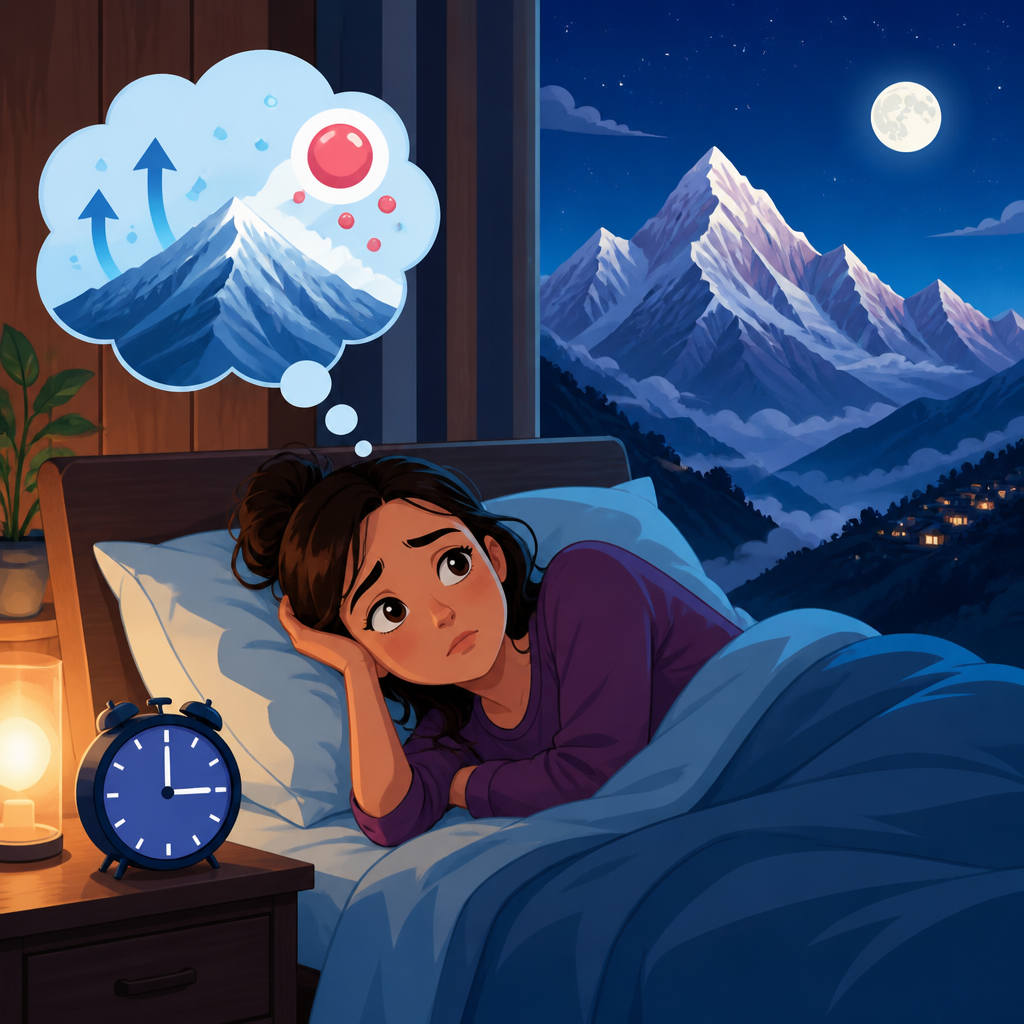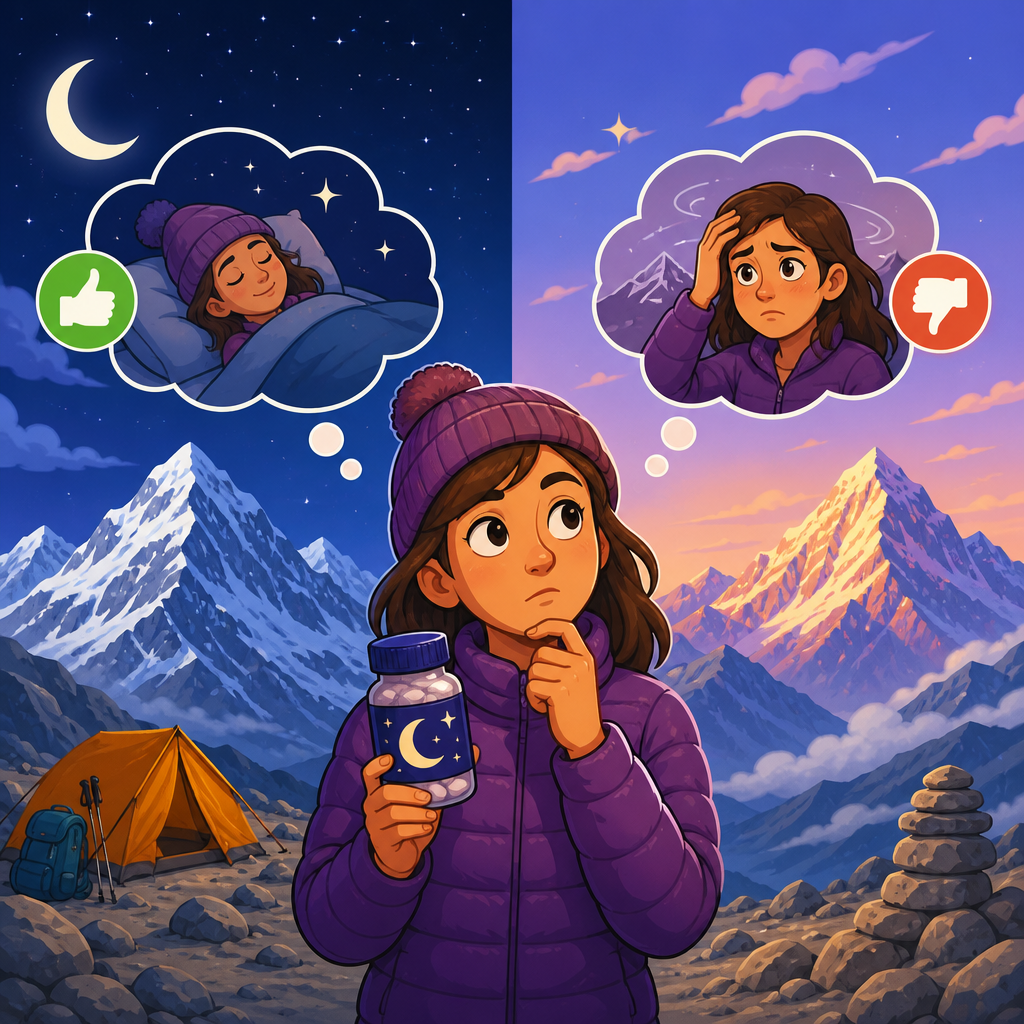
Melatonin at altitude can help or hurt depending on why you are taking it, how high you are sleeping, and whether your main problem is circadian timing, fragmented sleep, or symptoms of altitude illness. In mountain towns, high camps, and long-haul trips to trailheads, people often reach for melatonin because they know sleep usually gets worse as elevation rises. That instinct is understandable, but altitude sleep is not a single problem with a single fix. It is a mix of lower oxygen pressure, unstable breathing during sleep, travel-related circadian disruption, cold, dehydration, anxiety, and changes in training load.
Melatonin is a hormone produced by the pineal gland that signals biological night. It does not work like a classic sedative. Instead, it nudges the body clock and can modestly reduce sleep-onset latency, especially when sleep timing has been disrupted by east-west travel, late light exposure, or irregular schedules. At altitude, the question is more complicated because reduced oxygen can trigger periodic breathing, repeated awakenings, and lighter sleep architecture. A supplement that helps one person fall asleep faster may do little for another person whose sleep is being interrupted by respiratory instability every few minutes.
I have worked with runners, skiers, trekkers, and climbers who sleep well at sea level yet struggle above roughly 2,500 meters, and the pattern is consistent: the first nights are usually the worst, symptoms vary by individual, and the best solution starts with identifying the mechanism. If the issue is jet lag before an alpine objective, melatonin may be useful. If the issue is acute mountain sickness, a pounding headache, or severe periodic breathing, melatonin is not the primary tool. Understanding that distinction matters for safety, recovery, and performance.
This page is the hub for sleep and recovery within sleep, hydration, and nutrition because altitude sleep sits at the center of adaptation. Poor sleep raises perceived exertion, worsens mood, impairs appetite regulation, and can increase the chance of bad pacing decisions. It also interacts with hydration strategy, carbohydrate intake, and acclimatization planning. A practical approach therefore includes sleep timing, bedroom environment, caffeine cutoffs, alcohol limits, evening fueling, and when needed, medications or supplements chosen for the right reason.
Why sleep changes at altitude
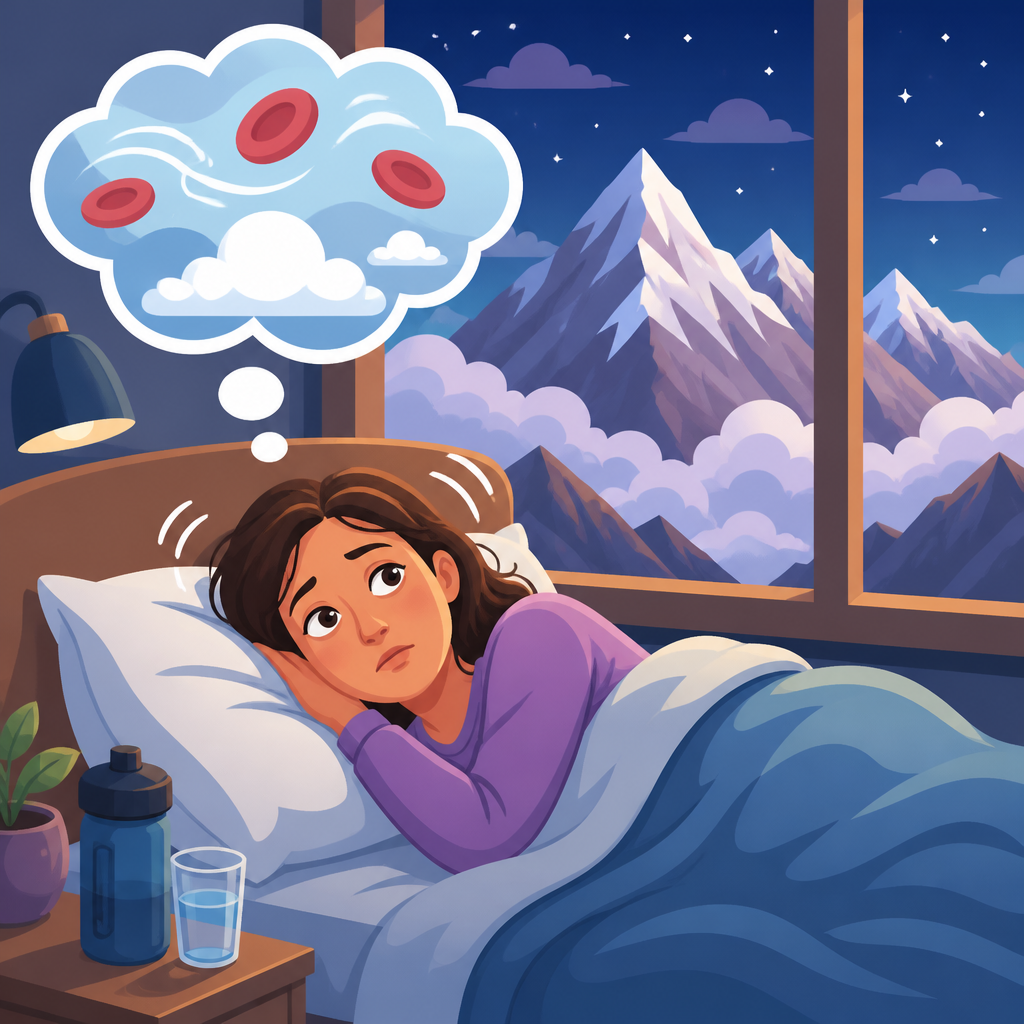
Altitude alters sleep mainly because the partial pressure of oxygen falls as elevation increases. Even if the percentage of oxygen in the air stays near 21 percent, each breath delivers less oxygen to the lungs. The body responds by increasing ventilation. During sleep, that response becomes unstable in many people, producing a waxing and waning breathing pattern called periodic breathing. The cycle can include brief pauses, drops in oxygen saturation, and micro-awakenings that fragment sleep.
Research on high-altitude sleep repeatedly shows lower sleep efficiency, more awakenings, and shifts in sleep stages, particularly during the first several nights at a new elevation. People often describe a strange combination of fatigue and inability to stay asleep. They may drift off normally, then wake after one or two hours with a racing heart or a sensation of needing a deep breath. Others feel as if they barely slept despite spending enough time in bed. These complaints are real and are not simply anxiety or unfamiliar lodging.
The effect size depends on altitude and individual susceptibility. Around 1,500 to 2,000 meters, many healthy travelers notice little change. Above 2,500 meters, sleep disruption becomes more common. Above 3,500 meters, it is common enough that it should be expected during early acclimatization. Cold, dry air, nasal congestion, and heavy training further worsen the picture. So does arriving dehydrated after a flight, driving late to a ski town, or drinking alcohol to “sleep better,” which often backfires by increasing awakenings and worsening oxygen dips later in the night.
What melatonin does, and what it does not do
Melatonin’s main jobs are to signal darkness and shift circadian timing. In plain terms, it tells your brain that nighttime has arrived. Supplemental melatonin is most useful when your internal clock and local clock are misaligned. That is why evidence is strongest for jet lag and delayed sleep timing. It can also shorten the time it takes to fall asleep in some adults, though the effect is usually modest rather than dramatic.
What melatonin does not reliably do is suppress the respiratory instability created by altitude. It is not an acclimatization drug. It does not treat acute mountain sickness. It does not raise oxygen saturation in a meaningful way. If your sleep is being shattered by periodic breathing, melatonin may help you feel sleepier at bedtime without fixing the reason you are waking up. In some people, that still feels beneficial. In others, it changes very little beyond making the first hour easier.
Dose matters. Many commercial products contain 5 to 10 milligrams, which is often far more than needed for circadian purposes. In clinical practice and travel settings, lower doses such as 0.3 to 1 milligram can be enough for timing effects, while 1 to 3 milligrams may be used for sleep onset. Higher doses can increase next-day grogginess, vivid dreams, or an overall hungover feeling, which is exactly what athletes and mountain travelers do not want before a summit push or technical descent.
When melatonin can help at altitude
Melatonin is most likely to help at altitude in three situations. First, when travel has disrupted your body clock. A runner flying from New York to Chamonix or Denver may face both jet lag and elevation. In that case, timed melatonin can reduce circadian mismatch while acclimatization handles the altitude side of the equation. Second, it can help travelers who are sleeping in a bright, noisy lodge or under unusually long summer daylight, where the normal evening melatonin rise is delayed by light exposure. Third, it may help people whose main complaint is difficulty falling asleep rather than repeated awakenings through the night.
A common real-world example is the weekend skier who drives from near sea level to 2,800 meters, arrives wired after six hours in the car, eats late, scrolls on a bright phone, and then lies awake in a dry condo. Here, a low dose of melatonin thirty to sixty minutes before the target bedtime may be reasonable, especially if paired with dimmer light, earlier food, and no alcohol. Another example is the climber who crossed eight time zones and must sleep at an alpine hut on the first night. Again, melatonin can address the travel timing problem, though it should not be mistaken for protection against altitude illness.
When melatonin can hurt, or at least be the wrong tool
Melatonin can hurt when it creates false confidence, masks a more important problem, or leaves you sedated for an early start. If you have headache, nausea, dizziness, or unusual fatigue after a rapid ascent, assume altitude illness first. Going to bed with a supplement instead of reassessing the ascent profile is poor risk management. Sleep disturbance is one symptom of acute mountain sickness, and the correct response may be rest, hydration with appropriate electrolytes, carbohydrate intake, pain control, slowing the climb, or descent depending on severity.
It can also be the wrong tool when the dominant issue is periodic breathing. In those cases, acetazolamide has much stronger evidence because it stimulates ventilation and reduces central apneas related to altitude. I have seen people report that melatonin “did nothing” at 3,600 meters, then sleep noticeably better once they used an acclimatization plan and, when appropriate, discussed acetazolamide with a clinician. Melatonin is also poorly suited to nights when alertness must be perfect before dawn. Even mild residual drowsiness can matter for driving, avalanche terrain, route finding, or glacier travel.
| Situation | Likely main problem | Is melatonin useful? | Better first priority |
|---|---|---|---|
| Jet-lagged arrival at 2,000 to 3,000 m | Circadian misalignment | Often yes | Timed light exposure and low-dose melatonin |
| First night above 3,500 m with repeated awakenings | Periodic breathing and acclimatization stress | Limited | Acclimatization plan; consider acetazolamide with clinician input |
| Headache, nausea, poor sleep after rapid ascent | Possible acute mountain sickness | No, not as primary treatment | Stop ascent, assess symptoms, descend if worsening |
| Bright lodge, late sunset, trouble falling asleep | Delayed melatonin release from light exposure | Possibly | Dim light, eye mask, earlier bedtime routine |
How to use melatonin more safely at elevation
If you choose to try melatonin at altitude, keep the strategy conservative. Start low, usually 0.3 to 1 milligram if the goal is body-clock adjustment, or 1 to 3 milligrams if the goal is falling asleep faster. Take it thirty to sixty minutes before the intended bedtime, not in the middle of the night before an alpine start. Use a reputable brand that has third-party testing through programs such as USP, NSF Certified for Sport, or Informed Sport, because melatonin content in supplements can vary substantially from the label.
Timing is as important as dose. Melatonin taken too late can push sleep inertia into the morning. That is especially problematic in the mountains, where people often wake before sunrise and make critical decisions quickly. I recommend trialing it at home before a trip so you know how you respond. Some people feel normal the next morning; others get vivid dreams, brain fog, or a heavy feeling that is hard to shake even after coffee and breakfast.
You also need to review interactions and contraindications. Melatonin can amplify drowsiness when combined with alcohol, antihistamines, certain sleep medications, or cannabis. It may interact with anticoagulants, immune-modulating therapies, and some seizure or blood pressure medications. Pregnant travelers, adolescents, and anyone with a complex medical history should talk to a clinician rather than self-experiment at a remote trailhead. Natural does not automatically mean risk free.
The broader sleep and recovery plan for altitude
The best altitude sleep strategy is layered. Acclimatization comes first: ascend gradually, limit the first-day effort, and if possible sleep lower than the highest point reached. Hydration matters, but overdrinking does not fix altitude and can disturb sleep through frequent urination. Aim for steady fluid intake earlier in the day, plus sodium appropriate to sweat loss. Eat enough carbohydrate in the evening, because low glycogen and under-fueling increase stress hormones and make sleep more fragile. A simple dinner of rice, potatoes, pasta, soup, and lean protein often works better than a huge fatty meal.
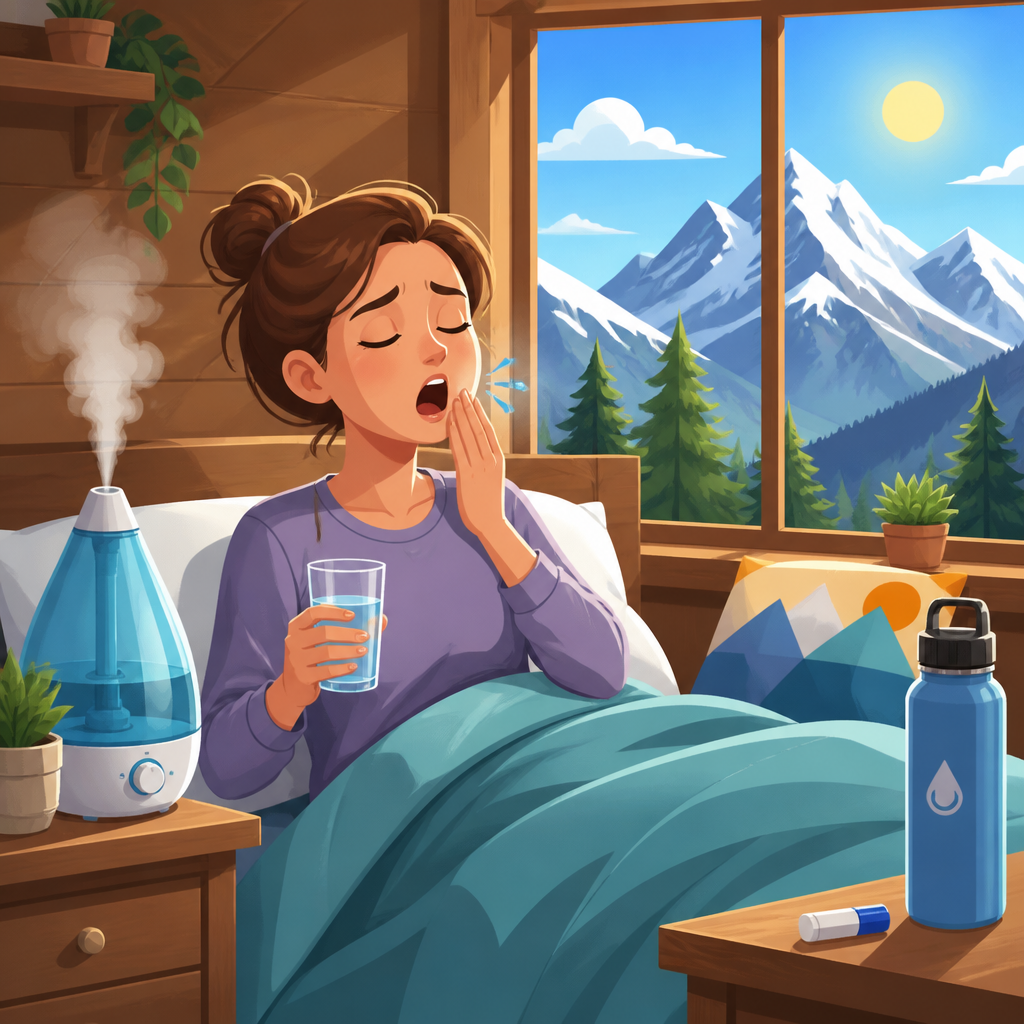
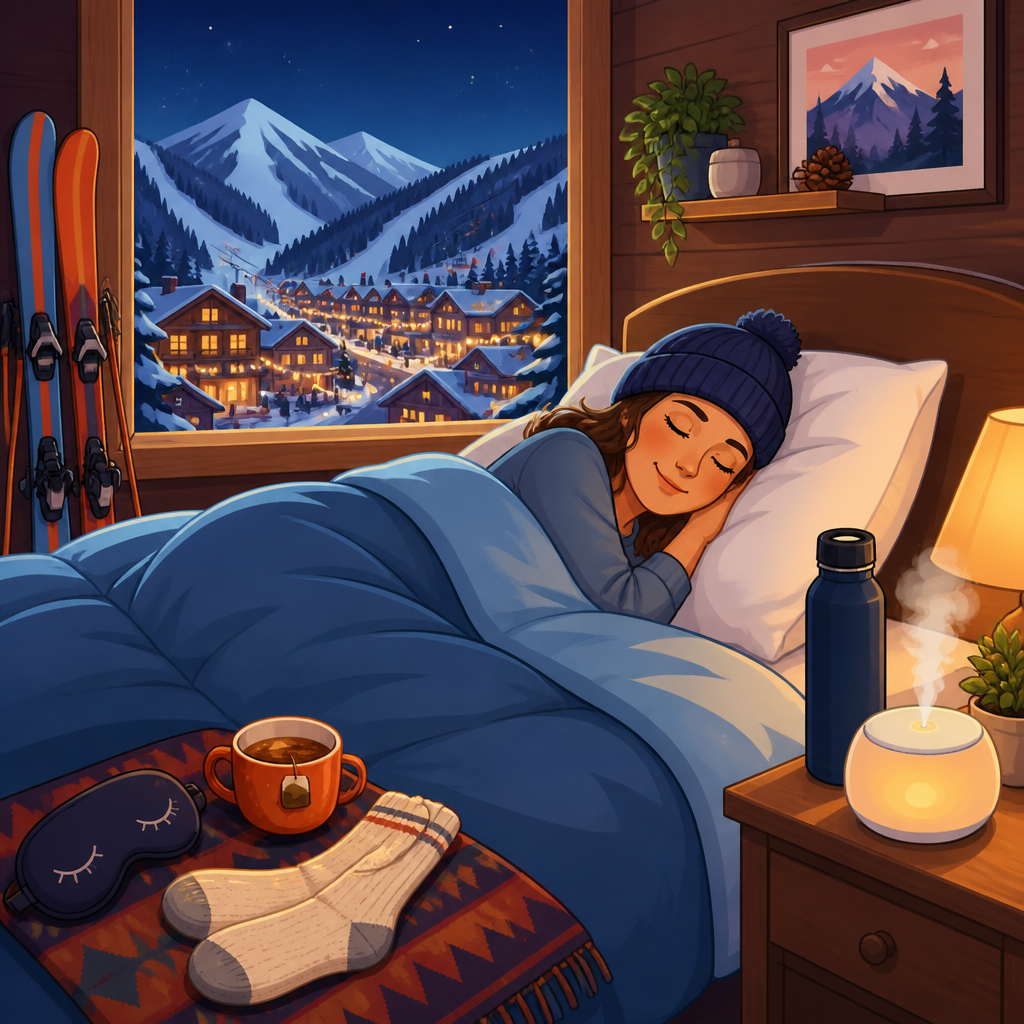
Protect the sleep environment aggressively. Use a humidifier if available, saline spray for dry nasal passages, earplugs for shared huts, and an eye mask during long summer daylight. Keep the room cool but not cold. Cut caffeine by early afternoon if you are sensitive, and avoid using alcohol as a sleep aid. Alcohol may make you sleepy initially, but it fragments sleep later and can worsen breathing instability. For athletes in training camps, reduce evening intensity and leave enough time between the last hard session and bedtime.
This hub connects naturally to the rest of sleep and recovery. If nighttime urination is waking you, review hydration timing rather than simply blaming altitude. If you wake hungry at 2 a.m., examine total energy intake and post-exercise fueling. If your resting heart rate stays elevated for days, the issue may be accumulated fatigue rather than melatonin deficiency. Good recovery at altitude is rarely about one pill. It is about matching the tool to the mechanism and supporting adaptation from multiple angles.
Bottom line: does melatonin help or hurt?
Melatonin helps at altitude when the main problem is circadian disruption, bright-light exposure, or difficulty falling asleep. It hurts when it replaces better judgment, masks evolving altitude illness, or leaves you groggy when alertness is essential. It is not a cure for periodic breathing, poor acclimatization, or acute mountain sickness. Those conditions require a different response, and in many cases the most effective intervention is a slower ascent or descent, not another supplement.
For most healthy adults, the practical takeaway is simple. If you already tolerate melatonin well, a low dose may be useful on the first nights of travel to altitude, especially after crossing time zones. Keep the dose conservative, take it early enough, and pair it with strong sleep hygiene. If your symptoms include repeated gasping awakenings, significant headache, nausea, or unusual shortness of breath, shift attention away from melatonin and toward acclimatization, symptom assessment, and medical guidance when needed.
Sleep and recovery at altitude improve fastest when you treat them as a system. Control light, timing, food, fluids, effort, and ascent profile first; then consider melatonin as a targeted add-on rather than a blanket solution. Use that framework on your next mountain trip, and you will make better decisions, recover more fully, and sleep with fewer surprises.
Frequently Asked Questions
Does melatonin help you sleep better at altitude?
Melatonin can help at altitude, but whether it is useful depends on what is actually disrupting your sleep. If your main issue is circadian timing, such as crossing time zones on the way to a mountain trip, arriving late after a long travel day, or struggling to fall asleep at a normal local bedtime, melatonin may be beneficial because it helps signal to the brain that it is time to sleep. In that setting, it can make sleep onset easier and may improve the feeling of being “wired but tired” after travel.
If the problem is altitude-related sleep fragmentation, the picture is more complicated. At higher elevations, sleep often worsens because lower oxygen pressure changes breathing patterns during the night. Many people experience frequent awakenings, lighter sleep, restless breathing, or periodic breathing, where breathing cycles between deeper breaths and brief pauses. Melatonin does not correct the low-oxygen environment, so it may not do much for those repeated physiological disruptions. In some cases, a person may fall asleep a little faster but still wake up repeatedly through the night.
That is why melatonin is best thought of as a targeted tool rather than a general altitude sleep cure. It may help if your problem is schedule-related or mild sleep-onset insomnia, but it is less reliable if poor sleep is being driven by altitude illness, unstable breathing, headache, nausea, or a camp sleeping setup that is cold, noisy, or uncomfortable. In practical terms, melatonin may help some travelers at moderate elevation, but it should not be expected to solve every kind of sleep problem that shows up higher in the mountains.
Can melatonin make altitude sickness worse?
Melatonin is not generally considered a direct cause of altitude sickness, but it can be a poor fit if it masks symptoms or creates confusion about what is happening overnight. Acute mountain sickness typically involves headache, nausea, loss of appetite, fatigue, dizziness, and poor sleep after ascent. If someone takes melatonin, feels groggy, and then assumes that their symptoms are just from the supplement or from a “bad night,” they may overlook early signs that they are not acclimatizing well. That is one of the main ways melatonin can indirectly hurt rather than help.
Another issue is that melatonin does not treat the underlying mechanisms of altitude illness. If someone is sleeping poorly because they are breathing abnormally at night, developing a worsening headache, or feeling short of breath, using melatonin as the main strategy can delay more effective action. Depending on the situation, that action may include slowing ascent, hydrating appropriately, resting, using proven altitude medications when indicated, or descending. A sleep aid should never substitute for recognizing a deteriorating altitude response.
There is also a practical performance concern. Melatonin can leave some people with residual sleepiness, slowed reaction time, or a “hangover” feeling the next morning, especially if they take too much or use it at the wrong time. In the mountains, that can matter. Early starts, driving rough roads, moving on exposed terrain, and making route decisions all require alertness. So while melatonin does not necessarily worsen the physiology of altitude sickness, it can complicate symptom interpretation and next-day functioning, which is why it should be used thoughtfully rather than automatically.
When is melatonin most useful during mountain travel or sleeping at high camp?
Melatonin is most useful when the main challenge is body-clock disruption rather than altitude illness itself. A common example is a traveler who flies across multiple time zones, drives late to a trailhead, and then tries to sleep at a local bedtime that does not match their internal clock. In that case, melatonin may help shift sleep timing and reduce the time it takes to fall asleep. It can also be useful for people who know from prior trips that the first night is often difficult because of excitement, travel fatigue, and a temporarily delayed sleep schedule.
It may also be reasonable at moderate elevations when symptoms are mild and the person otherwise feels well. Someone sleeping in a mountain town or a lower acclimatization stop may benefit if they are not dealing with a severe headache, nausea, significant shortness of breath, or obvious signs of worsening altitude stress. In these settings, melatonin can be one piece of a broader sleep strategy that includes limiting alcohol, keeping the sleeping area dark and warm, maintaining a realistic bedtime, and allowing time to acclimatize gradually.
It is less useful as elevation increases and sleep disruption becomes more driven by unstable breathing and low oxygen exposure. At high camp, especially if someone is waking repeatedly gasping, developing altitude symptoms, or feeling markedly worse each night, melatonin should not be the central solution. The better question at that point is whether the sleeping altitude is too aggressive, whether additional acclimatization is needed, and whether the person is safe to remain there. In other words, melatonin works best for timing problems and mild sleep initiation trouble, not as a fix for the deeper physiologic stress of a hard ascent.
How do you know if your altitude sleep problem is circadian, fragmented sleep, or altitude illness?
The easiest way to sort this out is to look at the pattern. Circadian sleep problems usually show up as trouble falling asleep at the desired local bedtime, particularly after travel, late exposure to bright light, or a schedule shift. You may feel awake even though you are tired, then sleep more normally once you finally drift off. If that sounds familiar, melatonin may be more likely to help because the issue is timing.
Fragmented altitude sleep looks different. You may fall asleep without much trouble but wake up over and over, feel like your breathing is irregular, notice episodes of suddenly becoming more alert, or wake feeling unrefreshed despite spending enough time in bed. This kind of sleep disruption is common as elevation rises because lower oxygen pressure alters nighttime respiration. Melatonin may help only marginally here, since it does not address the breathing instability that often drives the awakenings.
Altitude illness adds another layer. If poor sleep comes with headache, nausea, unusual fatigue, dizziness, reduced appetite, or worsening exercise tolerance after ascent, it is important to think beyond “insomnia.” Those symptoms suggest that the problem is not just a shifted body clock or a normal rough night in the mountains. In that situation, the priority is assessing acclimatization status and overall safety. A useful rule of thumb is this: if the main complaint is “I cannot fall asleep,” think circadian timing; if it is “I keep waking up all night,” think fragmented altitude sleep; if it is “I feel sick and sleep is bad too,” think possible altitude illness. That distinction helps determine whether melatonin is likely to help, do very little, or distract from a more important problem.
What are the biggest mistakes people make when using melatonin at altitude?
One common mistake is treating melatonin like a general sleeping pill for any mountain night that goes badly. At altitude, sleep can deteriorate for very different reasons, including low oxygen, periodic breathing, headache from acute mountain sickness, dehydration, cold exposure, noise, and anxiety about the next day. If you use melatonin without asking what the real cause is, you may end up taking something that does not solve the problem and gives you false confidence that you have addressed it.
Another major mistake is taking too much or taking it at the wrong time. More is not necessarily better with melatonin. Excessively high doses can leave people groggy, vivid-dreaming, disoriented, or sluggish the next morning. That is a real concern before alpine starts, long drives, technical climbing, or any activity where judgment and coordination matter. Timing matters too. Melatonin works best as a signal to the circadian system, not simply as a sedative used randomly in the middle of the night. Poor timing can make sleep timing less predictable and may worsen next-day alertness.
A third mistake is using melatonin while ignoring warning signs that call for a different response. If someone is getting progressively worse at altitude, cannot sleep because of shortness of breath, or develops classic symptoms of acute mountain sickness, the answer is not just another sleep aid. The answer may be a slower ascent, a rest day, medication specifically used for altitude in appropriate cases, or descent. Finally, people often overlook the basics: warm gear, reduced alcohol use, a reasonable ascent profile, and enough time to acclimatize. Melatonin can be useful in a narrow role, but it works best when it supports good altitude practices rather than trying to replace them.