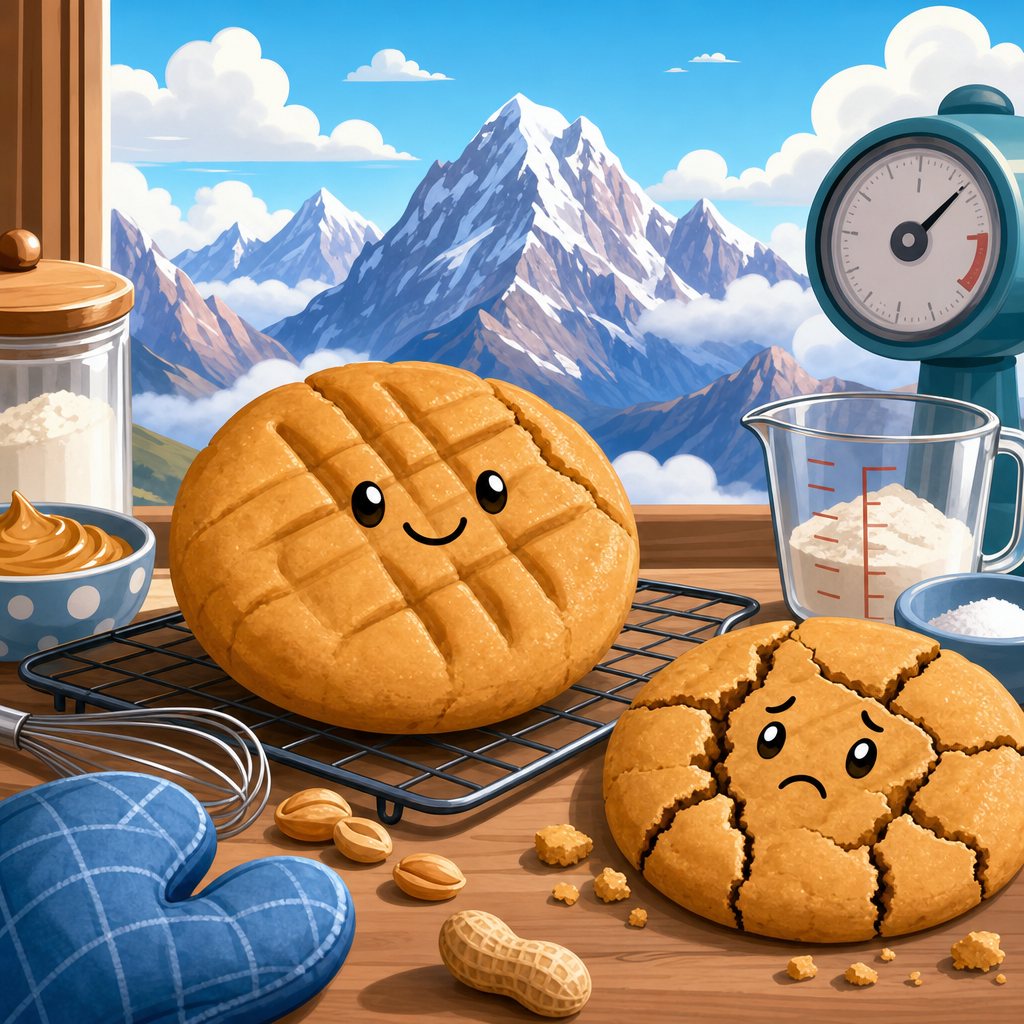
Peanut butter cookies at altitude crack more easily because reduced air pressure changes how moisture evaporates, how sugars concentrate, and how leavening gases expand during baking. In mountain kitchens, a dough that behaves perfectly at sea level can spread too fast, set too late, and lose interior moisture before the structure stabilizes. That combination creates deep fissures, dry edges, and cookies that look rugged when you wanted a smooth, tender finish. I have tested peanut butter cookies for clients and home bakers from Denver to Leadville, and the same pattern appears repeatedly: cracking is rarely one isolated mistake. It is usually the result of several small altitude effects stacking together.
In practical terms, altitude baking usually means baking above 3,000 feet, with stronger adjustments often needed past 5,000 and 7,500 feet. Peanut butter cookies deserve special attention because peanut butter is already a low-moisture, high-fat ingredient, and classic formulas often rely on a high sugar load plus a press-and-bake shape. Those traits make them especially sensitive to overexpansion and surface drying. This hub page explains how to stop cracking, but it also serves as your guide to cookies and bars at altitude more broadly, because the same principles govern crinkle cookies, blondies, brownies, shortbread bars, oatmeal cookies, and pan bakes. Once you understand the mechanics, you can diagnose almost any batch with confidence.
Three terms matter most. Structure comes from flour, egg proteins, and in some recipes starch gelatinization. Spread is how far dough relaxes and flows before the cookie sets. Surface set is the moment the outer layer firms enough to contain the interior. At altitude, steam escapes faster, gases from baking soda and baking powder expand more aggressively, and dough often needs either more moisture, less leavener, a slightly hotter oven, or a shorter bake to keep the surface from tearing. The goal is not to eliminate all texture. Peanut butter cookies traditionally have some craggy character. The goal is to control cracking so the cookie stays tender, attractive, and consistent batch after batch.
Why peanut butter cookies crack at altitude
The most direct answer is that the top dries and firms while the inside is still rising and pushing outward. Lower atmospheric pressure means water boils at a lower temperature, so moisture leaves the dough more readily. Meanwhile, carbon dioxide from baking soda and steam from the dough expand faster than they do at sea level. If the exterior sets before the interior finishes expanding, the crust splits. In peanut butter cookies, that risk is amplified because peanut butter contributes fat and solids but not much free water. Dough can look rich and soft in the bowl yet still bake up dry on the surface.
Sugar also plays a role. Granulated sugar attracts water and influences spread, browning, and surface texture. At altitude, a high-sugar cookie can spread quickly, then lose moisture just as quickly, especially in a dry climate common to mountain regions. Brown sugar helps because it contains molasses and holds moisture better than white sugar alone. So does adding egg yolk, milk, or a small amount of extra flour only when spread is excessive. Cracking is not always caused by too little flour. Very often it starts with too little retained moisture or too much lift relative to structure.
Another common cause is overaeration during mixing. When you cream butter and sugar aggressively, you build air pockets into the dough. At sea level, that may create a lighter cookie. At altitude, those pockets expand more dramatically in the oven. Combined with baking soda, the result can be a cookie that domes, fractures, then collapses into dry ridges. I usually mix peanut butter cookie dough only until combined and cohesive rather than chasing a fluffy creamed texture. That one change often reduces random cracking more than people expect.
Core adjustments that stop cracking
Start with leavening. If a recipe uses baking soda, reduce it modestly at altitude rather than eliminating it. A practical range is reducing by about 1/8 teaspoon per teaspoon once you are around 5,000 feet, then evaluating from there. Too much reduction can leave cookies dense, greasy, and flat, but too little encourages blowout. Baking powder tends to need similar caution, though peanut butter cookies more often rely on soda because of the acidity in brown sugar and other ingredients. Keep in mind that natural peanut butter and conventional stabilized peanut butter do not behave identically. Natural styles can be looser and oilier, which may require extra chilling and slightly different flour balance.
Next, increase moisture retention. An extra egg yolk, one to two tablespoons of milk, or a partial swap from white sugar to brown sugar can make a visible difference. Brown sugar is especially useful because it softens texture and slows surface drying. If your cookies crack deeply and taste dry, adding moisture is usually more effective than simply lowering the oven temperature. Counterintuitive as it sounds, altitude bakers often benefit from a slightly higher oven temperature so the cookie sets sooner and loses less internal moisture overall. A 15 to 25 degree Fahrenheit increase is a common starting point, followed by a shorter bake.
Chilling is another high-value fix. Resting dough for at least 30 minutes lets flour hydrate and firms the fat, slowing early spread. In my testing, chilled peanut butter dough produces more even edges and shallower cracks than warm dough scooped straight after mixing. Chill matters even more with natural peanut butter or recipes containing melted butter. Do not rely on chilling alone, though. If the formula is fundamentally too dry or too leavened for altitude, cold dough may still crack once the center expands.
| Problem | Likely altitude cause | Best first adjustment |
|---|---|---|
| Deep surface cracks | Exterior setting before interior expansion finishes | Reduce leavener slightly and add 1 egg yolk or 1 tablespoon milk |
| Dry, crumbly cookie | Too much moisture loss during bake | Increase brown sugar, shorten bake, raise oven 15 degrees |
| Cookie spreads too much then cracks | Fat too warm or structure too weak | Chill dough and add 1 to 2 tablespoons flour if needed |
| Domed cookie with burst top | Overaeration and excess leavening | Mix less and reduce baking soda |
| Greasy, dense cookie | Leavening reduced too far or formula unbalanced | Restore some soda and verify peanut butter type |
Best ingredient choices for altitude cookie success
Peanut butter type changes everything. Conventional peanut butter, such as Jif or Skippy, contains stabilizers that create a more predictable dough. Natural peanut butter can absolutely work, but it must be thoroughly stirred and often performs better after refrigeration. If oil separation is not fully reincorporated, one scoop of dough may bake dry and another may spread excessively. For a reliable altitude baseline, start with conventional peanut butter, then adapt once the rest of the formula is stable.
Flour deserves equal attention. All-purpose flour remains the default for most peanut butter cookies, but protein content varies by brand. King Arthur all-purpose flour is around 11.7 percent protein, while many mainstream all-purpose flours are lower. At altitude, slightly higher protein can help with structure and reduce uncontrolled spread, but too much can toughen the cookie. If you routinely bake in a very dry mountain climate, weighing flour is better than measuring by cup. A small overpour by volume can turn a tender cookie sandy fast, especially in nut-butter doughs.
Eggs help bind, emulsify, and retain moisture. When cookies crack and crumble, adding an extra white is not always the best move because whites can tighten structure and dry the perception of the crumb. An extra yolk is usually more effective. Fat choice matters too. Butter brings flavor and spread; shortening limits spread and can produce a smoother surface. For peanut butter cookies at altitude, an all-butter dough can work, but a blend of butter and shortening often gives the best control. If your goal is minimal cracking and soft centers, this blend is worth testing.
Mixing, shaping, and baking methods that matter
How you mix the dough directly affects cracking. Creaming butter and sugar until pale and fluffy is standard in many cookies, yet at altitude it can add more trapped air than you want. For peanut butter cookies, mix butter, peanut butter, and sugars until smooth, then add eggs and dry ingredients only until incorporated. Scrape the bowl thoroughly so you do not compensate with overmixing. This restrained method creates a denser, more uniform dough that expands predictably.
The classic fork crosshatch is useful because it pre-flattens the dough and reduces the need for dramatic oven spread. However, pressing too hard thins the edges and encourages overbaking. I aim for discs about 1/2 inch thick with gentle pressure. Uniform size is critical. If one tray contains both 20-gram and 35-gram portions, smaller cookies will dry before larger ones finish setting, making troubleshooting nearly impossible. A #40 or #50 scoop gives much better consistency than eyeballing portions by hand.
Oven management is often overlooked. Most home ovens run hot or cycle unevenly, and altitude magnifies those inconsistencies. Use an oven thermometer. Bake one tray at a time in the center unless you have verified even performance with a convection setting. Parchment usually outperforms dark greased sheets because dark pans brown faster and can set the bottoms too early. Pull cookies when edges are set and centers still look slightly soft. Carryover heat finishes them. Waiting for a dry-looking center in the oven is a reliable way to get cracked tops and crumbly interiors.
How these principles apply across cookies and bars
This page is the hub for cookies and bars at altitude because peanut butter cookies teach the core logic behind the whole category. Crinkle cookies crack intentionally, but if the fissures are too wide or the interior is dry, the same fixes apply: reduce leavening, improve moisture retention, and manage surface set. Oatmeal cookies often need less leavener and more chilling. Chocolate chip cookies may need a bit more flour or a temperature increase to control spread. Sugar cookies can benefit from less aeration and careful pan choice. The diagnosis always starts with the same questions: Did the dough lose moisture too quickly? Did it expand too fast? Did the structure set in time?
Bars and pan cookies behave differently because the pan supports the batter, but altitude still changes moisture balance and rise. Brownies may dome and sink if overleavened. Blondies can turn cakey if too much air is beaten in. Shortbread bars often need little adjustment beyond watchful baking because they contain minimal leavening, yet they can still dry out in mountain climates. Magic bars, lemon bars, and cheesecake bars each present different challenges, but surface drying and rapid evaporation remain central themes. Once bakers understand that altitude accelerates both expansion and moisture loss, recipe adaptation becomes far less mysterious.
For internal site organization, cookies and bars should be treated as linked problem-solving content rather than isolated recipes. A strong sub-pillar cluster would include altitude chocolate chip cookies, brownies that do not sink, blondies that stay chewy, oatmeal cookies that do not overspread, and bar cookies with clean slices. Peanut butter cookies belong at the center because they clearly reveal the interaction between fat, sugar, protein, and leavening. If a baker can fix cracking here, they can transfer that judgment to most drop cookies and many bar formulas.
Troubleshooting by symptom, not by guesswork
The fastest way to improve results is to change one variable at a time and read the cookie accurately. If the cookie has deep cracks but good flavor, start by reducing baking soda slightly. If it is cracked and dry, add moisture before adding more flour. If it spreads into a thin brittle round, chill the dough, verify butter temperature, and consider a small flour increase. If it stays thick and greasy, you may have reduced leavening too much or used a very oily natural peanut butter. Keep notes on altitude, pan, oven temperature, dough temperature, and brand of peanut butter. Those details matter more than most people realize.
A final point: some cracking is desirable in traditional peanut butter cookies, especially on hand-pressed doughs. The aim is controlled cracking, not a perfectly smooth bakery-style top at all costs. The best altitude peanut butter cookie has modest fissures, crisp edges, a tender center, and a balanced peanut flavor that is not dulled by excess flour. The route there is consistent: slightly less leavening, slightly better moisture retention, restrained mixing, proper chilling, and an oven hot enough to set the cookie before it dehydrates.
If you bake cookies and bars at altitude regularly, treat every batch as useful data. Start with one dependable peanut butter cookie formula, adjust methodically, and use what you learn across the rest of the category. That approach saves ingredients, shortens the learning curve, and delivers better texture than random trial and error. For your next batch, pick one change from this guide, measure carefully, and compare the results. Small, evidence-based adjustments are how mountain bakers stop cracking and produce cookies worth repeating.
Frequently Asked Questions
Why do peanut butter cookies crack more at high altitude than they do at sea level?
At high altitude, the lower air pressure changes the way cookie dough behaves from the moment it goes into the oven. Moisture evaporates faster, so the outside of the cookie can dry and set before the center has finished expanding. At the same time, leavening gases from baking soda, baking powder, trapped air, and steam expand more readily, which pushes upward and outward on a surface that is already becoming firm. That mismatch is a major reason peanut butter cookies develop deeper, rougher cracks in mountain baking.
Peanut butter cookies are especially prone to this because peanut butter is naturally dense, high in fat, and relatively low in water compared with many other cookie doughs. If the dough loses moisture too quickly, it can become crumbly at the edges while the interior still tries to rise and spread. Sugar concentration also increases faster at altitude as water cooks off, which can alter how the surface sets and encourage fissures. In other words, cracking is not usually caused by one single mistake. It is the result of faster evaporation, quicker surface drying, and stronger expansion all happening before the structure has time to stabilize smoothly.
What is the best way to adjust a peanut butter cookie recipe at altitude to reduce cracking?
The most reliable approach is to make several small, controlled adjustments instead of one dramatic change. First, reduce the leavening slightly, especially if the recipe already uses a generous amount of baking soda or baking powder. At altitude, those gases expand more aggressively, so a small reduction can help prevent the cookies from ballooning and splitting before the crumb sets. Second, consider increasing moisture modestly by adding a little extra egg, an extra yolk, or a small amount of liquid if the dough seems dry. This helps the cookies stay flexible longer as they bake.
Third, many bakers get better results by slightly increasing the oven temperature while shortening the baking time just a bit. That sounds counterintuitive, but it can help the cookie structure set sooner and more evenly so the dough does not overspread and dry out before it holds itself together. Fourth, watch the sugar and fat balance. Too much sugar can encourage rapid spread and stronger surface cracking, while too much fat can make the dough collapse and dry around the edges. Finally, chill the dough before baking. Chilling gives the flour time to hydrate, firms the fat, slows early spread, and often produces a more controlled rise with a smoother surface. For altitude baking, small recipe tweaks plus dough temperature control usually make the biggest difference.
How does dough consistency affect cracking in peanut butter cookies at altitude?
Dough consistency is one of the biggest predictors of whether your cookies will bake up smooth or rugged. If the dough is too dry, it has less flexibility as it expands in the oven, so the surface breaks more easily. Dry dough also tends to produce cookies with crumbly edges, a rough top, and a texture that feels sandy instead of tender. At high altitude, even a dough that seemed normal when mixed can behave as if it were drier once baking begins, simply because moisture escapes faster in the oven.
On the other hand, dough that is too soft can also contribute to cracking, just in a different way. A very soft peanut butter dough may spread too quickly before it sets, thinning the structure and creating uneven expansion. That rapid spread can leave the center rising against a weakened surface, which leads to large fissures rather than fine, controlled cracking. The goal is a dough that is soft but cohesive, easy to scoop, and not greasy or crumbly. If your dough falls apart when pressed, it may need more moisture or more mixing to fully combine. If it looks shiny, slack, or overly loose, it may need chilling or a slight flour adjustment. At altitude, texture matters as much as ingredient ratios, because the oven magnifies every small imbalance.
Should I chill peanut butter cookie dough before baking at high altitude?
Yes, in most cases chilling is one of the simplest and most effective ways to reduce excessive cracking at altitude. Chilling firms the fats in the dough, which slows down the initial spread during the first minutes of baking. That delay is helpful because it gives the dough more time to set in a controlled way instead of rushing outward and losing moisture too fast. Chilled dough also hydrates more evenly as it rests, which means the flour and other dry ingredients absorb moisture more completely. A well-hydrated dough is less likely to split harshly as it expands.
Chilling is especially useful for peanut butter cookies because peanut butter can make dough feel soft, oily, or fragile even when the ingredient amounts are correct. Resting the dough in the refrigerator helps create a more stable texture and often improves both shape and flavor. If you have been getting cookies with deep cracks, dry rims, and uneven tops, chilling for even 30 minutes can improve the result. Longer chilling, such as 1 to 24 hours, may help even more, depending on the recipe. The key is consistency: scoop the dough evenly, chill it thoroughly, and bake on a fully preheated oven so the cookies set predictably. At altitude, temperature control before baking is often just as important as what happens during baking.
What baking mistakes make altitude peanut butter cookies crack worse, and how can I avoid them?
Several common mistakes can make cracking much worse in mountain kitchens. One of the biggest is using the sea-level recipe exactly as written without testing adjustments. What worked perfectly at lower elevation may have too much leavening, too much sugar, or not enough moisture once you bake it higher up. Another frequent problem is overbaking. Because moisture leaves cookies faster at altitude, even an extra minute or two can turn a tender cookie into one with dry edges and pronounced surface breaks. Pulling the cookies when the centers still look slightly soft usually gives a better final texture than waiting for them to look fully done on the sheet.
Other issues include using an oven that runs hot, failing to chill soft dough, and pressing the cookies too thin before baking. Peanut butter cookies are often patterned with a fork, but flattening them too much can encourage rapid edge setting and uneven cracking as the center expands. Inaccurate measuring is another hidden culprit, especially with flour. Too much flour makes the dough stiff and more likely to split, while too little can cause excessive spread followed by collapse and rough surfaces. To avoid these problems, measure carefully, bake a test batch first, adjust one variable at a time, and pay attention to dough feel as much as the written formula. At altitude, the best cookies usually come from observation and fine-tuning, not from following a recipe blindly.