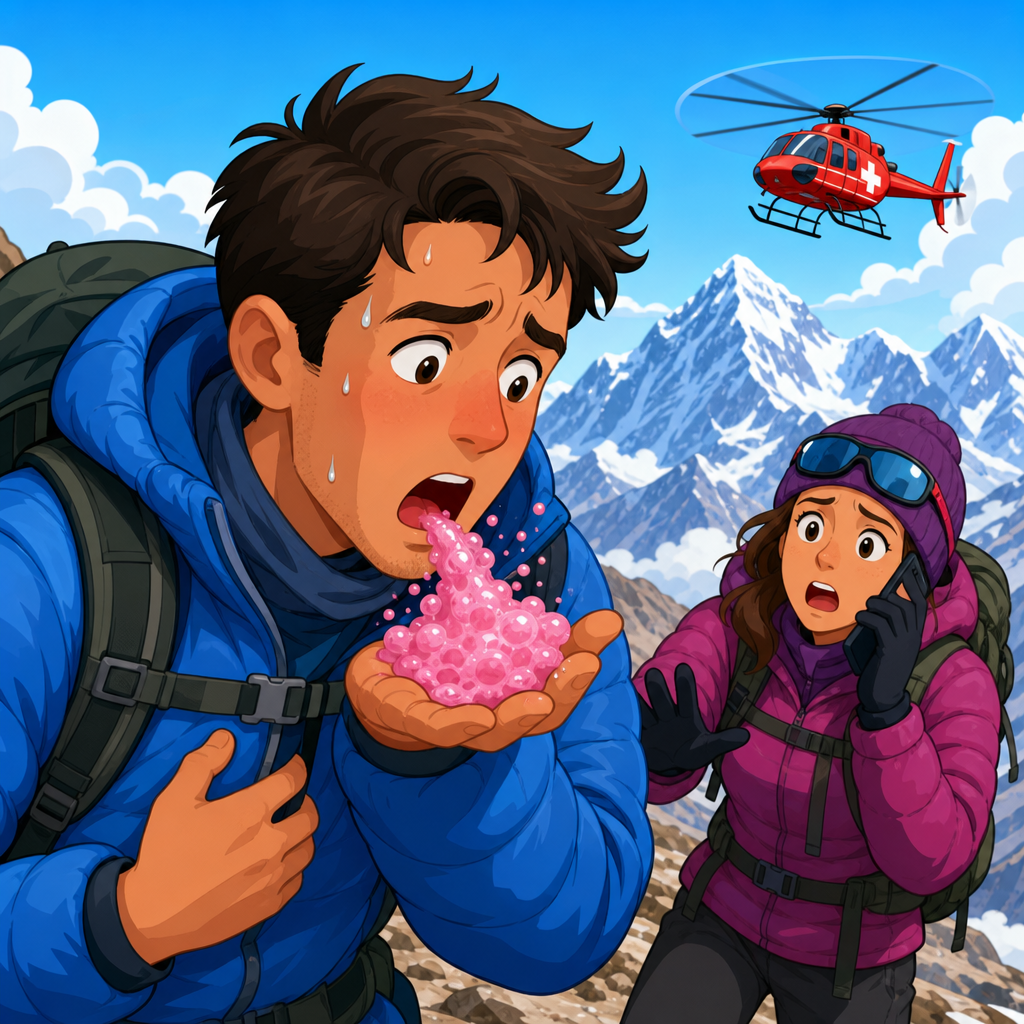
Pink frothy sputum at altitude is a red-flag sign of high-altitude pulmonary edema, usually called HAPE, and it should be treated as a life-threatening emergency requiring immediate descent and urgent medical care. HAPE is a form of noncardiogenic pulmonary edema that develops when low oxygen at high elevation triggers intense constriction in the lung circulation, raising pulmonary artery pressure and forcing fluid and blood cells across the alveolar-capillary membrane into the air spaces. When that fluid mixes with air and a small amount of blood, the cough can produce the classic pink frothy sputum that climbers, guides, and expedition medics recognize as a late and dangerous finding.
I have seen altitude illness progress from mild breathlessness to severe respiratory distress with unsettling speed, especially after a rapid ascent, a hard summit push, or a night spent sleeping higher than planned. The reason this topic matters is simple: HAPE can be fatal within hours if people keep ascending, dismiss symptoms as a chest cold, or try to “push through” because the group itinerary feels important. Unlike ordinary shortness of breath from exertion, HAPE causes breathlessness out of proportion to activity, worsening cough, reduced exercise tolerance, low oxygen saturation, and eventually trouble breathing even at rest. Pink frothy sputum is not an early clue; it usually means the lungs are already filling with edema fluid.
As a hub article for altitude illness and acclimatization, this guide explains what HAPE is, why pink frothy sputum appears, how to recognize the full symptom pattern, who is at risk, what immediate treatment is recommended, and how prevention works. If you remember one point, remember this: at altitude, a cough producing pink frothy sputum is never something to monitor casually overnight. Descend now, give supplemental oxygen if available, reduce exertion completely, and arrange evacuation. Those steps save lives.
What HAPE is and why pink frothy sputum appears
HAPE occurs most often above about 2,500 to 3,000 meters, although susceptible people can develop it lower and many cases appear around 3,000 to 4,500 meters after fast ascent. The mechanism is different from heart-failure-related pulmonary edema. In HAPE, the trigger is hypoxia. Low oxygen causes hypoxic pulmonary vasoconstriction, a normal response meant to redirect blood flow toward better-ventilated areas of the lung. At altitude, that response can become uneven and exaggerated. Some vessels constrict strongly while others remain more open, so blood is driven at high pressure into parts of the lung that cannot tolerate the load. The capillary wall experiences stress failure, and protein-rich fluid leaks into the alveoli.
That leak explains the symptom progression. Early on, people notice a dry cough, unusual breathlessness when walking uphill, and reduced pace compared with others. As edema worsens, gas exchange drops, oxygen saturation falls, and the cough becomes wetter. Crackles may be heard in one or both lungs, often starting in the right middle lobe region. By the time sputum turns pink and frothy, fluid is mixing with surfactant and small amounts of blood from capillary injury. This finding is alarming because it signals significant alveolar flooding, not a minor irritation from cold air or dehydration.
Real-world confusion happens because trekkers often expect altitude illness to mean headache, nausea, and dizziness, which are more typical of acute mountain sickness. HAPE may begin without much headache at all. I have evaluated climbers whose only initial complaint was that they were suddenly the slowest person on a familiar slope. They blamed poor sleep, a heavy pack, or a lingering viral cough. Hours later they were panting at rest in the tent. That pattern is why HAPE demands respect: the disease can hide behind ordinary explanations until it abruptly becomes unmistakable.
Symptoms, warning signs, and how HAPE differs from normal altitude breathlessness
The most useful way to recognize HAPE is to compare symptoms against what is expected for the elevation and exertion level. Normal altitude breathlessness improves quickly with rest. HAPE breathlessness persists, worsens overnight, and appears during easier and easier tasks. Typical symptoms include decreased exercise performance, unusual fatigue, dry cough progressing to productive cough, chest tightness, rapid heart rate, rapid breathing, and low oxygen saturation for the elevation. Advanced signs include shortness of breath at rest, inability to lie flat comfortably, audible crackles or gurgling, cyanosis, confusion from hypoxemia, and pink frothy sputum.
People often ask whether a pulse oximeter can diagnose HAPE. The answer is no, but it can support the clinical picture. Many healthy people at altitude have lower saturations than they expect, and the number varies with device quality, temperature, nail polish, poor perfusion, and elevation. Still, if one team member is substantially lower than others at the same altitude and is also coughing, slowing down, and breathing hard at rest, HAPE should move high on the list. The Lake Louise framework helps with overall altitude illness assessment, but HAPE is primarily a clinical diagnosis based on symptoms and exam findings, not a score alone.
A common mistake is confusing HAPE with a respiratory infection. Both can cause cough, fatigue, and crackles. However, HAPE typically follows recent ascent, worsens with exertion and sleep at altitude, and improves dramatically with descent and oxygen. Fever is not a defining feature. Another mistake is assuming fitness protects against HAPE. It does not. Very fit athletes sometimes ascend aggressively, ignore reduced performance, and get into trouble because their conditioning allows them to compensate until the disease is advanced.
Risk factors, triggers, and who gets HAPE
Anyone ascending too high too fast can develop HAPE, but some factors increase risk substantially. The strongest risk factor is a prior history of HAPE. If someone has had it before, recurrence risk is meaningful enough that future ascents should be planned conservatively and often with preventive medication under medical guidance. Rapid ascent is the classic trigger, especially sleeping elevation gains that exceed common acclimatization recommendations. Intense exertion soon after arrival, cold exposure, and concurrent respiratory infection may also contribute. Children and young adults can be affected, and HAPE is well documented in trekkers, climbers, soldiers, and skiers.
There is also individual biological susceptibility. Some people mount an exaggerated pulmonary vascular response to hypoxia, with higher pulmonary artery pressures than peers at the same altitude. That is why one member of a group becomes ill while others remain well despite the same itinerary. Susceptibility can involve reduced nitric oxide availability, increased sympathetic activity, and uneven pulmonary vasoconstriction. People with certain underlying conditions, including pulmonary hypertension or structural heart disease, require specialized pre-trip counseling before high-altitude travel.
| Risk factor | Why it matters | Practical implication |
|---|---|---|
| Previous HAPE | Strongest predictor of recurrence | Use slower ascent and discuss prophylaxis |
| Rapid ascent | Limits acclimatization time | Avoid large sleeping elevation jumps |
| Heavy exertion early | Raises oxygen demand and pulmonary pressure | Keep first days deliberately easy |
| Cold exposure | Can intensify pulmonary vasoconstriction | Stay warm, especially at night |
| Respiratory infection | Reduces reserve and complicates diagnosis | Be cautious with ascent if coughing already |
Importantly, HAPE can occur with or without acute mountain sickness and can coexist with high-altitude cerebral edema, the brain-swelling emergency known as HACE. If a person with suspected HAPE is also confused, ataxic, severely drowsy, or behaving abnormally, think combined illness and escalate urgency further. That is a rescue situation, not a wait-and-see situation.
Emergency response and treatment at altitude
If pink frothy sputum appears at altitude, the response is immediate: stop ascent, stop exertion, administer supplemental oxygen if available, and descend as soon as it is safe to do so. Descent is the definitive field treatment because it reverses hypoxia, lowers pulmonary artery pressure, and allows the edema process to resolve. Even a few hundred meters can help, but the goal is a clear move to significantly lower sleeping altitude and access to medical evaluation. A patient should not carry a pack, should be kept warm, and should be assisted because exertion worsens hypoxemia.
Supplemental oxygen is highly effective. In many cases, oxygen quickly reduces distress and buys time for a safer evacuation, but it is not a substitute for descent unless weather or terrain makes immediate movement impossible. A portable hyperbaric chamber can also be lifesaving in remote settings. By increasing effective inspired oxygen pressure, it can temporize severe HAPE when descent is delayed. However, symptoms often recur after removal if the patient remains at the same altitude, so it should be viewed as a bridge, not a cure.
Nifedipine is the best-established medication for HAPE treatment and prevention in susceptible individuals because it lowers pulmonary artery pressure. Wilderness Medical Society guidance and high-altitude medicine practice commonly use extended-release nifedipine in the field when HAPE is suspected, especially if oxygen and immediate descent are limited. Phosphodiesterase-5 inhibitors such as tadalafil or sildenafil have preventive and adjunctive roles in selected cases, but they are not the first thing to improvise from a teammate’s medication pouch without a plan. Diuretics such as furosemide are generally not recommended for HAPE in the field because the problem is not fluid overload from heart failure, and dehydration can make the situation worse.
Antibiotics are not routine unless there is genuine concern for pneumonia. Dexamethasone is central for HACE and may be used when cerebral symptoms coexist, but it is not the primary treatment for isolated HAPE. These distinctions matter. In remote medicine, the right treatment priorities are descent, oxygen, warmth, rest, and evacuation support. Medication helps, but it does not replace those fundamentals.
Prevention, acclimatization, and when to cancel the climb
The most reliable HAPE prevention strategy is conservative ascent. In practical terms, once above roughly 3,000 meters, increase sleeping altitude gradually and include rest or stabilization days during bigger climbs. “Climb high, sleep low” can help, but only when the actual sleeping schedule remains sensible. I advise teams to treat the first two days at a new altitude band as adaptation days, not performance days. Eat normally, stay warm, avoid alcohol excess, and keep effort submaximal. None of those steps can rescue a reckless itinerary, but together they lower risk.
For people with previous HAPE, prevention needs to be personalized. Many benefit from a slower itinerary and pre-trip review with a clinician experienced in altitude medicine. Nifedipine extended release is the classic prophylactic option for known HAPE susceptibility. Tadalafil is another evidence-based option in selected adults. Acetazolamide helps acclimatization broadly and is valuable for acute mountain sickness prevention, but it is not the main targeted drug for HAPE prevention. That distinction is often missed by travelers who assume one altitude medicine covers every altitude problem.
Finally, know when to abort. If someone develops unexplained breathlessness, worsening cough, low exercise tolerance, or low oxygen saturation that is clearly off-pattern for the group, do not continue upward hoping symptoms will settle. HAPE rarely rewards optimism. The safest decision is to stop, assess carefully, and descend early if there is any meaningful concern.
Pink frothy sputum at altitude means the lungs are leaking fluid and blood into the air spaces, and that is why it is an emergency. The underlying condition, HAPE, is not ordinary altitude fatigue, a harmless cold-weather cough, or something a strong hiker can out-tough. It is a dangerous failure of adaptation to hypoxia that raises pressure in the lung circulation, damages the alveolar-capillary barrier, and progressively impairs oxygen transfer. Once cough becomes wet, breathlessness appears at rest, or sputum turns pink and frothy, the window for casual observation has closed.
The essential actions are straightforward and effective: stop ascent, minimize exertion, give oxygen if available, descend promptly, and arrange medical evaluation. Portable hyperbaric therapy and nifedipine can be valuable tools, especially in remote terrain, but they support the core treatment rather than replace it. Prevention depends on conservative ascent, proper acclimatization, and extra caution for anyone with a prior history of HAPE or a clearly aggressive itinerary.
Use this article as your HAPE hub within altitude illness and acclimatization planning, then build a practical response plan before your trip. If your team knows the signs early and acts fast, HAPE is often reversible. If you are heading to altitude soon, review your itinerary today, identify descent options, and make sure oxygen, communication, and evacuation decisions are not being improvised on the mountain.
Frequently Asked Questions
What does pink frothy sputum at altitude usually mean?
Pink frothy sputum at altitude is a classic danger sign of high-altitude pulmonary edema, or HAPE. In simple terms, it means fluid has leaked into the air sacs of the lungs and mixed with small amounts of blood, creating a bubbly, pink-tinged sputum when the person coughs. This is not a normal reaction to exertion, cold air, or a mild altitude adjustment. It strongly suggests that the lungs are under severe stress from low oxygen at high elevation.
HAPE happens because low oxygen triggers intense constriction of blood vessels in the lungs. That raises pressure in the pulmonary circulation and forces fluid, and sometimes red blood cells, across the alveolar-capillary membrane into the air spaces. Once that happens, breathing becomes less efficient, oxygen levels drop further, and the condition can worsen quickly. Pink frothy sputum is therefore a late and serious warning sign, not something to “watch and wait” on. If it appears at altitude, the safest assumption is that the person has a life-threatening medical emergency until proven otherwise.
Why is pink frothy sputum considered a medical emergency at high altitude?
It is considered an emergency because it signals that the lungs are filling with fluid and can no longer exchange oxygen normally. HAPE can progress rapidly over hours, turning shortness of breath with exertion into severe breathlessness at rest, marked weakness, confusion, bluish lips, and ultimately respiratory failure. A person may look only moderately ill at first, but their oxygen levels can be dangerously low and falling.
What makes HAPE especially dangerous is that the altitude itself keeps driving the problem. As long as the person stays high, the low-oxygen environment continues to worsen the abnormal pressure in the lung circulation. That means rest alone is not enough, and waiting until morning or hoping symptoms settle can be fatal. Immediate descent is the cornerstone of treatment, along with supplemental oxygen if available and urgent medical evaluation. In remote settings, delay in descent is one of the biggest reasons outcomes become serious.
What other symptoms of HAPE often appear along with pink frothy sputum?
Pink frothy sputum typically appears alongside several other concerning symptoms. The most common early warning signs are unusual shortness of breath during activity, reduced exercise tolerance, and fatigue that seems out of proportion to the effort. A person may notice they cannot keep up with companions, need frequent stops, or feel breathless doing tasks that were easy the day before.
As HAPE worsens, symptoms usually become more obvious and alarming. These can include shortness of breath at rest, a persistent cough, chest tightness, rapid breathing, a fast heart rate, weakness, difficulty lying flat, and crackling sounds in the lungs. Some people also develop blue or gray lips or fingernails from low oxygen. In more advanced cases, confusion, poor coordination, or altered mental status may develop, especially if severe low oxygen is affecting the brain as well. If pink frothy sputum appears with any of these symptoms, the situation should be treated as immediately dangerous.
What should you do immediately if someone coughs up pink frothy sputum at altitude?
The correct response is to treat it as HAPE and act without delay. The person should stop climbing, avoid exertion, and begin descending as soon as possible. Descent is the most important intervention because it reduces the low-oxygen stress that is driving the fluid leak in the lungs. Even a moderate drop in elevation can help, but the goal is to get to substantially lower altitude and into medical care as quickly and safely as possible.
If supplemental oxygen is available, give it right away. Keep the person warm, upright if that helps breathing, and under close observation. Do not leave them alone, and do not assume they can “sleep it off.” If a portable hyperbaric bag is available in an expedition or wilderness setting, it can be a useful temporary measure when immediate descent is delayed, but it is not a substitute for getting lower. Urgent evacuation and medical assessment are essential, because HAPE can deteriorate quickly and may require oxygen therapy, monitoring, and additional treatment. The key point is simple: no further ascent, no waiting for improvement, and no underestimating the seriousness of the symptom.
Can pink frothy sputum at altitude ever be something less serious, and how can HAPE be prevented?
While there are other causes of coughing up pink or blood-tinged sputum, at altitude this symptom should be presumed to be HAPE until a qualified clinician determines otherwise. The setting matters. In a high-altitude environment, especially when paired with breathlessness, cough, fatigue, or reduced performance, pink frothy sputum is a major red flag. It is not something to self-diagnose as a minor chest infection, irritation from cold dry air, or simple overexertion. Because the risks are so high, the safest approach is immediate descent and emergency evaluation rather than trying to sort out less serious explanations on the mountain.
Prevention centers on proper acclimatization. Ascend gradually, build in rest days, avoid sleeping at much higher elevations too quickly, and pay attention to early symptoms instead of pushing through them. People with a history of HAPE are at increased risk and should be especially cautious. Heavy exertion soon after ascent may contribute, and respiratory infections can make the situation harder to recognize and manage. In some high-risk individuals, a clinician may prescribe preventive medication such as nifedipine before ascent, but that should be based on medical guidance. The most reliable prevention strategy is still a slow, staged ascent and immediate response to any early warning signs.