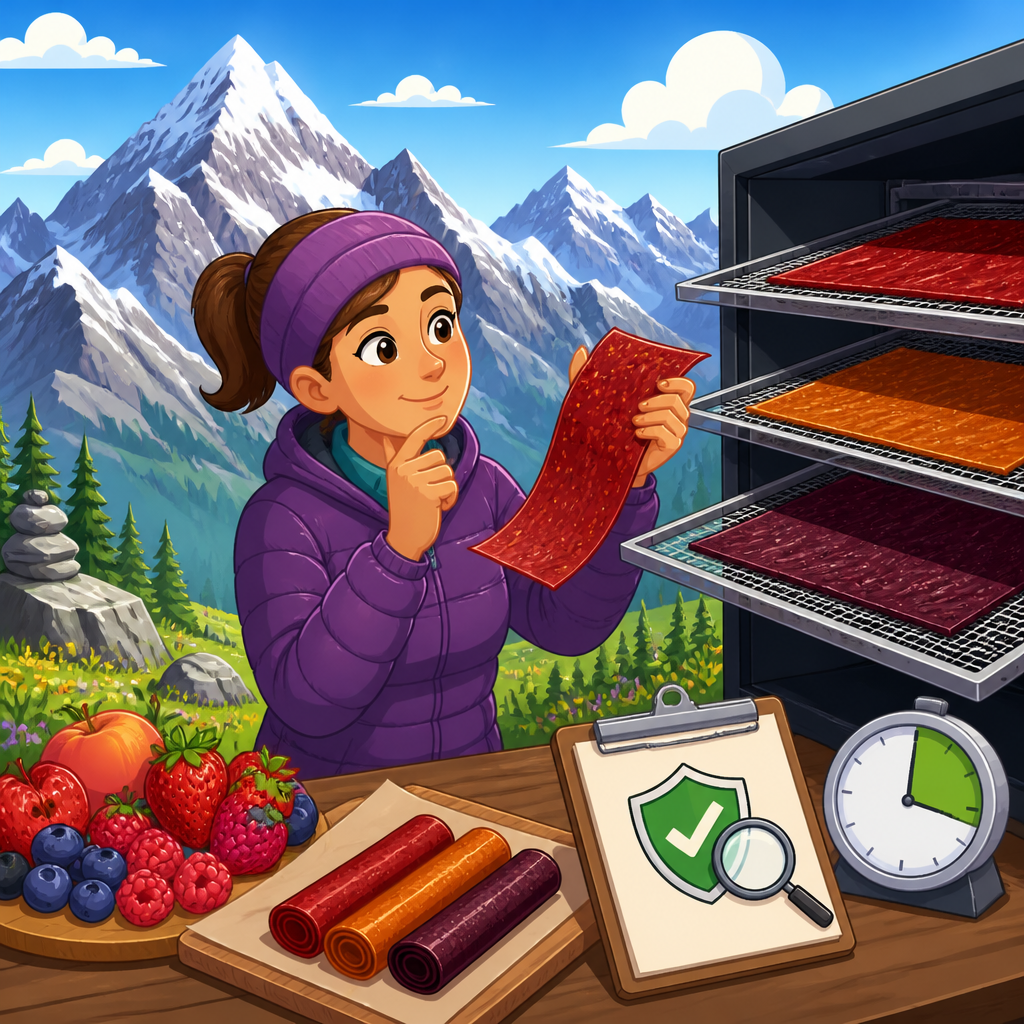
High-altitude fruit leather sits at the intersection of dehydration, sugar concentration, acidity, and safe home food preservation, which is why drying times and food safety questions deserve more than a quick rule of thumb. In mountain kitchens, cooks quickly learn that altitude changes how water behaves. Boiling points drop, evaporation rates shift, air often becomes drier, and familiar recipes for jam, jelly, fruit butter, syrups, and even old-fashioned candies stop behaving exactly as they do at sea level. Fruit leather may look simple—just puréed fruit spread thin and dried until pliable—but producing a shelf-stable, flavorful sheet at 5,000, 7,000, or 9,000 feet requires attention to fruit chemistry, equipment performance, and storage practices.
When I test fruit leather in high-country kitchens, the biggest mistake I see is assuming altitude changes every preservation rule in the same way. It does not. Altitude strongly affects heat-based processes such as water-bath canning because lower boiling temperatures reduce lethality unless time is adjusted. It can also influence candy stages because syrup temperatures correspond to sugar concentration differently at elevation. Dehydration is different. Drying relies more on airflow, temperature, humidity, thickness, and sugar content than on the boiling point alone. That distinction matters because many home preservers lump dried fruit, canned jam, and cooked preserves into one category, then apply the wrong correction.
For this hub page, “Candy, Preserves & Canning” includes fruit leather, jams, jellies, marmalades, chutneys, syrups, fruit butters, candied fruit, and acidified fruit preserves. The central questions are practical: How long does fruit leather take to dry at altitude? Is fruit leather safe without canning? Do you need special temperature targets? How do high-altitude conditions affect pectin set, sugar stages, and canning times across related recipes? The short answer is that fruit leather can be made safely at altitude, but only when you control fruit acidity, layer thickness, dryer temperature, and post-drying storage. Understanding those variables gives you better texture, more predictable drying times, and safer preservation across the entire sweet-preserves category.
Why altitude changes preservation results
Altitude matters because atmospheric pressure declines as elevation increases. At sea level, water boils at 212°F, but that boiling point drops roughly 2°F for every 1,000 feet of elevation, so water boils around 202°F near 5,000 feet and about 194°F near 9,000 feet. In canning, that lower temperature is critical because microbial destruction depends on heat delivered over time. Standard water-bath processes therefore need altitude adjustments, and pressure canning requires pressure changes to compensate. For candy and sugar work, the reduced boiling point means thermometers and stage temperatures need correction to avoid overcooking or undercooking.
Dehydration responds differently. A dehydrator removes moisture by circulating warm air over food, not by bringing the product to a rolling boil. In many mountain regions, ambient humidity is lower, which can speed moisture loss from fruit purée. At the same time, cooler nighttime kitchen temperatures, inconsistent household ovens, and thicker fruit mixtures can slow drying dramatically. That is why two cooks at the same elevation may report very different fruit leather times. Altitude sets the environmental context, but the direct drivers are formulation and drying conditions.
For the broader “Candy, Preserves & Canning” category, the practical lesson is straightforward. Use altitude-adjusted methods for canning, temperature-adjusted targets for candy, and moisture-focused judgment for dried products. Fruit leather belongs in the third group. It is not shelf-stable because of altitude itself; it is shelf-stable only if enough available water is removed and the finished leather is stored to prevent moisture reabsorption and mold growth.
How long high-altitude fruit leather really takes to dry
Most fruit leather dries in 6 to 12 hours in a dehydrator set between 135°F and 140°F, but high-altitude batches often fall anywhere from 5 to 14 hours depending on humidity, purée composition, and thickness. In my own tests with apple-plum and peach leather at roughly 6,200 feet, a thin layer around one-eighth inch dried in about 7 hours in a rear-fan dehydrator, while a sweeter strawberry-banana blend spread closer to one-quarter inch took nearly 11 hours. The thicker, higher-sugar batch stayed tacky much longer because dissolved sugars bind water and slow final drying.
Oven-dried fruit leather is less predictable. Even when the dial says 170°F, many home ovens cycle well above that point, creating cooked edges and a wet center. At altitude, cooks often assume the drier air will solve this, but uneven heat still causes failures. If you must use an oven, prop the door slightly open for airflow, rotate trays, and expect a wider time range of 4 to 10 hours. Dehydrators remain the better choice because they maintain gentle heat and steady air movement, both essential for safe, even drying.
Drying time should never be judged by the clock alone. Properly dried fruit leather is glossy to matte, flexible, and no longer wet when touched at the center. It should peel away from the liner without leaving smears of purée. If you press a fingertip onto the center and lift, the surface should feel dry but still pliable, not brittle. Any cool, sticky, or thicker patch needs more time. At altitude, edges can dry before the middle, so rotating sheets and spreading purée slightly thicker at the rim can improve uniformity.
Fruit leather safety: acidity, sugar, and water activity
The key food safety question is not whether fruit leather was made in the mountains. It is whether the finished product has low enough available moisture and enough natural or added acidity to discourage pathogens and spoilage organisms. Most fruits used for leather are naturally acidic, typically below pH 4.6, which helps limit the growth of dangerous bacteria such as Clostridium botulinum. That is one reason fruit leather is generally considered a dehydration project rather than a pressure-canning project. However, acidity alone does not prevent mold or yeast if the product remains too moist.
Water activity is the concept that explains this best. Microbes need available water, not just total moisture, to grow. Sugar lowers water activity by tying up water, which is why sweetened leather usually keeps better than unsweetened purée at the same texture. Still, sugar is not a guarantee of safety. A mango leather dried only partially may mold in storage even though it tastes concentrated and sweet. Fruit selection also matters. Very low-acid mixtures, especially those blended with large amounts of pumpkin, melon, or vegetable purée, should be acidified with bottled lemon juice or another tested acidic ingredient before drying.
If you want the safest formula, start with ripe but sound fruit, wash it thoroughly, trim bruised areas, and heat the purée before drying when using questionable fruit quality. A brief simmer can reduce surface microbes and improve texture. The National Center for Home Food Preservation and many extension services recommend conditioning or testing for uniform dryness before storage. That means ensuring no hidden wet spots remain. For long-term room-temperature storage, the finished leather must be dry enough to resist sticking and packed so it cannot absorb humidity from the air.
Best methods for making fruit leather at altitude
Consistent technique matters more than special mountain tricks. Use a smooth purée, line trays with nonstick dehydrator sheets or parchment made for low heat, and spread the mixture evenly to about one-eighth to one-quarter inch. Keep the center slightly thinner than the edges if your dehydrator runs cooler in the middle, which many stackable models do. Set the dehydrator between 135°F and 140°F. Lower temperatures prolong drying enough to invite quality loss, while higher temperatures can case-harden the surface, trapping moisture below.
Sweeteners are optional, but they change texture. Applesauce, pear purée, and berries often dry well without extra sugar. Honey produces a softer, more pliable leather but can extend drying time. Corn syrup or glucose, common in commercial fruit snacks, reduces crystallization and keeps sheets flexible, though most home cooks prefer cane sugar or no sweetener at all. Pectin is rarely necessary for fruit leather, yet a small amount of apple purée can improve body in loose fruits such as apricot or cherry. Spices, vanilla, and citrus zest are fine additions as long as they do not significantly increase moisture.
For a reliable mountain process, use this baseline comparison.
| Factor | Best Practice | Why It Matters at Altitude |
|---|---|---|
| Tray thickness | Spread 1/8 to 1/4 inch evenly | Thin, even layers dry predictably despite variable mountain humidity |
| Drying temperature | 135°F to 140°F | Promotes safe moisture removal without scorching edges |
| Fruit acidity | Use acidic fruits or add bottled lemon juice | Supports microbial safety in mixed-fruit leathers |
| Equipment | Fan dehydrator preferred over oven | Airflow matters more than elevation alone |
| Storage | Wrap airtight and keep cool, dark, and dry | Prevents moisture pickup in changing mountain climates |
Once dried, cool the leather completely, peel it from the liner, and cut or roll it. Wrap portions in parchment or plastic, then place them in airtight containers. For best quality, refrigerate or freeze if you made a low-sugar batch or if summer humidity rises indoors. Properly dried leather often holds at room temperature for up to a month, but colder storage extends quality and lowers risk.
Common mistakes and how to avoid them
The most common error is underdrying the center. Fruit leather can feel done around the edges while remaining wet in the middle, especially with thick peach, banana, or mango mixtures. Always test several spots. A second mistake is pureeing fruit with too much added liquid, such as orange juice, water, or maple syrup. Extra liquid lengthens drying time and increases the chance of uneven drying. If flavor needs adjustment, use concentrated ingredients like lemon juice, zest, or a small amount of sugar instead.
Another frequent problem is confusing fruit leather guidance with canning guidance. Home cooks sometimes ask whether they should water-bath can fruit leather jars. The answer is no; fruit leather is preserved by dehydration, not by canning after the fact. Packing leather into jars without verified dryness can trap moisture and create mold problems. Likewise, vacuum sealing is not a cure for underdried products. It can actually hide spoilage until a package is opened. Dry first, then package.
Watch ingredient combinations carefully. Adding dairy, large amounts of nut butter, or egg white turns a simple fruit leather into a different product with different safety considerations. Those enrichments raise perishability and are poor choices for room-temperature storage. If you want creamy texture, use a tested refrigerator or freezer fruit roll formulation instead. In mountain towns where fresh apricots, chokecherries, and wild plums are common, I also recommend straining purée to remove coarse skins that trap moisture pockets and cause leathery, uneven sheets.
How fruit leather fits into candy, preserves, and canning at altitude
Fruit leather is the dehydrated branch of a larger preserving system, and understanding the neighboring branches makes every recipe more successful. Jams and jellies depend on the balance of pectin, acid, and sugar. At altitude, the endpoint temperature for gel formation shifts because the boiling point is lower, so sea-level “cook to 220°F” guidance often overcooks mountain batches. A more accurate rule is to target about 8°F above your local boiling point or use a sheet test, freezer test, or refractometer when precision matters.
Candy work changes too. Soft-ball, firm-ball, and crack stages all occur at lower thermometer readings as elevation rises. Fudge, divinity, brittles, and caramels need corrected targets or they set too soft or too hard. Preserves and syrups may seem forgiving, but over-reduction can darken flavor and concentrate sugar beyond the intended texture. Canning remains the most exacting method because process times and pressures must follow tested altitude adjustments from extension services, the USDA, or the National Center for Home Food Preservation.
That is why this page works as a hub for “Candy, Preserves & Canning.” Fruit leather teaches the core mountain lesson: separate the preservation mechanism from the recipe category. Drying is about moisture removal and storage barriers. Jam making is about pectin chemistry and concentration. Candy is about sugar stage and temperature correction. Canning is about validated thermal processing. When cooks understand which science controls each product, they stop guessing and start getting repeatable results at altitude. Use that framework whenever you move from fruit rolls to apricot jam, raspberry syrup, peach butter, or pickled fruit chutney.
High-altitude fruit leather is safe and successful when you focus on the factors that actually control the outcome: fruit acidity, even thickness, drying temperature, airflow, and truly complete drying before storage. Altitude influences the environment, but it does not replace sound preservation rules. Expect most dehydrator batches to finish in 6 to 12 hours, with some mountain batches running shorter or longer based on humidity, sugar content, and tray depth. Judge doneness by texture, not just time, and store the finished leather airtight so it cannot pull moisture back from the air.
Across the wider world of candy, preserves, and canning, the same principle applies. Different products fail for different reasons. Fruit leather molds when it is underdried or poorly stored. Jam fails when pectin, acid, or endpoint temperature are wrong. Candy misbehaves when thermometer targets are not corrected for elevation. Canned preserves become unsafe when tested altitude adjustments are ignored. Once you match the method to the science, mountain cooking becomes far more predictable.
Use this hub as your starting point for altitude-smart preserving: dehydrate fruit leather with care, calibrate sugar work, and rely on tested canning guidance for shelf-stable jars. If you preserve fruit regularly, build a simple altitude toolkit with a dependable dehydrator, an accurate digital thermometer, a scale, proper canning jars, and current extension recommendations. Those tools, combined with careful observation, will help you make better fruit leather and better preserves in every season.
Frequently Asked Questions
How does high altitude affect fruit leather drying time?
High altitude changes several conditions at once, so fruit leather rarely dries exactly like it would at lower elevations. As elevation increases, water boils at a lower temperature, air pressure drops, and the surrounding air is often less humid. In practice, that means moisture can leave the fruit puree differently than many standard recipes assume. In some mountain climates, the drier air may help surface moisture evaporate faster, but that does not always mean the entire sheet dries evenly or safely in less time. Thickness of the puree, sugar content, the type of fruit used, and whether the product was preheated all still matter.
It is better to think of altitude as a factor that changes drying behavior rather than one that guarantees faster or slower results. A thin apple or berry puree spread on a lined dehydrator tray may dry relatively efficiently at altitude, while a thicker peach, pear, or mixed-fruit leather can remain tacky in the center even when the edges look done. Oven drying can be even more variable because home ovens cycle on and off, and many cannot reliably hold the low temperatures ideal for leather. For that reason, visual and texture cues are more dependable than the clock alone. Properly dried fruit leather should feel dry to the touch, pliable, and leathery without wet spots, stickiness, or pockets of puree underneath the surface.
Rotating trays, keeping the puree at a uniform thickness, and checking several areas rather than just the edges will improve consistency. If one tray is drying faster than another, swap positions during the process. At high altitude, plan for flexibility instead of forcing a recipe’s exact hour count. Dry until the leather is evenly dried all the way through, then cool it briefly before testing again, because warm fruit can seem softer and moister than it will at room temperature.
What is the safest temperature for drying fruit leather at high altitude?
The safest approach is to dry fruit leather in a temperature-controlled dehydrator, generally around 135°F to 140°F for fruit. That range is widely used because it removes moisture efficiently without scorching the sugars or case-hardening the outer surface too quickly. Altitude does not usually require a dramatically different drying temperature for fruit leather, but it does increase the importance of using equipment that can actually maintain the target range. A dehydrator with steady airflow is much more reliable than an oven running at its lowest setting if that setting is still too hot or fluctuates widely.
Food safety depends on more than just warmth. The goal is to reduce moisture enough that spoilage organisms cannot easily grow, while also starting with fruit that is wholesome and properly handled. Use clean utensils, sanitize or thoroughly wash drying trays and liners, and prepare the puree from sound fruit with any bruised or moldy portions removed. If the fruit is low in acid, blending it with higher-acid fruit or adding a small amount of lemon juice can help improve both flavor and preservation quality, though this does not replace proper drying. Sugar also affects the finished texture and preservation characteristics, but it should not be relied on as the primary safety control in home fruit leather.
If using an oven, verify the actual temperature with an oven thermometer and crack the door only if the manufacturer or recipe method allows for adequate moisture release. Temperatures that are too low may prolong drying excessively, while temperatures that are too high can cook the puree, darken it too much, or create a dry outer layer with residual moisture trapped inside. At high altitude, where recipes for other preserves often need adjustment, fruit leather is one of those products where careful monitoring is more important than arbitrary changes. Consistent low heat, good airflow, and complete drying are the keys.
How can I tell when high-altitude fruit leather is fully dried and safe to store?
The best indicator is the condition of the finished leather, not simply elapsed drying time. Fully dried fruit leather should peel away from the liner easily, though a light flexibility is normal. It should feel smooth and leathery, not brittle, wet, sticky, or syrupy. When you press the center with a clean finger, it should not leave an indentation filled with moisture or cause puree to cling to your skin. Edges often dry first, so always test the middle and any thicker spots where puree may have been spread unevenly.
Cooling is an important part of judging doneness. Warm fruit leather can feel softer and more pliable than it will after standing for a few minutes. Remove a tray, let it cool briefly, then test again. If any section feels cool and damp rather than simply flexible, return it to the dehydrator. At high altitude, where surface drying may happen quickly in dry air, this step helps you avoid mistaking a dry-looking top for a fully dried sheet. The inside must be adequately dried too.
Once the leather is done, condition your storage expectations realistically. Fruit leather is shelf-stable only when it has been dried thoroughly and stored to protect it from moisture. Cut it into strips, roll it in clean parchment or waxed paper if desired, and store it in airtight containers or moisture-proof packaging. Keep it in a cool, dark place. If your kitchen is warm or humid at certain times of year, refrigeration or freezing offers added protection and can preserve quality longer. If you notice condensation inside the container, visible mold, off odors, or fermentation-like smells, discard the batch. Those are signs the product retained too much moisture or was contaminated during handling or storage.
Do I need to add sugar, lemon juice, or preservatives to make fruit leather safe at high altitude?
Not necessarily, but each of those ingredients can affect safety, texture, and storage quality in different ways. Sugar helps bind water and improves pliability, flavor, and color retention, but fruit leather can be made without added sugar if the fruit is naturally sweet enough. Unsweetened leather may dry a bit differently and can become firmer or more brittle depending on the fruit. Lemon juice can be especially useful because acidity supports better flavor balance, slows browning, and may improve the preservation profile of some lower-acid fruits when used as part of a tested method or sensible formulation.
What matters most is that the fruit starts out safe and the puree is dried thoroughly. Altitude changes drying conditions, but it does not remove the need for good acid balance and careful handling. Fruits such as apples, berries, plums, and many stone fruits are commonly used for leather because they naturally contain acids and sugars that lend themselves well to drying. Milder fruits like pears, bananas, or some melon blends may benefit from added lemon juice for both taste and quality. Commercial preservatives are generally not necessary for home fruit leather if you use clean preparation methods, dry the product fully, and store it correctly.
If you are improvising a recipe at high altitude, avoid assuming that extra sugar alone will make up for incomplete drying. It will not. Likewise, lemon juice improves acidity but does not compensate for a leather that remains too moist in the center. The safest strategy is to treat sugar and acid as supportive tools, not substitutes for process control. Choose ripe, sound fruit, puree it smoothly, spread it evenly, dry it thoroughly, and package it promptly once cooled. That combination matters far more than adding optional ingredients out of habit.
What are the most common food safety mistakes people make with fruit leather in mountain kitchens?
One of the biggest mistakes is relying on a standard drying time from a recipe without checking the actual product. High-altitude kitchens often behave differently from lowland kitchens, and environmental conditions can vary dramatically even between two mountain homes. A batch that dries in one afternoon in a dry climate may take much longer during a stormy week or in a less efficient oven. Assuming it is done because the timer says so can lead to moisture trapped in the center, which shortens shelf life and increases the risk of spoilage.
Another common mistake is spreading the puree too thickly or unevenly. Thick centers and thin edges almost guarantee inconsistent drying. The edges may become overdried while the middle remains tacky and unsafe for pantry storage. Using damaged fruit is another avoidable problem. Bruised, fermented, or moldy fruit should never be “saved” by dehydrating it, because drying does not undo spoilage that has already begun. Sanitation also matters more than many people realize. Dirty liners, poorly washed hands, or containers packed while still damp can all undermine an otherwise good batch.
Storage errors are also frequent. Fruit leather that is safely dried can still be ruined by exposure to humidity after drying. Leaving finished sheets uncovered on the counter, sealing them before they have cooled, or storing them in loosely closed bags can allow condensation and moisture pickup. In mountain regions where daytime and nighttime temperatures swing sharply, that risk can be higher than people expect. To avoid problems, cool the leather, package it airtight, and store it somewhere cool and dry. If there is ever any doubt about moisture level or freshness, refrigeration or freezing is the safer choice. The general rule is simple: when in doubt, dry longer, store colder, and discard anything that shows signs of spoilage.