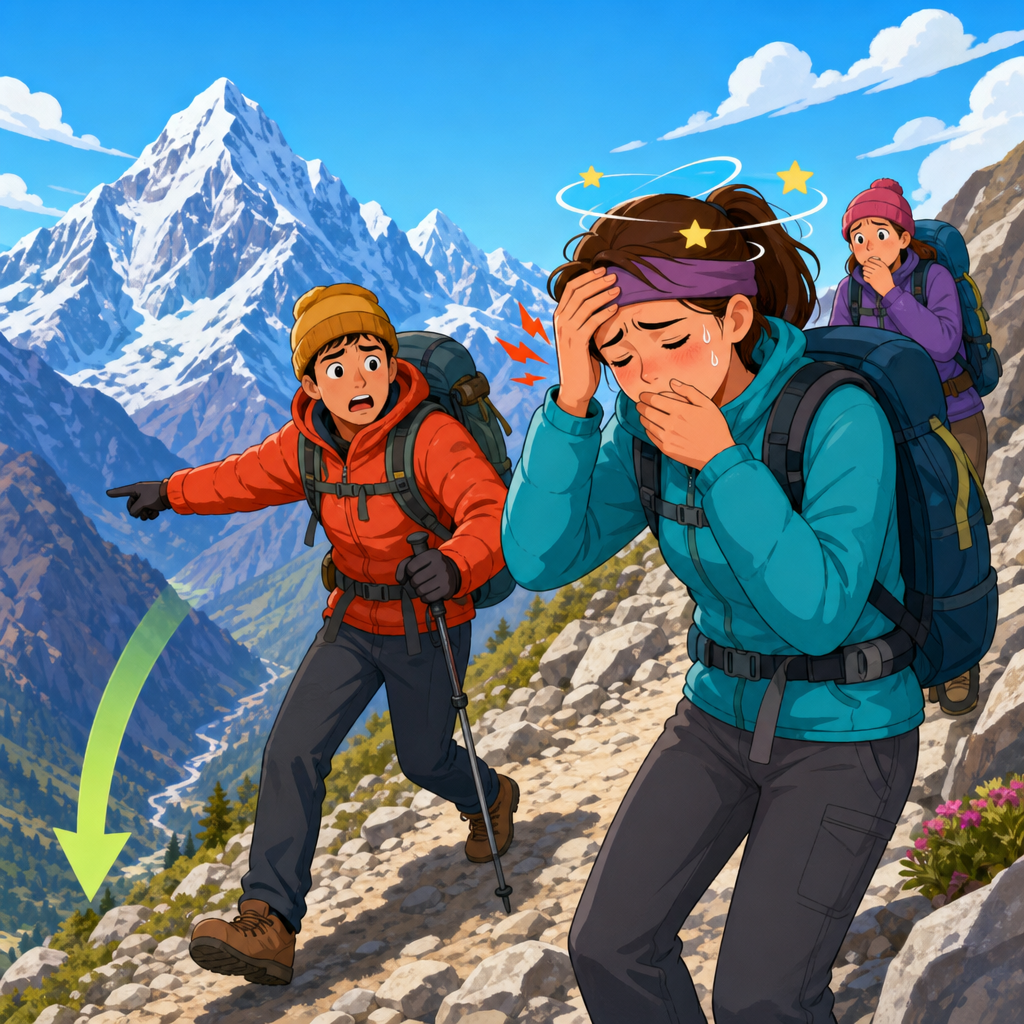
Altitude illness can deteriorate quickly, and knowing when to descend immediately because altitude symptoms are getting worse is one of the most important safety skills in mountain travel. In practical terms, descent means losing elevation without delay, not waiting until morning, not hoping medication will solve the problem, and not assuming fitness will protect you. The core issue is hypoxia: as barometric pressure drops, less oxygen reaches the blood and tissues, especially the brain and lungs. Most high-altitude problems fit into three categories: acute mountain sickness, high-altitude cerebral edema, and high-altitude pulmonary edema. Acute mountain sickness usually starts with headache, nausea, fatigue, dizziness, or poor sleep. Cerebral edema means the brain is swelling from altitude stress and can cause confusion, ataxia, behavior change, or decreasing consciousness. Pulmonary edema means fluid is accumulating in the lungs and can cause breathlessness at rest, chest tightness, cough, low exercise tolerance, crackles, or blue lips. I have seen mild symptoms improve with rest and a conservative ascent plan, but I have also seen trekkers go from “just a bad headache” to stumbling, vomiting, and gasping within hours. That is why this subject matters: delayed descent is a common factor in severe outcomes, while prompt descent is the single most effective treatment for worsening altitude illness.
This hub page covers descent, treatment, and emergency response in a way that helps you decide fast under pressure. The central rule is simple: if symptoms are worsening despite rest, or if severe neurological or breathing symptoms appear at any time, descend immediately. Supplemental oxygen, dexamethasone, nifedipine, and portable hyperbaric bags can be valuable tools, but none of them should be used as excuses to remain high unless evacuation is impossible. The Wilderness Medical Society and the UIAA emphasize the same hierarchy: stop ascent, assess severity, treat, and descend when red flags appear. Understanding those red flags before a trip can prevent hesitation when judgment is impaired by cold, exhaustion, darkness, or summit pressure. This article also acts as the hub for the broader descent and emergency response topic, linking the concepts that sit behind more detailed guides on emergency medications, oxygen strategy, evacuation planning, overnight monitoring, and what to do when weather or terrain delays rescue. If you trek, climb, guide, or travel on high roads and passes, you need one takeaway above all others: worsening altitude symptoms are not a test of toughness; they are a medical warning that altitude exposure is exceeding your body’s ability to adapt.
Recognize the exact symptoms that demand immediate descent
The question people ask most often is, “How bad is bad enough?” The clearest answer is this: descend immediately if there are signs of high-altitude cerebral edema or high-altitude pulmonary edema, or if acute mountain sickness is progressing instead of stabilizing. Red-flag neurological symptoms include confusion, disorientation, unusual irritability, hallucinations, inability to walk heel-to-toe, collapsing while walking, severe lethargy, or reduced responsiveness. In the field, I use a very simple gait test because it cuts through debate. If the person cannot walk a straight line, put on boots properly, answer basic orientation questions, or coordinate movements that were easy earlier, they should be going down. Severe respiratory red flags include shortness of breath at rest, rapid breathing that does not settle, persistent cough especially with pink or frothy sputum, chest congestion, obvious struggle to breathe while lying down, blue fingernails or lips, or crackling sounds in the lungs. These are not “watch and wait” symptoms.
Progressive acute mountain sickness also deserves respect. A headache alone is not automatic descent if it is mild and improving with rest, fluids, food, and simple analgesics. But headache combined with repeated vomiting, rising fatigue, dizziness, or inability to keep pace can become the front edge of something more serious. One common mistake is focusing on oxygen saturation from a fingertip pulse oximeter. Readings can be helpful as a trend, but they are not the diagnosis. I have seen people with acceptable-looking numbers who were clearly neurologically impaired, and I have seen low readings in cold fingers that improved after warming. Clinical deterioration matters more than the device. If symptoms are getting worse over several hours, if the patient cannot function normally, or if anyone in the group says, “This person is not acting like themselves,” descent should start.
Why symptoms worsen and why staying put can be dangerous
Symptoms worsen when oxygen delivery falls below what the body can compensate for. Acclimatization increases ventilation, changes blood chemistry, and gradually improves tolerance, but it takes time. Ascending too fast, sleeping too high, doing hard exertion after arrival, alcohol use, sedatives, respiratory infection, dehydration, and prior altitude illness all increase risk. The danger is not only that the person feels miserable. Cerebral edema can impair judgment, so the patient may resist help, deny symptoms, or insist on continuing upward. Pulmonary edema can escalate overnight, especially in cold conditions, turning a manageable situation at dusk into a respiratory emergency before dawn. This is why “let’s see how you feel in the morning” can be a dangerous decision when symptoms are already progressing.
Terrain and logistics also magnify risk. At 4,500 meters, a two-hour delay can become a six-hour extraction if weather closes in, batteries die, or the only strong team member becomes exhausted. I have repeatedly found that groups wait too long because descent feels operationally difficult. Yet physiologically, descent works fast because every few hundred meters lowers hypoxic stress. Even a descent of 500 to 1,000 meters can produce meaningful improvement. If evacuation to a clinic is available, that is ideal, but do not confuse descent with definitive hospital care. The first lifesaving move is reducing altitude exposure now. In remote ranges, the safe mindset is to descend while you still have daylight, mobility, and organized teammates rather than after the patient becomes confused or unable to walk.
Immediate field response: what to do in the first minutes
Once worsening altitude symptoms are recognized, the response sequence should be deliberate and fast. Stop ascent immediately. Protect the patient from cold, wind, and exertion. Reassess mental status, breathing, pulse, and ability to walk. If the patient is breathless at rest, ataxic, or confused, assign one person to stay with them continuously and another to organize descent or rescue communication. Never leave a deteriorating altitude patient alone in a tent. If they can walk safely with assistance, begin descending at once. If they cannot, prepare a supported evacuation using available team resources, local porters, pack animals, improvised carry methods, or formal rescue assets. In many mountain settings, the practical threshold is simple: if self-powered descent is uncertain, call for help early.
Supportive treatment can buy time but should not create false reassurance. Give supplemental oxygen if available, especially for pulmonary edema or neurological symptoms. Oxygen flow rates vary by system, but the goal is clear clinical improvement, not a perfect number on a monitor. Dexamethasone is commonly used for suspected cerebral edema or severe acute mountain sickness; nifedipine is used for pulmonary edema in selected cases. These medicines have established roles in wilderness protocols, but they are adjuncts, not substitutes for descent. A portable hyperbaric chamber can temporarily simulate lower altitude and is highly useful when weather or darkness delays movement, yet the patient still needs descent as soon as feasible. Keep the person warm, minimize exertion, and avoid overhydration. Forced fluids do not cure altitude illness and can complicate pulmonary edema.
| Situation | Likely problem | Immediate action | Can you delay descent? |
|---|---|---|---|
| Mild headache, mild nausea, stable symptoms | Uncomplicated acute mountain sickness | Stop ascent, rest, monitor closely | Only if symptoms are improving |
| Headache plus worsening vomiting, fatigue, dizziness | Progressive acute mountain sickness | Treat, reassess, prepare descent | No if symptoms keep worsening |
| Confusion, ataxia, altered behavior | High-altitude cerebral edema | Dexamethasone, oxygen, immediate descent | No |
| Breathlessness at rest, cough, crackles, blue lips | High-altitude pulmonary edema | Oxygen, minimize exertion, immediate descent | No |
| Reduced consciousness or cannot walk | Severe cerebral edema or advanced illness | Rescue evacuation and urgent descent | No |
Choosing descent, evacuation, oxygen, and medications
The best intervention depends on severity and location, but priorities remain consistent. For uncomplicated acute mountain sickness that is mild and stable, the safest move is to stop ascent until symptoms resolve. For worsening symptoms, descent is the treatment. For suspected cerebral or pulmonary edema, descent becomes urgent and nonnegotiable. The common field question is whether to descend on foot, use pack support, shelter in place with oxygen, or trigger rescue. My rule after years of high-altitude trip planning is to choose the option that gets the patient to lower elevation fastest without increasing danger to the group. A walking descent is often best if the patient is coordinated and strong enough. If walking requires steep effort, exposure, or technical ground, an assisted evacuation may actually be safer because exertion can worsen pulmonary edema and poor coordination can turn a medical problem into a trauma incident.
Medication decisions should follow established protocols and prior training. Acetazolamide helps acclimatization and can assist some acute mountain sickness cases, but it is not the primary rescue drug for severe deterioration. Dexamethasone can rapidly improve symptoms of cerebral edema and severe acute mountain sickness; however, improvement after a dose does not mean the danger has passed. Nifedipine lowers pulmonary artery pressure and is used in pulmonary edema, particularly when oxygen or prompt evacuation is limited. Some clinicians also use phosphodiesterase inhibitors in selected contexts, but field teams should not improvise beyond what they know well. Portable hyperbaric bags, such as the Gamow or Certec bag, are effective bridges when descent is delayed, but they require staffing, monitoring, and repeated treatment cycles. Every expedition should decide before departure who carries oxygen, who holds medication authority, what communication device will be used, and what weather, daylight, or route conditions would trigger an immediate turnaround.
Common mistakes that turn manageable illness into emergency
The most dangerous mistake is normalization. Groups often reinterpret warning signs as dehydration, food poisoning, hangover, viral illness, lack of fitness, or anxiety because they want a less serious explanation. Another mistake is relying on the strongest personality instead of objective symptoms. Summit-driven teams may defer to the person who insists they are fine even when they are weaving on the trail. I have also seen medication misuse: taking dexamethasone to keep climbing, using oxygen briefly for comfort and then returning to sleep at the same altitude, or masking headache with painkillers while ignoring vomiting and weakness. These approaches can hide deterioration while the underlying hypoxic injury continues.
Operational errors matter too. Waiting until night, splitting the group without a communication plan, failing to record symptom progression, and not checking for ataxia or resting breathlessness all increase risk. Another frequent error is underestimating children, older adults, or very fit athletes. Altitude illness does not spare strong people; in fact, highly motivated athletes sometimes push deeper into trouble because they are used to overriding discomfort. Finally, many travelers arrive without a descent threshold agreed in advance. A good team defines it before the trip: any ataxia, confusion, breathlessness at rest, or steadily worsening symptoms means immediate descent, no debate. That precommitment reduces hesitation at the exact moment judgment is most likely to fail.
How to build an emergency descent plan before the trip
The safest altitude response begins before anyone leaves home. Build a written plan that lists route elevations, sleeping elevations, turnaround points, nearest clinics, helicopter limitations, local rescue numbers, radio or satellite contacts, and medication kits. Verify whether evacuation insurance covers high altitude and whether the policy requires preauthorization. In remote areas, identify where a patient can realistically be moved in one hour, four hours, and overnight. That planning matters because “descend immediately” means different things on Kilimanjaro, the Inca Trail, the Everest region, the Colorado fourteeners, or the Himalaya of Ladakh. On a day hike, immediate descent may mean hiking to the trailhead. On an expedition, it may mean dropping to the last camp, entering a hyperbaric bag while rescue is arranged, then moving again at first light.
Training should include symptom recognition, simple neurological assessment, pulse oximeter limitations, oxygen setup, and who has authority to cancel the climb. After any significant altitude event, do not re-ascend until the diagnosis is clear and symptoms have completely resolved; after cerebral or pulmonary edema, medical review is essential before future exposure. The main benefit of good planning is speed. When altitude symptoms are getting worse, the team should not be starting a debate. It should be executing a plan. Review your protocols, pack the right tools, and set conservative descent rules before your next trip.
Frequently Asked Questions
What altitude symptoms mean I should descend immediately rather than rest and watch?
You should descend immediately if symptoms are clearly worsening, severe, or affecting the brain or lungs. Red-flag signs include shortness of breath at rest, worsening cough, chest tightness, blue or gray lips, confusion, unusual behavior, trouble walking in a straight line, repeated vomiting, severe weakness, fainting, or a severe headache that keeps getting worse despite stopping ascent. These are not signs to “wait and see.” They suggest the body is no longer adapting to reduced oxygen well enough and may be progressing from mild altitude illness into a dangerous emergency.
In mountain travel, “descend immediately” means losing elevation now, not after a nap, not after dinner, and not after sunrise. Altitude illness can deteriorate quickly because hypoxia affects the brain and lungs directly. Mild symptoms such as a light headache or reduced appetite may improve with rest at the same elevation, but once symptoms intensify or new neurological or breathing symptoms appear, continued exposure to altitude increases the risk. The safest rule is simple: if symptoms are getting worse instead of better, especially after stopping ascent, go down.
How can I tell the difference between mild altitude sickness and a true descent-now emergency?
Mild acute mountain sickness usually causes headache, fatigue, poor sleep, light nausea, or reduced appetite, but the person remains alert, coordinated, and able to function normally. In many cases, those milder symptoms can be managed by stopping ascent, resting, hydrating normally, and monitoring carefully. The key point is that mild illness should stabilize or improve. It should not steadily worsen while the person remains at the same elevation.
A descent-now emergency begins when symptoms move beyond simple discomfort and start showing failure of oxygen delivery to the brain or lungs. If the person is confused, unusually irritable, stumbling, unable to balance, too weak to walk normally, breathless while resting, or developing a wet or persistent cough, that is no longer mild altitude sickness. Severe headache with vomiting, drowsiness that is hard to interrupt, and any decline in mental status are especially concerning. In practical terms, if the person looks progressively less capable, less coordinated, less mentally clear, or more breathless over time, treat it as an emergency and descend. Waiting for a perfect diagnosis in the field is a common and dangerous mistake.
If medication or supplemental oxygen is available, do I still need to descend?
Yes, if symptoms are worsening or severe, descent remains the priority. Medication can help in some situations, and supplemental oxygen can be extremely valuable, but neither should be used as an excuse to stay high when the condition is deteriorating. The core problem is hypoxia caused by lower barometric pressure at altitude. The most reliable way to reduce that stress is to get the person to a lower elevation where more oxygen is available to the body naturally.
Some treatments may buy time or support the descent, but they do not replace it in a worsening case. A person with declining coordination, confusion, severe headache, vomiting, or breathing problems needs lower altitude, not optimism. Even fit, experienced climbers can worsen rapidly. Fitness does not protect someone from altitude illness, and a temporary improvement after medication can create false confidence. The correct mindset is: use treatments to assist evacuation and descent, not to delay them.
How far and how fast should someone descend when altitude symptoms are getting worse?
The goal is to lose elevation without delay and continue until symptoms clearly improve or until you reach professional medical care. There is no single number that fits every situation, because terrain, weather, darkness, group resources, and the person’s condition all matter. But the principle is straightforward: go down as soon as possible, by the safest route available, and do not stop high just because the plan for the day said to stay there.
Even a moderate loss of elevation can make a meaningful difference, especially if symptoms are caused by worsening hypoxia. In some cases, just getting substantially lower may improve headache, breathing, or alertness enough to stabilize the situation. If the person cannot walk safely, the group should treat it as a rescue problem, not a motivation problem. Move downhill, reduce exertion if possible, keep the person warm, and monitor mental status and breathing continuously. If severe symptoms are present, descending is urgent, and outside rescue support should be activated as early as possible.
What mistakes make altitude illness more dangerous when symptoms are getting worse?
The most dangerous mistake is delay. People often convince themselves to wait until morning, finish the route, sleep on it, or “see how things look in an hour.” That can be deadly when altitude illness is progressing. Another common error is assuming that a strong, young, or highly trained person is less likely to get seriously ill. In reality, altitude illness is driven by how the body responds to reduced oxygen, not by toughness or fitness. A very fit person can deteriorate just as quickly as anyone else.
Other risky mistakes include leaving the sick person alone, encouraging them to keep climbing, masking serious symptoms with medication while staying at the same elevation, and dismissing confusion or clumsiness as exhaustion. Groups also get into trouble when they underestimate nighttime descent, weather exposure, or the need to call for help early. The safest response is disciplined and simple: stop ascent, recognize worsening symptoms as a warning sign, descend immediately, and seek medical support when severe symptoms are present. In altitude emergencies, decisive action saves lives far more often than wishful thinking.