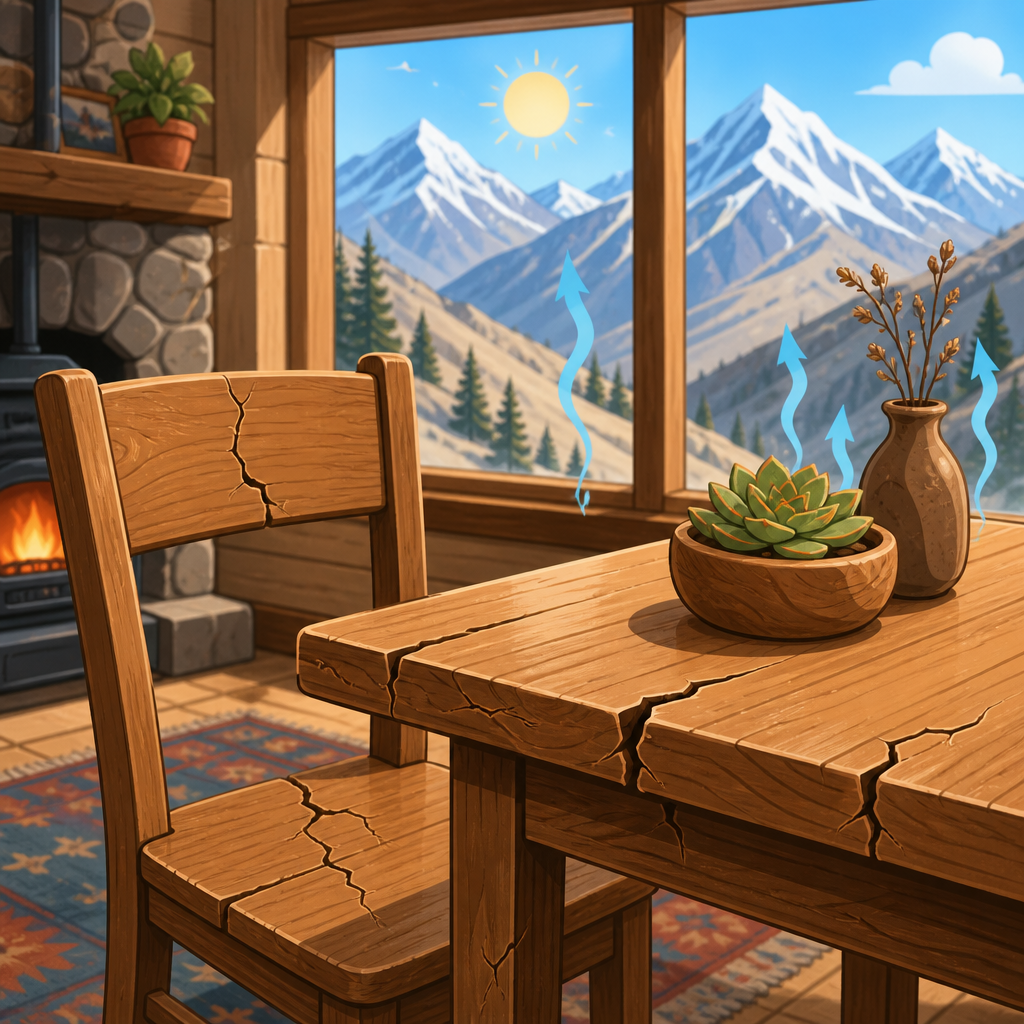
Wood furniture cracks more in dry mountain houses because the indoor environment pulls moisture out of wood faster and more completely than most owners expect. In practical terms, the problem is not altitude alone. It is the combination of low outdoor humidity, aggressive winter heating, strong solar gain, thinner air that dries interiors quickly, and long seasonal swings that push wood below the moisture level it had when it was built. Once that happens, panels shrink, joints loosen, veneers split, and finishes telegraph every movement underneath. I have seen this repeatedly in mountain homes where tables made for coastal climates develop end checks within one heating season. Understanding indoor systems and humidity is the key to preventing that damage.
For this hub article, indoor humidity means the amount of water vapor suspended in the air inside the home, usually discussed as relative humidity, or RH. Wood movement refers to dimensional change caused by changing moisture content inside the wood cells. Equilibrium moisture content, often shortened to EMC, is the point at which wood is neither gaining nor losing moisture because it has balanced with surrounding air. These terms matter because furniture follows physics, not preferences. If a dining table arrives at 8 percent moisture content and the house drives it toward 4 percent, the wood will shrink until it gets there. Cracks are often the visible consequence of that forced adjustment.
This topic matters beyond furniture care because indoor humidity sits at the center of comfort, building durability, health, and off-grid system design. Air that is too dry increases static electricity, nose and throat irritation, and dust circulation. It also stresses wood floors, millwork, guitars, cabinetry, and doors. Air that is too wet can create condensation, mold risk, and window damage. In mountain housing, the challenge is sharper because many homes are occupied part time, heated unevenly, and built with large view windows and high-output wood stoves or forced-air systems. Managing humidity is therefore part of running the house well, not just preserving antiques.
As the hub page for indoor systems and humidity, this article explains why wood cracks in dry mountain houses, how HVAC and heating choices affect interior moisture, what humidity range actually protects furniture, where humidification works or fails, and how to monitor conditions before damage appears. It also connects the subject to related concerns such as ventilation, insulation, air sealing, off-grid power limits, and seasonal home management. If you understand these interactions, you can make better decisions about furniture placement, humidifier sizing, winter thermostat settings, and the broader home systems that keep interiors stable.
Why mountain houses dry wood so aggressively
Wood cracks in mountain houses because low indoor RH drives moisture out of wood until the wood reaches a new EMC. The lower the RH, the lower the EMC, and the greater the shrinkage. This is most severe across the grain, not along it. A wide solid-wood panel can lose enough width to split at a restrained joint or open a glue line. Drawers stick in humid summers and rattle in dry winters for the same reason: wood is constantly adjusting.
Mountain climates intensify this cycle. Cold outside air contains little absolute moisture. When that air infiltrates the house and is heated, its relative humidity drops sharply unless moisture is added back. A simple example explains the effect. Outdoor air at 20 degrees Fahrenheit and 60 percent RH may feel damp outdoors, but once brought inside and heated to 70 degrees without added moisture, the resulting indoor RH can fall to extremely dry levels. In real homes, that means winter readings of 15 to 25 percent are common. At those levels, many furniture species and finishes are under sustained stress.
Altitude contributes indirectly. Higher elevations often have stronger sun, faster evaporation, and larger day-night temperature swings. Snow-climate houses also run heating systems for long periods, and many owners leave thermostats set low when away, then raise them quickly on arrival. That rapid change accelerates moisture loss from exposed surfaces. I have measured sideboards near south-facing glass that ran far drier than the center of the room because solar gain heated the casework every clear afternoon.
Construction style can worsen the problem. Great rooms with cathedral ceilings stratify warm air, and forced-air ducts can move a lot of dry air across furniture. Fireplaces and wood stoves add comfort but also increase air exchange as combustion appliances pull air from the house. Even balanced ventilation can dry interiors in winter if no humidity strategy is in place. The result is not one dramatic event but thousands of drying hours.
How wood movement turns low humidity into cracks
Wood is hygroscopic, meaning it absorbs and releases moisture naturally. Below the fiber saturation point, changes in moisture content cause dimensional change. Tangential shrinkage is usually greater than radial shrinkage, which is why flatsawn boards move more noticeably across their width. Species matters. Hard maple, red oak, and beech can move substantially. Walnut and mahogany are often more forgiving visually, but they still move. Veneered furniture is not immune either; the veneer is thin, but the substrate and adhesive system still respond to moisture stress.
Cracks form when wood movement is restrained or when drying is uneven. Tabletops split when breadboard ends are fixed too rigidly. Frame-and-panel doors crack when a floating panel has been glued in place. Case sides check when one face sits in direct sun near a window while the inside remains cooler. Old repairs also fail. I often see mountain-house furniture repaired with rigid fillers that cannot move with the surrounding wood, so the wood opens again beside the repair.
Finish influences rate, not immunity. Conversion varnish, lacquer, shellac, oil, and polyurethane all slow moisture exchange to some degree, but none stop it. End grain and unfinished undersides exchange moisture fastest. That is why the underside of a table can lose moisture more quickly if warm supply air blows directly on it. It is also why balancing a finish schedule on all faces still matters in modern furniture making.
| Condition | Typical indoor effect | Furniture risk |
|---|---|---|
| RH 15–25% for weeks | Wood EMC drops sharply | Panel splits, joint opening, veneer checking |
| Furniture near supply register | Localized rapid drying | Finish stress, drawer shrinkage, seam failure |
| Direct winter sun through glass | Surface overheating and uneven drying | Case checking, top warping, finish crazing |
| Part-time heating with quick warm-up | Repeated moisture cycling | Accelerated movement and cumulative cracking |
Indoor systems that control humidity, for better or worse
Heating and ventilation choices determine whether a mountain house stays in a safe range. Forced-air systems are common and convenient, but they can lower localized RH around furniture because warm moving air increases evaporation from wood surfaces. Hydronic radiant heat tends to feel less drafty and may reduce extreme air movement, yet it does not add moisture on its own. Wood stoves produce strong comfort but often coincide with very dry interiors, especially in tight homes without humidification. Mini-split heat pumps avoid combustion air losses, but winter operation still dries indoor air if outside air infiltration remains high.
Humidification methods differ significantly. Portable room humidifiers can help a bedroom or music room, but they are often undersized for open-plan mountain houses. Furnace-mounted bypass humidifiers are simple and inexpensive, yet their output depends on furnace run time and water temperature, so they may underperform in very cold weather. Fan-powered evaporative units increase capacity somewhat. Steam humidifiers provide the most controllable whole-house humidity and can operate independent of call-for-heat, which is a major advantage in shoulder seasons and in efficient homes. They also use more electricity and require regular maintenance to control scale.
Ventilation adds another layer. Exhaust-only systems can increase infiltration of cold, dry outdoor air. Balanced systems such as HRVs and ERVs improve air quality with more control, but they do not eliminate winter dryness. In cold mountain climates, an ERV may transfer some moisture compared with an HRV, though actual performance depends on temperature, airflow, and unit design. Good indoor air quality still matters, so the goal is not to shut ventilation off. The goal is to pair ventilation with humidity control and proper air sealing.
Air sealing, insulation, and window performance also affect humidity management. Leaky envelopes bring in dry air continuously. Poorly insulated window zones create cold surfaces that limit how high you can safely run indoor RH before condensation appears. That is why a realistic target depends on the house, not just the furniture. In a modern well-insulated home with quality windows, maintaining 35 to 40 percent RH in winter may be feasible. In an older cabin with single-pane glass, even 30 percent may fog windows during cold snaps.
What humidity range protects wood furniture best
For most homes, a winter indoor RH target of about 30 to 40 percent protects wood furniture while avoiding many condensation problems. Short excursions outside that band are normal, but sustained periods below 25 percent are where I start expecting visible shrinkage in sensitive pieces. Museums often keep tighter standards, commonly around 45 to 55 percent with minimal fluctuation, because collections include fragile veneers, marquetry, and centuries-old glue. Most occupied houses cannot maintain museum conditions year-round, and they do not need to. What they need is stability and avoidance of the driest extremes.
Temperature matters because RH changes with temperature. A room at 68 degrees and 35 percent RH is gentler on furniture than a room at 75 degrees and 25 percent RH. This is why mountain homeowners who like very warm interiors may unknowingly increase drying stress. Lowering the thermostat a few degrees can reduce the moisture deficit the wood experiences, especially when paired with humidification. The point is not discomfort; it is balance.
Monitoring is essential. Use calibrated digital hygrometers in the main living area and in at least one problem room, then compare readings over time. Data-logging sensors from brands such as SensorPush, Govee, and Inkbird make seasonal patterns obvious. If one room repeatedly drops below the rest, look for a supply register, sunny glazing, a nearby stove, or an envelope leak. Without measurements, owners often blame the furniture maker when the house environment is the real cause.
Placement decisions help immediately. Keep wood furniture away from direct supply vents, wood stoves, baseboard heaters, and intense south- or west-facing glass. Use blinds or UV-filtering window films where solar gain is severe. In part-time homes, avoid dramatic thermostat setbacks if valuable furniture, instruments, or wood finishes are present. Consistency beats swings.
Practical strategies for mountain homeowners and off-grid cabins
The most effective prevention plan starts with diagnosis. First, measure RH and temperature continuously through a full winter. Second, identify whether dryness is house-wide or localized. Third, match the humidification method to occupancy, floor plan, and power availability. In a full-time home with ductwork, a properly sized steam humidifier tied to a humidistat usually gives the best control. In a radiant-heated house without ducts, standalone steam or high-capacity evaporative units may be more realistic. In off-grid cabins, power draw matters, so passive measures and lower-tech humidification may play a larger role.
Water quality and maintenance cannot be ignored. Evaporative pads clog with minerals, steam canisters scale up, and portable units become microbial reservoirs if neglected. Follow manufacturer service intervals and use treated or filtered water when recommended. A neglected humidifier can solve one problem while creating another through white dust, odors, or poor output. In service calls, I have seen homes with humidifiers installed but effectively nonfunctional for years because pads had hardened shut.
Furniture-specific steps also matter. Acclimate new pieces before placing them in the driest room. Ask makers what moisture content they build to; reputable shops often target a range suited to the destination climate. For custom work headed to a mountain house, quarter-sawn stock, stable joinery, floating panels, and allowance for movement are not luxuries. They are standard good practice. For existing furniture, avoid storing it in garages or unheated rooms where humidity and temperature swing harder than in the main house.
If cracks have already appeared, repair timing matters. Do not rush to fill an opening during the driest part of winter if the wood will swell closed in summer. Stabilize the indoor environment first, then assess whether the split is cosmetic, structural, or finish-related. A qualified furniture conservator or restoration specialist can decide whether the right fix is humidification, reglueing, a dutchman patch, veneer stabilization, or finish consolidation. Good repairs respect future movement rather than fighting it.
Key takeaways for managing indoor systems and humidity
Wood furniture cracks more in dry mountain houses because winter indoor air often drops to humidity levels that force wood well below its previous moisture content. The damage is predictable: as wood dries, it shrinks across the grain, and restrained parts split, joints open, and veneers fail. Altitude is only part of the story. Heating patterns, ventilation, air leakage, solar exposure, and furniture placement usually matter more than owners realize.
The practical solution is steady humidity management. Aim for roughly 30 to 40 percent RH in winter when the house can support it without condensation. Measure conditions with reliable sensors instead of guessing. Choose humidification equipment based on house size, heating system, and occupancy pattern, and maintain it properly. Reduce localized drying by moving furniture away from vents, stoves, and harsh sun. In custom or replacement furniture, prioritize construction that allows seasonal movement.
As the central resource for indoor systems and humidity, this hub should guide every related decision in the home, from ventilation upgrades to off-grid power planning. Stable indoor moisture protects furniture, improves comfort, and reduces stress on floors, trim, doors, and instruments. Review your winter humidity data, inspect vulnerable rooms, and make one improvement before the next heating season begins.
Frequently Asked Questions
Why does wood furniture crack more often in dry mountain houses than in other homes?
Wood furniture cracks more often in dry mountain houses because wood is constantly trying to balance its moisture content with the surrounding air, and mountain interiors are usually much drier than people realize. The main issue is not altitude by itself. The bigger problem is the combination of very low outdoor humidity, long heating seasons, intense sun exposure, and indoor conditions that remove moisture from wood quickly and repeatedly. When furniture is made, it is built at a certain moisture content that reflects the climate and factory conditions at that time. If that same piece is moved into a mountain home where winter air is much drier and the heating system runs for months, the wood can lose more moisture than it was designed to lose in normal use.
As the wood dries, it shrinks across the grain. That shrinkage places stress on panels, joints, veneers, and finishes. A solid wood top may develop small splits. Wide panels may pull apart at glue lines or frame joints. Drawers can loosen, doors can shift, and veneer can begin to lift if the core and face materials move at different rates. In many mountain homes, the change is not subtle. Furniture may spend part of the year in a relatively stable condition, then be pushed into severe dryness during winter heating or sun-filled days. Those repeated seasonal cycles increase the risk of visible cracking over time.
That is why furniture that performs well in a moderate climate may begin showing problems after one or two winters in a dry mountain house. The environment is simply more aggressive. The air pulls moisture out of the wood faster and more completely, and once the wood drops below a safe range, the material starts to move enough to create damage.
Is altitude the reason wood furniture cracks, or is low humidity the real cause?
Low humidity is the real cause. Altitude matters indirectly because mountain regions often have thinner, drier air and stronger drying conditions indoors, but wood does not crack just because a home sits at a higher elevation. What affects the furniture is the moisture balance between the wood and the air around it. When indoor relative humidity stays low for extended periods, wood loses bound moisture from its cell structure. As that happens, it shrinks. If the shrinkage becomes too great or happens unevenly, cracks and joint problems can follow.
In mountain homes, several factors work together to keep humidity low. Cold outdoor air contains less moisture to begin with. When that air is brought indoors and heated, its relative humidity drops even further. Forced-air systems, wood stoves, fireplaces, and radiant heat can all contribute to prolonged dryness. Add strong solar gain from large windows and long winter seasons, and the interior may remain far drier than the owners expect. So while altitude is part of the broader climate story, it is not the direct mechanical reason the wood splits.
This distinction matters because it points to the right solution. You cannot change your elevation, but you can manage indoor humidity, placement, and seasonal care. Owners who focus only on altitude often assume damage is unavoidable. In reality, many cracking problems can be reduced significantly by controlling the indoor environment and keeping furniture away from the driest, hottest zones of the house.
What parts of wood furniture are most likely to crack or fail in a dry mountain home?
The most vulnerable parts are usually wide solid-wood panels, tops, side panels, door panels, drawer fronts, frame-and-panel assemblies, veneers, and glued joints. These areas are most exposed to dimensional change because wood shrinks and swells across the grain much more than along it. A wide tabletop, for example, can lose enough moisture in a dry mountain winter to shrink noticeably. If the construction does not allow for that movement, the wood can split or pull against its fasteners and joinery.
Glue joints are another common trouble spot. Even when glue itself remains sound, the surrounding wood may shrink enough to create stress around the joint. That can lead to visible separation at seams, loosened chair rungs, shifting table bases, or small openings where parts once fit tightly. In case goods such as dressers and cabinets, drawers may become loose or rattle because the drawer sides and bottoms have dried out and contracted.
Veneered furniture can also suffer in very dry interiors. Veneer is thin wood adhered to a core, and when the veneer and substrate respond differently to moisture loss, the surface may bubble, lift, split, or check. Finishes can give an early warning as well. Fine hairline cracks, open pores, ridges at panel edges, or a slightly rough feel may indicate that the wood underneath is shrinking. These signs are especially common near heat sources, sunny windows, south- or west-facing rooms, lofts, and upper levels where warm dry air collects.
Understanding where problems usually appear helps owners catch issues early. Small seasonal gaps, a tightening or loosening drawer, or a faint line forming in a top panel may seem minor, but in a dry mountain environment they often signal that the furniture is below a healthy moisture range and needs environmental correction before the damage becomes permanent.
How can I prevent wood furniture from cracking in a dry mountain house?
The most effective prevention is to keep indoor humidity in a stable, moderate range and to avoid exposing furniture to concentrated heat and sun. In most homes, a relative humidity range of about 35 to 45 percent is a practical target for wood furniture, though exact numbers can vary with the piece, the season, and the broader building conditions. The key is stability. Furniture handles gradual, moderate change much better than extended periods of extremely dry air. If your house drops into the 20 percent range or below for weeks at a time, the risk of shrinkage and cracking rises sharply.
Using a reliable humidification strategy is often essential in mountain climates. That may mean a whole-house humidifier integrated with the HVAC system, portable room humidifiers in key living areas, or both. Just as important, monitor conditions with a hygrometer rather than guessing. Many homeowners assume the air feels comfortable, only to discover that their winter indoor humidity is far too low for wood furnishings. Measuring the environment gives you a chance to correct it before damage starts.
Placement also matters. Keep furniture away from heat registers, baseboard heaters, fireplaces, wood stoves, and sun-drenched windows whenever possible. Even a well-built piece can dry unevenly if one side receives constant warmth or direct afternoon sun. Use blinds or drapes during the brightest part of the day in rooms with strong solar gain. Avoid placing fine wood furniture in lofts, window walls, or rooms that are closed off and overheated in winter. If a piece must stay in a risky location, rotating it occasionally and maintaining stricter humidity control nearby can help reduce uneven drying.
Routine care supports prevention too. Clean with products appropriate for finished wood, avoid overwetting surfaces, and do not assume oils or polishes replace humidity control. Surface products may improve appearance, but they do not restore the internal moisture content that dried wood has lost. If you are buying new furniture for a mountain home, ask how it was constructed and whether it is suitable for low-humidity environments. Well-designed joinery, properly acclimated materials, and movement-friendly construction details make a real difference.
Can cracked wood furniture be repaired, and when should I call a professional?
Yes, cracked wood furniture can often be repaired, but the right approach depends on what actually happened to the wood and whether the indoor environment has been corrected first. A common mistake is repairing the visible crack without addressing the dryness that caused it. If the piece remains in very low humidity, the repair may fail, new cracks may appear, or joints may continue to loosen. Before any serious repair, the furniture should be evaluated in the context of the home’s humidity levels, heating patterns, and placement.
Minor seasonal gaps sometimes close partially when humidity improves, but true splits, open glue joints, lifting veneer, and structural movement usually need hands-on repair. A professional may rehumidify the piece carefully, reglue separated joints, stabilize or close cracks, patch missing fibers, flatten and reattach veneer, or refinish damaged areas. The repair method should match both the construction and the value of the furniture. Fine antiques, custom cabinetry, and heirloom dining tables deserve a more conservative restoration approach than inexpensive mass-produced pieces.
You should call a professional when the crack is widening, the piece feels loose or unstable, veneer is lifting, doors or drawers no longer fit correctly, or the finish is breaking along a structural line. Professional help is also wise if the furniture has sentimental or monetary value, because improper home repairs can make the damage worse and reduce value. In many cases, early intervention is the difference between a straightforward stabilization and a more invasive rebuild.
The good news is that dry-climate damage is not always the end of the piece. Many items can be restored successfully if the environment is brought under control and the repair is done with an understanding of wood movement. The most durable solution combines both: fix the furniture and fix the conditions that dried it out in the first place.