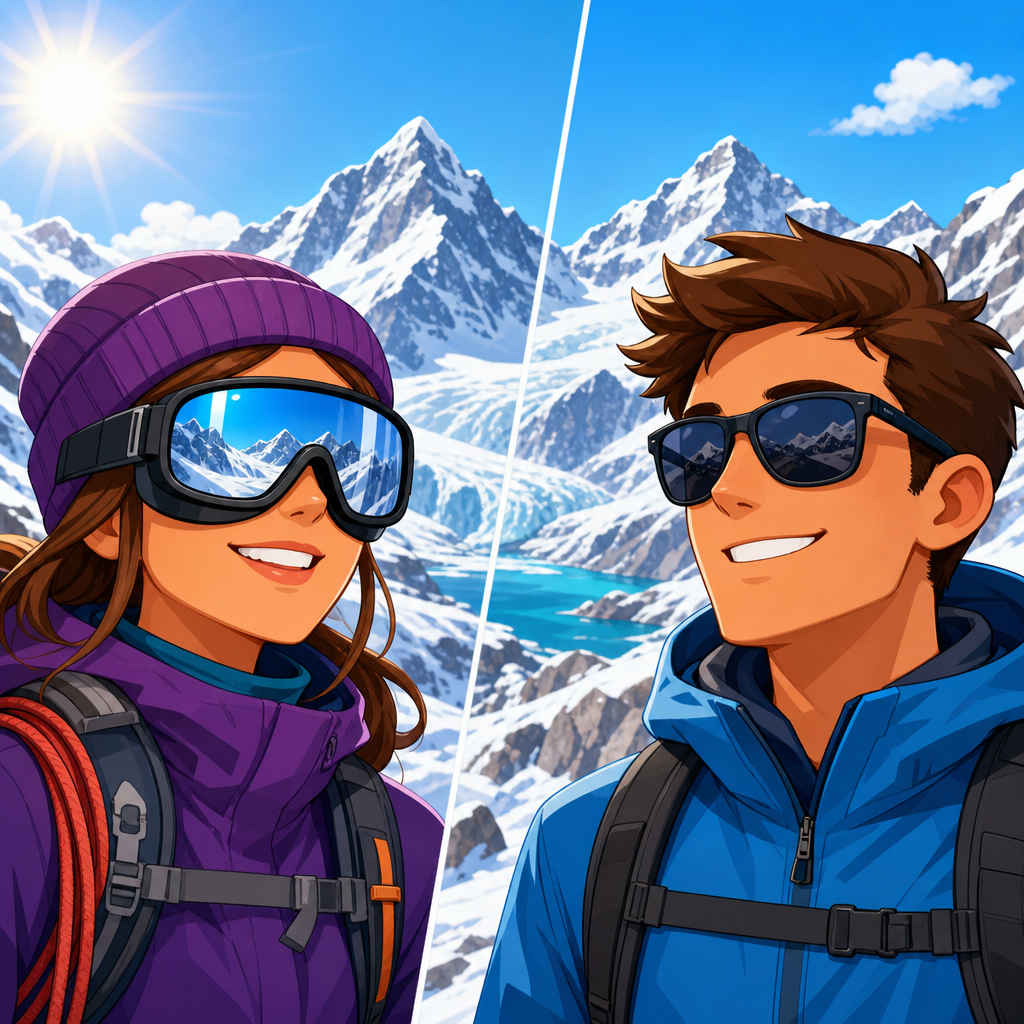
Glacier glasses and regular sunglasses are not interchangeable in snow and alpine travel, because high-altitude light exposure combines intense visible light, amplified ultraviolet radiation, and reflected glare that ordinary fashion or casual sport eyewear often fails to control. In mountain environments, the right eye protection is a safety item, not a style choice. I have learned that distinction the hard way on bright spring traverses where teammates wearing everyday sunglasses developed headaches, watery eyes, and patchy facial sunburn before noon, while those in proper glacier glasses stayed comfortable and focused. This guide explains the difference, when each type works, and how to build a reliable sun, eye, and skin protection system for hiking, ski touring, mountaineering, glacier travel, and high camps.
Glacier glasses are specialized mountain eyewear designed for severe brightness and lateral light exposure. They typically use dark lenses with high visible light filtration, full ultraviolet protection, wraparound coverage, and side shields that block stray light entering from the sides. Regular sunglasses vary widely, from casual street models to quality sport frames, but many prioritize comfort and appearance over complete protection in snow. The key terms matter. Visible light transmission, or VLT, describes how much visible light passes through the lens; lower percentages mean darker lenses. UV400 means protection against ultraviolet wavelengths up to 400 nanometers, covering UVA and UVB. Category 4 lenses are extremely dark lenses intended for very bright conditions, while Category 3 suits many sunny everyday uses. Understanding those specifications is essential before choosing eyewear for alpine objectives.
This topic matters because snow reflects a large share of solar radiation, and ultraviolet exposure increases with elevation. Public health guidance from the World Health Organization and major eye care associations consistently warns that UV damage can affect the cornea, lens, and retina over time, while acute overexposure can trigger photokeratitis, commonly called snow blindness. In plain terms, snow blindness feels like sandpaper in the eyes, often beginning hours after exposure, and it can shut down travel plans or create a real emergency if vision deteriorates in technical terrain. Strong sun also affects skin. Lips crack, noses burn, and the underside of the chin can redden from reflected light. That is why this hub covers not only glacier glasses versus regular sunglasses, but also the broader system of lenses, fit, side coverage, sunscreen, lip balm, hats, and habits that keep mountain travelers functional.
What glacier glasses do that regular sunglasses often cannot
The defining advantage of glacier glasses is complete light management. In snow and alpine terrain, harmful light does not come only from above. It bounces upward from snowfields, sideways from rock and ice, and around the edges of poorly sealed frames. A true glacier glass addresses that with four features: certified UV protection, low VLT, wraparound geometry, and side shields or deep frame coverage. Many also include grippy temples, removable nose pieces, and venting that limits fogging while preserving protection.
Regular sunglasses can still be excellent when they are built as performance eyewear, but the category is inconsistent. A quality pair from Oakley, Smith, Julbo, or Costa may have strong optics and UV protection, yet without side protection it can still allow enough stray light to cause fatigue on a glacier. By contrast, glacier glasses are purpose-built for environments where the sun is relentless for hours. That purpose shows up in details: darker mineral or polycarbonate lenses, leather or synthetic side shields, curved temples that stay on under helmets, and frame designs tested by guides, climbers, and skiers.
The practical result is less squinting, better contrast management, and lower risk of eye injury. On long approaches, people often notice only comfort differences. On exposed snow ridges, the difference becomes safety-critical. When your eyes are watering, your depth perception drops, your concentration narrows, and transitions like cramponing, rope management, and crevasse assessment become harder.
Lens categories, VLT, and color: what actually works on snow
For snow and alpine travel, lens darkness matters, but darkness alone is not enough. The baseline requirement is UV400 protection from a reputable manufacturer. After that, VLT and lens category determine suitability for brightness. Category 3 lenses usually allow about 8 to 18 percent VLT and work well for many sunny hikes, ridgeline scrambles, and mixed terrain days. Category 4 lenses usually allow about 3 to 8 percent VLT and are the standard recommendation for glaciers, high peaks, spring snowfields, and expeditions in very bright conditions. Because they are so dark, Category 4 lenses are generally not safe for driving.
Lens tint influences contrast and comfort. Brown, amber, and copper tints often improve terrain definition in variable light, which helps identify sastrugi, icy patches, or old boot tracks. Gray lenses preserve color neutrality and work well in harsh bright sun. Mirror coatings reduce glare and visible light further, but the coating does not replace UV protection. Polarization is useful in some mountain settings because it cuts glare, yet it can also make icy textures, wet patches, or electronic screens harder to read for some users. I treat polarization as optional, not mandatory, for technical alpine use.
| Feature | Regular sunglasses | Glacier glasses | Best use |
|---|---|---|---|
| Lens category | Usually Category 2 or 3 | Usually Category 3 or 4 | Category 4 for glaciers, high snow, bright expeditions |
| Visible light transmission | Often 10 to 25 percent | Often 3 to 12 percent | Lower VLT reduces eye strain in severe glare |
| Side protection | Minimal to moderate | High, often with side shields | Blocks reflected and lateral light |
| Coverage and wrap | Varies widely | Purpose-built wraparound fit | Improves seal and reduces squinting |
| Typical terrain | Town, trail, moderate sun | Snowfields, glaciers, alpine ridges | Choose based on objective, not appearance |
Coverage, side shields, and fit: the details that prevent snow blindness
Side shields are the feature most people underestimate until they spend a full day on snow. Even excellent dark lenses can fail if light leaks in around the edges. Leather side shields became the iconic glacier-glasses solution for a reason: they work. Modern synthetic shields are lighter and tolerate moisture better, but the principle is identical. Block peripheral glare, and your eyes stay calmer.
Fit matters just as much. Frames should sit close enough to reduce gaps without crushing the temples or fogging constantly. Nose pads should keep the lens centered and stable during sweaty climbs and windy descents. Temple arms need enough grip to stay secure under a helmet and when looking down at footing. If you already know your face shape causes gaps at the cheeks or brow, try wraparound frames in person. A premium lens in a poor-fitting frame is a compromised system.
Ventilation is the tradeoff. More enclosure means more protection, but also more chance of fogging when you stop, skin uphill in cold air, or pull a buff over your nose. This is where established mountain brands distinguish themselves. Models from Julbo, Cébé, and Vallon, for example, often balance side coverage with airflow better than generic “glacier style” fashion frames. Anti-fog coatings help, but smart vent design and disciplined use matter more.
When regular sunglasses are enough, and when they are not
Regular sunglasses are enough for many mountain days if the terrain is dry, the elevation is moderate, the sun angle is manageable, and you are not surrounded by reflective snow for long periods. A summer trail run below treeline, a dry autumn ridge walk, or a sunny approach on dirt may be fine with well-made Category 3 sport sunglasses that provide full UV protection and decent wrap. If your route only crosses short snow patches, you may never need more.
They stop being enough when snow becomes the dominant surface, the route climbs high, or the day includes prolonged exposure above treeline. Spring ski tours, glacier approaches, volcano climbs, hut-to-hut traverses, and high-altitude mountaineering are classic glacier-glasses environments. Multi-day trips amplify the problem because the damage is cumulative. A few uncomfortable hours on day one can become debilitating by day three.
A simple rule I use is objective-based selection. If the route description includes glacier travel, sustained snowfields, or all-day travel on open alpine faces, bring glacier glasses first and treat regular sunglasses as backup. If conditions are mixed and weather uncertain, photochromic lenses in a highly protective frame can work, but only if the lowest VLT is dark enough for full sun on snow.
Building a complete sun, eye, and skin gear system
Eye protection works best as part of a broader sun-safety kit. In alpine travel, I pack glacier glasses or strong sport sunglasses, a brimmed cap or helmet-compatible sun hat, broad-spectrum sunscreen rated SPF 30 or higher, SPF lip balm, and a face covering for wind and reflected burn. Dermatology associations consistently recommend broad-spectrum products because UVA contributes to long-term skin damage while UVB drives burning. In snow, both matter.
Sunscreen application fails most often because people underapply and forget to reapply. Put it on before exposure, not after the first burn sensation. Cover ears, nose, cheeks, chin, and the underside of the jaw where reflection hits. Reapply every two hours, and sooner with sweat, wiping, or wet weather. Zinc oxide sticks are excellent for noses and cheekbones because they stay put. Lip balm should be reapplied frequently, especially in dry cold air where cracked lips can worsen quickly.
Clothing also matters. A cap reduces direct overhead light entering above the frame. A neck gaiter protects the lower face. Lightweight hooded sun layers with high ultraviolet protection factor are increasingly common for glacier approaches and summer mountaineering. For contact lens wearers, carry lubricating drops approved for your lenses, because dry, windy air and high UV environments often aggravate irritation.
Common buying mistakes and how to avoid them
The first mistake is assuming dark lenses automatically block UV. They do not. Cheap dark lenses without proper UV filtration can be worse than no sunglasses because the pupil dilates behind the dark tint, potentially allowing more harmful radiation in. Buy from reputable brands that clearly state UV400 or equivalent certified protection.
The second mistake is choosing fashion over coverage. Flat lifestyle frames may look fine in town, but on snow they leak light from every angle. Third is relying on one pair for every activity without matching the lens category to the environment. Many people own Category 3 sunglasses and assume they are universally suitable. They are not. Another mistake is ignoring fit under helmets, buffs, and hoods. Test eyewear with the exact kit you use in the mountains.
Finally, people forget contingency planning. Bring a retention cord, a microfiber cloth, and a hard case. If you lose eyewear in a crevasse field or on a windy col, the day can unravel fast. Experienced guides often carry a backup pair because the penalty for lens damage or loss is disproportionately high.
Choosing the right setup for hiking, ski touring, and mountaineering
For hiking and trekking that occasionally touches snow, a high-quality Category 3 wraparound sunglass with excellent UV protection is often the most versatile choice. For ski touring, where transitions, sweat, wind, and bright spring reflections all collide, many travelers prefer glacier-style sunglasses on the ascent and goggles on the descent. For mountaineering and glacier travel, Category 4 glacier glasses with side shields remain the benchmark because they handle the highest consequence environment most reliably.
If you are buying one premium pair specifically for alpine use, prioritize certified protection, side coverage, secure fit, and lens category before brand aesthetics. Try models from established mountain makers, read the technical specifications, and choose according to the brightest terrain you expect, not the average day. Then support that choice with disciplined skin protection habits. Good mountain sun gear reduces fatigue, prevents avoidable injury, and preserves performance when the terrain demands attention elsewhere.
The bottom line is simple: regular sunglasses can work for general outdoor use, but glacier glasses are the better tool for snow and alpine travel because they are designed to manage reflected glare, intense ultraviolet exposure, and peripheral light leakage. That single design difference translates into better comfort, steadier vision, and lower risk of snow blindness on serious objectives. As the hub for sun, eye, and skin gear, this guide points to the principle that should shape every related purchase: choose protection based on terrain, duration, and brightness, then build a complete system around it.
If your plans include spring snow, glaciers, high peaks, or multi-day alpine travel, upgrade before the trip rather than after a painful lesson. Check your lens category, verify UV400 protection, test frame fit with your helmet and hat, and pack sunscreen and lip balm with the same seriousness you give navigation or layers. Your eyes and skin absorb the consequences of shortcuts quickly in the mountains. Make sun protection part of your standard safety checklist, and your days on snow will be clearer, safer, and far more comfortable.
Frequently Asked Questions
What is the main difference between glacier glasses and regular sunglasses for snow and alpine travel?
The biggest difference is that glacier glasses are built specifically for extreme light environments, while regular sunglasses are usually designed for everyday comfort, driving, casual sport, or fashion. In the mountains, especially on snow, your eyes are dealing with a much harsher mix of direct sun, strong ultraviolet radiation at altitude, and intense reflected glare coming up from below. Regular sunglasses may darken your view, but that does not automatically mean they provide the level of protection needed for alpine travel.
Glacier glasses typically combine very dark lenses, high-quality UV protection, side shields, and a wraparound shape that blocks light entering from the sides, top, and even below. That matters because in a snowfield or on a glacier, stray light can reach your eyes from multiple angles, not just straight ahead. Many ordinary sunglasses leave those gaps exposed. Glacier glasses are also often designed to stay secure in wind, sweat, and cold, which is critical when you are moving on steep terrain and cannot afford to keep adjusting your eyewear.
In practical terms, glacier glasses are protective equipment. They help reduce the risk of snow blindness, eye strain, headaches, watering eyes, and visual fatigue that can undermine judgment and safety. Regular sunglasses may be fine for town, trailheads, or low-glare environments, but in true alpine conditions they are often not enough.
Why are regular sunglasses often not safe enough on snow or at high altitude?
Regular sunglasses can fall short because mountain light is far more aggressive than what most people experience at sea level or in daily life. As elevation increases, ultraviolet exposure also increases, and snow reflects a large amount of light back into the eyes. That means your eyes are being hit from above and below at the same time. A pair of standard sunglasses might cut brightness somewhat, but still allow too much visible light, too much side glare, or too much reflected exposure to reach the eye.
One of the most common problems is incomplete coverage. Everyday sunglasses often have open sides, a flatter profile, and lenses that are not dark enough for bright snowfields. On a spring traverse, on a glacier, or above treeline under clear skies, that can lead to squinting, eye fatigue, and eventually photokeratitis, commonly called snow blindness. This is essentially a sunburn of the cornea, and it can be extremely painful. People sometimes assume any lens labeled UV400 is good enough, but UV filtering alone is not the whole story. Glare control, side protection, and adequate visible light reduction are just as important in these settings.
Another issue is stability and durability. In alpine travel, eyewear has to perform in cold wind, sudden weather shifts, and technical movement. If your sunglasses slip, fog excessively, or let in harsh peripheral light, they stop being reliable safety gear. That is why ordinary sunglasses are often considered a poor substitute once you are traveling seriously on snow or in high, exposed terrain.
What features should I look for in glacier glasses for alpine conditions?
Start with full UV protection, but do not stop there. Good glacier glasses should offer 100% UVA and UVB protection and use lenses dark enough for high-glare environments. For snow and glacier use, many experienced travelers prefer Category 4 lenses, which are designed for exceptionally bright conditions. These lenses transmit much less visible light than standard sunglasses, helping reduce squinting and visual overload on reflective terrain. However, because Category 4 lenses are very dark, they are generally not suitable for driving.
Coverage is equally important. Look for side shields or a close wraparound design that blocks peripheral light. This is one of the defining traits of glacier glasses and one of the reasons they outperform regular sunglasses in alpine settings. A secure fit is also essential. Frames should stay in place when you are sweating, wearing a hat or helmet, or moving over uneven ground. Nose grips, temple grips, and retention cords can make a real difference over a long day.
Lens quality matters too. Good optics reduce distortion and eye strain, which becomes increasingly important when reading terrain, identifying hazards, and maintaining comfort for hours in bright conditions. Some users like polarized lenses because they cut reflected glare, but polarization can sometimes affect how certain surfaces, screens, or subtle terrain textures appear, so it is worth trying them in realistic conditions before relying on them for a major trip. Ventilation and anti-fog performance also matter, especially during climbs, transitions, or changing weather. In short, the best glacier glasses combine darkness, coverage, optical clarity, fit, and durability into one system built for harsh mountain light.
Can glacier glasses prevent snow blindness, and what happens if my eye protection is inadequate?
Yes, appropriate glacier glasses can significantly reduce the risk of snow blindness, but only if they are worn consistently and are truly suitable for the conditions. Snow blindness, or photokeratitis, happens when the surface of the eye gets overexposed to ultraviolet radiation. Snow greatly intensifies that risk by reflecting light back upward, and altitude increases the strength of UV exposure. Add long hours outside, and even a cool or cloudy day can become hazardous for your eyes.
The symptoms of inadequate eye protection often do not show up immediately. A person may feel fine during the day, then later develop painful burning eyes, tearing, redness, light sensitivity, blurred vision, and the sensation that sand or grit is trapped under the eyelids. In more severe cases, opening the eyes can become difficult. This is not just uncomfortable. It can seriously affect your ability to descend safely, navigate, or care for yourself and your group. In the mountains, that turns an eye problem into a larger safety problem very quickly.
That is why experienced alpine travelers treat glacier glasses as essential gear, not an optional accessory. Prevention depends on choosing the right eyewear, using it before discomfort begins, and keeping it on whenever the light is intense. If your eyes start to feel strained, watery, or unusually tired, that is often an early sign your protection is not doing enough. Better coverage and darker, mountain-appropriate lenses can make the difference between a strong day and a miserable, potentially dangerous one.
Are glacier glasses always necessary, or are there times when regular sunglasses are acceptable?
Glacier glasses are not necessary for every outdoor outing, but they are strongly recommended whenever you are traveling on snow, glaciers, high ridgelines, or open alpine terrain with intense light exposure. The key question is not whether the day feels warm or whether the sun seems harsh at the trailhead. The real issue is how much direct and reflected light your eyes will face over time. Bright spring snow, long days above treeline, glacier travel, ski mountaineering, and high-altitude climbs are classic situations where glacier glasses are the better and safer choice.
Regular sunglasses may be acceptable for lower-elevation hiking, forested approaches, mixed-weather days, or non-snow travel where glare is limited and reflected light is not a major factor. But once you move into sustained snow travel or strong alpine sun, the margin for error gets smaller. Many people discover that sunglasses they love for running, beach use, or everyday wear become inadequate as soon as they step onto a bright snowfield. They may still feel comfortable for a few minutes, but over hours they often allow too much light in from the sides or fail to reduce glare enough to protect the eyes properly.
A practical approach is to match your eyewear to the objective. If the route includes snow travel, long exposure, and high-altitude reflection, bring glacier glasses and treat them as standard equipment. If conditions are milder, regular high-quality sunglasses may be fine. But when there is any doubt, especially in alpine environments, it is smarter to lean toward more protection rather than less. Your eyes recover slowly from mistakes, and in mountain terrain the cost of underestimating light exposure can be much higher than most people expect.