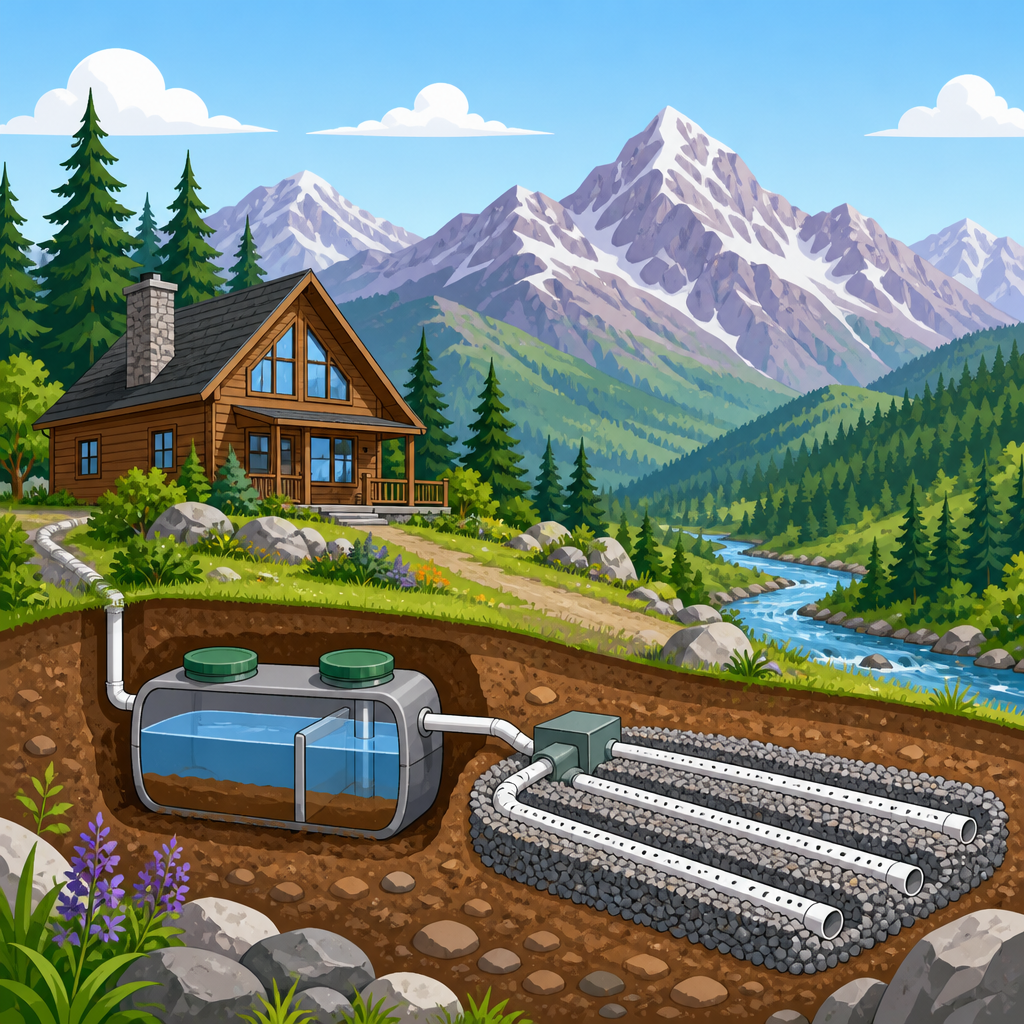
Septic systems in mountain terrain demand a different level of planning because steep slopes, shallow soils, fractured rock, snowmelt, and limited contractor access can turn a routine wastewater project into a costly failure if the basics are ignored. A septic system is the on-site infrastructure that collects household wastewater, separates solids in a septic tank, and disperses clarified effluent into soil for final treatment. In mountain terrain, that treatment step is the challenge. Soil depth may be thin, groundwater may perch above bedrock after storms, and winter freeze-thaw cycles can damage lines or reduce infiltration. For off-grid and resilience-minded properties, the stakes are even higher because septic reliability affects sanitation, water protection, occupancy permits, and long-term livability. I have worked with rural sites where the cabin looked perfectly buildable until the soil logs and slope measurements showed the drainfield would need a completely different location, a pumped system, or an alternative treatment unit.
Planning basics start with understanding that a mountain septic system is not just a tank and some trenches. It is a regulated treatment train shaped by topography, geology, climate, and daily water use. The core terms matter. The septic tank provides primary settling and anaerobic digestion. The drainfield, also called a soil absorption system or leach field, distributes effluent into unsaturated soil. Vertical separation is the usable soil depth between the infiltrative surface and limiting conditions such as groundwater, restrictive clay, or bedrock. Perc tests estimate infiltration, but modern design often relies more heavily on full soil evaluation by a licensed site professional because texture, structure, and seasonal saturation tell a more complete story. Pressure distribution, dosing, sand filters, aerobic treatment units, and mound systems become common in mountain settings because gravity alone rarely solves every constraint.
This topic matters because mistakes are expensive and consequences spread beyond one parcel. A failed system can contaminate wells, springs, streams, and downhill neighbors. It can also block financing, stall permits, and reduce resale value. In off-grid living, septic decisions connect directly to water storage, backup power, access roads, and winter operations, making this page a practical hub for resilient property planning.
Start with the site, not the house plan
The most common mountain-property error is placing the cabin first on paper and trying to force the septic system into whatever space remains. On difficult terrain, the sequence should reverse: identify suitable wastewater treatment areas, reserve replacement area, confirm well setbacks, and only then finalize the building footprint, driveway, and grading plan. This is standard best practice because many jurisdictions require a primary and reserve dispersal area, and on a steep lot those areas may be the single scarcest resource. I have seen buyers walk away from otherwise attractive parcels once they learned that a driveway cut or retaining wall would consume the only code-compliant reserve field area.
A proper site review looks at slope percentage, contour shape, existing vegetation, signs of seepage, seasonal drainages, cut-and-fill feasibility, and access for excavation equipment and future pumping trucks. South-facing slopes may thaw earlier and support different soil moisture patterns than shaded north-facing benches. Concave hollows often collect subsurface flow, while convex shoulders can shed water and provide better treatment conditions. You also need to map constraints beyond the lot lines: wells on adjacent properties, streams, irrigation ditches, unstable slopes, avalanche paths, and road easements. The septic system must work for decades, not just pass an inspection on a dry summer day.
Understand soils, bedrock, and groundwater behavior
Mountain terrain magnifies the importance of a real soil investigation. A fast perc rate alone does not mean a site is suitable. Coarse colluvial soils may accept water quickly yet provide limited treatment if effluent moves too rapidly to fractured bedrock. Conversely, a slower loam with strong structure and sufficient depth can perform well even when a simple perc test looks mediocre. That is why many states require soil profile pits and morphological analysis by a licensed sanitarian, engineer, or soil scientist. The evaluator records horizons, texture, structure, consistence, redoximorphic features, rock fragments, and limiting layers, then translates those observations into loading rates and system options.
Bedrock is especially important in mountain areas because “rock” is not one condition. Massive competent rock near the surface limits vertical separation and often triggers mounds or lined systems. Fractured rock can be worse because untreated or partially treated effluent may move laterally through cracks toward springs or streams. Seasonal groundwater is another hidden risk. Snowmelt and long spring rains can create perched water tables above dense till or fragipan layers that appear dry in late summer. For this reason, good designers ask when the site was tested, review local soil maps critically, and account for the wettest practical operating season rather than the most convenient one for construction.
Choose the right system type for the terrain
Conventional gravity trench systems remain the simplest and often the least expensive option, but they only work where slope, soil depth, and setbacks allow. In mountain terrain, alternatives are common and should be viewed as tools, not failures. Pressure-dosed drainfields provide more uniform distribution than gravity, an important advantage on variable slopes and long laterals. Mound systems import suitable sand media to create vertical separation above shallow soil or bedrock. At-grade systems reduce deep excavation and can fit sites with restrictive subsoils. Aerobic treatment units improve effluent quality before dispersal, helping where dispersal area is constrained or environmental sensitivity is high. Sand filters, packed-bed filters, and drip dispersal may also be used where standards permit.
The right choice depends on objective constraints and operating realities. A remote cabin with intermittent use may not be ideal for every treatment technology, especially systems that depend on continuous aeration and disciplined maintenance. A gravity system with a well-sited field is mechanically simple, but if gravity forces the field into a poor soil area, simplicity becomes false economy. I usually advise owners to compare not just installation cost but lifecycle demands: electrical dependence, winter reliability, alarm monitoring, service contracts, component replacement, and access for repairs. In resilience planning, the best system is often the one that matches both the land and the owner’s ability to maintain it during storms, outages, and shoulder seasons.
| System type | Best fit in mountain terrain | Main advantage | Main limitation |
|---|---|---|---|
| Conventional gravity trench | Moderate slopes with deep, suitable native soil | Low mechanical complexity | Needs favorable site conditions |
| Pressure-dosed field | Variable slopes or long distribution runs | Even effluent distribution | Requires pump and controls |
| Mound system | Shallow soil over bedrock or seasonal groundwater | Creates vertical separation | Higher cost and visual impact |
| Aerobic treatment unit | Environmentally sensitive sites or limited dispersal area | Higher effluent treatment level | Regular service and power needed |
| Drip dispersal | Complex topography with careful design approval | Flexible layout | Filtration and maintenance are critical |
Plan for water supply, water use, and peak loading
Septic design begins with expected wastewater flow, and mountain homes often have misleading occupancy patterns. A small off-grid cabin may host two people most weeks and ten people during holidays, hunting season, or summer gatherings. Design flow is usually set by code based on bedrooms, fixtures, or dwelling type, not by optimistic assumptions about low use. That conservative approach protects treatment performance because septic systems fail from hydraulic overloading as often as from bad soil. If the property also relies on hauled water, rainwater harvesting, or a low-yield well, owners sometimes imagine smaller flows automatically justify undersized septic infrastructure. Regulators rarely accept that logic without a formal basis, and they should not, because future ownership changes.
For resilience, pair septic planning with a realistic water budget. High-efficiency toilets, WaterSense fixtures, front-load washers, and leak detection reduce daily loading and extend system life, but they do not replace correct design. Equalization tanks, timed dosing, and pressure distribution can smooth surges from weekend occupancy. Greywater rules vary sharply by jurisdiction; where allowed, separate greywater strategies may reduce load, but they require distinct design, setbacks, and maintenance. The practical takeaway is simple: estimate actual use patterns, then design for code flow and worst-season function rather than average-case convenience.
Respect setbacks, access, and construction logistics
Setbacks govern whether a mountain septic system is legal and protective. Distances to wells, springs, streams, lakes, property lines, foundations, cuts, fills, and water lines are not paperwork trivia; they reflect contamination pathways and structural risk. Exact numbers differ by state and county, but well setbacks are often among the most restrictive, especially where groundwater flows downslope through fractured materials. On compact parcels, a neighboring well or creek can eliminate one side of the lot entirely. Before closing on land, request the local code, available permit records, and any prior site evaluations. If a seller says, “A septic should go anywhere up there,” treat that as speculation until documented.
Construction logistics also deserve early attention. Can an excavator reach the approved field area without destabilizing the slope? Will imported sand or gravel need repeated trips on a narrow road? Can a pump truck access the tank in mud season or after snow? Many expensive change orders happen because the paper design ignored turning radius, staging area, spoil placement, and erosion control. In mountain work, preserving native soil is crucial. Compaction from heavy equipment can destroy infiltrative performance before the system is even installed. Good installers rope off field areas, work in dry conditions when possible, and keep excavation bottoms level and uncompacted.
Design for winter, power outages, and long-term resilience
Off-grid and mountain living add operational constraints that suburban installations rarely face. Frost depth can affect sewer line burial, tank lids, and force mains. Snow cover often insulates, but plowed access roads and cleared field areas can increase freezing risk. Shallow lines, low winter occupancy, and leaking fixtures that create intermittent trickles are a bad combination because small flows can freeze more easily than steady use. Insulation board, proper cover depth, pitched building sewers, and protected dosing components are standard preventive measures. In very cold regions, designers may also avoid routing lines through unheated crawlspaces unless they are insulated and protected from wind.
Where pumps or advanced treatment units are used, backup power matters. A pressure-dosed field can often tolerate short outages because the tank provides emergency storage, but repeated multi-day outages without generator support create overflow risk. Aerobic systems may lose treatment performance if blowers are down too long. For resilience, owners should know pump chamber capacity, alarm settings, breaker locations, and generator connection procedures. Keep as-built drawings, control manuals, and service contacts on site. Just as importantly, protect the reserve area from future grading, parking, sheds, or gardens. A septic system is resilient only if the land needed for its repair still exists when the day comes.
Permitting, maintenance, and the role of expert help
Mountain septic success depends on permitting discipline and ongoing maintenance, not just initial design. Most jurisdictions require site evaluation, engineered or prescriptive plans, inspections during installation, and final approval before use. Alternative systems often carry operation permits, sampling requirements, or mandatory service contracts. These rules can feel burdensome, but they exist because on-site wastewater treatment is a public health system in miniature. Skipping permits may save weeks upfront and cost tens of thousands later when a sale, refinance, or enforcement action exposes unapproved work.
Professional help pays for itself when the site is difficult. A qualified designer can coordinate topographic survey, soil data, hydraulic calculations, and equipment selection into a buildable plan. An experienced installer knows how to work on steep ground without smearing trench bottoms or compacting imported media. A pumping contractor can establish maintenance intervals based on actual sludge and scum accumulation rather than guesswork; many households need tank pumping every three to five years, though usage varies. Homeowners should also learn the nonnegotiables: do not drive on the field, do not route roof drains into the system, do not flush wipes, grease, or solvents, and do not assume septic additives replace pumping. Reliable sanitation in mountain terrain comes from matching design to site, protecting the soil treatment area, and maintaining the system as carefully as any other critical utility.
Septic systems in mountain terrain succeed when planning begins with land conditions and follows through with realistic design, careful installation, and disciplined maintenance. The essential lessons are consistent: test soils thoroughly, verify setbacks and reserve area early, choose a system type that fits slope and soil limits, size for real occupancy and code flow, and account for winter access, power loss, and future repairs. For off-grid and resilience-minded owners, this is not a narrow permitting issue. It is foundational infrastructure that affects health, water quality, insurance, financing, and whether a remote property remains comfortable and legal over time.
If you remember one principle, make it this: the best mountain septic system is the one that works with the site instead of fighting it. A modest cabin on a well-chosen dispersal area will outperform an elaborate design squeezed onto marginal ground. Use this hub as your starting point for deeper decisions about water supply, backup power, access, and long-term off-grid operations, then bring in qualified local professionals before you finalize plans. Careful septic planning protects the land, protects downstream water, and gives your mountain home the dependable sanitation every resilient property needs.
Frequently Asked Questions
Why is septic planning more complicated in mountain terrain than on flatter sites?
Mountain properties introduce constraints that can change nearly every part of a septic design. On a typical flatter lot, the main questions are often soil suitability, required setbacks, and system size. In mountain terrain, those same issues still matter, but they are intensified by steep slopes, shallow soil depth, exposed or fractured bedrock, seasonal groundwater movement, snowmelt, erosion risk, and limited access for excavation equipment. The core challenge is that a septic system depends on soil to provide final treatment of wastewater after it leaves the tank, and mountain soils often do not offer enough depth, consistency, or usable area to do that safely without careful engineering.
Slope is one of the biggest concerns because wastewater must move into and through soil at a controlled rate. If the site is too steep, there may be a greater chance of uneven distribution, seepage breakout downslope, or instability in the dispersal area. Shallow soils over rock can sharply limit the vertical separation needed between the drainfield and restrictive layers. Fractured rock is especially important because it can allow effluent to move too quickly, reducing natural treatment and increasing the risk of contamination to springs, wells, or nearby surface water. Snow and freeze-thaw cycles add another layer of complexity, particularly in areas where winter conditions affect installation timing, access, and long-term operation.
Access can also become a practical and financial obstacle. Getting tanks, pipe, aggregate, and machinery to a steep or remote homesite may require specialized equipment, temporary road improvements, or staged construction. That affects budget, scheduling, and even which system types are realistic. For these reasons, mountain septic projects usually benefit from early site investigation, licensed design work, and realistic planning around both construction logistics and seasonal site conditions. The more difficult the terrain, the more important it is to treat septic planning as a site-specific engineering task rather than a standard installation.
What site conditions should be evaluated first before choosing a septic system in mountain terrain?
The first priorities are soil depth, soil texture, slope, groundwater conditions, and the presence of restrictive layers such as bedrock or dense impermeable material. These factors determine whether the site can support conventional soil treatment or whether an alternative system may be necessary. A proper evaluation usually includes soil testing, soil profile observations, and in many jurisdictions a percolation test or other hydraulic assessment. In mountain settings, it is especially important not to rely on assumptions based on nearby lots, because conditions can change dramatically across short distances.
Usable soil depth is critical. The dispersal field needs enough unsaturated soil beneath it to filter and biologically treat effluent before it reaches groundwater or rock fractures. If the soil is too shallow, the site may not qualify for a standard trench system. Slope must also be carefully measured, not estimated by eye. Even moderate changes in slope can affect system layout, construction methods, and code compliance. In addition, the designer needs to identify where water naturally moves during storms and snowmelt. A site that appears dry in late summer may behave very differently in spring runoff.
Another major consideration is setback compliance. Mountain lots can be constrained by wells, streams, drainage swales, property lines, driveways, retaining walls, and buildings. A system needs enough room not only for the initial installation but often for a designated repair area as well. Access for maintenance vehicles and pumping trucks should be reviewed early, because a technically suitable design can still become impractical if the tank cannot be serviced safely. Good planning also includes looking at where the house, driveway, and utility lines will go so the best septic area is protected from grading, compaction, and future disturbance. Starting with a complete site assessment helps prevent the common mistake of designing the house first and trying to fit the septic system into whatever space is left.
How do shallow soils and fractured rock affect septic system design in mountainous areas?
Shallow soils and fractured rock are among the most serious red flags on mountain properties because they directly affect the treatment function of the dispersal area. A septic system does not simply dispose of wastewater; it relies on contact with suitable unsaturated soil to remove pathogens, nutrients, and organic matter. When there is only a thin layer of soil above bedrock, there may not be enough vertical separation for that treatment to occur properly. If the underlying rock is fractured, wastewater can move through cracks rapidly and unpredictably, bypassing the slower biological treatment that healthy soil provides.
This matters for both performance and environmental protection. Effluent that enters fractures too quickly can migrate downslope, emerge at the surface, or reach wells, springs, or streams with limited treatment. In mountain communities where water supplies may come from private wells or sensitive watershed areas, that risk is significant. As a result, many sites with shallow or fractured subsurface conditions require alternative approaches such as pressure distribution, drip dispersal, sand-lined systems, mounds, or advanced treatment units designed to improve effluent quality before soil dispersal. The exact solution depends on local regulations, site limitations, and the degree of treatment needed.
Construction practices also become more important on these sites. Over-excavation, smearing of wet soils, or damage to the limited usable soil layer can further reduce system performance. That is why experienced installers and careful inspection matter. In some cases, the conclusion may be that the site cannot support a conventional septic system at all without significant design modifications. While that can increase upfront cost, it is far less expensive than installing an undersized or poorly matched system that fails early. On mountain lots, acknowledging the limits of shallow soils and fractured rock is not being overly cautious; it is the foundation of responsible septic planning.
What types of septic systems are commonly used when a conventional drainfield is not suitable on a mountain property?
When a conventional gravity drainfield is not appropriate, designers often look to alternative or engineered systems that can provide better treatment, better control of effluent distribution, or both. Common options include pressure-dosed drainfields, mound systems, at-grade systems, sand filters, aerobic treatment units, and drip dispersal systems. Each option is intended to address specific site constraints such as steep slopes, limited native soil depth, irregular topography, or the need for more consistent distribution across a challenging field area.
Pressure distribution is frequently used because it delivers effluent more evenly than simple gravity flow, which is especially useful on sites where elevation change or variable soil conditions could cause one part of the field to be overloaded. Mound or at-grade systems may be considered where natural soil depth is inadequate, because they create an approved treatment zone above the original grade using imported material and controlled construction methods. Aerobic treatment units and other advanced pretreatment technologies can improve effluent quality before dispersal, which may help where the receiving site has tighter environmental constraints. Drip dispersal can also be attractive on some mountain properties because it allows more flexible placement and shallow application, although it requires careful design, filtration, pressure regulation, and ongoing maintenance.
The right choice depends on more than whether the lot is steep. It depends on code requirements, long-term maintenance capacity, electrical availability, climate, access for repairs, and the owner’s willingness to monitor a more complex system. Alternative systems can work very well when properly designed and maintained, but they are not “install and forget” infrastructure. Homeowners should understand inspection intervals, pump and control component maintenance, filter cleaning, and any service agreements required by local regulations. In mountain terrain, the best system is usually the one that matches the site’s actual limitations while remaining practical to operate year after year in difficult weather and access conditions.
What planning mistakes cause the most expensive septic problems in mountain terrain?
The costliest mistakes usually happen early, before the first trench is ever dug. One of the biggest is underestimating the importance of a full site evaluation. Buyers or builders sometimes assume that if a neighboring property has a septic system, their parcel will be similar. In mountain areas, that assumption can be wrong within a matter of yards. A second major mistake is placing the house, driveway, garage, or retaining walls without preserving a suitable primary and replacement septic area. Once grading and structural layout are locked in, the septic designer may be forced into a compromised and expensive solution.
Another frequent problem is ignoring seasonal water behavior. A site visit during dry conditions does not reveal how snowmelt, spring saturation, or storm runoff may affect the dispersal area. Failing to account for these patterns can lead to surfacing effluent, saturated fields, erosion, or premature failure. Poor access planning is also costly. If installers, pump trucks, or future service technicians cannot safely reach the tank or treatment components, both initial construction and long-term maintenance become more difficult and expensive. In remote mountain settings, logistics can add substantially to project cost, especially if this is discovered late.
There is also a tendency to focus too heavily on initial installation price instead of total lifecycle cost. Choosing the cheapest design without considering soil limitations, pumping needs, monitoring requirements, and winter reliability can backfire quickly. Cutting corners on tank size, pretreatment, dosing controls, or construction quality often leads to repairs that cost far more than doing the job correctly at the start. Finally, many failures stem from poor communication among the property owner, septic designer, excavator, builder, and permitting authority. A mountain septic project works best when everyone understands the site constraints, approved design, construction sequencing